The most popular advice about leadership development training is also the least useful. It says leaders need more knowledge, better models and a stronger grasp of theory. That sounds sensible, yet it misses the point. Most organisations don't have a theory problem. They have a behaviour problem.
A leader can leave a workshop able to explain feedback models, delegation frameworks and decision-making styles, then return to work and keep interrupting, over-controlling and solving every problem for the team. Nothing changes because information was delivered, but behaviour wasn't rebuilt. That gap is exactly why leadership development so often feels expensive and underwhelming.
The strongest programs treat leadership as applied practice. They help a control-led manager become a trust-based leader by changing what happens in meetings, in pressure moments and in everyday conversations. For organisations trying to build stronger capability pipelines, that requires more than a workshop. It requires design, reinforcement and a workplace environment that supports transfer. A stronger learning and development culture is part of that equation.
Table of Contents
- Why Most Leadership Development Training Fails
- The Diagnostic Phase Defining Your Leadership Gaps
- Designing the Learning Journey and Curriculum
- Choosing the Right Delivery Format and Facilitation
- Managing Timelines Budgets and Logistics
- Measuring Leadership Growth and Business Impact
- From Program to Culture Sustaining Momentum
Why Most Leadership Development Training Fails
Leadership development training usually fails long before the workshop starts. The failure sits in the design assumption. Many organisations still treat leadership as a knowledge problem, so they fund content-rich sessions and expect behaviour to change on the job.
That is rarely how behaviour works.
Leaders do not struggle because they have never heard the right model for feedback, delegation or accountability. They struggle because under pressure they default to the habit their brain already trusts. In practice, stress narrows attention, time pressure rewards speed over reflection, and workplace cues pull people back to familiar responses. A two-day course can produce insight. It does not automatically rewire what happens in a tense one-to-one, a messy cross-functional meeting, or a deadline that is already slipping.
The core problem is transfer. People leave training with language, frameworks and good intentions, then return to the same calendar load, the same boss, the same team expectations and the same reward system. If none of that changes, old behaviour stays cheaper than new behaviour.
I see this pattern often. A manager attends training because the business wants more ownership in the team. Back at work, that manager still jumps in first, rescues too early, and answers questions the team should work through themselves. The program may have explained coaching well. It did not give the manager enough repetition, consequence and support to use coaching in a live environment when speed and control felt safer.
This is why traditional classroom training underdelivers. Information is mistaken for capability. Awareness is mistaken for readiness. Attendance is mistaken for progress.
Programs that create real change are built differently. They use experiential learning so leaders practise in conditions that resemble work, not in abstract discussion alone. They create enough repetition for a new response to feel usable, not just intellectually appealing. They also shape the environment around the learner, because behaviour is easier to sustain when managers, peers and business rhythms reinforce it. That principle sits behind a strong learning and development culture that supports behaviour change at work.
A stronger design usually includes three features:
- Practice under realistic pressure: Leaders rehearse feedback, delegation, decision-making and conflict in scenarios with social tension, incomplete information and consequences.
- Application tied to business work: Participants apply the learning to a current team issue, stalled project, or performance problem instead of writing generic action plans.
- Reinforcement after the event: Manager check-ins, peer accountability, coaching and follow-up assignments help turn one-off effort into a repeatable habit.
There are trade-offs. This approach takes more planning, more manager involvement and tighter operational discipline than booking a workshop and sending invitations. It also produces a better return because the goal shifts from delivering training to changing behaviour in the flow of work.
Leadership capability grows through repeated action, reflection and reinforcement. Without that, even well-liked training becomes another event people remember, quote, and rarely use.
The Diagnostic Phase Defining Your Leadership Gaps
Most leadership briefs are still too vague. “We need better leaders” sounds reasonable, but it doesn't help HR, People & Culture or business leaders choose the right intervention. Strong leadership development training starts by identifying where performance is breaking down and which leadership behaviours sit underneath that breakdown.
Start with business friction, not competencies
The first useful question isn't “What skills should leaders learn?” It's “Where is the organisation paying the price for weak leadership?” The answer may sit in missed handovers, slow decisions, unclear priorities, manager inconsistency after growth, or culture drift across distributed teams.
That diagnostic discipline matters because investment is often scattered. Organisations spend an average of $1,286 per manager annually on leadership development, yet 56% of managers receive no management training in their first year of leadership, which leaves a major capability gap at the point people first begin leading others (manager training statistics and budget data).
A practical diagnosis usually starts with three inputs:
| Diagnostic input | What to examine | What it reveals |
|---|---|---|
| Business priorities | Growth, change, retention, performance pressure, restructure | Where leadership behaviour must improve first |
| Team experience | Meeting quality, trust, clarity, ownership, cross-functional friction | How leadership is showing up day to day |
| Role realities | First-time manager demands, span of control, hybrid work, regional complexity | Which capabilities need context-specific support |
Used properly, behavioural tools can support this stage, but they shouldn't replace it. A profile is useful when it sharpens insight about team patterns and communication habits. It's less useful when it becomes the entire strategy. That's where the distinction between assessment tools and practical behaviour change becomes important, particularly when reviewing psychometric testing vs behavioural profiling.
Three leadership gaps that show up repeatedly
Across many workplace programs, three gaps appear again and again.
Communication. Leaders often underestimate how strongly their style shapes trust, clarity and participation. The issue usually isn't public speaking. It's whether the leader creates enough direction without over-controlling, asks questions that invite contribution, and handles pressure without narrowing the room.
Team alignment. High-performing individual contributors often struggle when promoted into leadership because the job shifts. Their role is no longer personal output. It becomes creating shared direction, clearer roles, better decision rhythms and stronger collaboration habits.
Culture ownership. Many organisations still treat culture as messaging. Leaders need to treat it as behaviour. Culture is built through repeated moments such as how meetings start, how conflict is handled, what gets recognised, and whether people feel safe to speak openly.
Practical rule: If the brief can't describe what leaders need to do differently next Monday, the diagnosis isn't finished.
Questions that sharpen the brief
A better diagnostic conversation sounds more like operational planning than generic capability talk.
- Where does leadership inconsistency show up most clearly? Think onboarding, weekly meetings, cross-team projects, change communication or performance conversations.
- Which leader group needs support first? New managers, mid-level leaders and senior leaders usually need different experiences.
- What would visible improvement look like? More ownership in meetings, clearer delegation, faster decisions, fewer escalations, stronger cross-functional cooperation.
- What conditions are blocking change now? Time pressure, manager overload, weak sponsorship, poor role clarity or fragmented teams.
When organisations do this work well, the brief gets tighter. The program stops trying to fix “leadership” and starts targeting communication, alignment and culture ownership in a way that maps to actual business outcomes.
Designing the Learning Journey and Curriculum
A strong curriculum doesn't begin with slides. It begins with the question, “What behaviour needs repeated practice before it becomes normal at work?” That shifts leadership development training away from one-off delivery and into learning architecture.
Why information-heavy programs stall
Traditional programs often assume people change when they understand more. The problem is that behaviour isn't driven by understanding alone. Under pressure, people revert to familiar patterns, especially if those patterns once helped them succeed.
That's why the neuroscience-to-practice gap matters. One analysis argues that most leadership programs focus on cognitive skills while ignoring the neurobiological basis of behavioural change, and that play-based and experiential learning creates embodied experiences that can bypass cognitive resistance and support lasting neural change (analysis of why many leadership programs don't work).
The practical implication is straightforward. Leaders need environments where they can feel the consequences of their style, test alternatives, reflect quickly and try again. A lecture can name trust. It can't simulate the moment a team shuts down because the leader rushed in too soon.
Build a curriculum around practice
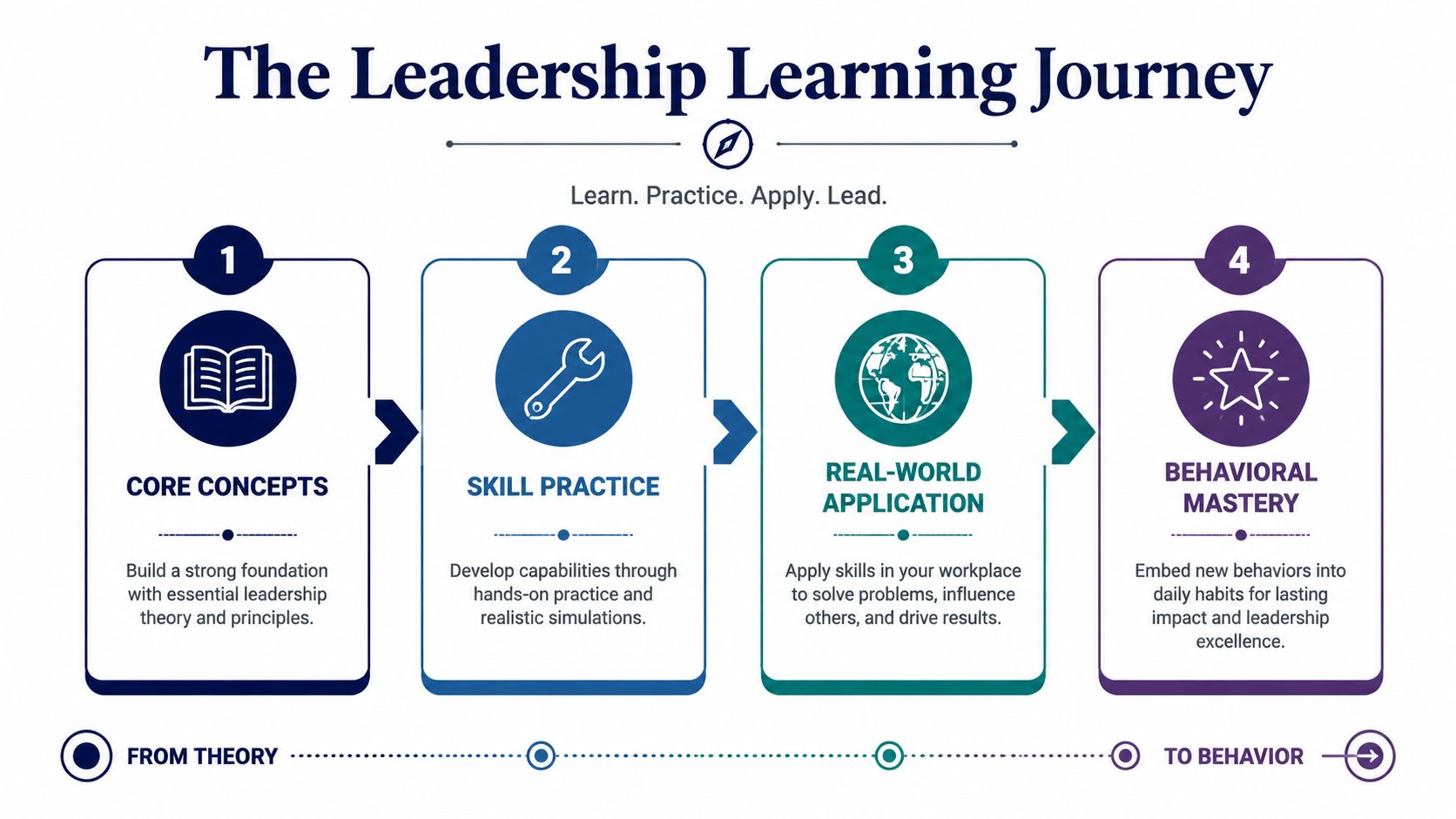
The most effective curriculum usually blends short concept inputs with active rehearsal, reflection and workplace application. Rather than packing everything into a single day, it helps to structure a sequence.
Clarify the leadership standard
Define the few behaviours the organisation wants leaders to display consistently. Keep them observable. “Runs meetings that invite contribution” is more useful than “communicates effectively”.Create psychologically safe practice Use simulations, facilitated activities, role-based scenarios and peer discussion to surface habits in real time. Many organisations use play-based facilitation well in these contexts. It lowers defensiveness and lets leaders experience communication, trust and adaptability rather than talk about them abstractly.
Tie learning to live work
Every participant should leave with an application task linked to an actual challenge, such as resetting team expectations, redesigning decision forums or changing how one-to-ones are run.Add reinforcement points
Reflection prompts, manager check-ins, coaching conversations and follow-up workshops keep new behaviours from fading after the session.
Behaviour changes faster when participants can practise without reputational risk, then apply with real accountability.
A practical example is a program built around communication, team alignment and culture ownership. The communication strand may involve pressure-based facilitation, feedback practice and debriefs on how leader behaviour affects participation. The alignment strand may focus on team roles, decision patterns and collaboration habits. The culture strand may examine rituals, recognition, meeting norms and the conditions that shape how people show up.
Choose tools that fit the gap
Method should follow diagnosis. If the issue is role clarity and contribution balance, Belbin profiling may help teams see how strengths interact. If the issue is energy, accountability and team attitude, FISH! training may provide a shared behavioural language. If the issue is relational trust, participation and adaptability, structured experiential facilitation may be the better vehicle.
Some organisations also use customised options such as human skills workshops and facilitated team experiences or programs from providers such as Corporate Challenge Events when the brief calls for applied, play-based practice in communication, collaboration and culture. The method only earns its place if it helps leaders perform differently back at work.
A useful curriculum avoids two common design errors:
- Trying to cover everything: Broad programs produce thin practice.
- Treating all leaders the same: First-time managers and senior executives shouldn't sit in identical learning journeys.
Leadership development training works better when it acts like a system. Concepts matter, but only when they are attached to practice, application and reinforcement.
Choosing the Right Delivery Format and Facilitation
Delivery format isn't a scheduling choice alone. It shapes energy, attention, risk-taking and how much useful discomfort a group can handle. The format has to suit the behaviour being built.

How formats change the learning experience
In-person sessions are usually strongest when leaders need to practise communication under pressure, build trust quickly or work through interpersonal dynamics. The room gives facilitators more to work with. They can read hesitation, challenge avoidance and draw quieter voices in more effectively.
Virtual delivery can still work well, especially for geographically dispersed teams or shorter reinforcement sessions. It's often suited to reflection, coaching, structured discussion and follow-up application reviews. It tends to be less effective when the program relies heavily on physical interaction, complex simulation or high-energy team dynamics.
Hybrid delivery can solve access problems, but it often creates two different experiences in one program. If used, it needs careful facilitation and activity design so remote participants aren't reduced to observers.
A blended model is increasingly hard to ignore. In a global leadership development study, blended learning approaches delivered 43% higher completion rates than single-format programs, and one-on-one coaching for managers increased by 58% since 2020, pointing to a wider shift toward multi-channel learning ecosystems (global leadership development study findings).
A simple comparison helps:
| Format | Best suited to | Watch-outs |
|---|---|---|
| In-person | Trust-building, live practice, culture resets, team dynamics | Travel, venue costs, time out of role |
| Virtual | Reinforcement, coaching, dispersed teams, shorter modules | Lower room energy, easier disengagement |
| Hybrid | Mixed-location access when attendance matters | Uneven participation if poorly designed |
What skilled facilitation actually does
Facilitators don't just deliver content. They create the conditions in which leaders can examine their behaviour clearly without becoming defensive.
That requires more than subject knowledge. A capable facilitator can read group dynamics, manage tension, challenge dominant voices, involve quieter participants and connect the activity back to workplace reality. In leadership development training, that translation step is critical. The room needs someone who can move from “interesting exercise” to “what changes in your next team meeting?”
- Look for behavioural depth: Ask how the facilitator handles resistance, hierarchy and low psychological safety.
- Check for design flexibility: The strongest facilitators adapt live when the group reveals a more urgent pattern than the original brief suggested.
- Test commercial understanding: Leaders engage more seriously when the facilitator can connect behaviour to delivery, retention, execution and culture.
For organisations comparing options, a leadership coach and facilitator capability guide can help separate presenters from practitioners.
Managing Timelines Budgets and Logistics
A leadership program can be strategically sound and still fail in delivery because the planning was sloppy. Poor scheduling, unclear participant communication, weak sponsor involvement and under-scoped venues create avoidable drag before the first activity begins.
Plan the program like an operational rollout
Treat the program as a business project, not a diary entry. That means assigning ownership early and locking in decisions that affect participation quality.
A practical rollout often includes:
- Discovery and scoping: Confirm business outcomes, participant groups, program length, delivery format and sponsor expectations.
- Provider selection: Review methodology, facilitation approach, customisation process and post-program support.
- Participant readiness: Send a clear brief explaining why people are attending, what they'll be asked to do and how the learning connects to work.
- Operational setup: Confirm venue layout, travel, technology, catering, accessibility, timings and session materials.
- Post-session follow-up: Schedule check-ins, manager conversations and action review points before the program even runs.
The logistics should make the learning feel deliberate. If the event feels improvised, participants assume the capability agenda is improvised too.
Timelines should also match the type of change being asked for. A communication reset for one leadership team can move quickly. A broader manager capability program across locations usually needs phased delivery and reinforcement built in from the start.
Where budget discipline matters most
Budget pressure often pushes organisations into false economies. They trim discovery, compress delivery time or skip reinforcement, then wonder why the workshop felt positive but produced little visible change.
A smarter allocation approach usually prioritises:
| Budget area | Why it deserves protection |
|---|---|
| Program design | Off-the-shelf content rarely fits team realities closely enough |
| Facilitation quality | Delivery quality shapes trust, candour and application |
| Reinforcement | Without follow-up, transfer drops quickly |
| Operations | Venue, tech and timing affect attention and participation |
The budget conversation also needs realism about internal time. Leaders attending a program are stepping away from operational work. If the organisation won't protect that time, the learning competes with inboxes, urgent requests and half-attention.
For HR teams, executive assistants and event organisers, one practical rule helps: remove friction before the day. Participants shouldn't have to guess where they're going, why they're there or what's expected afterwards. Leadership development training lands better when the administration communicates seriousness, clarity and intent.
Measuring Leadership Growth and Business Impact
The easiest way to make a leadership program look successful is to ask whether people enjoyed it. That is also the easiest way to miss whether anything changed.

Stop treating satisfaction as proof of impact
Positive feedback forms have a place. They show whether the session felt relevant, credible and well run. They do not show whether a leader now handles conflict better, delegates more clearly or creates safer discussion in team meetings.
That gap matters because leadership development training is intended to change behaviour under pressure, not create insight in a room alone. As noted earlier, research on leadership interventions found that transfer into day-to-day work is often weak when organisations fail to measure application properly. That is the actual risk. Teams report a good workshop, senior sponsors receive a tidy summary, and nothing important shifts in how leaders work.
A practical evaluation approach asks a harder question. What are leaders doing differently 30, 60 or 90 days later?
Measure at four levels
Useful measurement works across four levels. Each one answers a different business question, and each one becomes more valuable when the program includes practice, reflection and follow-up rather than one-off classroom delivery.
Participant response
Did the program feel relevant enough to earn attention and effort?
This is the place for post-session feedback on facilitation quality, pace, usefulness and perceived fit. If participants found the examples generic or the facilitator lacked credibility, that needs attention. It is operational data, not proof of business value.
Learning and insight
Did participants understand the concepts and recognise the habits they need to change?
Short knowledge checks, scenario discussions, self-assessments and reflective prompts help here. Neuroscience matters at this stage because awareness alone rarely rewires behaviour. Leaders need repetition, feedback and emotionally meaningful practice if they are going to respond differently in real workplace situations.
Behaviour on the job
Are other people seeing a change?
This is the level many organisations skip, and it is usually the most revealing. Look for observable shifts in meeting design, delegation, quality of feedback, conflict handling, decision clarity and follow-through. Manager check-ins, peer observations, direct report feedback and action-learning reviews all help capture this.
Business-linked outcomes
Did those behaviour shifts support the result the program was commissioned to improve?
The metric should match the original problem. If the brief was inconsistent communication during growth, track communication clarity and alignment. If the issue was poor team trust, track psychological safety, retention risk or cross-functional friction. If leaders were struggling to sustain healthy team norms, a workplace culture reinforcement program for positive teams can also give the organisation a clearer line of sight between leader behaviour and team experience.
What credible evidence actually looks like
Strong evaluation rarely comes from one dataset. It comes from pattern matching across several signals.
For example, a program for frontline managers might show high confidence scores immediately after the workshop. That sounds promising, but confidence is a weak proxy for performance. A stronger picture emerges when three months later direct reports report clearer expectations, senior leaders notice better escalation discipline, and meeting observations show managers asking more coaching questions instead of solving every problem themselves.
That combination is more convincing because it connects intention, behaviour and business effect.
A practical evidence set might include:
| Evidence type | Example |
|---|---|
| Survey data | Ratings on communication clarity, trust, coaching quality or team involvement |
| Observation | Changes in meeting behaviour, questioning style or conflict management |
| Team feedback | Direct report comments on clarity, consistency, accountability or support |
| Action tracking | Completion of workplace experiments, peer coaching commitments or manager follow-ups |
One more rule improves measurement quality fast. Set the success criteria before delivery starts. If the brief does not define what better leadership should look like in practice, evaluation usually collapses into attendance numbers, satisfaction scores and a polished summary deck.
From Program to Culture Sustaining Momentum
Leadership development training earns its value after the workshop, not during it. The session may create insight, language and commitment, but culture shifts when those behaviours are reinforced in ordinary work.
Reinforcement is where culture shifts
The most reliable follow-through mechanisms are usually simple. Peer coaching circles help leaders compare what they tried and where they got stuck. Short follow-up modules keep language alive without dragging people back into theory. Manager-led discussions create accountability when participants return to their teams.
Culture ownership also becomes clearer at this stage. Organisations begin to see whether leaders are embedding the behaviours into rituals such as team check-ins, one-to-ones, meeting design, recognition and decision-making. That's where a program starts influencing how people experience the workplace.
One useful option for organisations focused on follow-through is to combine leadership learning with Positive Teams workplace culture programs or similar reinforcement tools that give leaders a practical way to keep behaviours visible after the initial intervention.
How to choose the right partner
A credible partner won't rush to recommend a package before understanding the business problem. The right questions are usually more revealing than the proposal itself.
- How do they diagnose leadership gaps before suggesting a program?
- What does customisation look like in practice?
- How do they build behavioural rehearsal into the experience?
- What post-program reinforcement do they recommend?
- How do they measure application and business relevance, not just satisfaction?
The best partnerships treat leadership development as a transfer system. They focus on communication, alignment and culture ownership in ways that fit the organisation's context. That's what gives the work a chance to outlast the event.
Corporate decision-makers looking to turn leadership development training into visible workplace behaviour can explore Corporate Challenge Events for play-based, facilitated programs that support communication, team alignment and culture ownership through practical team experiences, profiling tools and workplace-focused workshops.