
Most advice about play at work gets the premise wrong. It treats play as a reward after the work is done, or worse, as a fluffy morale tactic that serious organisations tolerate once a year at the offsite.
That framing misses the point. Play based learning in a corporate setting isn’t about games for their own sake. It’s a deliberate way to help teams practise communication, judgement, adaptability and trust under light pressure, before those same skills are tested on live projects, client work and change programs.
The strongest argument for this approach doesn’t come from party culture. It comes from learning science. Australian evidence on play has shown that structured, purposeful play strengthens the same kinds of executive capabilities that matter in teams, including self-regulation, problem-solving and cognitive flexibility. The useful question for HR leaders isn’t whether adults should “have more fun” at work. It’s whether the organisation is creating enough low-risk environments for people to learn how to work well together.
Table of Contents
- Redefining Play Based Learning for the Workplace
- The Science of Play and Adult Performance
- Key Benefits for Your Organisation’s Culture and Bottom Line
- A Practical Framework for Implementation
- Play Based Learning in Action in Australia
- Addressing Scepticism and Measuring Success
- Conclusion Make Play a Pillar of Your Culture
Redefining Play Based Learning for the Workplace
The first mistake organisations make is equating play with unstructured fun. Those aren’t the same thing.
In the workplace, play based learning is a design method. It uses challenge, experimentation, feedback and reflection to build capability. The activity may look light on the surface, but the intent is serious. It’s closer to a training drill than to entertainment.
A useful comparison is sport. Training sessions often involve short, competitive exercises, simulated scenarios and repeated problem-solving. Nobody mistakes that for wasted time. Teams use it because practice under controlled conditions improves performance when pressure rises. Corporate play should be judged the same way.
What play is and what it isn’t
Play at work works best when it has boundaries, a goal and a reason for existing.
- It is structured: the facilitator sets a task, time frame, constraints and a debrief.
- It is social: participants must coordinate, negotiate and respond to one another.
- It is safe to test: people can try approaches, fail quickly and adjust without real business risk.
- It isn’t forced fun: if the activity has no learning design, adults spot that immediately.
Practical rule: If an activity can’t be tied to a business behaviour such as clearer communication, better cross-functional coordination or stronger decision-making, it isn’t play based learning. It’s just an activity.
This distinction matters because the evidence behind play isn’t really about amusement. A landmark Australian study linked play-based programs for children aged 4 to 5 with 25% higher executive function skills, including self-regulation and problem-solving, as summarised in this overview of the Telethon Kids Institute LSAC findings. Those are the same categories of capability that high-performing teams rely on every day.
That doesn’t mean adult teams should be treated like classrooms. It means the underlying mechanism matters. Purposeful play gives people a chance to think, adapt, collaborate and recover in real time. In business, those behaviours show up in project launches, stakeholder meetings, change rollouts and conflict conversations.
Why the workplace version must be intentional
Adult teams bring different constraints. They have hierarchy, role complexity, competing priorities and varying comfort with public participation. That’s why workplace play must be designed, not improvised.
A sound model usually includes:
- A business objective such as rebuilding trust after restructure, improving communication across departments or increasing participation in hybrid teams.
- A suitable challenge that creates enough stretch to reveal habits without overwhelming participants.
- A debrief that connects behaviour in the room to behaviour back at work.
The mindset shift is simple. Stop treating play as a break from performance. Start treating it as one way teams rehearse performance. That’s also the logic behind a play philosophy for workplace connection and performance.
The Science of Play and Adult Performance
Teams often describe the outcome of a strong play-based session as “good energy”. That’s true, but incomplete. The more useful explanation is biological and behavioural. Well-designed play changes attention, emotional state and social interaction in ways that make learning easier.
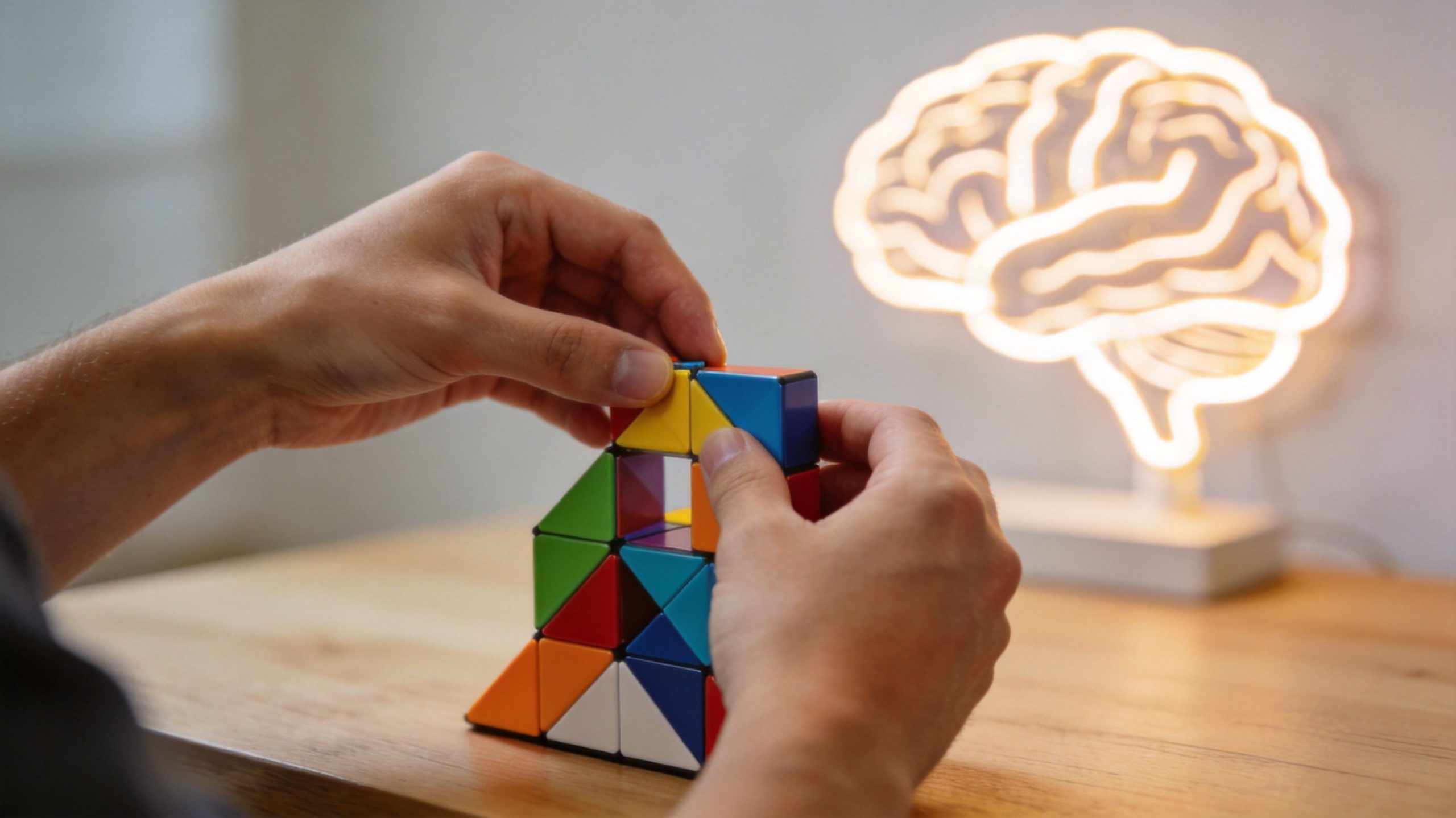
One practical way to explain this to senior stakeholders is the DOSE frame. It’s a simple shorthand for Dopamine, Oxytocin, Serotonin and Endorphins. The point isn’t to turn HR into neuroscientists. The point is to show why some learning formats wake people up and others don’t.
Dopamine and attention
Novelty matters. When adults face a fresh challenge with a visible goal, attention sharpens. That’s one reason repetitive, lecture-heavy formats can struggle to hold energy, especially late in a long conference day.
In play based learning, novelty is created through constraints, competition, time pressure, role allocation or a tangible build task. Dopamine supports motivation and focus, which helps participants stay engaged long enough to practise a new behaviour rather than merely hear about it.
Oxytocin and trust
Many business problems are trust problems wearing operational clothes. A delayed handover, poor meeting behaviour or lack of candour often comes back to whether people feel safe enough to rely on one another.
Collaborative challenges help because they require interdependence. One person can’t solve everything alone. People must ask for input, accept help and respond to feedback in the moment. That kind of exchange supports social bonding, which is why relationship-based activities often outperform passive team socials.
Teams don’t build trust by talking about trust. They build it by doing hard, shared tasks together and seeing how others respond.
Serotonin, Endorphins and regulation
Play can also stabilise group mood. A task that produces shared progress, visible contribution and moments of release helps people regulate stress and stay present. This matters in workplaces that are already carrying fatigue.
Australian evidence gives this idea practical weight. Data summarised from the Australian Council for Educational Research found a 0.45 standard deviation gain in executive function for participants in play-based programs, and the same source notes pilot data from Australian firms showing an 18% uplift in team morale after guided play challenges, as outlined in this summary of play-based learning evidence. For corporate leaders, the important translation is that guided challenges can strengthen self-regulation and cognitive flexibility.
That last word matters. Guided.
Unstructured activity can generate noise, exclusion or confusion, especially in adult groups with mixed personalities, seniority and neurodiversity. A facilitator needs to dose challenge carefully, create clear instructions and keep the task purposeful. That’s the difference between a room that feels awkward and a room that learns.
A useful primer for HR teams thinking about the biology of engagement is this discussion of the DOSE of play in workplace teams.
Key Benefits for Your Organisation’s Culture and Bottom Line
The strongest business case for play based learning isn’t “people enjoyed it”. It’s that a well-run session lets teams rehearse how they work under pressure, ambiguity and interdependence. Those aren’t soft outcomes. They sit under delivery, retention and culture.

When leaders ask what play changes, the better answer is behavioural. It changes how people participate, how they recover when a plan fails, and how quickly they coordinate with people outside their usual lane.
Better collaboration across difference
Most organisations don’t suffer from a total lack of talent. They suffer from silos, uneven communication and avoidable friction between functions.
Play-based tasks expose those patterns fast. A cross-functional challenge can reveal who dominates, who withholds useful information, who waits for permission and who translates complexity well. That’s why the right activity can do more for collaboration than another slide deck on teamwork.
Research summarised from the Australian Institute of Family Studies found that play-rich learning contexts were associated with a 35% uplift in resilience and negotiation abilities, highlighting why play can help bridge gaps in capability and participation across diverse groups in the workplace, as discussed in this article on the power of play-based learning.
Stronger psychological safety and experimentation
True creative thinking does not occur because leaders tell people to “be more creative”. It happens when teams can test ideas without fear of embarrassment or status loss.
A good play format creates a contained environment where trying, failing and adjusting feels normal. That gives quieter team members a clearer entry point. It also gives managers a live view of whether their team culture rewards contribution or punishes risk.
Consider the difference between these two settings:
| Setting | Typical behaviour |
|---|---|
| Traditional meeting | People defend positions, defer to hierarchy, protect reputation |
| Guided play challenge | People test options, ask for help, adapt quickly, share partial ideas |
That shift matters because the habits built in low-stakes moments often reappear in high-stakes work.
Higher engagement with a clearer return
Not every useful team intervention has to look formal. In many workplaces, a structured challenge gets stronger participation than a conventional workshop because adults can experience the lesson before they’re asked to discuss it.
Leaders usually care about outcomes such as:
- Retention signals: people are more likely to stay where they feel connected and useful.
- Project execution: stronger communication reduces rework and misalignment.
- Manager capability: leaders see team dynamics rather than guessing at them.
- Culture consistency: values become visible through action, not posters.
Many organizations underestimate play. They see a short activity. What they’re really buying is a faster route to behavioural evidence. That’s why many teams now evaluate the ROI of play in workplace performance through culture, engagement and collaboration lenses rather than treating it as a social extra.
A Practical Framework for Implementation
Most failed workplace activities have the same flaw. They start with the event and only later ask what it was meant to achieve.
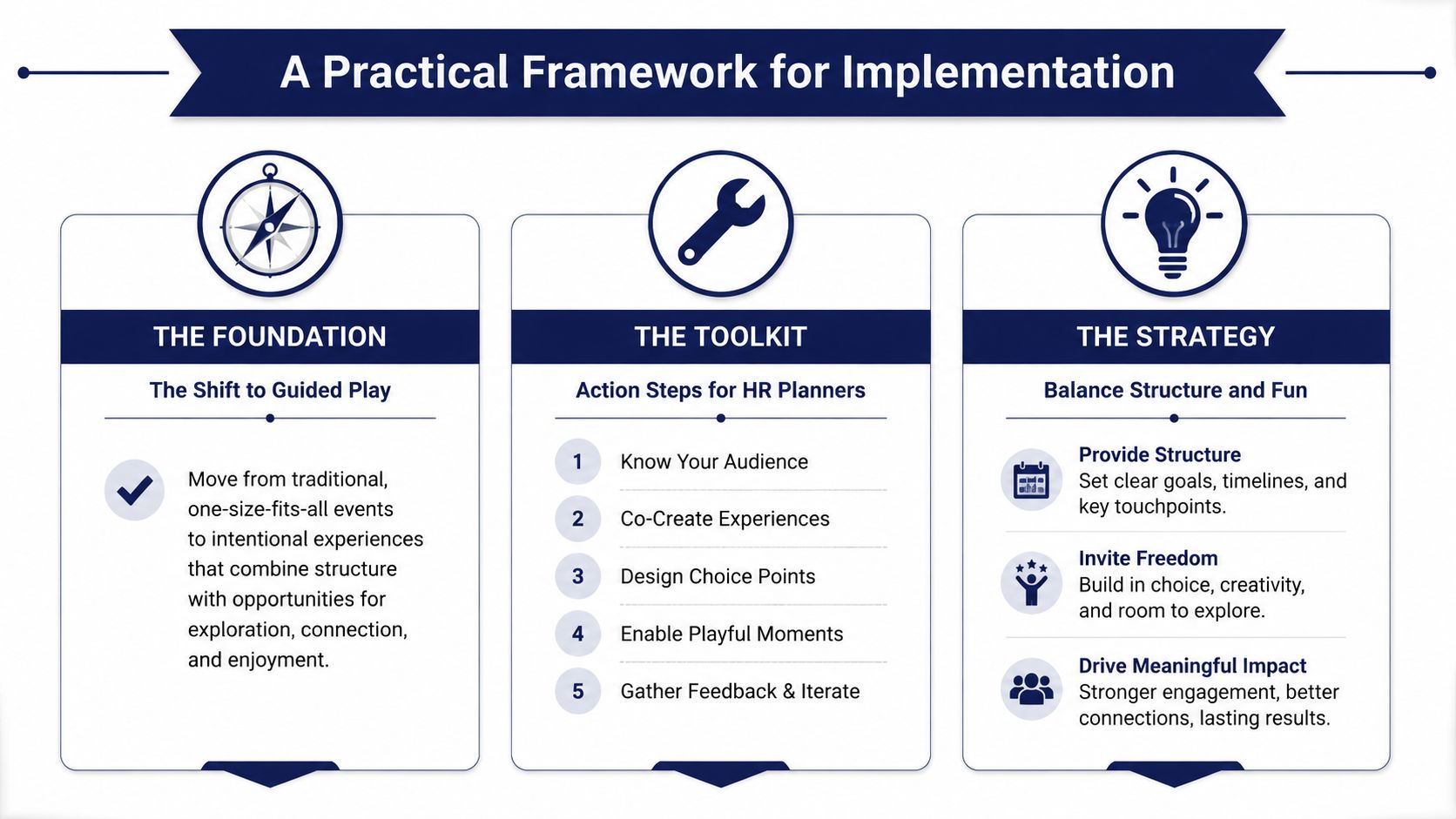
A stronger approach starts with a business problem. If the organisation needs better cross-departmental communication, the session should force information sharing. If the issue is decision paralysis, the task should require prioritisation under time pressure. Play based learning works when design choices match workplace realities.
Guided play is the operating model
The best corporate version of play sits between two weak options. On one side is unstructured fun with no transfer back to work. On the other is rigid training that asks people to absorb concepts without testing them socially.
Guided play combines freedom and structure. Participants get room to experiment, but the facilitator controls the frame.
A practical design sequence looks like this:
-
Define the target behaviour
Name the behaviour in operational terms. “Improve teamwork” is too broad. “Increase handover clarity between sales and delivery” is usable. -
Choose the right task format
Match the challenge to the behaviour. A creative build works for experimentation. A puzzle relay works for communication under constraint. A charity challenge can support purpose and collaboration at the same time. -
Set boundaries clearly
Adults engage better when they know the rules, time frame, success condition and why the task matters. -
Debrief for transfer
Ask what happened, what patterns appeared and where those same patterns show up at work.
Leader prompt: “Where did the team lose time, and where does that same delay happen in our projects?”
That final step is where learning becomes usable. Without reflection, even a strong activity fades into memory as a pleasant event.
Matching Play Activities to Business Objectives
| Business Objective | Activity Type Example | Desired Outcome |
|---|---|---|
| Cross-department communication | Information-sharing challenge with split instructions | Clearer handovers and fewer assumptions |
| Creative problem-solving | Collaborative invention or prototype task | More experimentation and broader idea contribution |
| Trust after organisational change | Team challenge with rotating leadership | Greater reliance on peers and visible support behaviours |
| Purpose and morale | Charity-focused build or CSR challenge | Shared meaning and stronger social connection |
| Decision-making under pressure | Timed scenario simulation | Faster prioritisation and clearer role allocation |
This kind of planning helps HR teams avoid generic “fun days” that feel disconnected from actual business needs. A useful culture resource for planners is the Culture Playbook on bringing play into everyday work.
Facilitation turns activity into learning
The activity itself is only half the equation. Facilitation quality determines whether the session surfaces useful behaviour or just creates temporary energy.
Strong facilitation usually includes:
- Observation: noticing who takes over, who checks understanding and who disengages.
- Pacing: adjusting difficulty so the task stays challenging without tipping into frustration.
- Inclusion: giving multiple entry points so extroverts don’t dominate the experience.
- Translation: tying observed behaviours back to meetings, projects and stakeholder work.
A simple test helps here. If the debrief can only produce comments like “that was fun” or “people seemed to enjoy it”, the design wasn’t specific enough. If the debrief produces comments like “finance and operations didn’t share assumptions until late” or “new managers waited too long to ask for help”, the session has generated something the business can use.
Play Based Learning in Action in Australia
Theory becomes credible when teams can see how it plays out inside familiar organisations. In practice, play based learning is rarely rolled out as a grand transformation. It usually starts with a stubborn issue that standard meetings haven’t fixed.
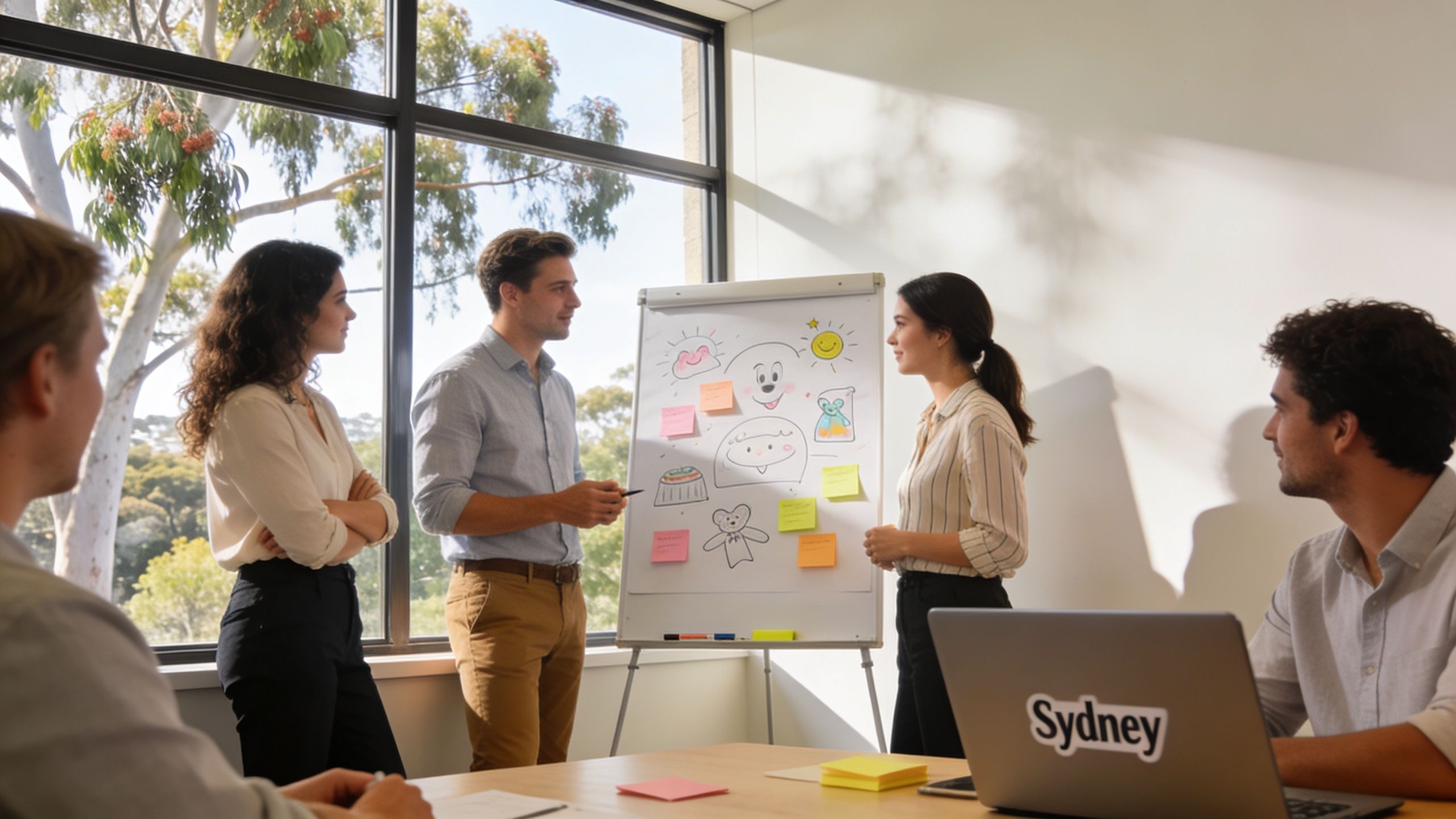
One common pattern appears in fast-growing firms. A Melbourne technology team may have smart people and decent intent, yet product, sales and client success keep talking past one another. A guided challenge with incomplete information can surface the actual problem quickly. One group assumes context is obvious. Another group waits too long to clarify. A third group optimises for speed and creates rework. The value isn’t the game. The value is that everyone can see the pattern at the same time.
Typical scenarios where this works well
A Sydney professional services team might use a creative build challenge after a restructure. The objective isn’t to “boost fun”. It’s to get newly combined teams cooperating around a shared outcome, with enough light pressure to reveal whether old loyalties still dominate behaviour.
A Brisbane operations group might choose a practical, timed problem-solving session before a busy delivery period. That format can expose whether managers delegate clearly, whether specialists explain constraints in plain language, and whether quieter staff are invited into decisions early enough.
The clearest sign that a session worked is when managers start naming work habits, not activity moments.
Another strong use case sits inside CSR-focused events. A purpose-driven challenge often changes the emotional tone of the room. People aren’t just competing. They’re building something that matters outside the business. That can be especially useful after a difficult period, when teams need reconnection without the artificial feel of a forced celebration.
What good execution looks like
Across these kinds of settings, a few design choices consistently matter:
- Mixed teams beat familiar groups: people need to work beyond their usual reporting lines.
- Visible constraints matter: limited resources or incomplete information create useful pressure.
- Reflection must be immediate: the debrief should happen while behaviours are still fresh.
- Manager participation helps: when leaders join in properly, hierarchy softens just enough for better observation.
Partnerships that bring global play expertise into the local market can also help organisations access stronger design models, as seen in this Australasian partnership focused on the science of play.
Addressing Scepticism and Measuring Success
Scepticism about play at work isn’t always resistance. Sometimes it’s good judgement.
Many professionals have sat through badly designed “fun” sessions that felt childish, irrelevant or awkwardly compulsory. The answer isn’t to dismiss those concerns. It’s to separate poor execution from the method itself.
What sceptics usually get right
The common objections tend to be versions of the same warning.
-
“We’re professionals.”
Correct. Adults expect relevance, clarity and respect. If an activity lacks purpose, they’ll reject it. -
“We don’t have time.”
Also fair. Any intervention that takes people away from work must create learning the business can use. -
“What if people hate it?”
A real risk. Some formats are too vague, too performative or too socially exposing.
Emerging Australian data supports that more nuanced view. In 2026 data, 41% of organisations reported morale boosts from play-infused events, but other Australian findings indicate that unstructured play can underperform for some adults, especially when compared with more structured challenges. The same emerging evidence notes 28% higher empathy scores in Australian guided-play pilots, which reinforces a practical point: adult play works best when it’s designed and facilitated with care.
That’s why guided play is so important. Adults don’t need less structure. They need the right amount of structure.
How to measure whether it worked
The wrong question is “Did people have fun?” That may matter, but it’s not enough. The better question is whether the session changed a behaviour the organisation cares about.
A practical measurement approach can include:
-
Pre- and post-session pulse questions
Ask teams about communication clarity, confidence in colleagues, willingness to contribute ideas, or comfort asking for help. -
Manager observations
Look for changes in meeting participation, escalation quality, handover discipline or speed of decision-making. -
Collaboration indicators
Review whether cross-functional interaction improves after the session, especially on active projects. -
Debrief themes
Capture recurring patterns from participants. If several teams identify the same blocker, that’s useful diagnostic information.
Good measurement tracks behaviour after the room has gone quiet.
The trade-off is simple. If the organisation wants quick entertainment, any icebreaker will do. If it wants capability, culture and better team performance, the activity must be treated as a learning intervention. That requires a sharper brief, a stronger facilitator and a willingness to evaluate the outcome properly.
Conclusion Make Play a Pillar of Your Culture
Workplaces don’t become more adaptive because leaders ask for agility. They become more adaptive when teams regularly practise communication, experimentation, trust and recovery under manageable pressure. That’s where play based learning earns its place.
Used well, play isn’t a detour from serious work. It’s one of the safest and fastest ways to expose how a team operates. It shows who speaks up, who collaborates, who asks for clarity and how people respond when the first plan fails. Those are the behaviours that shape culture and performance long after the session ends.
The organisations getting the most from play aren’t treating it as an annual novelty. They’re using guided challenges, structured reflection and purposeful design to build capability over time. That makes play a leadership tool, not an entertainment line item.
HR and People & Culture leaders don’t need more generic engagement tactics. They need methods that help teams work better together. Play, when designed properly, does exactly that.
For organisations ready to turn play into a practical performance tool, Corporate Challenge Events delivers purpose-driven team experiences across Australia that help strengthen collaboration, morale and workplace culture through well-designed, guided activities.