
Most advice on play at work gets the framing wrong. It treats play as a morale booster, an occasional offsite activity, or a way to lighten the mood when a team feels flat. That framing is too small for the realities leaders are managing halfway through the year.
By the middle of the year, leadership often becomes a conversation about progress.
The plan is revisited, the numbers are examined, and the second half of the year begins to take shape around what still needs to be delivered. This is necessary work. Serious leadership requires attention to performance, and capable teams need clarity when the pressure of the year begins to sharpen.
Yet there is another form of progress that is harder to see on a dashboard. It sits in the quality of judgement people are able to bring to the work, especially when the answer is not obvious and the next decision carries some risk. A leader can have a clear strategy and still unintentionally create an environment where people wait for certainty before they move. That is the point where permission becomes part of performance, because the team’s ability to act intentionally depends on whether people understand the frame they are trusted to work within.
In a serious workplace, permission is not the absence of standards. It is the presence of a frame strong enough for people to act inside it. When leaders create that frame well, people are clearer about where judgement is expected, where experimentation is useful, and where mistakes can be examined without becoming a reason to retreat. This is the space where play belongs in leadership: not as entertainment, but as the human permission to test, adapt and learn while staying connected to the work that matters.
Table of Contents
- Redefining Play as a Core Leadership Tool
- The Business Case for Granting Permission
- How to Diagnose Your Team’s Play Deficit
- Practical Strategies to Grant Permission at Work
- Embedding Play Through Structured Team Building
- Measuring the Impact of a Playful Culture
Redefining Play as a Core Leadership Tool

A mid-year reset gives leaders a rare opportunity to look beyond whether the work is moving and ask whether the conditions around the work are still helping people move with intelligence. The strongest leaders do not only read performance after it has happened. They shape the environment that makes better performance possible.
Microsoft’s 2025 Work Trend Index described a widening capacity gap: 53% of leaders said productivity needed to increase, while 80% of the global workforce said they did not have enough time or energy to do their work. The same report found that employees were interrupted every two minutes during the standard working day by a meeting, email or ping. Permission does not grow easily in an environment where attention is constantly being claimed and the demand for output keeps rising.
Gallup’s 2026 State of the Global Workplace report adds another layer. Global employee engagement fell to 20% in 2025, its lowest level since 2020, with Gallup estimating the cost of low engagement at US$10 trillion in lost productivity.
In Australia, only 23% of employees are engaged at work, according to Gallup’s 2024 reporting referenced here. Conventional performance management clearly isn’t producing enough commitment, energy, or initiative. Leaders need practices that change team behaviour, not just another request for discretionary effort.
That is why permission to play needs to be defined carefully. In leadership, it does not mean giving people unlimited freedom or asking work to become more casual. It means creating a clear enough boundary that people can move within it without waiting for approval at every turn.
What leaders are actually granting
A leader grants permission to play when they make three things explicit:
- What can be tested: small process changes, meeting formats, communication approaches, workshop methods
- What can’t be compromised: client obligations, safety requirements, compliance standards, delivery deadlines
- How learning will be reviewed: short debriefs, visible decisions, and shared reflection after a trial
That is why play belongs beside psychological safety and accountability, not in opposition to them. Teams contribute more when people know the edges of the field and still have room to move.
Practical rule: If a team can question the method but still owns the outcome, permission is present.
Leaders looking to build this capability through workplace design, not just good intentions, can see how play-based learning in organisations turns participation into a practical performance tool.
The Business Case for Granting Permission
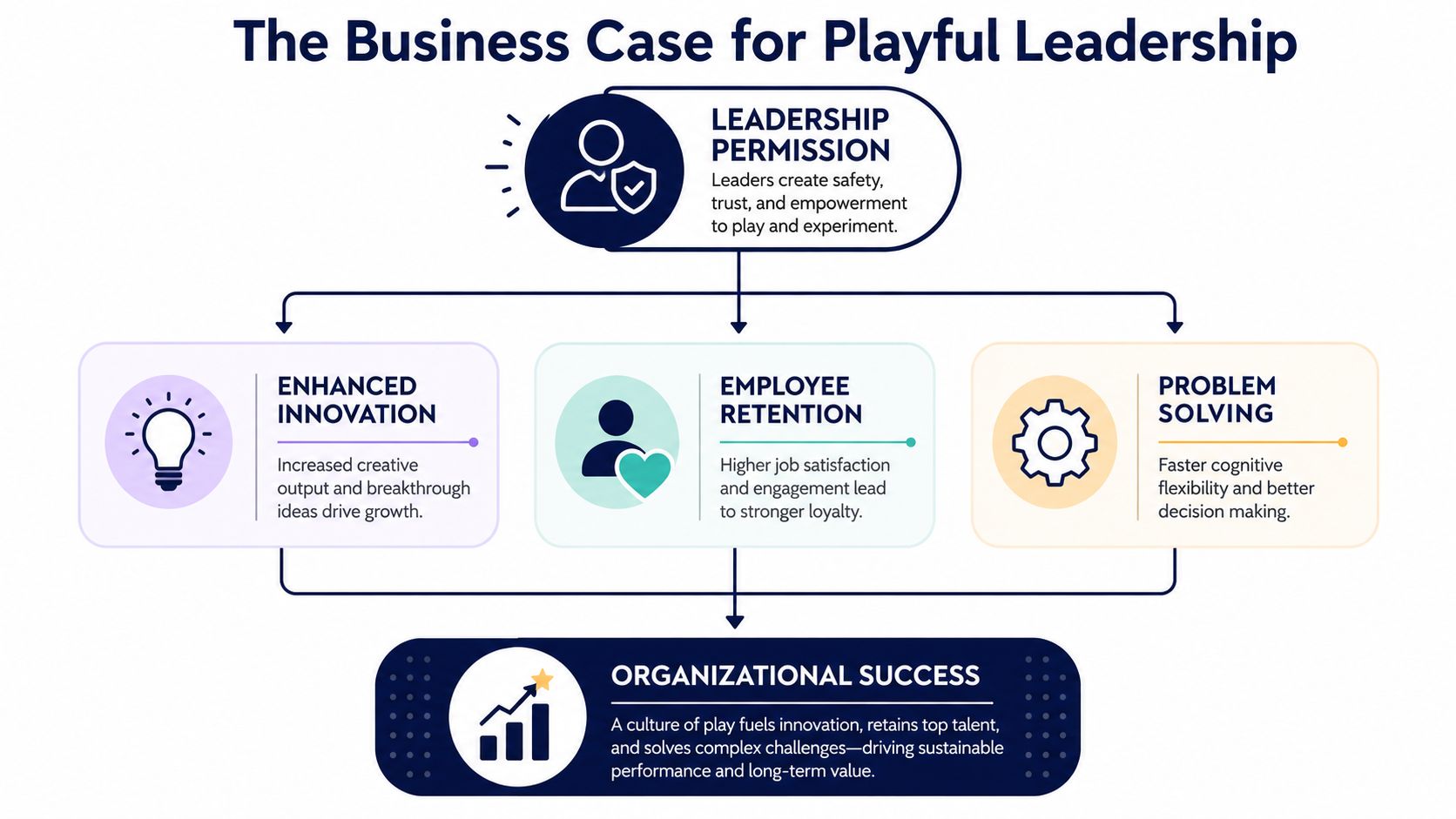
The business case is stronger when leaders stop describing play as a culture extra and start treating it as a work design decision.
For Australian leaders, that matters because psychosocial hazards are now a formal workplace health and safety focus, and work-related mental stress is a major driver of serious workers’ compensation claims, as outlined in this discussion of permission as a professional leadership advantage. In practice, that means leaders are expected to pay attention to how supervision, communication, and team interaction affect stress and performance.
To understand permission to play, leaders first need to understand why play is more than behaviour.
At a biological level, play begins before conscious strategy. Jaak Panksepp’s work on mammalian play helped show that play is rooted in ancient subcortical systems involved in motivation, emotion and social engagement. This is why play cannot be reduced to a personality preference or a workplace style. It is part of the human operating system, and when it is activated, it changes the state a person is working from.
That state is the bridge to performance. In play, the brain is practising exploration under lower threat. Self-monitoring softens, the fear of getting it wrong carries less force, and people become more willing to respond to what is happening rather than protect themselves from it. For leaders, this is the practical significance of play. It creates the conditions where judgement can develop before certainty is available.
Why this belongs in operational leadership
Permission to play works as a preventive control because it helps teams reset before strain becomes absence, conflict, or withdrawal. Low-stakes interaction can lower perceived interpersonal risk. That makes it easier for people to ask for help, surface concerns, and contribute ideas earlier.
A leadership team doesn’t need to approve a large initiative to use this well. It can show up in the first ten minutes of a workshop, in the way a manager frames a pilot, or in how a team reviews a failed attempt.
| Leadership approach | Likely effect on team behaviour |
|---|---|
| Tight control with little room to test | Compliance without much ownership |
| Broad encouragement with no boundaries | Activity without much clarity |
| Permission with clear guardrails | Experimentation tied to outcomes |
The value isn’t abstract. Teams that feel safer to contribute usually coordinate faster, adapt more readily, and recover from setbacks with less friction.
Permission to play earns its place when it improves how work gets done, not when it simply makes work feel lighter.
For leaders who need a stronger commercial lens, the ROI of play at work is a useful way to frame the conversation with HR, People & Culture, and senior stakeholders.
How to Diagnose Your Team’s Play Deficit
A team rarely says, “there’s no permission to play here.” The signal appears in behaviour. Meetings stay polite but thin. Ideas arrive late. People execute tasks without much ownership because speaking up feels risky, inefficient, or pointless.
A quick audit works better than a broad culture review. Keep it simple and specific.
A short permission pulse check
Use these prompts in a pulse survey, leadership reset meeting, or workshop check-in:
- Can people question how work is done without being seen as difficult?
- Do team members suggest experiments, or wait for direction?
- When something goes wrong, does the conversation focus on learning or blame?
- Do quieter team members contribute in planning discussions?
- Are decisions explained clearly enough that people know where they can act?
- Do people ask for help early, or only when a problem is already visible?
If responses are hesitant, inconsistent, or overly diplomatic, the issue usually isn’t capability. It’s climate.
What to watch in real time
A leader can learn a lot by observing ordinary routines.
- Meeting participation: the same few voices dominate while others stay in execution mode
- Risk response: people defend existing processes even when they aren’t working well
- Error recovery: mistakes are hidden, delayed, or over-explained instead of surfaced and resolved
- Follow-through: teams comply with decisions they never really bought into
For leaders wanting more structured ways to introduce this kind of behavioural reflection, the Play Hub offers a useful reference point for building repeatable team habits.
Practical Strategies to Grant Permission at Work
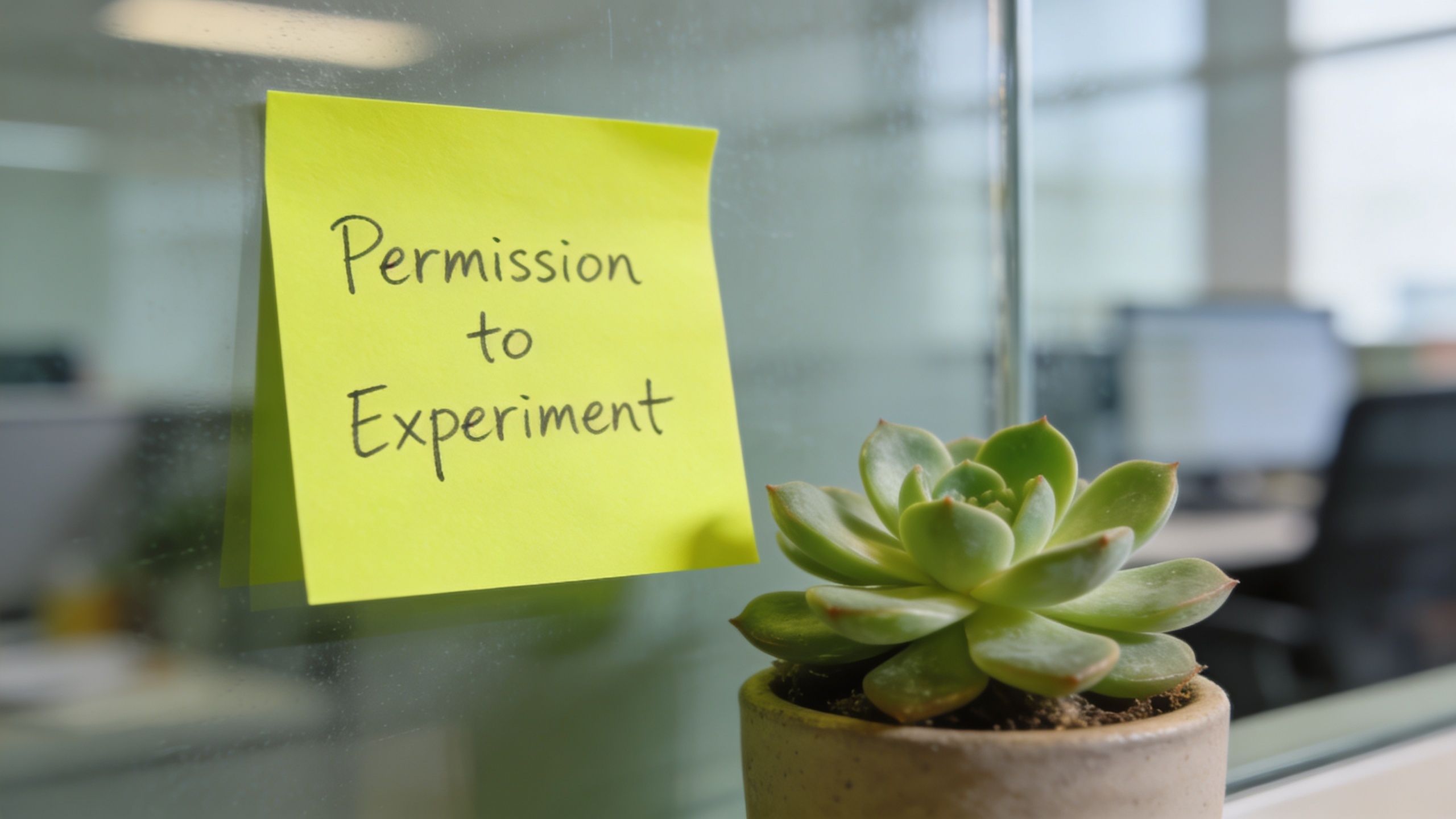
Permission doesn’t become real when a leader says “be creative” or “bring your whole self.” It becomes real when people know what they are allowed to try this week, what decisions they can make without approval, and what will happen if a sensible experiment doesn’t work.
Permission begins with modelled behaviour. A leader gives the first signal by showing that early thinking has a place before it is judged. That does not require a theatrical culture or constant high energy. It requires a leader who can hold the standard while making enough room for discovery, reflection and sensible experimentation.
That clarity matters even more in hybrid environments. The ABS-referenced discussion here notes that 37% of employed Australians usually worked from home in August 2024, which means leaders can’t assume spontaneous interaction will close the gap. Remote and hybrid teams need explicit norms if they are going to experience the same level of safety and belonging as onsite colleagues.
Daily leader behaviours that actually work
Some actions are small, but they change the tone of a team quickly:
- Name the experiment window: “Let’s test this approach for two weeks, then review.”
- Separate test from identity: critique the method, not the person who proposed it
- Reward useful surfacing: thank people for raising concerns early, especially when the message is inconvenient
- Debrief in public: when a trial fails, discuss what was learned and what changes next
“Try this and tell us what happened” creates more movement than “bring me a perfect answer.”
Adapting it for onsite, hybrid, and remote teams
Different environments need different signals.
| Team setting | Leadership adjustment |
|---|---|
| Onsite | Use visible prompts in meetings and workshops so experimentation doesn’t get buried under routine |
| Hybrid | Rotate contribution methods so remote staff aren’t always reacting after the room has decided |
| Remote | Build structured check-ins and short energisers into long sessions to reduce passivity and fatigue |
Leaders who struggle to make this practical in a busy schedule often benefit from borrowing ready-made formats for fitting play into the workweek, rather than trying to invent every ritual from scratch.
Embedding Play Through Structured Team Building

Daily leadership habits are essential, but they don’t always shift an entrenched pattern on their own. A team can agree, in theory, that experimentation is welcome and still fall back into caution the moment pressure rises. That is where structured team building, conference energisers, and facilitated offsites earn their place.
A mid-year reset is a practical place to begin because it already asks the team to pause and look at how the year is unfolding. That reset might be an offsite, a facilitated team-building experience or a longer meeting with enough space to move beyond reporting. The form matters less than the condition it creates. If the session only reviews targets, it may sharpen the plan without changing how people enter the work. If it gives people permission to engage differently, it can shift the human infrastructure that carries the plan into the second half of the year.
This is where play-based team building can do more than energise a room. Designed well, it gives people a lower-risk environment to practise the behaviours leaders often need when pressure is higher. The value is not only in the activity itself. It is in the permission the activity creates and the leadership conversation that follows.
The work then needs a rhythm beyond the reset. For leaders who want a practical starting point, the free 12 Week Play Plan offers a simple way to keep play present in the everyday experience of work. It helps teams introduce small, repeatable moments that build connection, reflection and playful practice without turning play into another heavy initiative. The deeper purpose is to help leaders move permission from a single event into the operating rhythm of the team.
Measuring the Impact of a Playful Culture
Leaders don’t need a complicated dashboard to tell whether permission is changing team performance. They need a small set of indicators that show whether participation, trust, and learning are becoming more visible in the flow of work.
Start with leading indicators. Watch idea flow in planning sessions, the range of voices contributing to discussions, the number of small experiments proposed, and how quickly the team recovers when something goes wrong. Those measures help leaders assess whether the environment is opening up or staying cautious.
A practical measurement frame
A simple review table is often enough:
| Type of indicator | What to monitor |
|---|---|
| Leading | participation in meetings, quality of debriefs, volume of workable ideas, speed of error recovery |
| Lagging | engagement trends, retention patterns, project delivery consistency, stakeholder confidence |
Qualitative evidence matters as well. Team narratives, manager observations, and customer feedback often reveal the shift before formal reporting does. If people say meetings are more useful, trade-offs are clearer, and experimentation feels safer, those are meaningful operating signals.
Leaders who want a stronger framework for linking play to performance can use ideas from why teams need a dose of play to shape short review cycles and adjust the practice over time.
A mid-year reset is a strong moment to make permission visible, practical, and repeatable. Corporate Challenge Events helps Australian organisations turn play into a structured leadership tool through team building, conference energisers, offsites, and culture programs designed to strengthen connection, communication, and performance. For teams ready to reset how they work together, it’s worth exploring a customized session or a practical planning conversation.