
By mid-June, many Australian teams are trying to finish projects, close reporting gaps, cover leave, complete reviews, and prepare next-year plans at the same time. Energy is low, calendars are crowded, and hybrid work makes it harder to tell whether a team is aligned or quiet.
That's why an end of financial year team reset works best when it's treated as an operating intervention, not a morale add-on. At this point in the year, leaders don't need another vague conversation about goals. They need a structured way to close out what no longer fits, clarify what the team is carrying into July, and restore enough focus that people can execute without dragging unresolved issues into the new financial year.
Table of Contents
- Why an EOFY Reset is a Strategic Necessity
- Laying the Groundwork for a Successful Reset
- Designing Your EOFY Reset Agenda
- Choosing Activities That Drive Real Outcomes
- Facilitation Tips and Follow-Up Actions
- Conclusion From Reset to Renewed Momentum
Why an EOFY Reset is a Strategic Necessity
In Australian organisations, EOFY isn't an arbitrary date. It's a formal business threshold. The standard income year runs from 1 July to 30 June, and the ATO confirms that 30 June closes the financial year, which is why businesses use the period to finalise records, reconcile accounts, and prepare reporting. In practical terms, it lands at the same time as budgeting, workforce planning, and performance review cycles, which makes it a natural point to reassess priorities and reset team expectations before the next cycle begins (ATO timing and business context).

Leaders often miss the opportunity because EOFY already feels overloaded. Finance is chasing reconciliations. Managers are trying to finish reviews. HR is handling reporting, workforce changes, and planning conversations at once. In that environment, a reset can look optional. It isn't.
The reset is operational, not symbolic
A useful reset answers a hard question. What should this team stop carrying into July? That could be a muddled project list, overlapping ownership, unresolved tension between functions, or goals that no longer match the workload.
Practical rule: If the session doesn't change how work will be prioritised in July, it wasn't a reset. It was a discussion.
The strongest teams use EOFY to close loops. They identify what's complete, what's delayed, what needs active escalation, and what should be paused. That creates breathing room before the next planning cycle starts. It also reduces the common pattern where teams return in July with a fresh budget and the same unresolved friction.
Fatigue changes what good leadership looks like
At this stage of the year, teams don't need high-energy rhetoric. They need clarity, sequencing, and a sense that leadership understands the load they've been carrying. That's one reason many organisations use targeted EOFY alignment sessions and structured team-building touchpoints to stabilise energy rather than add more noise. A useful example is this perspective on why EOFY can be the right time for team building, particularly when the goal is to reconnect people around shared priorities.
A reset also helps leadership separate two issues that often get mixed together:
| Issue | What leaders often assume | What's usually happening |
|---|---|---|
| Lower energy | Motivation problem | Cognitive overload and competing priorities |
| Slower delivery | Capability gap | Too many dependencies and unclear ownership |
| Friction between teams | Personality clash | Misaligned goals at year-end pressure points |
When leaders read the moment accurately, the reset becomes more precise. It stops being a generic reflection exercise and becomes a disciplined way to reduce drift, protect performance, and give the team a cleaner start to the new financial year.
Laying the Groundwork for a Successful Reset
Poor EOFY sessions usually fail before anyone enters the room. The agenda looks polished, the venue is booked, and the calendar invite is well written, but no one has defined what the reset is meant to fix. As a result, the day becomes a mix of updates, broad conversation, and goodwill with very little operating value.
The pre-work has to be sharper than that. An end of financial year team reset should begin with one decision from leadership: is the team primarily solving for cohesion, clarity, or execution? Those goals overlap, but they aren't the same, and the session design changes depending on which one matters most.
Start with a business problem, not an activity idea
The ABS Job Mobility data for 2024 showed that 9.6% of employed people changed jobs during the year, which points to a workforce that is constantly shifting and reorganising (ABS job mobility context). For corporate teams, that often means EOFY arrives with new starters still bedding in, backfills not yet complete, and responsibilities that have shifted without being fully reset.
That environment creates a predictable leadership risk. Teams keep operating on assumptions that were true earlier in the year but no longer reflect current reality.
A better starting point is a short diagnostic. Leadership teams should answer:
- Where is the team losing traction: Is work slowing because decisions are delayed, handovers are weak, or priorities are too broad?
- What changed during the year: Did restructures, departures, new hires, or reporting-line changes alter how the team works?
- What must be true by July: Should the reset produce tighter delivery, clearer ownership, better cross-functional trust, or a more realistic roadmap?
Teams don't need a reset because the calendar says so. They need one because work has changed faster than operating habits.
Build the case in operational language
Budget approval gets easier when the reset is framed as a response to coordination risk, role ambiguity, and planning slippage rather than as a culture spend. Senior stakeholders usually respond to three points.
First, the reset shortens the gap between annual review and actual execution. Second, it gives managers a forum to clarify roles before new-year plans harden into assumptions. Third, it helps absorb team movement without asking people to figure out the next twelve months on the run.
For teams also reviewing capability gaps or redesigning how functions support internal stakeholders, resources on building internal creative infrastructure can be useful because they show how team design, ownership, and service models affect execution quality beyond the org chart alone.
Define success before planning the day
A strong reset brief should fit on one page. If it takes longer, the objective is probably still too vague.
Use this structure:
Primary outcome
One sentence only. Example: “By the end of the session, the team has a clear set of priorities for July to September and named owners for each.”Secondary outcomes
Limit these to two. Common examples include improving trust between functions, reducing duplicated effort, or integrating new team members into existing workflows.Non-goals
State what the day won't solve. This prevents the session from turning into a backlog of every unresolved issue from the year.
For leaders planning a broader alignment day, these strategic planning workshop tips can help shape the session so it stays tied to decisions rather than drifting into general discussion.
Designing Your EOFY Reset Agenda
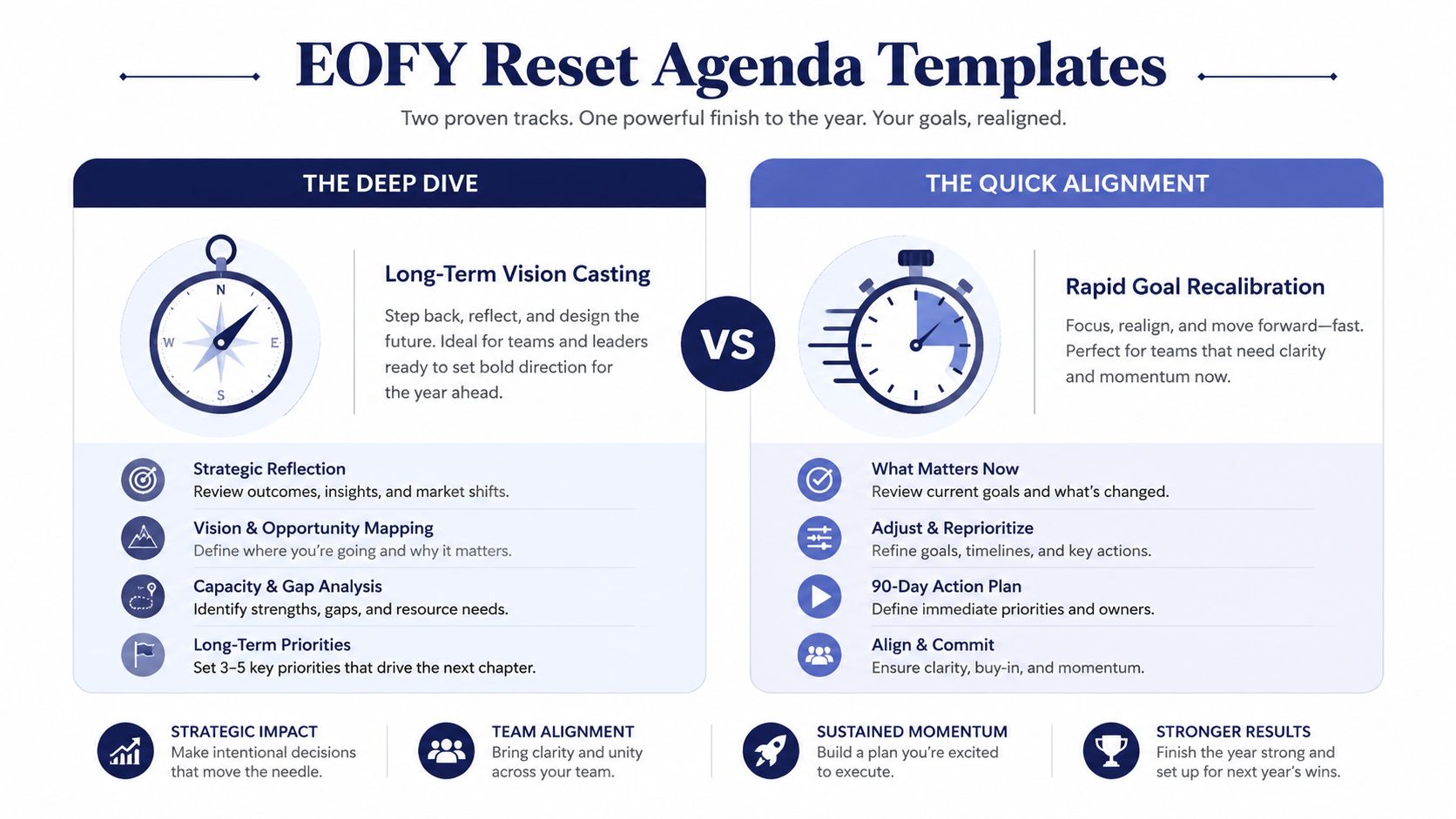
A good agenda doesn't start with time blocks. It starts with the team's actual operating condition. Some teams need space for deeper repair because the year has been fragmented. Others need a compact decision session because the work is clear and only the priorities have drifted.
Choose the format that matches the problem
The most common mistake is choosing the format that feels easiest to organise rather than the one that fits the issue.
| Format | Best used when | Watch-out |
|---|---|---|
| Half-day session | The team is fundamentally healthy but needs sharper alignment before July | Too little time for complex conflict or major redesign |
| Full-day workshop | The team needs both reflection and future planning | Can become heavy if every agenda item is discussion-based |
| Multi-day offsite | Leadership wants strategic reset plus relationship rebuilding across functions | Requires disciplined facilitation to avoid drift |
| Virtual reset | Team members are dispersed and in-person logistics are unrealistic | Needs tighter pacing and stronger visual structure |
A half-day session suits teams that don't need to unpack the whole year. It works when the challenge is mostly prioritisation. Keep the scope narrow. Review what carried the most weight this year, identify what no longer belongs in the next quarter, then set a short action plan.
A full-day format suits teams with several moving parts. It allows enough time to review performance, surface friction points, rebuild shared understanding, and still leave with decisions. It also gives enough room to separate emotional debriefing from practical planning, which often improves the quality of both.
A multi-day offsite is useful when the team has been through significant change, when several leaders need to reset together, or when cross-functional relationships need work. The danger is that leaders treat the additional time as permission to include everything. That usually produces fatigue rather than clarity.
A virtual reset can work well for hybrid teams if it is designed properly. It needs shorter modules, visible documentation, clear pre-reading, and active facilitation. People lose focus quickly when video calls are used as a substitute for structure.
What each agenda should produce
The verified methodology most worth using is simple: diagnose performance, realign roles and priorities, then run a short execution sprint into 30 June (three-step EOFY cadence). That cadence is reliable because it forces the session to move from reflection into ownership.
A practical half-day template might look like this:
- Opening review: What worked, what created drag, and what the team must stop doing
- Priority reset: The few outcomes that matter most going into July
- Role and handover clarification: Who owns what, and where dependencies create risk
- Commitment block: Immediate next actions before the financial year flips
A full-day version can go further by separating strategic and relational work.
Morning
- Performance snapshot
- Team pulse discussion
- Function-to-function friction mapping
Afternoon
- New FY priorities
- Role clarity and decision rights
- Action register and check-in rhythm
The agenda is doing its job when it reduces ambiguity. If it only generates insight, the team will still hit July with the same operating friction.
For larger planning days, it helps to borrow discipline from conference design. This guide to structuring a great conference agenda is useful because the same principles apply. Pace matters. Cognitive load matters. People engage better when the day alternates between thinking, discussion, and decision.
A few design choices consistently work better than others:
- Use pre-reading sparingly: Give participants enough context to arrive informed, but don't send a mini annual report.
- Separate diagnosis from solutioning: If the team tries to solve problems before agreeing on the problem, the loudest voice usually sets the direction.
- End with visible commitments: Every meaningful decision should be documented live, not reconstructed later from half-remembered notes.
Teams that are already tired don't need a more entertaining agenda. They need a more decisive one.
Choosing Activities That Drive Real Outcomes
The activity layer of an EOFY reset is where many corporate teams lose credibility. Leaders ask for something engaging, planners respond with something upbeat, and the day ends with positive energy but no real movement on the issues that were slowing the team down. That's why activities need to be selected for what they reveal, not just how they feel in the moment.

The most dependable structure is to pair every activity choice with the three-part reset cadence already established: diagnose the past, realign the future, then create a short execution push into 30 June. When an activity doesn't support one of those stages, it usually belongs somewhere else.
Morale and connection
If the team is depleted, start with something that restores openness without demanding immediate strategic precision. Play-based team building, well-designed charity challenges, or structured collaborative tasks can help in this regard. The point isn't diversion. It's to create enough shared energy that people re-enter planning mode with less guardedness and more willingness to contribute.
Useful formats here include:
- Collaborative build challenges: Good for surfacing communication habits and reintroducing cross-team interaction
- Charity-based activities: Helpful when leadership wants the session to carry a broader sense of purpose
- Facilitated energisers: Best used as short resets between heavier planning blocks
For teams searching for broader inspiration, these actionable concepts for corporate gatherings offer a practical starting point, particularly when the requirement is to balance engagement with professional outcomes.
Alignment and decision-making
If the core issue is fragmentation, use activities that expose assumptions and force teams to work across dependencies. Scenario exercises, business simulations, and structured problem-solving formats are usually stronger than generic social mixers because they reveal how decisions get made.
This is the right place for:
- Cross-functional problem labs
- Priority-ranking exercises
- Team mapping sessions that identify handoff points and approval friction
One option in this category is a facilitated corporate program from Corporate Challenge Events' team building range, where activity selection can be matched to objectives such as collaboration, communication, or conference alignment rather than treated as stand-alone entertainment.
A reset activity earns its place when the debrief changes how the team will work next quarter.
Performance and role clarity
When leadership already knows morale isn't the main issue, move quickly into structured workshop formats. The strongest activities at this stage are the ones that produce artefacts the team can use after the day ends. That could be a responsibility map, a decision-rights matrix, a list of paused work, or a short operating charter for the next quarter.
These formats are often less flashy, but they create more traction:
- Role clarity workshops for teams with blurred ownership
- Decision protocol exercises where managers agree how escalations will be handled
- Execution planning sprints that convert priorities into due dates, owners, and dependencies
The trade-off is straightforward. Highly social activities can lift energy faster, but they won't fix confusion on their own. Heavier workshop formats can create clearer operating outcomes, but they need good facilitation or they'll feel like another long meeting. The best EOFY reset combines both. It restores connection first, then uses that energy to produce decisions the team can work from in July.
Facilitation Tips and Follow-Up Actions
Even a strong agenda can stall if the room isn't handled properly. EOFY sessions are often filled with people who are tired, pressed for time, and carrying unresolved irritation from the year. Good facilitation doesn't try to smooth that over. It gives the team a controlled way to surface what matters without letting the day turn into a circular airing of complaints.
Run the room with discipline
Open with context and rules. People contribute more candidly when they know the session is designed to improve how work happens, not to revisit every frustration in detail. That means naming the purpose, showing the decision points, and making it clear which topics belong in the room and which should be handled elsewhere.
A few practices improve quality quickly:
- Use visible capture: Record priorities, blockers, and decisions where everyone can see them
- Time-box debate: Some issues need discussion, but not all deserve equal airtime
- Draw quieter voices in early: Hybrid and cross-functional teams often default to the same speakers unless the facilitator changes the pattern
One approach that consistently works is to separate contribution rounds. Start with silent reflection, then small-group discussion, then plenary decisions. That sequence reduces groupthink and stops the most confident voices from framing the issue too early.
Turn discussion into accountable action
Australian finance-close guidance makes a useful point here. Operational bottlenecks are often caused by coordination failures rather than weak strategy, which is why effective EOFY resets depend on explicit responsibilities, mapped dependencies, and a visible action register after the session (coordination and close visibility guidance).
That translates well into team practice. Before the session ends, every agreed priority should have:
| Requirement | What it should say |
|---|---|
| Owner | One named person, not a department |
| Due point | A clear timing checkpoint |
| Dependency | What must happen first, or who else is involved |
| Review rhythm | When the team will check progress |
Don't close the session on shared optimism. Close it on named ownership.
Sustaining momentum matters just as much as running the day well. A simple follow-up rhythm usually works better than an elaborate reporting process. Schedule short check-ins through July and August, review only the agreed action register, and remove stalled items quickly if assumptions have changed.
Leaders who want the energy of the reset to carry into day-to-day work often benefit from practical guidance on maintaining momentum after a team-building event. The principle is straightforward. If the post-session rhythm is vague, the reset fades. If it's visible and consistent, the team starts the year with traction instead of good intentions.
Conclusion From Reset to Renewed Momentum
An end of financial year team reset works when leadership treats it as a serious piece of operating design. By late June, many groups are not short on effort. They are short on clarity, energy, and shared understanding about what the next stretch of work requires.
That's why the reset deserves more than a reflective conversation and a catered lunch. It needs clear intent, an agenda that matches the team's condition, activities chosen for business outcomes, and follow-through that makes accountability visible. When those pieces are in place, EOFY becomes more than a deadline. It becomes a clean line between what the team is closing and what it is consciously carrying forward.
There's also a broader leadership signal in doing this well. It shows the team that the organisation isn't content to let fatigue, ambiguity, and accumulated friction roll into another cycle unchecked. Instead, leadership is willing to stop, sort, decide, and re-commit with discipline.
That approach changes the value of the day. The reset stops being a symbolic gesture and starts functioning as a stabiliser for performance, coordination, and trust. For Australian organisations navigating hybrid work, year-end workload, and constant change, that's a more useful outcome than temporary morale alone.
A strong July doesn't begin on 1 July. It begins in the decisions made before the financial year turns.
Corporate teams that want help turning EOFY into a structured, play-based reset can explore Corporate Challenge Events. Their programs can be used as one component within a broader reset strategy, particularly when the brief calls for stronger connection, clearer collaboration, and purposeful team engagement rather than a purely social event.