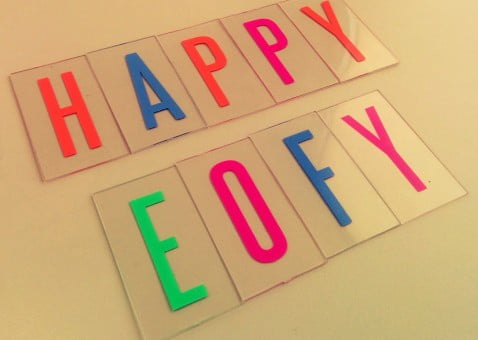
Late June often looks the same in senior leadership meetings. Finance is closing out the year. Managers are trying to recognise effort without losing momentum. Teams are tired, less patient, and more likely to retreat into silos at the exact point the business needs alignment for the new financial year.
That makes EOFY team building a useful leadership tool, not a box to tick before everyone disappears into reporting and leave plans. Used well, it helps reset strained working relationships, surface how the team is functioning under pressure, and give people a clear sense of what the next year requires.
In Australia, the 1 July to 30 June financial year creates a natural decision point. Late May and June are well suited to bring teams together, acknowledge the intensity of the closing period, and set expectations for the year ahead. The strongest eofy team building ideas are designed with that context in mind.
The real question is not which activity looks fun on paper. It is which format will improve energy, focus, trust, and execution once the event is over.
Table of Contents
- 1. Charity-Based Team Building with Community Impact
- 2. Play-Based Problem-Solving Challenges
- 3. Active and Adventure Team Building Programs
- 4. Creative and Artistic Team Building Programs
- 5. Interactive Entertainment and Game-Based Events
- 6. Conference Energisers and Interactive Keynotes
- 7. Team Development Programs with Assessment and Coaching
- 8. Custom-Designed Experiences Aligned with Organisational Strategy
- 8-Point EOFY Team-Building Comparison
- Choosing the Right EOFY Experience for Your Team
1. Charity-Based Team Building with Community Impact
A familiar EOFY pattern plays out in many organisations. Leaders want to recognise a hard year, the team is running low on energy, and a standard lunch or drinks event feels too thin for the moment. Charity team building solves that problem well because it gives people a shared task, a visible outcome and a stronger reason to show up engaged.
This format works particularly well when leadership wants the event to do more than reward effort. It can reinforce values, reconnect dispersed teams and create a cleaner reset before the new financial year starts. Australian EOFY event guidance has increasingly treated charity formats as a practical option for organisations that want community impact without losing the team experience.
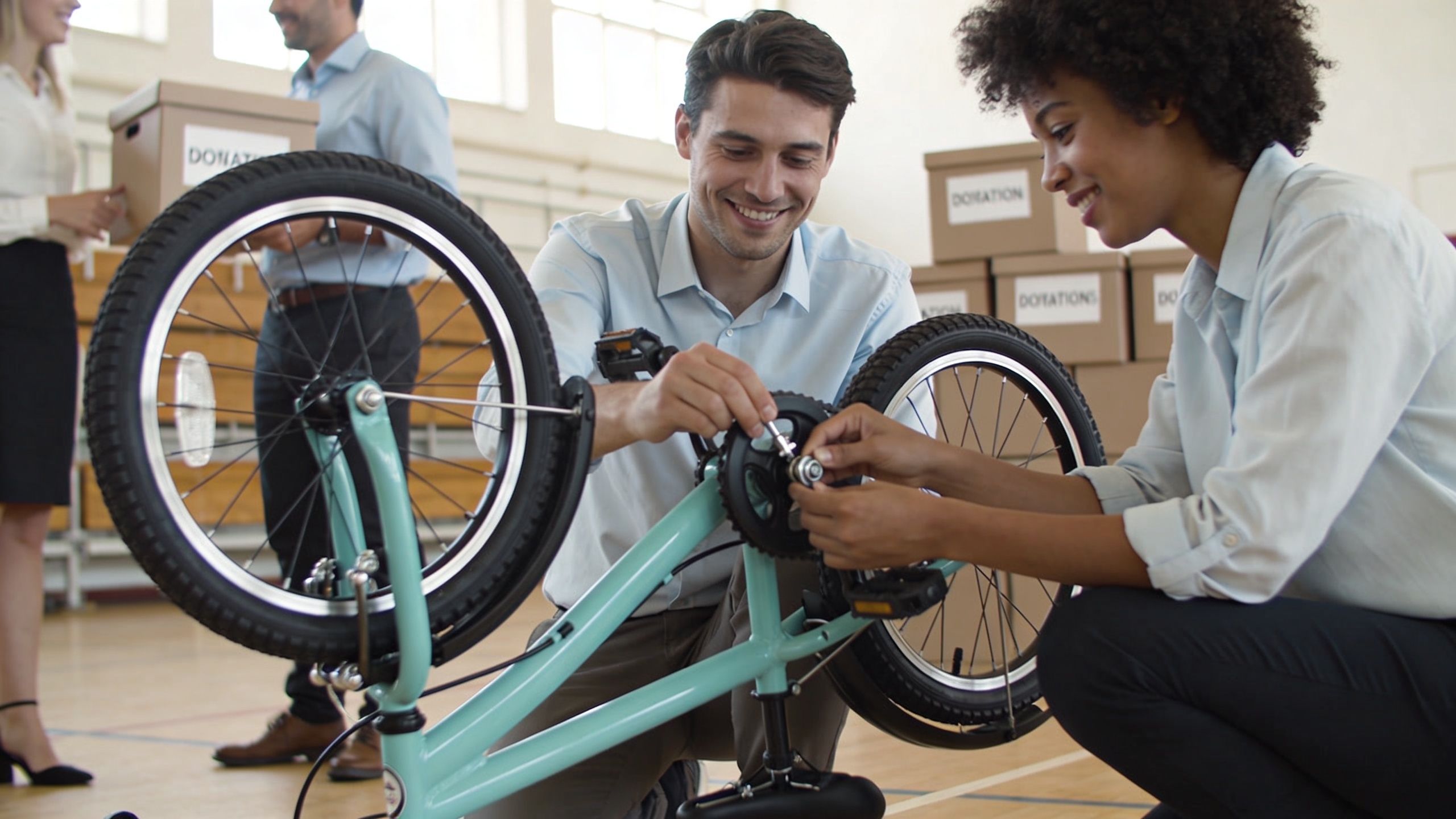
Programs such as Bikes for Tykes, Give a Dog a Home, Toys for Tykes or care-kit assembly are effective because the purpose is clear. People know who benefits. That clarity matters at EOFY, when teams are more likely to respond to substance than to novelty.
Why it works at EOFY
EOFY brings two realities at once. Teams want recognition, and they are often carrying decision fatigue from months of deadlines, reporting and budget pressure. A purpose-led event respects both conditions. It still gives people a break from routine, but it also gives the day weight.
Practical rule: If leadership wants the day to signal values as well as appreciation, charity-based eofy team building ideas often outperform generic hospitality.
There is a trade-off. Charity formats need tighter planning than a simple social event. The cause has to fit the organisation, the beneficiary has to feel credible, and the activity needs enough structure to keep the experience productive rather than worthy-but-flat.
Done well, the payoff is stronger. A finance team might build bikes for children. An IT division might assemble support packs for a local service. A professional services firm might run a donation challenge tied to a community partner. The best choice is the one that matches the organisation's stated priorities and gives employees a clear reason to care before they arrive.
2. Play-Based Problem-Solving Challenges
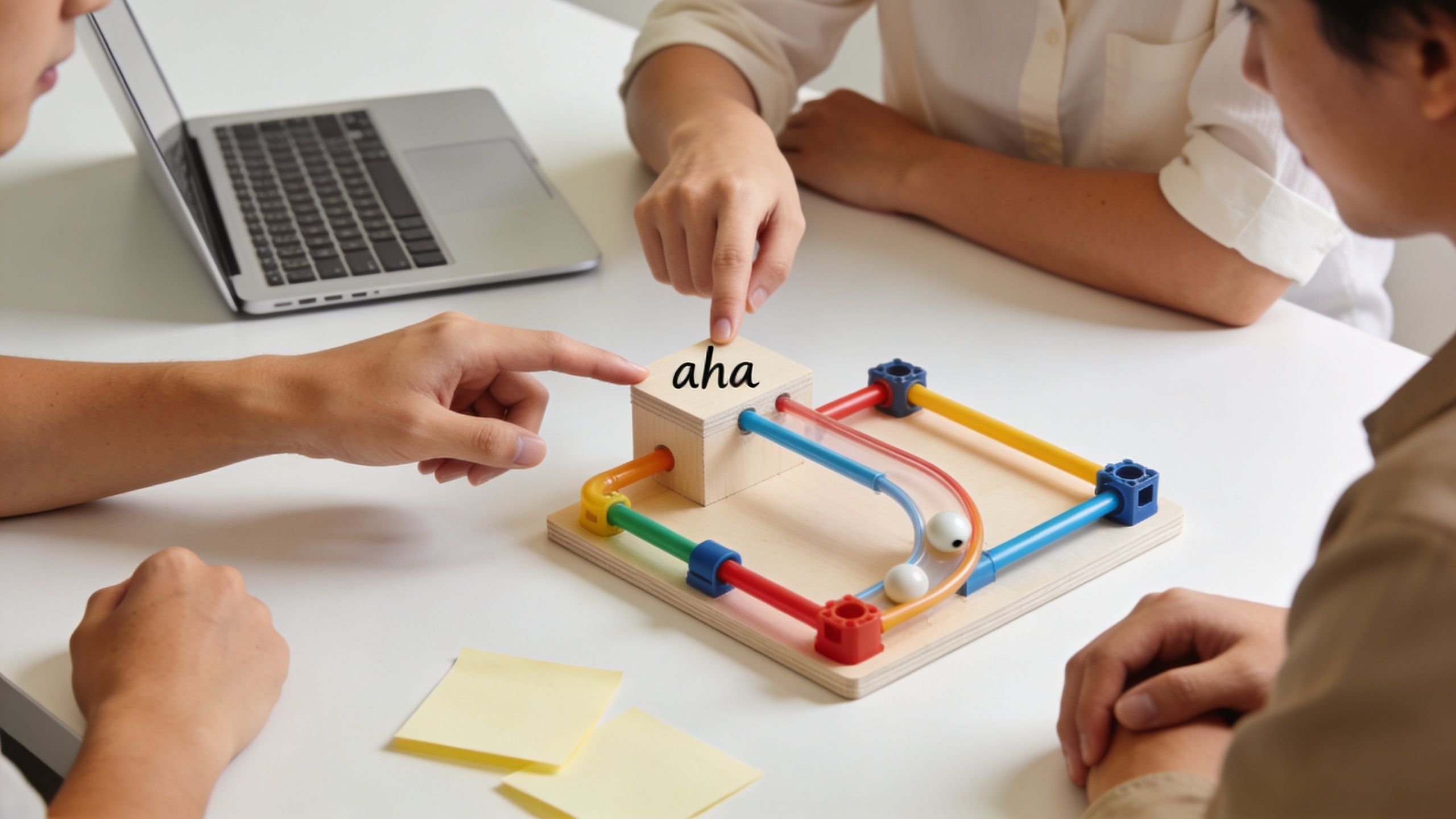
Some teams don't need rest as much as they need a reset in how they work together. Structured challenge formats such as Out of the Box, Pipeline, Mission Impossible or Safe Crack are effective when the team has become transactional, siloed or over-reliant on a few voices.
This format suits office and finance-heavy environments particularly well because the activities mirror the way those teams already operate under pressure. Australian event guidance for finance and accounting teams highlights escape rooms, trivia, race-style challenges and simulation games as strong choices because they reinforce rapid communication, prioritisation and error minimisation in a time-boxed setting, as outlined in this guide to team building ideas for finance and accounting teams.
Where this format fits best
This is a smart choice when leaders want to surface team habits, not just improve mood for an afternoon. A debrief after the activity often reveals who listens, who rushes, who coordinates well and where friction shows up under time pressure.
Examples are easy to picture. A product team can use Pipeline to expose handoff problems. A leadership group can use Out of the Box to test how quickly people align around incomplete information. A finance function can use a challenge sequence to sharpen communication before a new reporting cycle starts.
Good facilitation turns a game into a working session in disguise.
For teams interested in the behavioural side of this approach, a Science of Play keynote or broader play-based team building session can help connect the activity back to focus, trust and adaptability at work.
3. Active and Adventure Team Building Programs
A team can finish June technically on target and still look flat in the room. Long reporting cycles, deadline pressure and too much time at desks show up as shorter patience, lower participation and less generosity across functions. Active formats help reset that pattern because they change the conditions, not just the agenda.
Mini Olympics, Beach Olympics, Great Race, Survivor and City Scramble work best when leaders want to break routine, test collaboration under light pressure and send a clear signal about how the next financial year should feel. The value is not exercise for its own sake. It is the chance to see how people communicate, support each other and handle setbacks when the usual hierarchy fades into the background.
This format suits sales teams, operations groups and larger departments particularly well. It can also help cross-functional teams that need to rebuild trust after a hard quarter or prepare for a faster pace in Q1.

What to watch
Physical energy does not guarantee a good outcome. Poorly designed adventure programs can exclude part of the team, reward volume over contribution and leave leaders with a fun day that changed nothing.
The strongest programs are built for range, not intensity alone.
- Design for inclusion: Build in roles for planning, navigation, communication, observation and decision-making, not only speed or stamina.
- Plan for conditions: Outdoor EOFY events need weather contingencies, shade, hydration, transport planning and realistic session length.
- Balance the teams: Overly aggressive competition can narrow participation if the same confident personalities dominate every round.
- Debrief what mattered: If the goal is to reset team dynamics, close with a short facilitated discussion on what helped performance and what needs to change back at work.
For dispersed or mixed-capability workforces, adaptation matters. The Australian Bureau of Statistics Labour Force release reflects the scale and diversity of the Australian workforce. Event design should account for different fitness levels, mobility needs, confidence levels and cultural preferences from the start.
Used well, active EOFY programs do more than lift mood for an afternoon. They help leaders close the year with shared effort, visible behaviours and stronger momentum for the one about to start.
4. Creative and Artistic Team Building Programs
Not every EOFY team needs more adrenaline. Some need a lower-friction environment where people can think differently without feeling tested. Creative formats such as LEGO Legends, Art in a Day and Project Runway work well because they lower the stakes, shift the cognitive pattern and let quieter team members contribute in a new way.
This matters at EOFY because many employees are already tired. SEEK's 2025 Workplace Happiness Index found 59% of Australian workers were happy at work, with 41% neutral or unhappy, which suggests plenty of teams arrive at mid-year events carrying strain rather than enthusiasm. In that context, calmer creative eofy team building ideas can be a better call than loud, relentless competition.
Best use cases
Creative programs are useful when a team needs reconnection more than performance theatre. HR teams use collaborative art pieces to reflect culture priorities. Marketing teams use design challenges to break routine thinking. Cross-functional groups use LEGO builds to visualise future-state ideas or project goals.
A fatigued team usually responds better to invitation than pressure.
The strongest brief sets clear constraints and removes fear of judgment. People don't need to be artistic. They need permission to contribute, experiment and talk to each other without the usual workplace script.
5. Interactive Entertainment and Game-Based Events
The CFO has closed the numbers. The sales team is flat, operations is stretched, and half the workforce is joining from home. In that setting, interactive entertainment earns its place because it gets people participating fast, without asking for a full day of energy they may not have.
Trivia, Minute to Win It, Oceans 11, Top of the Class and game-show formats work well at EOFY because the barrier to entry is low and the pace is high. That matters when the room is mixed across functions, seniority and personality. It also matters when leaders need an event that can reset tone quickly, not one that takes an hour to warm up.
Hybrid delivery is a practical advantage, not a nice extra. Forbes notes that virtual team-building activities can help remote employees feel included and connected, especially when organisations are trying to maintain collaboration across dispersed teams, as outlined in its guide to virtual team-building activities. For teams split across offices, regions or home-based roles, that flexibility helps avoid a two-speed event where one group participates and the other observes.
How to keep it business-relevant
Game-based events perform best when they are designed with a clear job to do. I have seen these formats work particularly well when leaders want to break end-of-year fatigue, rebuild interaction between teams that have spent months under pressure, or create a cleaner starting point for the new financial year.
The trade-off is straightforward. If the session is treated as filler, people enjoy it and forget it. If the design reflects the team's context, leaders get both energy and useful behavioural signals.
A law firm might use a heist-style challenge to test coordination under time pressure. A call centre might use Minute to Win It to restore pace and morale after a demanding quarter. A national business might run themed trivia built around company milestones, customer realities and cross-functional knowledge gaps.
Useful design choices include:
- Mix game types: Combine knowledge, creativity, movement and teamwork so different people can contribute.
- Use visible progress carefully: Live scoring lifts energy, but it should support participation rather than turn the event into a winner-takes-all contest.
- Build in a short debrief: Five focused minutes at the end helps leaders connect the experience to collaboration, communication and how the team needs to work next quarter.
Done well, interactive entertainment gives leaders a controlled way to change the mood in the room and observe how people respond. That makes it more than a celebration format. It becomes a practical reset tool at a point in the year when teams often need one.
6. Conference Energisers and Interactive Keynotes
Sometimes the EOFY event already exists. It's the annual conference, planning day or leadership offsite. In those cases, the smartest move isn't adding a separate team day. It's improving the one that's already in the calendar.
conference team building earns its place. Short, well-timed energisers and interactive keynote sessions can reset attention, shift mood and make a long agenda more usable. They're especially effective after lunch, before strategy workshops or between dense operational sessions.
When this outperforms a standalone event
For senior leaders, the value is efficiency. The organisation already has people in the room, often at considerable cost in logistics and travel. Adding a Science of Play session, interactive challenge or facilitated reset creates a stronger experience without requiring another date in the diary.
Gallup's data, referenced in this report on team building exercise statistics, found that engaged teams can deliver 21% higher profitability, 17% higher productivity and 41% lower absenteeism compared with less engaged teams. That doesn't mean a conference energiser solves engagement on its own, but it does support the case for treating attention, participation and connection as performance issues rather than event cosmetics.
A practical example is a leadership summit that inserts a structured challenge between planning sessions, then uses the debrief to discuss decision-making under pressure. Another is an all-staff conference that opens with an interactive keynote to establish a more open and collaborative tone for the day.
7. Team Development Programs with Assessment and Coaching
EOFY can expose a pattern leaders have been tolerating for months. Meetings drag because roles are fuzzy. Conflict gets deferred. Hybrid routines make small misunderstandings last longer than they should. In that situation, a celebration may lift mood for a day, but it will not improve how the team works in July.
Development-led formats such as Belbin profiling, FISH! accredited training, Play Principles and Positive Teams workshops are better suited to teams that need a reset with follow-through. They give people a shared way to describe behaviour, contribution, pressure responses and communication gaps. That matters because teams change faster when managers can name what is happening and respond consistently.
The strongest use case is carryover into the new financial year. Senior leaders should expect more than a good session and positive feedback forms. The value sits in what happens after the day itself: clearer expectations, better manager conversations, stronger cross-functional working habits and fewer avoidable tensions.
Where leaders get this wrong
A common mistake is treating assessment or coaching as an add-on to a social event. People enjoy the discussion, agree with the insights, then return to the same habits on Monday because nothing around them has changed. If the organisation wants a measurable outcome, EOFY should be the starting point for a short development cycle, with follow-up sessions, manager commitments and practical application built in.
Work patterns are part of the context. As noted earlier, hybrid work has changed how teams build trust and repair friction. Less time together means fewer informal opportunities to clarify intent, test assumptions and correct misunderstandings early. That is one reason structured team development has become more useful, especially for groups that depend on cross-functional coordination.
If the underlying problem is team dynamics, choose a format that leaves people with language, not just memories.
8. Custom-Designed Experiences Aligned with Organisational Strategy
Off-the-shelf formats are useful, but they aren't always enough. When an organisation is navigating a merger, a leadership transition, a difficult year, or a major strategic reset, custom design is often the right call. The event can be built around the specific behaviours, messages and priorities leaders need the team to carry into the new financial year.
Broader team building programs become more valuable when customized. A bespoke EOFY experience might combine recognition, problem-solving and facilitated reflection. It might use a charity component to reinforce purpose, or a narrative challenge to reflect a change agenda in a way people can feel and remember.
When bespoke design is worth it
Bespoke design makes sense when the organisation has a clear reason for the event beyond morale. That could include integrating newly combined teams, reinforcing values after restructuring, or resetting how departments collaborate ahead of a new operating plan.
Real scenarios are straightforward. A merged leadership group might need a custom challenge that mixes legacy teams and tests decision-making. A national business with metro and regional offices might need a blended format that includes onsite and remote staff equally. A company with a strong CSR agenda might want a custom purpose-led event that fits EOFY budgets, leadership messaging and employee expectations in one experience.
The best custom events aren't bigger. They're more specific.
8-Point EOFY Team-Building Comparison
| Program | Implementation Complexity | Resource Requirements | Expected Outcomes | Ideal Use Cases | Key Advantages |
|---|---|---|---|---|---|
| Charity-Based Team Building with Community Impact | Moderate, partner coordination and logistics required | Moderate, materials/donations, charity partner, venue, volunteer coordination | Measurable community impact, stronger morale, positive brand/ESG signals | EOFY CSR initiatives, values-driven firms, employee engagement campaigns | Purpose-driven engagement, aligns with ESG/CSR, boosts morale and reputation |
| Play-Based Problem-Solving Challenges | Moderate–High, needs skilled facilitators and tailored challenge design | Moderate, facilitators, materials, time for debrief and reflection | Improved problem-solving, communication insights, innovation capability | Teams needing creativity or collaboration training, innovation sprints | Neuroscience-backed, transferable frameworks, measurable team learning |
| Active and Adventure Team Building Programs | Moderate, safety, venues and weather contingency planning | Moderate–High, outdoor venues, equipment, facilitators, first aid | Increased energy, trust-building, memorable shared experiences | EOFY energisers, wellness initiatives, teams seeking active engagement | High engagement and motivation, wellness benefits, strong visual impact |
| Creative and Artistic Team Building Programs | Low–Moderate, material prep and creative facilitation required | Low–Moderate, art/prop supplies, space, facilitator support | Enhanced creative confidence, lateral thinking, tangible team outputs | Innovation culture development, cross-functional bonding, inclusive groups | Encourages divergent thinking, inclusive for varied abilities, tangible results |
| Interactive Entertainment and Game-Based Events | Low–Moderate, staging, emcee and pacing logistics important | Moderate, AV/scoring tech, emcee, props, space for large groups | High morale uplift, rapid bonding, strong entertainment value | Large EOFY celebrations, morale-boosting events, all-hands parties | Scalable, broad appeal, high-energy and memorable experiences |
| Conference Energisers and Interactive Keynotes | Low, scheduling and speaker coordination; timing is critical | Low, keynote facilitator, minimal props, short activity materials | Improved attention/retention, refreshed energy, science-backed insights | Long conferences, strategic offsites, multi-session events | Educational credibility, reaches large audiences, boosts conference ROI |
| Team Development Programs with Assessment and Coaching | High, multi-session design, assessments and follow-up coaching | High, certified coaches, assessment tools, ongoing time commitment | Sustained behavior change, diagnostic team insights, measurable performance gains | Leadership teams, enduring culture change, resolving deep team issues | Long-term ROI, evidence-based frameworks, shared language for collaboration |
| Custom-Designed Experiences Aligned with Organisational Strategy | High, in-depth consultation, stakeholder alignment and design time | High, project management, bespoke materials, longer lead times and budget | Highly relevant outcomes, strategic alignment, strong buy-in and measurable impact | Mergers/transitions, strategic culture initiatives, premium EOFY programs | Maximum relevance to objectives, unique experiences, strong alignment with business goals |
Choosing the Right EOFY Experience for Your Team
The best eofy team building ideas start with a leadership question, not an activity question. Is the team flat and overloaded. Is there a need to reconnect people across functions. Does the organisation want a stronger CSR signal. Is the actual priority energy, reflection, trust, or capability going into the new financial year.
That's why EOFY is such a useful planning point. It sits at the intersection of review and reset. Leaders are already looking at performance, culture and priorities, so the team experience should support those decisions rather than sit beside them as a separate social obligation.
A charity program can work when purpose and recognition need to be visible. A problem-solving challenge can help when collaboration has become strained. Creative sessions can be better for fatigued teams, while active programs can lift energy where momentum has dropped. For more complex needs, development programs or custom-designed experiences usually offer stronger long-term value than a generic event.
For organisations exploring structured options, Corporate Challenge Events is one relevant provider in Australia for play-based, charity, conference and custom EOFY formats. The right choice is the one that helps people return to work more connected, more focused and better able to work well together in the year ahead.
If EOFY is approaching and the team needs more than a lunch booking, Corporate Challenge Events can help shape an experience around culture, connection and performance goals. Their range includes play-based team building, charity programs, conference energisers and custom-designed events for organisations across Australia and New Zealand.