
Most advice on how to measure team performance begins with a dashboard. But collecting more data does not automatically create a clearer picture. If a scorecard only tracks tasks completed, hours logged or meetings attended, it may show that people are busy without revealing whether the team is producing quality work, collaborating effectively or improving over time.
A stronger approach begins with the outcomes the team exists to achieve. Leaders can then select a small, balanced set of measures covering productivity, quality, customer or stakeholder value, and the health of the team itself. The goal is not to monitor every movement. It is to support data-driven decision-making by identifying meaningful patterns, testing changes and learning what genuinely improves performance.
This also means looking beyond operational results. Trust, engagement and shared behaviours influence whether strong performance can be sustained. Our guide to measuring culture change explores how leaders can track those less visible shifts alongside traditional business measures.
Why Most Team Measurement Gets It Wrong
Many organisations measure teams by combining individual activity metrics and calling the result team performance. The dashboard may look convincing, but it often reveals who completed the most tasks rather than whether people coordinated effectively, produced quality work or achieved a shared outcome.
Practical rule: if a metric only makes sense at an individual level, it should not be the primary measure of team performance.
Timing creates another problem. Annual reviews and isolated quarterly results can miss emerging issues with handovers, decision-making, workload or engagement. Leaders need to examine patterns over time and distinguish between what the team delivers and how the team works together to deliver it.
Research examining objective measures of team performance reinforces how difficult it is to capture team effectiveness through one measure alone. A stronger scorecard combines a small number of leading and lagging indicators connected to the team’s purpose, such as output, quality, timeliness and collaboration. This is particularly important for hybrid teams, where reduced day-to-day visibility can encourage leaders to mistake digital activity for meaningful contribution.
The aim is not to turn every behaviour into a KPI. It is to select measures that help the team recognise change and make better decisions. Performance benchmarking can add useful context by showing how current results compare with a past baseline, internal standard or relevant external reference point. Used carefully, benchmarking reveals where improvement may be needed without reducing the team to a single score.
Define What the Team Is Trying to Move
Start with purpose, not measures
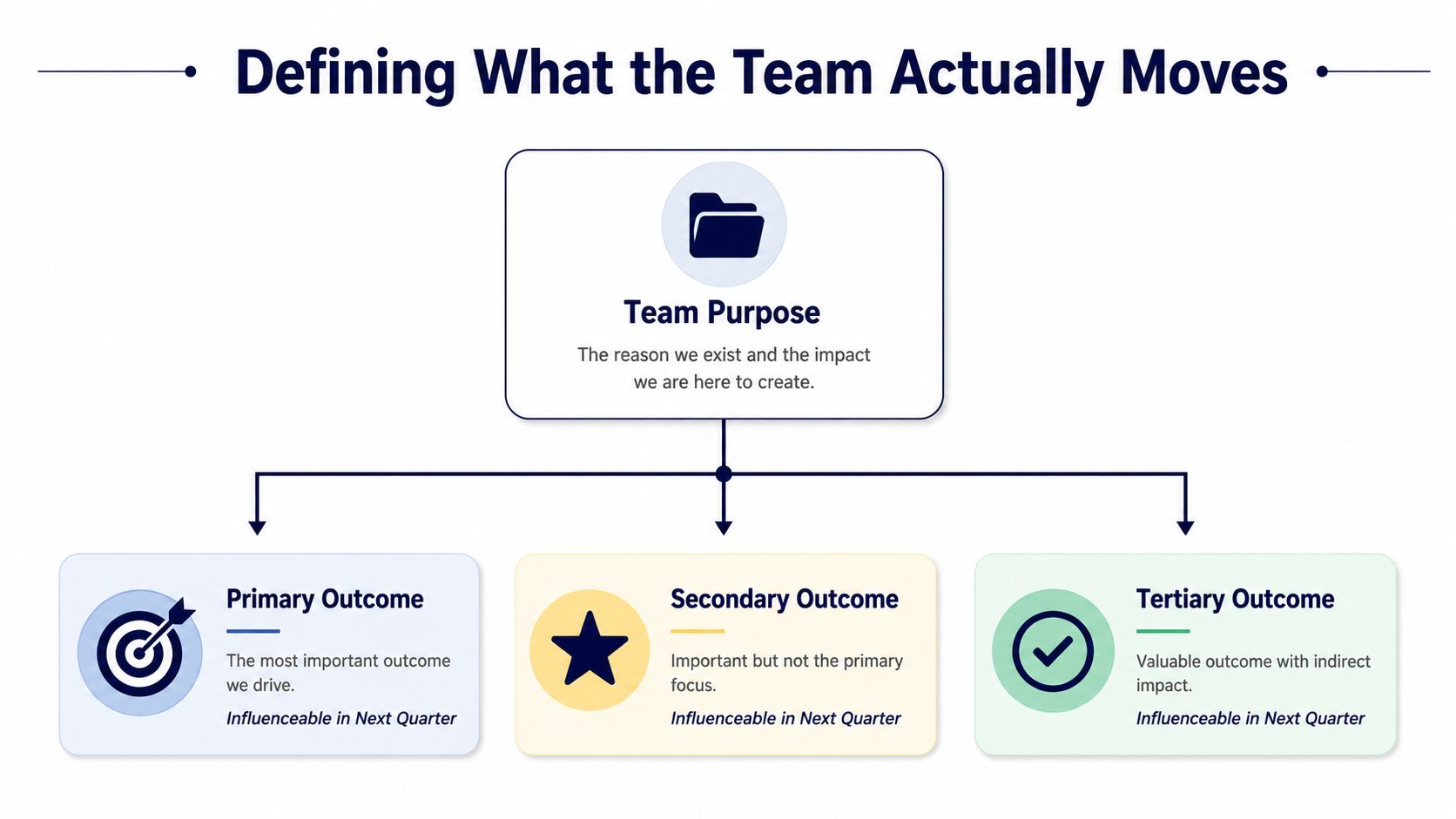
Before selecting metrics, define why the team exists and what it is expected to achieve. This usually means identifying who receives or depends on the team’s work, the value it provides and the outcomes it can realistically influence.
The distinction between influence and responsibility matters. Teams should not be judged solely on broad organisational results that sit outside their control. Instead, they need measures that connect their work to those results.
For example, a People and Culture team improving onboarding might track completion of essential steps, time to role readiness, new-employee confidence and manager feedback. A sales team might monitor qualified opportunities, forecast accuracy, conversion rates and the quality of handovers. These measures sit close enough to the work for the team to understand what is changing and take action.
Quarterly objectives can help turn this purpose into a manageable set of priorities. Each objective should describe a meaningful outcome, supported by a small number of measurable key results. Teams that need a starting structure can use a quarterly OKR planning template to connect priorities, measures and ownership.
The goal is not to fill the scorecard with every available number. It is to choose measures that answer three questions:
What are we trying to achieve?
What evidence will show that progress is being made?
What can this team reasonably influence?
Separate output signals from capability signals
A balanced scorecard should track both results and the team’s ability to produce them consistently.
Result measures show what the team delivers. Depending on its purpose, these might include throughput, cycle time, quality, customer satisfaction, completion rates or financial outcomes. Capability measures examine the conditions behind those results, such as role clarity, communication, decision-making, trust and access to the resources people need.
This distinction helps leaders interpret performance more accurately. A team may meet a deadline by working excessive hours, tolerating poor handovers or relying heavily on one person. The immediate result looks positive, but the underlying way of working may not be sustainable. Conversely, stronger role clarity or communication may appear before improvements become visible in operational results.
Engagement can provide additional context, but it should not be treated as proof of performance on its own. Used alongside operational measures, it can help leaders understand whether people have the clarity, motivation and support required to sustain their contribution. Our guide to developing a people and culture strategy explores how these workforce measures can be connected to broader organisational priorities.
Build a Small Scorecard You Can Actually Defend
Use a tight mix of measures
A useful team scorecard is deliberately small. It should include enough information to reveal whether the team is delivering well, without overwhelming people with numbers that never lead to action.
There is no universal number of KPIs that suits every team. The right number is the smallest set that provides a balanced view of performance and can be reviewed consistently. Each measure should connect to the team’s purpose, sit reasonably within its influence and help leaders make a decision.
A practical scorecard might cover four areas:
Delivery: Is the team completing the work it committed to?
Quality: Does the work meet the required standard?
Customer or stakeholder value: Is the work useful to the people it serves?
Team capability: Can the team sustain its performance?
The measures and review frequency will depend on the work. An operational team may need weekly data, while engagement or stakeholder feedback may be more meaningful when reviewed monthly or quarterly.
| Category | Example measure | What it helps reveal | Possible cadence |
|---|---|---|---|
| Delivery | On-time completion rate | Whether commitments are being met | Weekly |
| Efficiency | Average cycle time | How quickly work moves from start to finish | Weekly |
| Quality | Error or rework rate | Whether speed is affecting standards | Weekly or monthly |
| Customer or stakeholder value | Satisfaction or service feedback | Whether the work is meeting genuine needs | Monthly or quarterly |
| Team capability | Role clarity or engagement pulse | Whether people have the conditions required to perform | Monthly or quarterly |
| Sustainability | Absence, workload or turnover trends | Whether current performance may be creating longer-term strain | Monthly or quarterly |
Some measures show results that have already occurred, while others provide an earlier warning that performance could improve or decline. The distinction depends on the outcome being predicted. For example, role clarity may be an early indicator of effective execution, while rework records a quality problem that has already occurred.
Every measure should have a clear definition, data source, owner and review frequency. If the team cannot explain how a metric will inform action, it probably does not belong on the scorecard.
Avoid relying on one KPI
A single measure rarely tells the whole story. Faster completion times may look positive until error rates increase. High employee utilisation may appear efficient while leaving no capacity for collaboration, learning or unexpected work. Strong output in one month may conceal excessive workloads that cannot be sustained.
This is why measures should be interpreted together. Delivery data needs quality context. Customer feedback needs operational context. Engagement and role clarity need to be considered alongside actual results.
KPIs should also be reviewed periodically. A measure that was useful during one stage of a project may become irrelevant as the team’s priorities change. Quarterly planning provides a sensible opportunity to confirm that each measure still reflects the team’s purpose, current work and ability to influence the result.
Where possible, use information already captured through existing systems rather than creating unnecessary reporting work. The challenge is not collecting the greatest amount of data. It is choosing a small number of meaningful measures and using them consistently.
Set Baselines and Run Short Experiments
Establish the starting point before changing anything
A team cannot determine whether something has improved without first understanding its starting position. Before introducing a new process, workshop or team initiative, record the measures most closely connected to the intended outcome. This creates a baseline against which later results can be compared.
The baseline needs to be specific. “Improve communication” is difficult to assess, while reducing missed handovers, increasing participation in meetings or improving role clarity gives the team something observable to monitor. Depending on the objective, the starting point might include operational data, a short employee pulse, stakeholder feedback or direct observations from the team leader.
A baseline is different from a benchmark. The baseline records the team’s current position. Performance benchmarking compares that performance with a previous period, another internal team, an agreed standard or an appropriate external reference. Both can be useful, but an external benchmark should not replace an understanding of the team’s own circumstances and progress.
Once the baseline is clear, introduce a manageable change and set a date to review it. Workplaces are complex, so it may not be possible to isolate every variable or prove that one intervention caused a particular result. The purpose is to determine whether the measures are moving in the intended direction, explore what may have influenced the change and decide what to do next.
For teams using engagement as one part of their baseline, our guide to understanding employee engagement explains what engagement can reveal and how leaders can respond to it.
Test One Manageable Change at a Time
Once the baseline is established, choose a specific change that the team can implement and review. This might involve clarifying responsibilities, changing a handover process, reducing unnecessary approvals or introducing a more structured meeting format.
Before making the change, document:
The problem the team is trying to address
The action being introduced
The measures expected to change
The person responsible for implementation
The date on which progress will be reviewed
Workplaces are influenced by many variables, so the results may not prove that one action caused the change. Customer demand, staffing, competing priorities and wider organisational decisions can all affect performance. Recording this context helps the team interpret the results more carefully.
The purpose is to learn whether the change appears to be helping, whether it should be adjusted and what the team should try next. This turns measurement into an improvement process rather than a reporting exercise.
Review Performance and Turn Insight into Action
A scorecard only becomes useful when the team reviews it consistently. The appropriate cadence depends on the nature of the work and how quickly the measures change.
Operational measures such as completion rates, cycle time and errors may need to be reviewed weekly. Stakeholder feedback, engagement and longer-term capability measures may be more useful when examined monthly or quarterly. Reviewing data too frequently can encourage reactions to normal variation, while reviewing it too slowly can allow emerging problems to continue unnoticed.
The purpose of a performance review is not to read every number aloud. It is to identify meaningful movement, understand what may be influencing it and decide whether action is required.
A practical review should answer four questions:
What has changed?
What might explain the change?
Is this an isolated result or part of a developing pattern?
What should the team do next?
The discussion should finish with clear actions, owners and due dates. If a measure repeatedly generates conversation but never influences a decision, the team should reconsider whether it belongs on the scorecard.
Performance data should be used to investigate, not assign blame. If average completion times increase, for example, leaders should examine possible causes such as changing demand, unclear priorities, approval delays, limited resources or ineffective handovers. The number identifies where to look, but it does not explain the cause on its own.
Read Trends, Not Isolated Results
A single result can be misleading. One productive week does not necessarily indicate lasting improvement, just as one disappointing result does not always signal a serious performance problem.
Look at the direction of each measure over time and the amount of variation between reporting periods. Inconsistent results may reflect changes in demand, staffing, processes, data quality or circumstances outside the team’s control. Trends provide context and help leaders distinguish normal fluctuation from a pattern that requires attention.
Teams should also consider how measures interact. Faster delivery may be positive, but not if customer complaints or rework increase at the same time. Higher output may look encouraging, but not if it depends on excessive workloads or creates a backlog elsewhere in the organisation.
When reporting performance to senior leaders, keep the summary focused on what they need to know. This will usually include:
The current position against the agreed measures
The direction of the trend
Important factors influencing the result
Actions already being taken
Risks or decisions requiring escalation
The aim is to support better decisions, not create additional reporting for its own sake.
Avoid Measurement Mistakes That Break Trust
A performance measurement system will lose credibility if employees experience it as surveillance. Tracking screen time, keystrokes, online status or hours logged may produce activity data, but it rarely provides a reliable picture of collaboration, quality or contribution.
Before collecting information, leaders should be able to explain what is being measured, why it is needed, who will see it and how it will be used. The team should understand the purpose of the scorecard and have an opportunity to raise concerns about measures that appear unfair, unclear or outside its control.
Common mistakes include:
Surveillance creep: Collecting activity data because it is available rather than because it provides meaningful insight.
Vanity metrics: Reporting impressive-looking numbers that do not influence decisions.
Single-source data: Relying on one measure when a combination of results, feedback and observation would provide a fairer picture.
Rating confusion: Using a team scorecard as a substitute for a thoughtful individual performance process.
Metric fixation: Rewarding one KPI without considering its effect on quality, collaboration, workload or other priorities.
Unclear definitions: Allowing different people to calculate or interpret the same measure differently.
Poor transparency: Collecting information without clearly explaining its purpose or intended use.
Trust affects the quality of the information leaders receive. People are more likely to acknowledge problems, question assumptions and provide honest feedback when they believe the data will be used to improve the work rather than punish individuals. Our guide to psychological safety in the workplace explores how leaders can create the conditions for that openness.
A trustworthy measurement process uses consistent definitions, respects privacy and involves the team in interpreting the results. Numbers should begin a conversation, not deliver a verdict without context.
Make Measurement a Habit Your Team Trusts
Understanding how to measure team performance begins with clarity. Define why the team exists, identify the outcomes it can influence and select a small set of measures covering delivery, quality, stakeholder value and team capability.
Establish a baseline before introducing changes, then review the results at a cadence that matches the work. Look for trends rather than reacting to isolated numbers, consider the context behind each result and finish performance discussions with clear actions.
Trust remains central to the process. If employees believe the scorecard exists only to monitor them, they may disengage, avoid reporting problems or focus on making the numbers look good. Our guide to building trust in teams explains why credibility, consistency and follow-through matter.
Over the next 30 days, choose one team and clarify the outcome it is responsible for influencing. Select a small number of meaningful measures, record the starting position and agree on a review date. Involve the team in interpreting the results and deciding what happens next.
The goal is not to measure everything. It is to create a reliable picture of how the team is performing, identify where support or change is needed and make better decisions together.