Beyond Buzzwords: A Practical Toolkit for Team Dynamics
Every leader recognises the pattern. A team misses handovers, tension sits under the surface, meetings run long, and performance discussions drift toward vague language about communication. The problem usually isn't effort. It's that most leaders can see the symptoms of weak team dynamics but don't have a practical way to diagnose what's going wrong or where to intervene first.
That gap has become harder to ignore in Australian workplaces. In 2023 to 2024, the ABS reported that 76.4% of employed people used a computer in their main job, 59.4% used the internet, and 25.1% worked mainly from home, which shows how much day-to-day coordination now depends on digital interaction rather than shared physical space, as noted in this Australian team building statistics summary. For leaders trying to improve performance, WeekBlast's approach to team communication is a useful reminder that clarity and rhythm need design, not hope.
Table of Contents
5. National Institute for Play Research & The Science of Play
10. Google's Project Aristotle Case Study & Research on High-Performing Teams
1. Tuckman's Stages of Group Development Framework
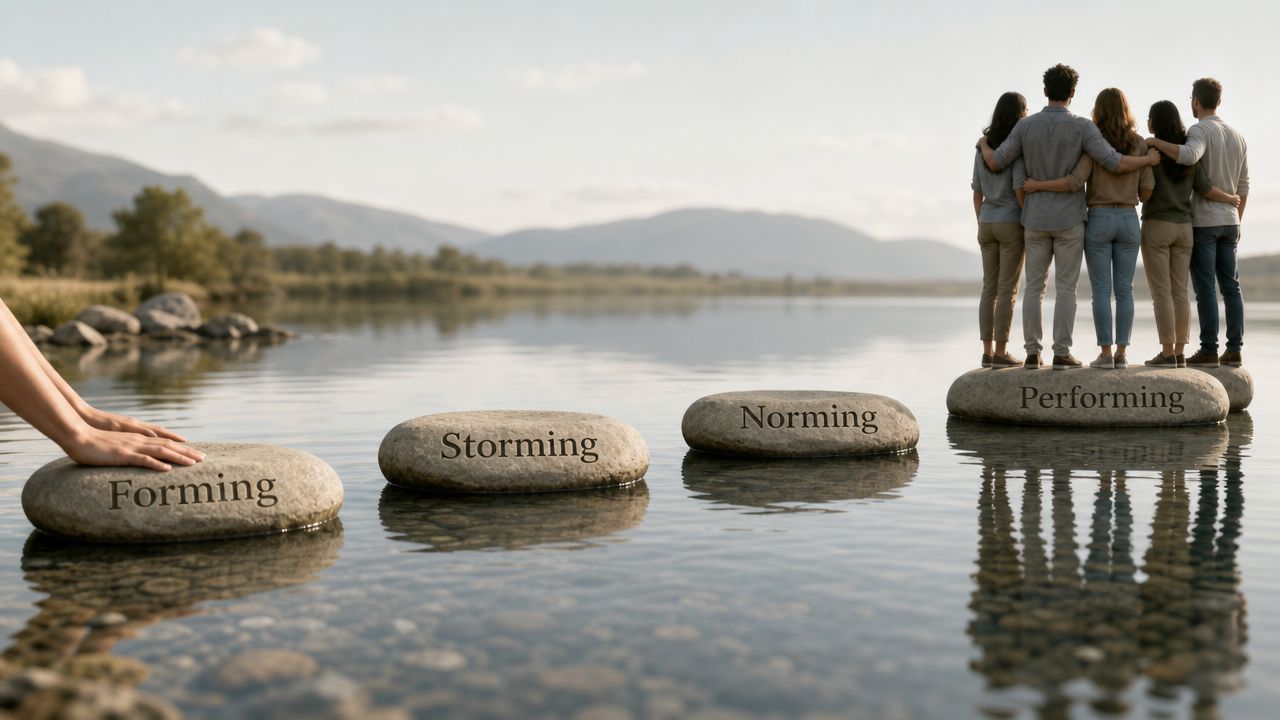
Tuckman remains useful because it gives leaders a simple way to name what's happening without treating normal friction as failure. A newly merged function, a project team with new members, or a department taking on a fresh mandate will often cycle through Forming, Storming, Norming and Performing, then repeat parts of that cycle when roles or priorities change.
That matters for event design as much as team coaching. A team in Forming needs fast trust-building and shared context. A team in Storming usually needs structured collaboration, visible decision rules and low-risk ways to test how they work under pressure.
Why leaders still use it
A good facilitator won't run the same session for every team. For a new leadership group, short collaborative challenges can help surface expectations early. For cross-functional teams, problem-solving tasks often reveal where assumptions about pace, ownership and communication differ.
Practical rule: Don't treat conflict in the Storming phase as proof that the team is broken. Treat it as proof that real differences are finally visible.
Leaders also need to know whether they're trying to build connection or improve operating performance. That distinction is often missed, and this guide on team bonding vs team building is useful because the intervention should match the actual stage of team development.
Forming response: Use structured introductions, shared goals and light cooperative tasks.
Storming response: Make trade-offs explicit, define norms and give the team a reason to solve something together.
Norming response: Reinforce what's working, document agreements and test them in live work.
2. Belbin Team Role Assessment
Belbin is one of the better tools for moving teams beyond personality stereotypes. It helps leaders look at contribution patterns rather than labelling people as difficult, quiet or dominant. In practice, many team dynamics problems are less about capability and more about an imbalance in how the team approaches ideas, coordination, challenge, detail and follow-through.
A common scenario is a product or project group with strong idea generation but weak completion discipline. Another is a senior team full of Coordinators and Shapers that can set direction quickly but leaves delivery teams to clean up ambiguity later.
How to apply it without boxing people in
Belbin works best when leaders use it as a working map, not a fixed identity. People can flex, but teams still show predictable strengths and blind spots. That makes the tool useful before a workshop, offsite or team building event because groupings and roles can be designed with intention rather than guesswork.
The most practical move is to debrief results in the language of contribution. This helps teams discuss why meetings stall, why ideas don't land, or why details get missed without turning the conversation into personal criticism. For leaders comparing options, this explanation of psychometric testing vs behavioural profiling helps clarify where Belbin fits.
Teams usually get more value from Belbin when they ask, “What roles are missing in this piece of work?” rather than “What type of person are you?”
3. Psychological Safety Assessment and Framework

Psychological safety is still one of the most important lenses for team dynamics because it explains why smart teams stay quiet, why risks go unspoken, and why learning slows when pressure rises. It is not about making every interaction comfortable. It is about whether people believe they can ask, challenge, admit, disagree and recover without social penalty.
In large Australian organisations, leadership behaviour is a measurable part of that picture. The Australian Public Service Commission's State of the Service reporting found that 80% of APS employees agreed their supervisor demonstrated the APS Values and Employment Principles, 78% agreed their supervisor treated them with respect and dignity, and 69% were satisfied with their overall job, as captured in this summary of Australian team culture statistics. Respectful supervision doesn't guarantee healthy team dynamics, but it creates the conditions for them.
Where leaders get it wrong
Many leaders say they want open discussion, then punish disagreement with impatience, withdrawal or overcorrection. Teams notice that quickly. Safety falls fastest when leaders ask for candour but reward compliance.
A practical assessment should look for signals such as who speaks first, whose ideas get revisited, how mistakes are handled and whether junior or remote voices influence decisions. For leaders seeing early warning signs, these hidden signals of team disconnection often show up before formal engagement issues do.
Leader modelling: Admit uncertainty before asking others to contribute.
Meeting design: Create turns for input instead of relying on confidence and interruption.
Follow-through: Thank challenge publicly and act on useful dissent.
4. The Five Dysfunctions of a Team Framework
Lencioni's model remains popular because it translates messy relational issues into a clear sequence. Absence of trust leads to fear of conflict. Fear of conflict weakens commitment. Weak commitment undermines accountability. Poor accountability pulls focus away from collective results. Leaders can use that cascade to find the first broken link rather than arguing endlessly about symptoms.
This framework is especially useful with executive teams and merged groups. When strategy execution keeps slipping, the issue often isn't just accountability. It may be that leaders never debated the decision properly, so nobody committed to it in the first place.
How to use it in real organisations
The mistake is using Lencioni as a culture lecture. It works better as a working diagnosis. If a leadership team avoids direct challenge in meetings, trust and conflict norms need attention before any accountability framework will stick.
A practical intervention often starts with low-risk trust work, then moves into real business conversations. Structured team challenges can help because they surface habits under pressure without the defensiveness that appears in formal meetings.
Leader prompt: If accountability is weak, ask whether the team actually made a clear commitment, in public, with ownership and timing attached.
Quarterly reviews also help. Teams drift, and dysfunctions return when priorities shift, membership changes, or an influential leader starts bypassing agreed norms.
5. National Institute for Play Research & The Science of Play
The science of play gives leaders a useful language for explaining why shared experiences can change team dynamics faster than another slide deck. In corporate settings, play isn't a break from performance. It is a way to activate the human conditions that support attention, experimentation, social connection and adaptive problem-solving.
That's why this research matters most with sceptical audiences. Executives often resist team building when it sounds recreational, but they respond differently when the intervention is framed as helping teams practise coordination, trust and recovery in real time.
Why this lens helps sceptical executives
Play-based design works best when it has a behavioural target. A charity build can test coordination and role clarity. A timed challenge can show whether the team over-controls information. A creative task can reveal whether the group values speed over idea diversity.
Corporate Challenge also publishes a useful perspective on the ROI of play, which helps HR and People & Culture leaders link event design to practical workplace outcomes rather than treating play as a standalone activity.
Executive buy-in: Frame play as performance infrastructure for collaboration and adaptability.
Facilitation choice: Debrief behaviours, not just enjoyment.
Transfer to work: Turn observations into operating norms the team can use the next week.
6. FISH! Philosophy & Training Program
FISH! works because it turns culture into visible behaviour. Its four ideas, Play, Make Their Day, Be There and Choose Your Attitude, are simple enough to remember and concrete enough to practise. For busy teams, that simplicity is an advantage.
The strongest use case is service-heavy or high-interaction environments where energy, attention and responsiveness shape daily experience. Executive assistants, office managers, customer-facing teams and support functions often get more from FISH! than from abstract culture language because it gives them repeatable behavioural cues.
Where it works best
FISH! is not a substitute for role clarity, good management or fair systems. It does not fix workload imbalance or leader inconsistency. What it can do is make team dynamics more intentional by reinforcing how people show up for each other during ordinary work.
That makes it a strong follow-up to team building. A well-facilitated event can create the emotional opening. FISH! gives leaders a simple way to carry that energy into routines, handovers and meetings.
Culture shifts when leaders reward the behaviours they say they want, especially the small ones that shape daily experience.
7. DiSC Behavioural Assessment & Team Dynamics Application
DiSC is popular for a reason. It helps teams discuss communication and behavioural preferences in plain language. That can reduce unnecessary friction quickly, especially where different styles have been misread as lack of care, lack of pace or lack of rigour.
In practice, DiSC is often most valuable after tension has already appeared. A direct senior stakeholder may think they're being efficient. A steady team member may read that as dismissive. A conscientious subject matter expert may want detail that an influence-style colleague sees as overcomplication.
What it changes after the event
The best use of DiSC is not to sort people into corners. It is to help them adapt. Teams improve when members learn how their style lands on others and what adjustment looks like under pressure.
For offsites and team days, DiSC also helps facilitators form balanced groups, anticipate friction points and design debriefs that move beyond “we just need to communicate better”. It becomes more powerful when paired with live observation, because people can see style habits play out in front of them rather than only reading them on a report.
Before the session: Identify likely style clashes in decisions, meetings and escalations.
During the session: Observe how pace, detail and influence show up in group tasks.
After the session: Agree on practical adaptations for email, meetings and feedback.
8. Positive Teams Framework & Research
Positive Teams can be misunderstood if leaders hear only the word positive. This isn't about forced enthusiasm or avoiding hard conversations. The better interpretation is that teams perform better when leaders intentionally build conditions such as belonging, autonomy, progress, strengths use and shared meaning.
That focus is useful because many organisations over-invest in fixing what's wrong and under-invest in repeating what already works. In team dynamics work, that imbalance matters. Teams need a shared language for strengths and momentum, not only for conflict and gaps.
How to avoid forced positivity
A credible Positive Teams approach still needs standards and truth-telling. Leaders should ask where the team feels effective, where progress is visible, and where people have enough ownership to do their best work. They should also ask what blocks those conditions.
This framework pairs well with team building when the event is designed to create visible wins. Success in a challenge, particularly one that requires cooperation, often gives a team a better reference point for what good interaction feels like. The debrief then needs to make that explicit so the insight doesn't evaporate once people return to normal workload.
9. Hackman & Wageman Team Effectiveness Model
Hackman and Wageman are useful when leaders are tempted to blame every performance issue on interpersonal dynamics. Sometimes the team gets along reasonably well and still underperforms because the system around them is weak. Direction is muddy, roles are loose, coaching is thin, or organisational support is inconsistent.
That broader view is increasingly relevant in hybrid environments. Recent Australian workplace reporting noted that 36% of employed people usually worked from home in November 2024, as discussed in this research summary on hybrid work and team dynamics. When teams operate across physical and digital settings, structure and context become central to performance.
Use it before booking an intervention
Before approving a team day, leaders should ask a few blunt questions. Does the team have a clear purpose? Are decision rights understood? Do systems support cross-functional work, or do they force people into side channels and workarounds? If those conditions are missing, a strong event may help relationships without fixing execution.
For leaders working on the broader picture, these high-performing team characteristics are a practical complement to Hackman's model, and clear goals also boost focus and motivation when teams need a stronger performance rhythm.
Compelling direction: People need a goal worth aligning around.
Enabling structure: Roles, norms and interfaces must support the work.
Supportive context: Systems can either reinforce collaboration or undermine it.
10. Google's Project Aristotle Case Study & Research on High-Performing Teams
Project Aristotle still gets cited because it gave many leaders permission to take team dynamics seriously. The widely remembered headline lesson is psychological safety, but the deeper lesson is just as important. Team performance doesn't come from talent lists alone. It comes from how people interact, respond to risk and share influence.
That insight has become more relevant as digital collaboration expands. The global team collaboration software market is projected to grow from USD 36.1 billion in 2024 to USD 57.4 billion by 2030, at a 7.4% CAGR, according to Grand View Research's team collaboration software market outlook. Tools can improve visibility and coordination, but they can't replace healthy team dynamics.
Why leaders still cite it
Project Aristotle is useful when a leadership team needs a credible starting point for investment in culture, facilitation or team development. It reframes the issue. The question stops being whether people are individually capable and becomes whether the environment helps them contribute fully.
That's also where many interventions fail. Leaders invest in platforms, rituals or workshops while leaving trust, challenge norms and speaking patterns untouched. The better approach is to treat team dynamics as an operating condition, not a soft extra.
Team Dynamics: Comparative Overview of 10 Key Resources
| Model / Tool | Type & Core Features | Value Proposition / Outcomes | Best Fit / Target Audience | Implementation Notes & USP (costs if any) |
|---|---|---|---|---|
| Tuckman's Stages of Group Development Framework | Framework; Forming → Storming → Norming → Performing (± Adjourning) | Clarifies team development path; guides timed interventions | New teams, merged units, leaders planning programmes | Use play to accelerate stages; linear model may cycle; great lens for event design |
| Belbin Team Role Assessment | Assessment tool; nine roles, online profile & team reports (~15–20min) | Reveals team composition, strengths & gaps for role allocation | Small to mid teams (4–15), project & leadership teams | Costs apply; complete pre-event; needs skilled facilitation to avoid stereotyping |
| Psychological Safety Assessment & Framework | Framework & diagnostic; 7‑item measures, research-backed interventions | Measures & increases speak-up, learning, innovation and retention | Innovation teams, healthcare, leaders driving culture change | Requires leader modelling and sustained follow-up; play effectively builds safety |
| The Five Dysfunctions of a Team Framework | Framework & diagnostic pyramid; five cascading dysfunctions | Diagnoses root trust/conflict/accountability issues to restore team health | Leadership teams, strategy groups, teams with alignment problems | Simple, memorable model; introduce after trust-building to avoid defensiveness |
| National Institute for Play / Science of Play | Research institute & science framework; neurobiology of play | Provides scientific credibility for play-based interventions | Executives, L&D, HR seeking evidence to fund programmes | Use science keynotes to secure buy-in; translation to practice needed; sustained play required |
| FISH! Philosophy & Training Program | Training programme; four principles (Play, Make Their Day, Be There, Choose Your Attitude) | Operationalises everyday behaviours to improve communication & presence | Customer service, frontline teams, leaders seeking cultural rituals | Accredited delivery; practical and memorable; needs reinforcement to stick |
| DiSC Behavioural Assessment & Team Dynamics | Behavioural assessment; four styles (D/I/S/C), quick profiles & team maps | Explains communication preferences and reduces style-driven conflict | Teams across orgs, project groups, leaders coaching interactions | Fast to deploy; costs vary; risk of labelling without coaching; pairs well with Belbin |
| Positive Teams Framework & Research | Framework & workshops; Safety, Belonging, Meaning, Autonomy, Progress | Strength-based approach to boost engagement, resilience and performance | Culture change programmes, retention-focused organisations | Energising approach; needs genuine commitment and leader modelling |
| Hackman & Wageman Team Effectiveness Model | Framework; five enabling conditions (direction, structure, context, coaching, resources) | System-level diagnosis linking team support to sustained performance | Organisations aiming for lasting performance change, sponsors of team change | Comprehensive but complex; use pre-event to identify systemic barriers |
| Google's Project Aristotle (Case Study) | Case study & research; analysed 180+ teams, identified psychological safety as top predictor | High-profile validation that team dynamics outrank individual talent | Exec sponsors, HR, change champions seeking evidence-based persuasion | Powerful proof point for funding; adapt learnings to smaller/less-resourced contexts |
From Diagnosis to Action Embedding Better Dynamics
These frameworks matter because they help leaders stop guessing. Tuckman helps identify where a team is in its development. Belbin and DiSC help explain contribution and interaction patterns. Psychological safety and Lencioni help diagnose relational barriers. Hackman and Wageman widen the lens so leaders don't confuse structural problems with personality problems.
The practical move is to combine diagnosis with lived experience. A team that completes a profile but never tests its habits in action won't change much. A team that attends an energetic offsite without a diagnostic lens may enjoy the day and still return to the same friction. The strongest work happens when the assessment informs the experience, and the experience gives the team a shared reference point for new behaviours.
That approach is also more relevant in AI-enabled and cross-functional environments. Deloitte's research found that 83% of high-trusting teams are AI users, compared with 63% of others, that teams seeing the strongest AI benefits are nearly 2x as likely to say they learn from each other and feel they can make decisions, and that cross-functional teams were 30% more likely to report significant gains in efficiency and innovation from AI use, according to Deloitte's analysis of AI, trust and team structure. The implication for leaders is straightforward. Better tools and analytics help most when trust, connectedness and decision norms are already being built.
There is also a risk in assuming that a warm culture equals a healthy one. Recent open-access research discussed in this team dynamics framework article highlights how team differential atmosphere can weaken collaboration and decision-making, and that empathy can dampen the harm without fully removing it. Leaders need to look for exclusion, favouritism and uneven influence, not just pleasant interactions.
For HR and People & Culture teams, the next step is usually a sequence, not a single event. Diagnose first. Design the intervention around the underlying issue. Debrief observable behaviour. Then embed follow-up through meeting norms, leader habits, accountability rhythms and team rituals. Corporate Challenge Events can be one relevant option for organisations that want to connect diagnostics, play-based experiences and workplace transfer in a corporate setting.
If your organisation is ready to turn team dynamics from a vague culture topic into a practical performance lever, Corporate Challenge Events offers play-based team building, profiling and facilitated programs designed for Australian workplaces, offsites, conferences and culture initiatives.