Work has always been a little weird.
There have always been mystery fridge containers, people who reply-all with confidence, and at least one person who treats the office printer like a personal enemy.
But the modern workplace has taken things to a new level.
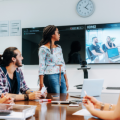
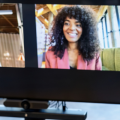
Hybrid work, remote calls, emoji etiquette, last-minute PowerPoint panic and the rise of the workday nap have created a whole new category of workplace behaviour. Some of it is funny. Some of it is oddly relatable. Some of it makes you wonder what is really happening behind all those blurred backgrounds.
Here are eight weird workplace statistics that prove work in 2026 is getting stranger, more human and, honestly, a lot more interesting.
31% of Gen Z have worked from another location without telling anyone
Working from home? Sure.
Working from home, but actually from a beach house, a friend’s apartment, a café two suburbs away or somewhere with suspiciously good lighting? Apparently, also yes.
SurveyMonkey found that 31% of Gen Z workers have worked from another location without telling anyone.
This is the kind of stat that makes managers suddenly very interested in background details. Is that a houseplant, or is that a resort lobby palm? Is that your home office, or are we hearing ocean waves?
The funny part is not just the secrecy. It is how much work has changed. For many people, work is no longer one fixed place. It is a laptop, a calendar and a very convincing “good morning” message.
Still, it does raise the bigger question: if people can work from anywhere, how do we make the moments they come together actually worth it?
26% of Millennials admit to taking a nap during the workday
The workday nap is alive and well.
SurveyMonkey found that 26% of Millennials admit to taking a nap during the workday.
Not “resting their eyes”. Not “thinking deeply”. A nap.
Honestly, it is hard to be shocked. Between early emails, late messages, back-to-back meetings and the general emotional weight of being asked to “jump on a quick call”, the modern worker is tired.
The funny thing is, the nap has somehow become the spiritual opposite of the traditional lunch break. Instead of leaving the office to buy a sandwich, some people are closing the laptop, setting a timer and entering what we might call a horizontal meeting.
No agenda. No minutes. No action items.
Just one employee, one couch and a desperate attempt to reboot the operating system.
29% of hybrid or remote workers have used the bathroom during a work call
We are not asking follow-up questions.
SurveyMonkey found that 29% of hybrid or remote workers have used the bathroom during a work call.
This may be the strongest argument yet for keeping cameras optional. It also explains why “sorry, I was on mute” has become one of the most suspicious sentences in modern work.
Of course, no one is saying this is ideal meeting behaviour. But it does show how much the boundaries of work have shifted. When work moved into people’s homes, it also moved closer to the laundry, the kitchen, the dog, the kids and, apparently, the bathroom.
Hybrid work has given people flexibility, but it has also made the workday strangely blended.
Some meetings really should have been emails. Others, apparently, should have waited five minutes.
PowerPoint edits spike 122% in the final 10 minutes before a meeting
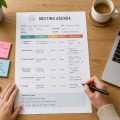
Nothing says teamwork like five people frantically editing the same deck while someone says, “Can we just make this slide a bit more visual?”
Microsoft found that PowerPoint edits spike 122% in the final 10 minutes before a meeting.
That is not a statistic. That is a corporate documentary.
We all know this moment. The meeting is about to start. Someone is changing a heading. Someone else is moving a logo by two millimetres. A third person is asking whether “strategic alignment” sounds better than “strategic priorities”. No one is calm, but everyone is pretending.
The final 10 minutes before a meeting are where confidence, formatting and version control go to fight.
The takeaway? Work is full of tiny shared rituals, even chaotic ones. Last-minute slide panic may not be ideal, but it is undeniably a team sport.
53% of workers use emoji when messaging colleagues, but 30% never use them with their boss
Emoji confidence disappears near management.
Slack found that 53% of respondents usually include emoji when messaging colleagues, while 30% never use emoji with their boss.
And honestly, fair.
A thumbs up to a teammate feels normal. A thumbs up to your manager can suddenly feel like a full legal review. Is it friendly? Is it passive aggressive? Is it too casual? Should it have been “Thanks, sounds great”? Has the thumbs up become too powerful?
The workplace emoji has become its own language. A ✅ can mean “done”. A 👀 can mean “looking into it”. A 🎉 can mean “great job”. And a slightly-too-formal “Thank you.” with a full stop can send an entire team into emotional analysis.
It is funny, but it also says something real about work. People want personality in their communication. They just also want to know where the invisible line is.
33% of employees admit to using business jargon they do not understand
Let’s circle back to what that actually means.
A survey cited by NeuroLeadership found that 33% of employees admitted to using business jargon terms whose meanings they did not know.
This is incredible and also completely believable.
At some point, most workplaces have collectively agreed to say things like “leverage the synergy”, “move the needle”, “deep dive”, “low-hanging fruit” and “take this offline” as though everyone knows exactly what is happening.
Sometimes, they do.
Sometimes, no one does.
The best part about jargon is that it can make a very simple sentence sound like it went to business school and came back with a lanyard.
Of course, not all workplace language is bad. Shared language can help teams move quickly. But if half the room is nodding while secretly wondering what “operationalise the framework” means, it might be time to use normal words again.
83% of employees at pet-friendly companies say their work is rewarding and exciting
The office dog may be employee of the month.
The Nationwide and HABRI study found that 83% of employees at pet-friendly companies say their work is rewarding and exciting, compared with 46% at non-pet-friendly workplaces.
That is a big difference for something with paws.
There is something very human about a pet-friendly workplace. A dog wandering past a meeting room instantly changes the energy. People smile. Shoulders drop. Someone who has not spoken all morning suddenly becomes extremely available for a pat.
Not every workplace can have pets, of course. Allergies, safety, leases and common sense all exist.
But the stat points to something bigger than dogs in the office. People respond to workplaces that feel warm, human and a little less sterile. Sometimes connection starts with a proper conversation. Sometimes it starts with someone asking, “Can I say hello to your dog?”
81% of professionals say work friends are highly important
The work bestie is not a distraction. They are workplace infrastructure.
KPMG found that 81% of professionals say work friends are highly important.
This is the stat that brings the weirdness back to something useful.
Because yes, work is strange. People are taking calls from mystery locations, napping during the day, sending carefully selected emoji, panic-editing PowerPoints and using jargon they may or may not understand.
But underneath all of that, people still want the same thing. They want to feel connected.
That is why team moments matter. Not forced fun. Not awkward icebreakers. Not “mandatory bonding” that makes everyone stare at the carpet.
The good stuff is simple. Shared experiences. Proper laughter. A reason to talk to someone outside your usual circle. A moment that makes the workday feel less like a stream of tasks and more like something people are doing together.
That might be a playful team challenge, a conference energiser, a shared lunch, a hands-on activity, or even something purpose-led like Charity Team Building where people get to connect while doing something useful.
It might also look like classic carnival games at a corporate picnic, or a simple activity designed to get people laughing without putting anyone awkwardly on the spot.
The research supports the idea too. Studies on workplace fun have explored how fun at work connects with employee creativity, manager support and trust. At Corporate Challenge Events, we see the same thing in practice. When people play together in a structured, inclusive way, they often communicate differently, notice new strengths and build the kind of small social moments that make work feel more human.
That is why team bonding activities and conversations about play in the workplace are becoming more relevant, not less.
Because work is getting weirder. But maybe that is not entirely a bad thing.
Maybe the mystery locations, emoji politics, office dogs and PowerPoint panic are all reminders that workplaces are full of actual humans.
And actual humans need more than tasks, meetings and deadlines.
They need connection. They need laughter. They need shared stories. And every now and then, they probably need a very well-timed nap.
Corporate teams that want practical, play-based culture programs can explore Corporate Challenge Events for conference energisers, charity team building, offsites and workplace experiences designed to support connection, collaboration and morale.