
Culture is not hard to measure because it is intangible. It becomes hard to measure when leaders rely on the wrong evidence.
As Leaders Loop explains in its guide to measuring and shifting culture, culture is reflected in what an organisation rewards, tolerates and ignores. Understanding it therefore requires leaders to look beyond stated values and surface-level sentiment to the behaviours and unwritten rules shaping everyday work.
Most organisations still treat culture like mood. They ask people how work feels, collect a broad engagement score, and hope that tells them whether collaboration, trust, accountability or inclusion has improved. It rarely does. Real culture change shows up in behaviour, decisions, routines and outcomes over time.
That matters even more when organisations use play-based interventions, team building programs, conference activities or charity events to shift connection and performance. The event itself is easy to evaluate. People enjoyed it, participation was strong and energy lifted. The harder question is whether those moments changed how teams work once the room is packed down and the calendar moves on.
A practical answer starts with a better measurement system. Leaders need a clear objective, a balanced toolkit, a baseline, a rhythm for measurement and a way to connect team dynamics to business performance. That is how to measure culture change without reducing it to one survey score or one-off event feedback.
Table of Contents
- Why Most Culture Initiatives Are Measured Poorly
- Defining Your Culture Change Objectives
- Selecting Your Measurement Toolkit
- Establishing a Baseline and Measurement Cadence
- Analysing Results and Linking Culture to Performance
- Common Pitfalls and How to Avoid Them
Why Most Culture Initiatives Are Measured Poorly
Leaders Loop’s Australian culture measurement toolkit reports that many culture efforts fail when organisations rely only on self-reported data. That pattern shows up for a simple reason. Sentiment is easy to collect, easy to present, and easy to mistake for proof.
A positive pulse survey can sit alongside slow decision-making, weak manager follow-through, and poor cooperation between teams. We see this often after high-energy culture events. People leave feeling connected, rate the experience well, and return to the same meeting habits, the same escalation delays, and the same reluctance to challenge poor behaviour. The intervention created a moment. It did not yet create a pattern.
Timing creates a second problem. One annual survey does not show whether culture is shifting or whether people are reacting to a restructure, peak workload, a new executive, or a bad quarter. Two snapshots taken a year apart rarely tell leaders what changed, when it changed, or which action caused it.
A third mistake is measuring activity instead of impact. Attendance rates, completion data, and post-event satisfaction have value, but they are entry-level signals. They show reach and immediate engagement. They do not show whether a play-based session improved peer trust six weeks later, reduced friction across functions in the next quarter, or changed how managers run team discussions.
That distinction matters. Play-based programs can improve team dynamics quickly because they lower defensiveness, increase participation, and create shared experiences people refer back to at work. If measurement stops at “people enjoyed it,” leaders miss the commercial question. Did that short-term lift turn into better handovers, faster conflict resolution, stronger speaking-up behaviour, or fewer project delays?
Culture is visible in behaviour
Culture becomes measurable when leaders track repeated behaviours tied to work. Watch how teams make decisions under pressure, how often risks are raised early, whether meetings include useful challenge, and what happens when priorities conflict. Promotion choices, project staffing, cross-functional response times, and exit interview themes usually reveal more than a satisfaction score on their own.
Practical rule: If a culture metric cannot be linked to a recurring behaviour, decision pattern, or business result, it is too abstract to manage properly.
Strong measurement uses more than one line of evidence. It combines what people report, what managers observe, and what operating data shows. For leaders shaping a broader People and Culture strategy, that means treating culture measurement like performance analysis. Define the behaviour, check whether it appears more often, and test whether that movement is affecting outcomes that matter to the business.
The strongest culture scorecards also separate short-term event effects from longer-term behaviour change. A team challenge might increase participation in the room. A better indicator is whether, over the next 30 to 90 days, the same group shows higher peer recognition, more balanced contribution in meetings, quicker issue escalation, or fewer breakdowns between functions.
That is where many culture initiatives are measured badly. Leaders count the response, not the residue. The useful question is not whether people liked the experience. The useful question is whether the experience changed how work happens after the energy of the event fades.
Defining Your Culture Change Objectives
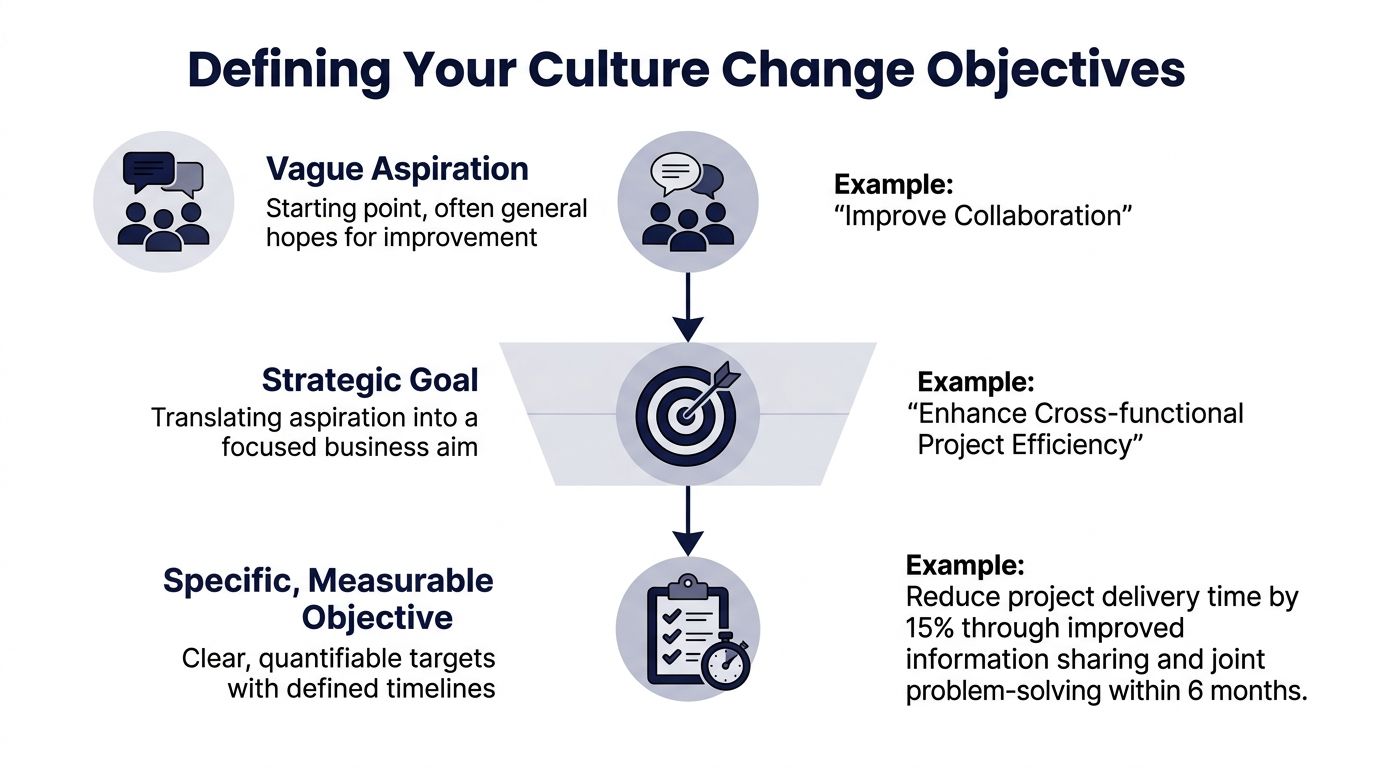
Most culture measurement breaks down before a survey is ever sent. The organisation hasn’t defined what needs to change with enough precision. “Improve collaboration” sounds sensible, but it’s too broad to measure and too vague to manage.
Start with the business problem, not the workshop theme
A culture objective should begin with a business friction point. Projects stall because teams don’t share information early. Managers avoid difficult conversations. New starters struggle to build relationships across functions. Customer issues bounce between departments because ownership is blurred.
When leaders start there, culture change stops being a soft aspiration and becomes an operational priority. The objective then becomes more specific. Instead of “build trust”, the target might be to increase the quality of cross-functional problem-solving during project delivery. Instead of “improve communication”, the focus might be faster escalation of risks and clearer decision ownership.
The critical few behaviours matter. As PwC Strategy& Australia notes in its culture survey reporting, organisations must identify and measure the “critical few” behaviours that resonate across the organisation to drive real change, rather than relying on generic metrics. That discipline keeps culture work from sprawling into a wish list.
Turn values into observable behaviours
Leaders often define culture in value language. Respect. Innovation. Accountability. Inclusion. Those terms are useful, but they aren’t measurable until they’re translated into visible actions.
A practical way to do that is to ask three questions:
- What should people do more often?
Example: involve other teams earlier, ask for input sooner, share lessons after projects. - What should people do less often?
Example: hold information inside one function, escalate late, avoid peer feedback. - What would a manager be able to observe?
Example: more balanced participation in meetings, faster handovers, fewer repeated misunderstandings.
A useful culture objective can be seen by colleagues, noticed by managers and tracked over time.
Play-based interventions can fit neatly into this process when leaders are disciplined about the intended transfer back to work. If the intervention is designed to improve communication, the measurable objective shouldn’t be “run a high-energy event”. It should be something like improved feedback openness, greater willingness to ask for help, or stronger cross-team interaction in the weeks after the event.
A simple objective-setting model
A strong culture objective usually has three layers:
- Broad aspiration
A cultural intention such as stronger collaboration, better trust, or more ownership. - Strategic goal
A business-linked aim such as improving cross-functional delivery, reducing avoidable conflict, or strengthening team coordination during change. - Specific measurable objective
A defined behavioural shift linked to a timeframe and a business context.
That last layer is where many organisations need more rigour. The destination has to be clear before any toolkit is chosen. Teams doing broader organisational development work usually get better results when each initiative has a small set of behavioural targets rather than a large set of ideals.
A well-formed culture objective also helps distinguish between different kinds of interventions. A charity team building program may be intended to deepen shared purpose and reinforce collaborative habits. A conference team building activity may be intended to accelerate connection between unfamiliar groups. A Christmas team building event may be used to recognise effort and rebuild energy. Each can support culture, but each needs a different measurement lens because the intended behavioural shift is different.
Selecting Your Measurement Toolkit
Once the objective is clear, the next task is choosing evidence that can detect change. Many teams overcorrect in this step. They either collect too little data and rely on anecdotes, or they collect too much and create reporting clutter no one uses.
A useful culture toolkit combines leading indicators, which show whether the intended behaviours are starting to spread, with lagging indicators, which show whether those shifts are influencing broader outcomes. It also combines quantitative and qualitative evidence so leaders can test whether the numbers and the lived experience point in the same direction.
Use more than one type of evidence
One helpful model comes from strategy+business on measuring culture, which sets out four measurement types: program or rollout KPIs, anecdotes, behavioural KPIs, and business KPIs. That’s a practical way to avoid the “single score” trap.
For a workplace culture initiative, that might look like this:
- Program KPIs track whether the intervention happened as intended.
Participation levels, manager attendance, completion of team debriefs, or follow-up commitments. - Anecdotes capture moments when people break old norms or adopt new ones.
These are especially useful after team building events because they surface real examples of changed interaction. - Behavioural KPIs show whether targeted habits are spreading.
Examples include feedback openness, quality of meeting participation, willingness to seek input, or confidence speaking across hierarchy. - Business KPIs connect the behaviour shift to outcomes leaders care about.
Depending on the objective, these may include project delivery quality, onboarding smoothness, internal service responsiveness, or team retention patterns.
The strongest toolkit doesn’t chase a magical culture score. It combines enough evidence to show whether behaviour is moving and whether that movement is affecting work.
That balanced approach is particularly useful for play-based interventions because post-event sentiment alone is a weak proxy. A team can enjoy an activity and return to the same habits on Monday. The measurement toolkit has to test transfer.
Example KPIs for play-based interventions
The table below shows a practical way to assess play-based team building beyond the event itself.
| Metric Type | KPI | Measurement Method |
|---|---|---|
| Program KPI | Participation and completion | Attendance records, facilitator observations, completion of team reflection tasks |
| Program KPI | Manager follow-through | Check whether leaders complete agreed post-event actions in team meetings or one-to-ones |
| Behavioural KPI | Feedback openness | Short pulse survey before and after the intervention asking whether people feel able to raise ideas, concerns and mistakes |
| Behavioural KPI | Cross-team interaction | Manager check-ins, collaboration logs, or team reflections on whether contact increased across functions |
| Behavioural KPI | Psychological safety signals | Pulse questions focused on speaking up, asking for help and contributing in meetings |
| Anecdote | Evidence of norm-breaking behaviour | Collect examples of teams taking faster ownership, inviting broader input, or resolving tension more constructively |
| Business KPI | Project coordination quality | Compare pre- and post-intervention observations on handovers, duplication and meeting efficiency |
| Business KPI | Team stability indicators | Track turnover themes, absence patterns or recurring friction points where relevant |
Many organisations can improve their understanding of employee engagement. Engagement data becomes much more useful when it sits alongside manager observations, operational signals and concrete examples of changed behaviour.
Match the tool to the objective
Not every objective needs the same instrument. If the goal is clearer behavioural definition, periodic pulse surveys and team check-ins may be enough. If the goal is deeper diagnosis, a more structured framework can help.
For organisations asking how to measure culture change in a more rigorous way, measurement should also account for the current blind spot in Australian practice around play-based interventions. Existing guidance often struggles to quantify whether the trust, communication or connection created during a play-based experience persists afterwards. That gap is exactly why post-event observation windows, manager check-ins and behavioural pulse questions matter so much.
When the intervention has a charity element, the toolkit should also distinguish between enjoyment and meaning. The shared contribution may create a different kind of emotional commitment than a standard team activity, but the proof still sits in what follows. Leaders should watch for stronger team identity, more generosity across roles and improved follow-through in daily work, rather than assuming the CSR component speaks for itself.
Establishing a Baseline and Measurement Cadence
Without a baseline, every result becomes an argument. Leaders debate whether behaviour improved, whether the shift was already underway, or whether the intervention arrived during a naturally better period. Baseline data removes much of that ambiguity.
Baseline data changes the quality of every later decision
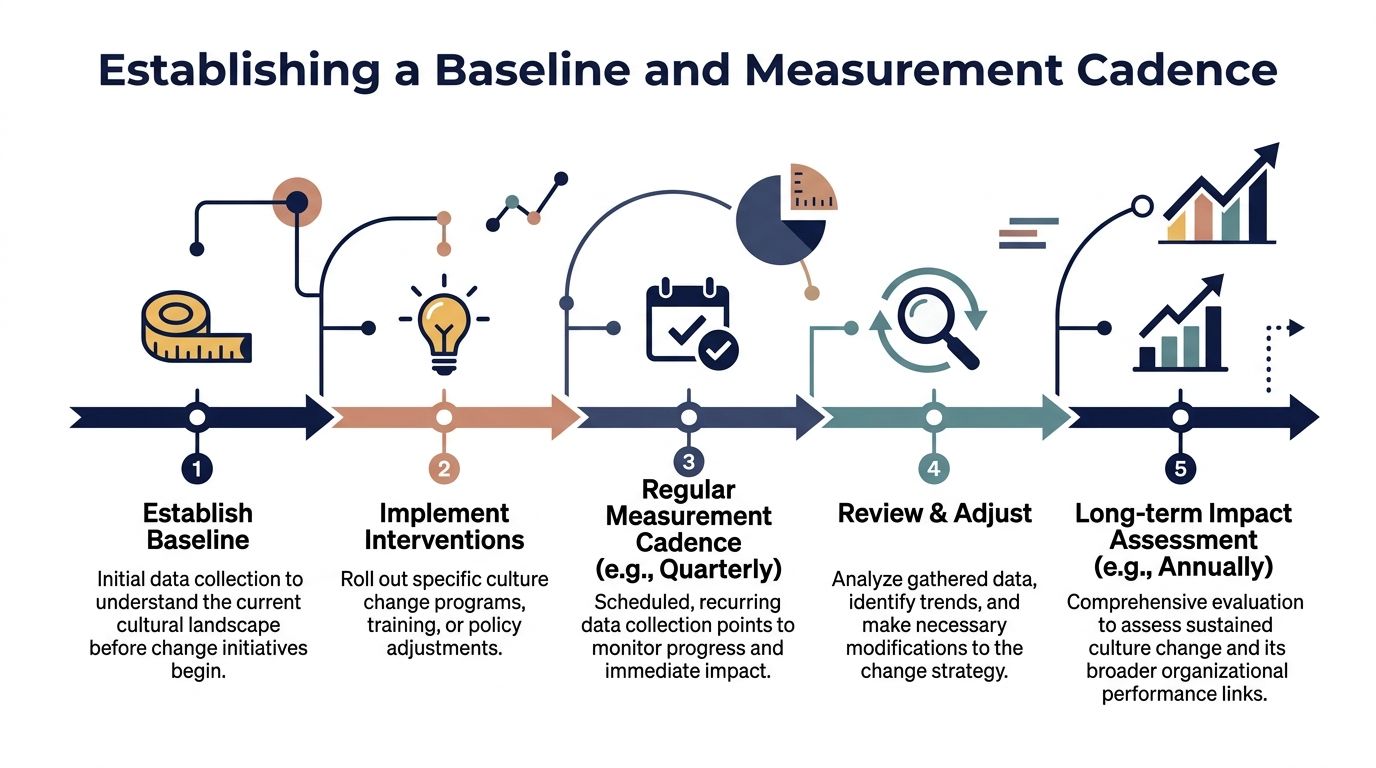
For workplace leaders, a baseline usually includes three layers of evidence collected before the initiative begins:
- Perception data such as pulse responses on trust, communication, psychological safety or collaboration.
- Behavioural observations from managers, facilitators or project leads.
- Operational context such as turnover themes, incident patterns, handover problems or delivery friction relevant to the objective.
A baseline also helps teams evaluate play-based interventions properly. If a conference team building session is intended to improve cross-functional connection, pre-event data should capture what those relationships currently look like. If a charity event is meant to reinforce shared purpose and cooperation, leaders should gather pre-event evidence on the current level of cross-team support and communication.
Use a cadence that shows movement, not noise
Timing matters as much as the baseline itself. Diligent’s guidance on measuring and monitoring corporate culture recommends a quarterly cadence rather than measuring annually or too frequently. That rhythm is practical because it gives organisations enough space for behaviour to show up, while still allowing leaders to spot movement and adjust.
Quarterly measurement is usually frequent enough to reveal a trend and infrequent enough to avoid survey fatigue.
A useful cadence for many organisations looks like this:
- Pre-intervention baseline
Gather the evidence before any event, workshop or leadership reset begins. - Immediate post-intervention check
Capture reaction, intention and immediate learning while the experience is fresh. - Quarterly behavioural pulse
Test whether the critical few behaviours are appearing more often in day-to-day work. - Annual deep review
Examine broader culture and business indicators with more context and depth.
This is especially useful in organisations trying to map out the future of company culture. An annual survey can still play a role, but it shouldn’t carry the full weight of measurement. Quarterly pulses, structured manager check-ins and scheduled reviews create a clearer picture of whether a change effort is holding.
When leaders ask how to measure culture change after a team building event, cadence is often the missing piece. The event itself may generate a visible lift. Deeper insight comes from the pattern that follows. If the intended behaviours show up at the next quarterly check, and then again later, the intervention has a stronger claim on cultural impact. If not, the event may have worked as an experience without becoming embedded in the way work happens.
Analysing Results and Linking Culture to Performance
A positive event score is not the result leaders are buying. They are buying a shift in how people work together, how quickly teams solve problems, and whether those changes show up in performance.
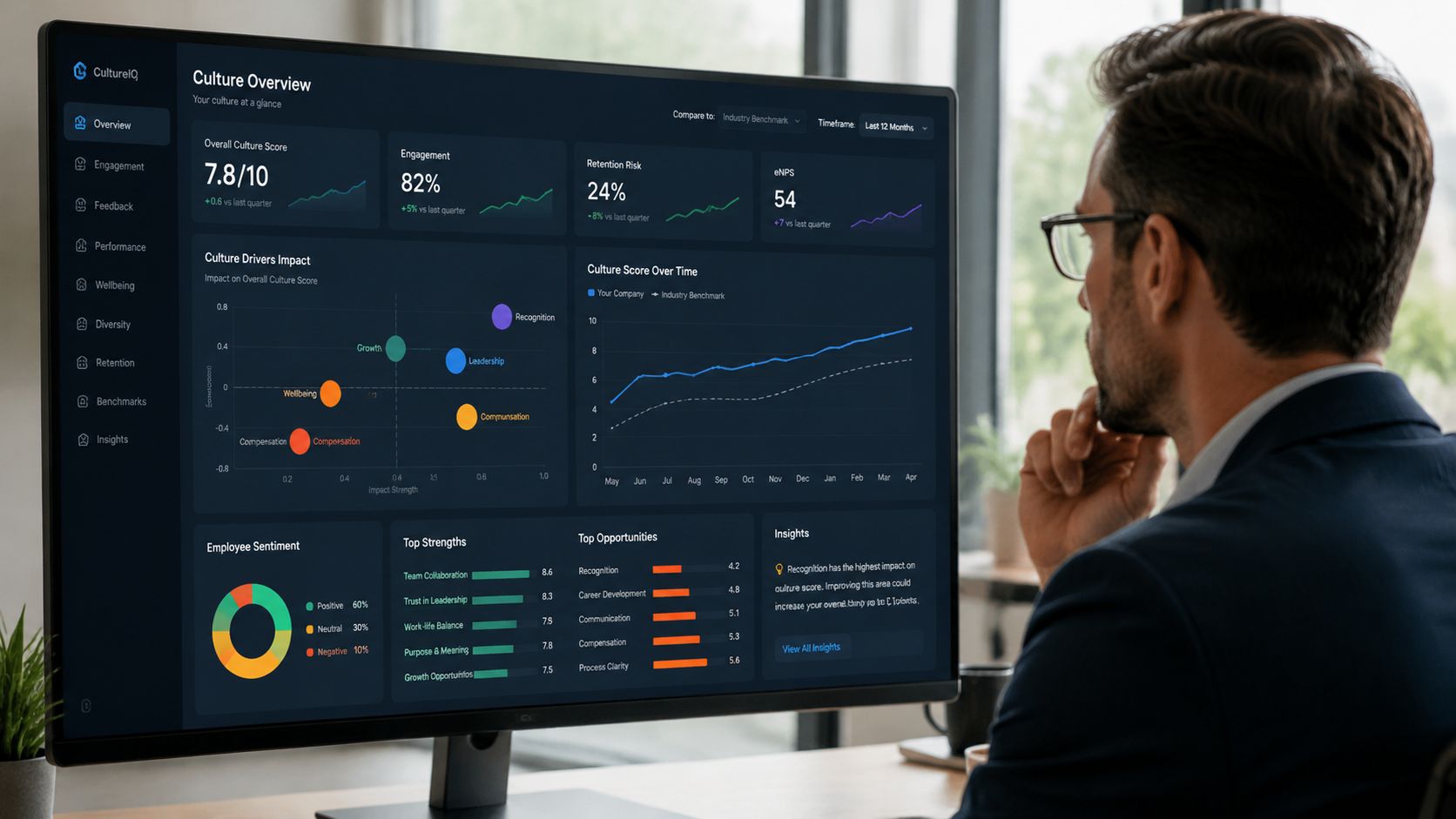
The analysis step is where many culture programs lose credibility. Teams collect reaction data, produce a tidy summary, and stop before testing whether the intervention changed behaviour. For play-based programs, that mistake is common. Energy is visible on the day. The harder question is whether that energy converted into better conflict handling, faster collaboration, stronger trust, or clearer accountability six to twelve weeks later.
Triangulate before drawing conclusions
Use at least three forms of evidence before making a performance claim. We look for alignment across sentiment, behaviour, and operations. If only one moves, the safest conclusion is that something shifted temporarily, not that culture changed.
As noted earlier, Leaders Loop recommends combining a values framework with behavioural evidence rather than relying on survey results alone. That principle holds up in practice because culture has both an attitudinal side and an observable side. People may report stronger connection after a team experience, but the real test is whether they start sharing concerns earlier, involving other functions sooner, or addressing tension before it slows delivery.
A practical triangulation set often includes:
- Sentiment evidence
Pulse responses on trust, inclusion, feedback quality, or confidence speaking up. - Behaviour evidence
Manager observations, meeting patterns, peer feedback, examples of faster issue escalation, or signs that teams are challenging ideas more constructively. - Operational evidence
Rework rates, handoff delays, service complaints, project cycle time, avoidable escalation, or other indicators tied to the original goal.
This matters in play-based interventions because the first signal usually rises fastest. People enjoy the event. They feel more connected. That is useful, but it is only the starting point. A stronger case appears when post-event enjoyment is followed by manager-noted behaviour change and then by an operational improvement, even a modest one, in the same teams.
Separate event impact from culture impact
Leaders need a clean distinction between what happened during the intervention and what carried into daily work.
For example, a problem-solving challenge might produce high participation, strong peer interaction, and immediate reports of better connection. Those are event metrics. Culture metrics come later. Did cross-team requests get answered faster afterward? Did project leads report fewer avoidable misunderstandings? Did retrospectives include more honest challenge? Did newer staff contribute earlier in meetings?
That distinction is especially important if the intervention is playful by design. Play can reduce social friction quickly. It can help people test different roles, reveal team habits, and build trust faster than a standard workshop. None of that guarantees persistence. The analysis has to show transfer.
Teams working on building trust in teams usually get better results when they define that transfer in advance. Trust is not a feeling to track in isolation. It is a pattern of behaviours such as asking for help earlier, admitting mistakes without delay, sharing context before problems grow, and challenging respectfully in meetings.
Report culture in the language of business performance
Senior leaders respond when culture data answers operating questions they already care about. Where is friction falling? Which teams are coordinating better? What risk is reducing? What manager behaviour needs reinforcement?
That means replacing abstract labels with observable business effects. Instead of reporting that collaboration improved, show that cross-functional projects hit handoff dates more consistently. Instead of saying psychological safety increased, show that teams raised delivery risks earlier and resolved blockers with less escalation. Instead of celebrating stronger engagement after an offsite, show whether the teams involved sustained better meeting discipline or reduced avoidable conflict in the following quarter.
For dashboard design, the discipline used in digital ROI reporting is useful. Sitecore ROI KPIs and analysis is a good example of tying each metric to an owner, a method, and a decision. Culture reporting benefits from the same standard. If a measure does not help a leader decide what to continue, change, or stop, it probably does not belong on the front page.
Build a report stakeholders can use
A strong culture report is selective. It does not try to prove everything. It shows whether the intended behaviour shifted, what evidence supports that conclusion, and which business outcomes appear to be moving with it.
| Reporting element | What it should show |
|---|---|
| Behaviour trend | Whether the critical few behaviours are increasing, holding, or slipping |
| Supporting evidence | Selected comments, manager observations, or examples that explain the pattern |
| Business link | Which team or operational outcome the behaviour should influence |
| Leadership action | What managers or executives need to reinforce, change, or remove |
Good analysis also shows restraint. Culture work rarely produces a clean cause-and-effect line because teams are influenced by leadership changes, workload, systems, and market pressure at the same time. The standard to aim for is credible contribution. If a play-based intervention improved connection in the short term, helped new behaviours appear in the following months, and those behaviours aligned with better team performance, leaders have a sound basis for deciding whether to scale, adapt, or stop the program.
Culture change becomes measurable when the organisation gets disciplined about three things. Define the behaviour. Track it consistently. Connect it to the way work gets done. That applies to leadership programs, team development, conference team building, charity team building and broader workplace transformation alike.
Corporate Challenge Events helps organisations turn play-based team building into purposeful culture work, with experiences designed to strengthen trust, communication, collaboration and shared energy at work. For teams that want events to do more than create a good atmosphere on the day, Corporate Challenge Events offers corporate team building, charity team building, conference programs and workplace culture experiences built around serious fun with practical organisational value.