
The meeting room is booked and the agenda is full, yet attention is divided and the same few people are carrying the conversation.
A kitchen changes that dynamic because people are no longer being asked to talk about teamwork. They have to practise it.
Ingredients need to be shared, responsibilities divided and decisions made before the clock runs out. People need to communicate across the kitchen, respond when plans change and combine their individual contributions into one finished result.
Cooking also creates something most workplace activities cannot: a shared meal shaped by the people in the room.
The food may reflect a family recipe, a cultural tradition, a favourite cuisine or a completely new idea created by the group. In diverse teams, these choices open conversations that may never happen during an ordinary workday. People learn why a flavour matters, where a technique comes from or how the same ingredient is used across different homes and cultures.
The result is not simply lunch. It is a shared experience built from the skills, ideas and traditions people bring with them.
Cooking together also changes the meaning of the finished meal because everyone has contributed to it. The same principle can be seen in why busy moms bake at home, where the process of making something adds meaning to the outcome.
What Happens When a Team Cooks Together
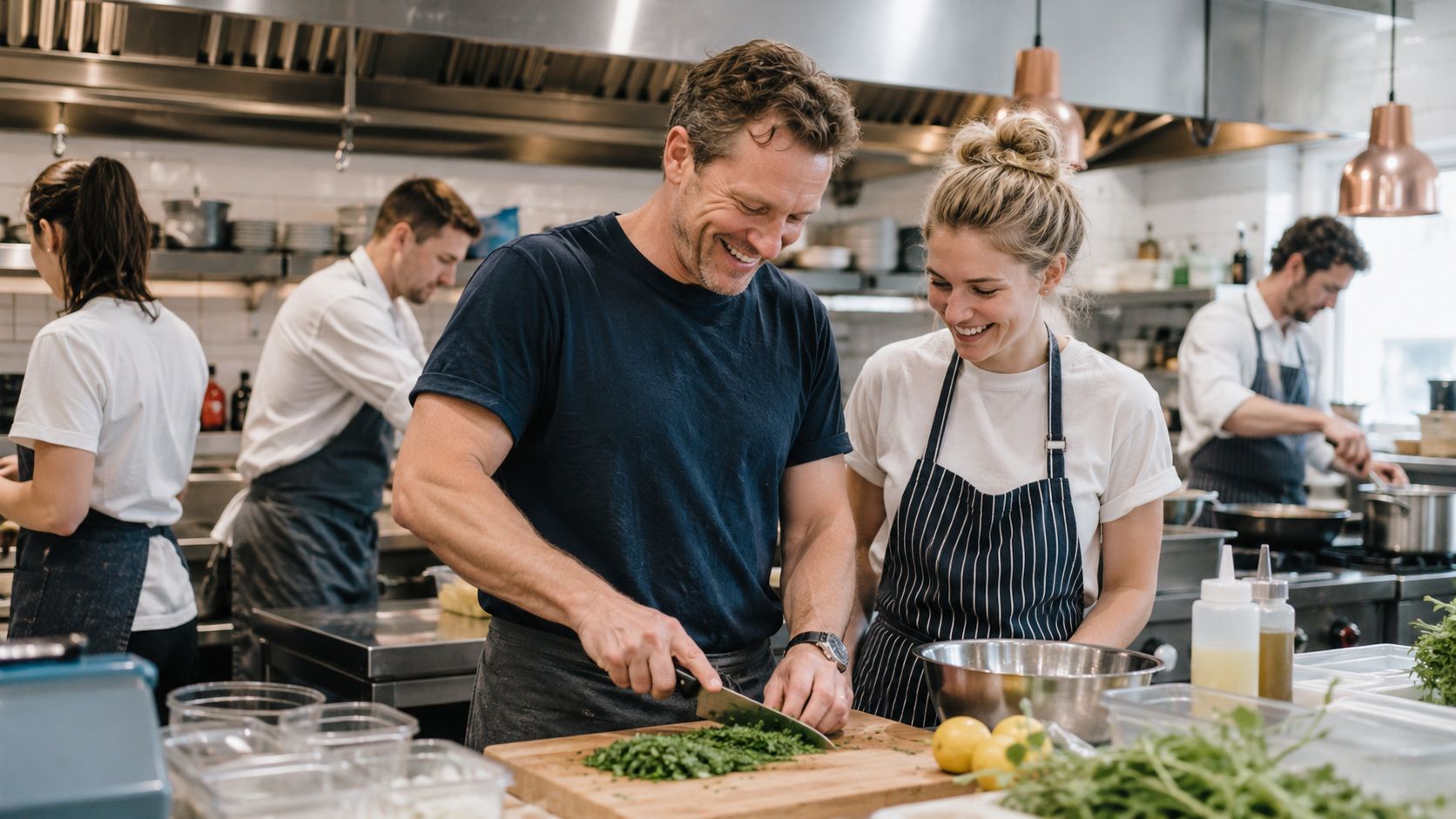
A working kitchen changes people quickly. The CEO is chopping herbs beside a graduate, someone who barely speaks in meetings is suddenly the person keeping the timer honest, and the quiet operator at the back is the one preventing the sauce from splitting. Everyone can see who is contributing, and everyone can see when a team is drifting.
That visibility is the point. In hybrid workplaces, connection often gets flattened into calendar invites, polite catch-ups and video calls that end before any real exchange happens. A cooking class breaks that pattern because the task is physical, shared and immediate, so status softens and contribution becomes more obvious than title.
The room starts to feel like a real work system
A kitchen is not casual, even when the atmosphere is relaxed. Ingredients need to be sorted, tools need to be ready, and the order of work has to make sense if the final dish is going to land. That structure gives people a believable reason to coordinate, which is why the format tends to feel more grounded than a generic social event.
For Australian teams, cooking-based programs feel credible because they sit within a well-established culture of hospitality, culinary training and shared food experiences. Broader Australian cooking class industry data reflects that familiarity, helping these programs feel grounded in practical skill-building rather than positioned as a novelty.
The practical test is simple: if people do not need to rely on one another, the activity is unlikely to reveal much about how they communicate, coordinate or work as a team.
That is why leaders looking for a more serious team experience often compare formats against the standards of task clarity and participation, not just entertainment. A useful lens is whether the event creates visible interdependence, something closer to work than a night out. For further internal planning context, the format also sits neatly beside play-based team development thinking, because the value comes from doing, not watching.
A kitchen also exposes habits that are easy to miss in the office. Some people jump in without waiting for permission, some hold back until they understand the sequence, and some assume their standard way is the only workable way. Those differences are useful because they surface how a team handles pace, uncertainty and shared responsibility while the stakes stay low enough for people to stay open.
The meal is the residue. The work is in the handovers, the corrections, the small negotiations over space and timing, and the way people respond when one part of the plan slips. That is why cooking classes for teams can reveal more about culture in an afternoon than a long meeting series often does. A group that can sort roles, share attention and recover from minor mistakes in the kitchen usually carries those behaviours back into the workplace with more honesty than polished debriefs ever produce.
The format also gives people a practical reason to rely on one another. That matters because trust grows faster when people have to pass ingredients, wait for a result, and finish something together.
How Cooking Helps Diverse Teams Share Culture
Food is one of the most natural ways for people to share something about who they are.
A formal workplace conversation about culture can sometimes feel stiff or overly deliberate. In a kitchen, the same conversation may begin naturally with a spice, a cooking method or an idea for the menu.
One participant may suggest a flavour they grew up with. Another may explain how the same ingredient is used differently in their family. Someone else may introduce the team to a dish or cuisine they have never experienced before.
These exchanges allow people to be curious about one another without asking anyone to represent an entire culture.
They also demonstrate that diversity is not an abstract value displayed on a workplace poster. It can directly change how a team thinks, solves problems and creates something together.
A mystery box of ingredients does not have one culturally neutral answer. Different participants will see different possibilities based on their knowledge and experience.
One person may recognise a traditional combination. Another may know a preparation method unfamiliar to the rest of the team. Someone else may suggest combining influences to produce something new.
The team must listen, ask questions and decide how those ideas can work together on one plate.
That process closely reflects collaboration across a diverse workplace. People do not need to communicate, think or create in exactly the same way. They need to recognise the value in what others bring and find a way to combine those contributions.
Cooking gives cultural knowledge a practical role within the team rather than treating it as an interesting fact shared during an introduction.
The Teamwork Skills Hidden in a Shared Kitchen
Every stage of cooking reveals a different aspect of teamwork.
| Kitchen stage | Team skill in practice | Workplace equivalent |
|---|---|---|
| Interpreting the brief | Understanding the objective | Aligning around a shared goal |
| Choosing the menu | Shared decision-making | Setting scope and priorities |
| Assigning kitchen roles | Delegation and role clarity | Allocating responsibility |
| Preparing ingredients | Organisation and readiness | Preparing before execution |
| Cooking under time pressure | Adaptability and communication | Managing competing deadlines |
| Plating the meal | Quality control | Delivering to an agreed standard |
| Presenting the dish | Storytelling and ownership | Communicating the team’s work |
| Sharing the meal | Recognition and reflection | Reviewing and celebrating together |
Menu design alone can reveal how a team makes decisions.
Does one confident person choose the entire direction? Does the group become stuck trying to include every suggestion? Can participants build on one another’s ideas and agree on what is achievable within the available time?
Preparation then tests whether the team can turn that decision into organised action. Ingredients need to be measured, equipment gathered and responsibilities made clear before cooking begins.
This sits naturally alongside problem-solving training for employees because both require teams to move from uncertainty towards coordinated action.
The pressure remains light enough to be enjoyable but meaningful enough to expose familiar habits.
Some people rush ahead before the plan is clear. Others wait for permission even when they can see what needs to happen. Some communicate constantly, while others assume everyone already understands the next step.
The kitchen gives teams an opportunity to recognise and adjust these behaviours without the defensiveness that can accompany a formal performance discussion.
Role rotation is particularly important. When the same people always lead, present or take the most visible tasks, the activity can reproduce the hierarchy that already exists at work.
Changing responsibilities gives quieter participants a genuine way into the experience. It also allows confident leaders to practise stepping back, listening and supporting someone else’s approach.
How Corporate Chef Turns Cooking Into Collaboration
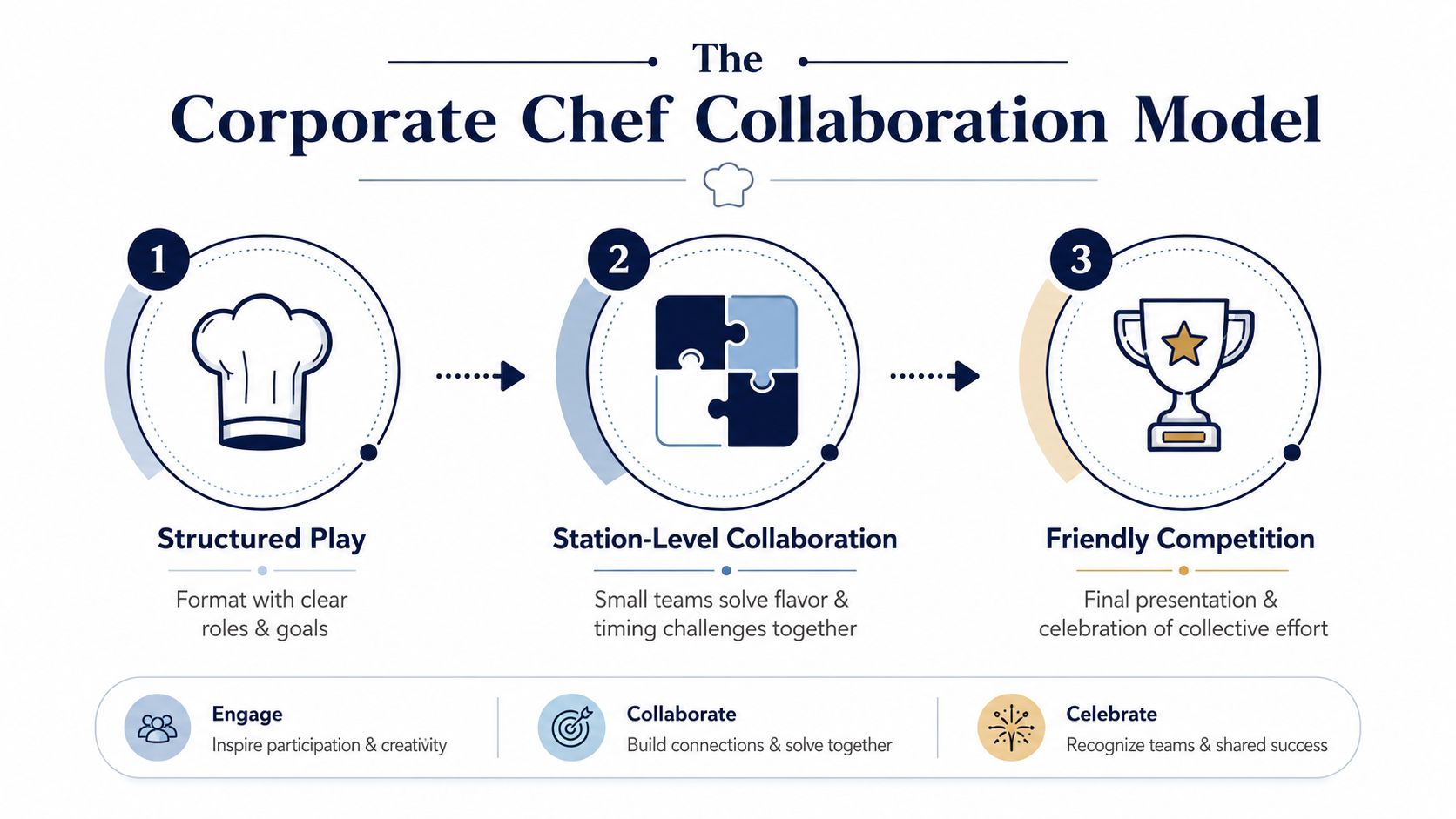
Corporate Chef transforms the kitchen into a structured culinary competition built around teamwork, timing and creativity.
The experience begins with a welcome from the Head Chef before teams discover the challenge ahead. Depending on the event format, participants may receive a mystery box of core ingredients or a budget to shop for what they need.
From there, teams must decide what they will cook, assign roles and develop a strategy for delivering their main course under pressure.
A professional chef is available to offer guidance on techniques, flavour combinations and time management, but the decisions remain with the team. Participants determine the menu, organise the work and decide what story they want their finished dish to tell.
The experience goes beyond cooking. Teams also style their table to complement their culinary vision, adding another layer of collaboration and creative decision-making.
As time runs down, each team presents its dish and story to the judging panel. Scores consider:
teamwork;
taste;
presentation;
creativity; and
use of ingredients.
This means culinary perfection alone is not enough.
A sophisticated dish prepared almost entirely by one confident cook does not demonstrate the same collaboration as a meal shaped by shared decisions, clear roles and contributions from across the team.
The competitive element creates energy, but the final experience brings everyone back together. Once judging is complete, participants sit down and enjoy the feast they have created.
One team earns the Corporate Chef title, but everyone shares the outcome.
The program is designed for groups of five to more than 500 participants and generally runs for three to four hours. It can be delivered indoors across Australia and New Zealand.
Corporate Chef Collaboration Model
How Charity Chef Adds Purpose to the Plate
Charity Chef uses many of the same culinary and teamwork dynamics but directs the finished result beyond the team.
The experience begins with a welcome from the event facilitator and professional chef. Each team is then challenged to design and cook a standout main course using a shared pantry of ingredients.
After a short planning period, participants allocate responsibilities, create their menu and begin cooking against the clock.
While part of the team focuses on perfecting the plate that will be presented to the judges, other participants prepare additional portions and carefully pack them into heat-proof containers.
The competition remains lively. Teams present their culinary concept and explain how they brought it to life under pressure, with judging based on taste, creativity, teamwork and presentation.
Then the purpose of the additional meals is revealed.
Once the winners have been announced, participants learn that the meals they prepared will be delivered to a local charity that evening.
The energy in the room shifts from competition to collective impact.
What started as a cooking challenge becomes something useful for people beyond the event. Participants can see that their planning, communication and effort have produced a real community outcome.
Purpose does not replace collaboration. It sharpens it.
The team still needs to negotiate ideas, share responsibilities and manage time, but there is now a beneficiary beyond the room. Details matter because the result will affect someone else.
Charity Chef generally runs for three to four hours, accommodates groups from five to more than 500 participants and can be delivered indoors across Australia and New Zealand.
Organisations exploring a purpose-led experience can also use this step-by-step guide to choosing a charity team building program to match the format and community outcome to their team.
Carrying the Experience Back to Work
A cooking event does not require a lengthy classroom debrief to make its workplace relevance clear.
The parallels are already visible.
Teams can reflect briefly on questions such as:
How did we decide what to create?
Whose knowledge changed our direction?
Did everyone have a meaningful role?
Where did our handovers become unclear?
Who contributed in a way we do not usually see at work?
How did we combine different ideas?
What helped us recover when the plan changed?
These questions turn the cooking experience into a useful reference point without draining the energy from the event.
A team may decide to rotate leadership more often, clarify handovers before moving into the next project stage or check whose perspective has not yet been heard before making a decision.
The goal is not to recreate the kitchen at work. It is to retain the behaviours the kitchen made visible.
More Than a Shared Meal
Corporate Chef and Charity Chef give teams more than an enjoyable meal.
They create a real task with visible contributions, shared pressure and a clear finish point. Participants need to communicate, divide responsibility, respond to setbacks and combine different ideas into one outcome.
They also create space for people to share culture through food.
A flavour, recipe or cooking technique can reveal something about a colleague that may never emerge through an ordinary workplace conversation. Those contributions become part of what the team creates rather than an aside to the experience.
Corporate Chef channels that process into a creative competition and shared feast.
Charity Chef adds an outward purpose by turning the team’s effort into meals for a local charity.
In both programs, the food matters, but the real value sits in what happens around it: people listening, contributing, adapting and creating something together.
That is why cooking brings teams together. The final meal is shared, but so are the stories, decisions and responsibilities that make it possible.