
In Australian healthcare, communication failures have been linked to preventable patient deaths at twice the rate of technical competence errors in a landmark study that changed how leaders think about team performance (Wilson et al. via PubMed Central). That single finding reframes team building for healthcare professionals. It isn't a reward day, a filler activity, or a break from serious work. It's a practical way to strengthen the behaviours that support safer handovers, clearer escalation, better cross-functional coordination, and stronger trust under pressure.
For healthcare leaders, HR teams, practice managers, and event organisers, the challenge is choosing programs that respect clinical realities. Shift work, hierarchy, emotional load, infection control, and limited time all shape what will work. Evidence around the science of play at work helps explain why well-designed shared experiences can improve trust, collaboration, and problem-solving without trivialising the work itself.
Table of Contents
Introduction to Healthcare Team Building
Healthcare teams work in environments where information passes quickly across roles, shifts, and settings. A missed detail during a handover, a hesitant escalation, or tension between departments can affect both staff experience and patient care. That's why team building for healthcare professionals needs to be treated as an operational tool, not a social extra.
Strong programs give staff a lower-pressure setting to practise the same behaviours they need on the floor. They listen more carefully. They clarify roles faster. They learn how colleagues think under time pressure. Those gains can carry back into hospitals, clinics, aged care, allied health, and community health settings, where collaboration rarely happens in neat conditions.
Understanding Why Healthcare Teams Need More Than Technical Skills
Clinical expertise keeps care safe. Teamwork determines whether that expertise reaches the patient at the right moment, in the right form, through the right conversation.
As noted earlier, research on preventable harm helped shift attention toward communication inside healthcare teams, not only individual technical performance. For leaders, that changes the planning task. The goal is not to book a generic staff event. The goal is to build repeatable habits such as clear escalation, closed-loop communication, role clarity, and calm coordination under pressure.
A useful comparison is a theatre team in surgery or a ward team during handover. Every person may know their own part well, yet the outcome still suffers if cues are missed, assumptions go unspoken, or people hesitate because rank gets in the way. Technical skill works like high-quality equipment. It matters, but equipment still needs the right connections, timing, and checks between users.
What technical excellence cannot solve by itself
Problems usually appear in the spaces between roles rather than inside one profession's training. A capable nurse, doctor, receptionist, pharmacist, therapist, or support worker can still be pulled into avoidable friction when the team lacks shared working habits.
Common examples include:
Delayed escalation: a junior team member spots a concern but is unsure how forcefully to raise it.
Role overlap or gaps: clinical and administrative staff both assume someone else will complete the next action.
Status barriers: useful information is softened, delayed, or left unsaid because the conversation feels risky.
Shift-to-shift drift: one group finishes with key context in mind, but the next group receives only part of the picture.
These are coordination problems. They need practice, not reminders alone.
That is why healthcare team building should be designed more like a simulation gym than a social outing. People need a safe place to rehearse how they speak, check, question, and recover. Leaders who want to strengthen those conditions often start with activities that support psychological safety in healthcare and workplace teams, because staff are more likely to speak up when the setting has already normalised respectful challenge.
Why structured play belongs in healthcare
Play can sound too light for a serious setting until it is defined properly. In adult learning, play means structured challenge with low clinical stakes and clear behavioural goals. It gives teams a way to practise timing, listening, adaptation, and trust without attaching every interaction to a patient outcome.
A short problem-solving activity, a charity challenge with defined team roles, or a hybrid session linking on-site and remote staff can reveal the same communication habits that show up during discharge planning, telehealth coordination, or a rushed handover. The difference is that staff can pause, reflect, and try again. That makes learning stick.
This specialised approach is especially useful in healthcare because the constraints are different from a standard office. Rosters split teams across shifts. Infection control may limit room setup or shared materials. Clinical communication needs to include concise updates, read-backs, and escalation language. Good program design works with those conditions instead of treating team building as separate from clinical practice.
Workforce models are also changing. Teams now coordinate across wards, community settings, and digital care pathways. For leaders planning around distributed services, resources such as remote telehealth nurse practitioner jobs show how collaboration increasingly depends on distance-friendly communication, not only face-to-face contact.
The practical lesson is simple. Healthcare teams need activities that match healthcare work. Short, purposeful, play-based, charity, and hybrid formats often do more than long generic sessions because they let staff practise how care is coordinated under real constraints.
Assessing Team Needs in Healthcare Settings
Before choosing an activity, leaders need a clear picture of the team they're trying to support. A metropolitan hospital unit, a mixed admin-clinical clinic, and a remote multipurpose service won't need the same format.
Start with the operating reality
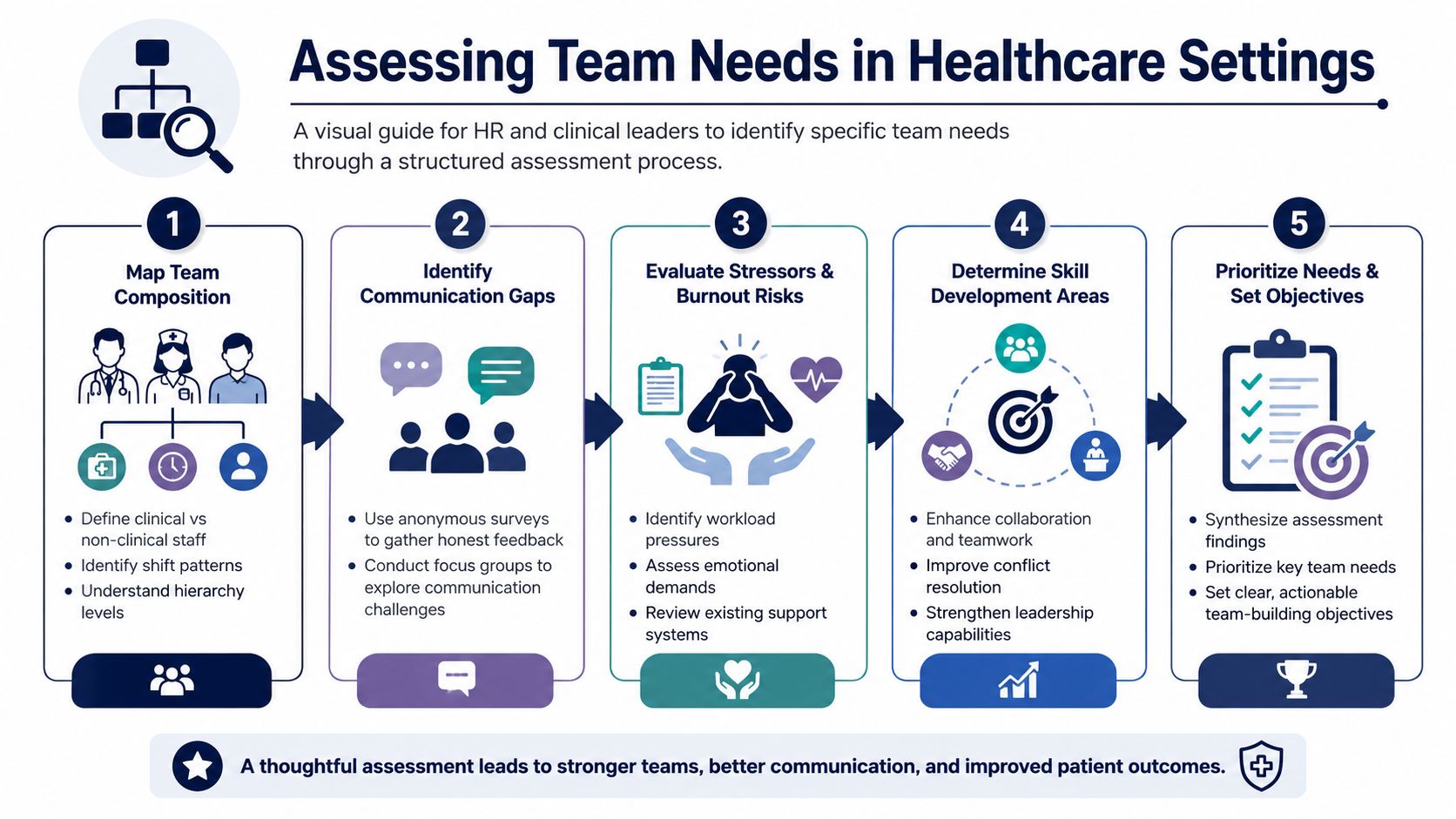
A useful assessment begins with who works together, when they overlap, and where friction appears. The best planning conversations usually map five things:
Team composition
Separate clinical, non-clinical, leadership, casual, agency, and support roles. Many issues come from interfaces between groups, not within one profession.Shift patterns
Identify whether staff can attend together or need repeated short-format sessions across rosters.Hierarchy pressure points
Ask where people hesitate to question, escalate, or challenge assumptions.Moments of coordination risk
Handovers, discharge planning, admissions, patient flow, scheduling, and incident response often reveal underlying teamwork gaps.Accessibility needs
Consider physical ability, cognitive load, language confidence, sensory preferences, and fatigue.
Ask questions that reveal behaviour, not just opinion
Simple prompts often surface more useful information than broad morale surveys. For example:
“Where does information commonly get delayed?”
“Which teams need to collaborate more smoothly but rarely share time together?”
“What kind of activity would feel appropriate in this professional environment?”
“What would make attendance easier across shifts?”
Practical rule: If the planning group can't name the specific communication moments they want to improve, the activity choice is probably too generic.
Selecting Inclusive and Safe Activities
The right activity is the one that fits the team's purpose, schedule, risk profile, and culture. In healthcare, selection needs more discipline than “what looks engaging”.
Match the format to the workplace
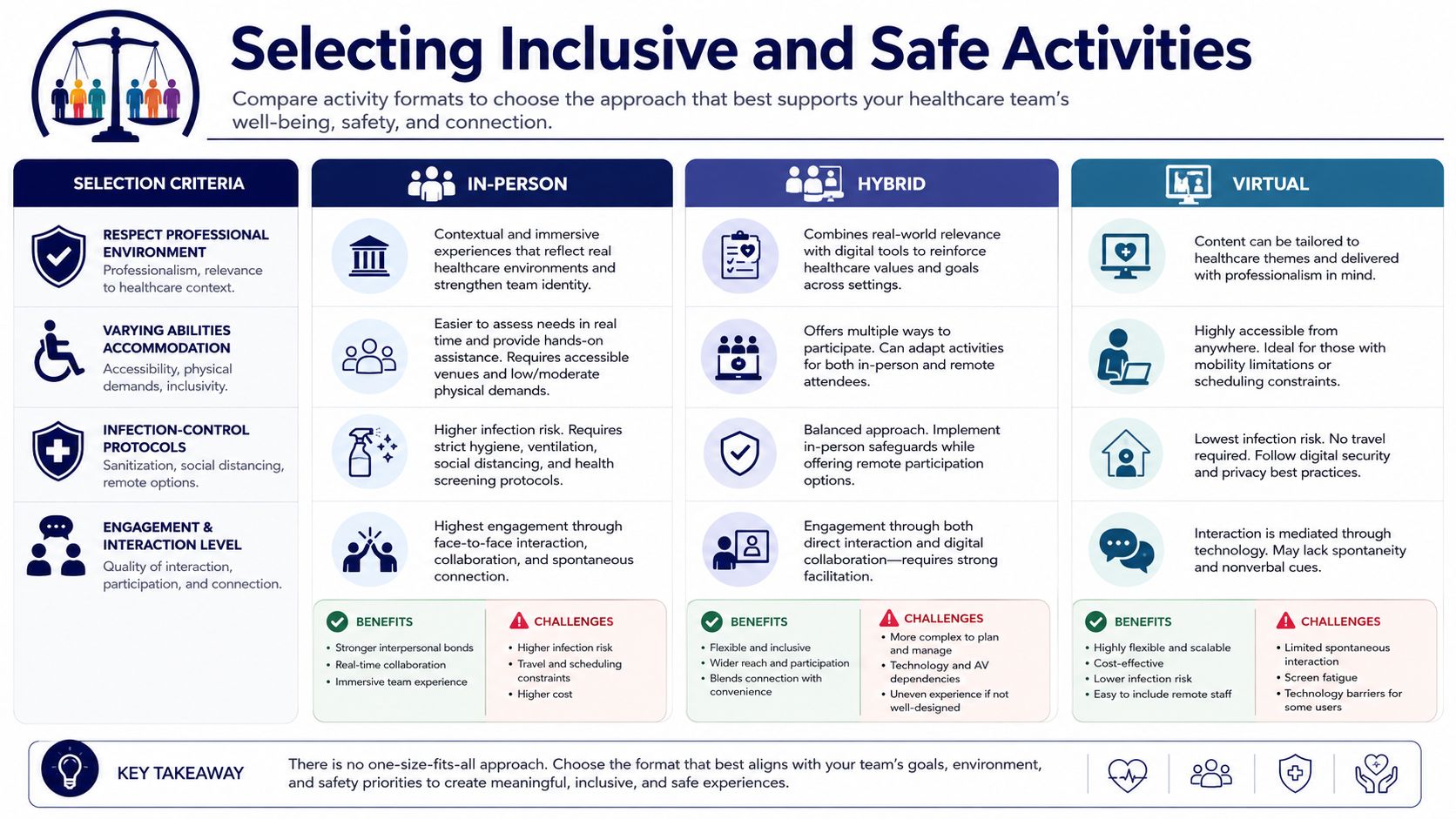
A quick comparison helps narrow options.
| Format | Best suited to | Watch-outs |
|---|---|---|
| In-person | Teams that need stronger interpersonal trust, cross-role visibility, and immediate interaction | Infection-control planning, room access, timing around patient care |
| Hybrid | Distributed services, multi-site health networks, rural teams, mixed rosters | Uneven participation if facilitation doesn't balance room and remote attendees |
| Virtual | Telehealth teams, dispersed admin-clinical groups, time-poor departments | Easier attendance, but activities need tight design to avoid passive observation |
Leaders also need to think about dignity and relevance. Activities should feel appropriate for adult professionals and adaptable for different comfort levels. That usually means avoiding anything that depends on public embarrassment, personal disclosure, or high physical demand.
Choose activities that practise useful team behaviours
Programs such as Safe Crack, Minute to Win It, Risk Reward, LEGO Legends, Bikes for Tykes, and Out of the Box can all work in healthcare settings when matched properly to the objective.
Safe Crack: useful for practising structured problem-solving, listening accuracy, and role clarity under time pressure.
Minute to Win It: works well for short-format energisers across conferences, team days, or shift-friendly sessions where leaders want fast rounds of collaboration.
Risk Reward: suits teams working on decision-making, prioritisation, and consequences under constrained resources.
LEGO Legends: often helps mixed groups visualise systems, handover challenges, or service redesign in a concrete way.
Bikes for Tykes: adds a charity outcome, which can be effective when organisations want connection and community contribution in the same session.
Out of the Box: supports creativity, communication, and coordinated execution without requiring clinical simulation space.
Build safety and inclusion into the design
According to the Australian Commission on Safety and Quality in Health Care, 70% of Australian health services report communication failures as a root cause of adverse events, yet most play-based content doesn't connect serious fun with the clinical communication protocols needed for patient safety (Australian communication and teamwork scoping paper). That gap is where careful design matters.
A stronger approach links play to workplace tools rather than treating it as separate from real practice. Teams might debrief an activity through:
SBAR-style reflection: What was the situation, what background mattered, what was assessed, and what recommendation emerged?
Crew Resource Management themes: Who monitored risk, who checked assumptions, who invited input?
Handover discipline: What information was lost when the task changed hands?
For teams with diverse processing styles, planners should also review guidance on team building for neurodiverse teams so facilitation, instructions, pacing, and sensory demands don't exclude strong contributors.
Delivering and Facilitating Effective Programs
A strong design can still fail if delivery ignores the rhythm of healthcare work. Facilitation needs to respect handovers, fatigue, and the fact that some participants may be arriving from emotionally difficult shifts.
Schedule around care, not against it
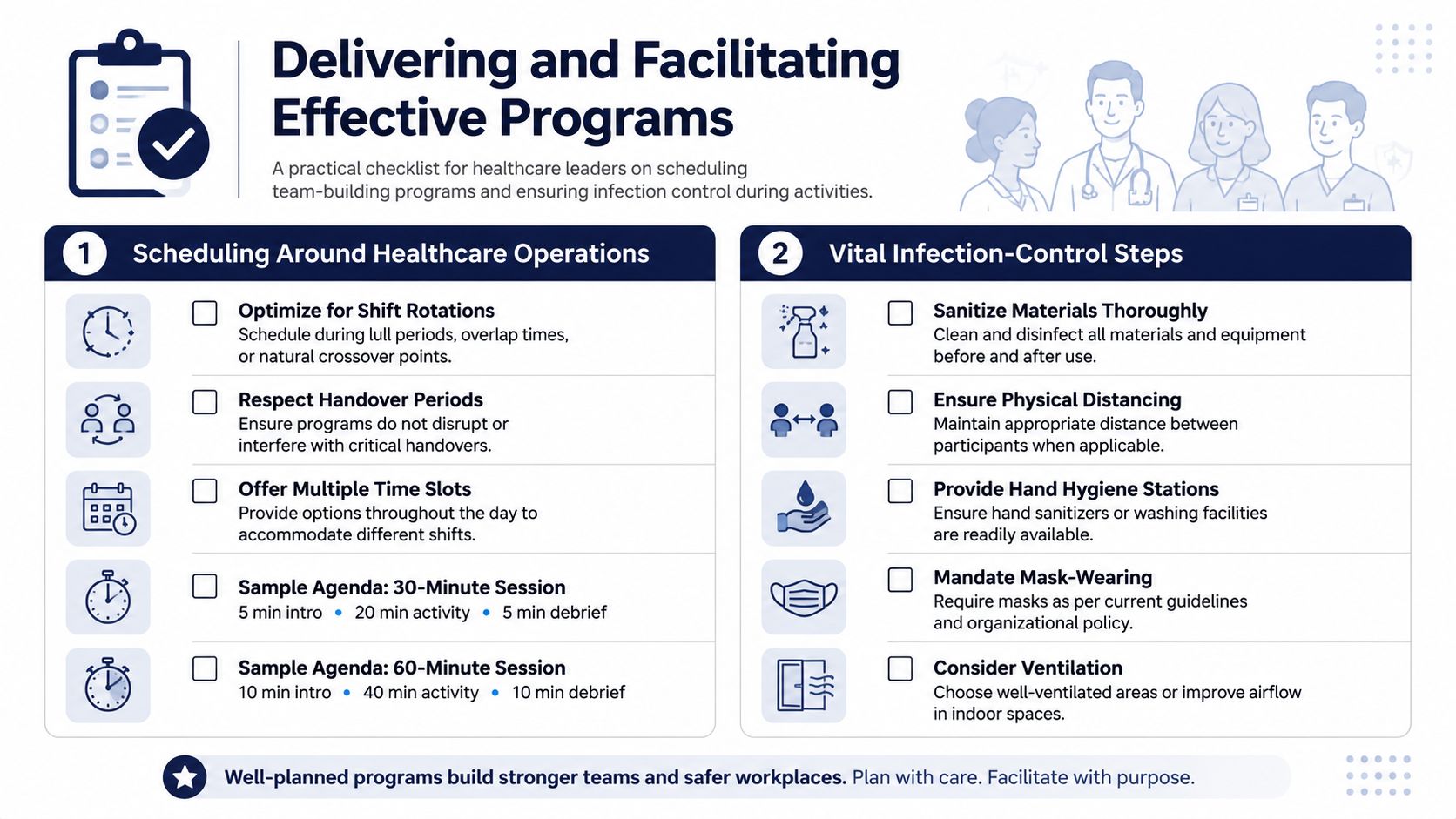
Shorter sessions often outperform longer ones because they reduce attendance barriers. A practical pattern looks like this:
For a 30-minute session: brief welcome, one focused activity, one short debrief tied to a workplace behaviour.
For a 60-minute session: context setting, two related activities or one longer challenge, then a richer debrief with team commitments.
For repeated delivery: run the same session across multiple time slots so day, evening, and night staff have equitable access.
Senior support also affects participation. When leaders protect the time and join appropriately, staff are more likely to treat the session as valid work rather than optional entertainment.
Facilitate the transfer back to work
The debrief is where team building becomes useful. Without it, participants may enjoy the challenge but miss the operational lesson.
Good debrief questions sound like this:
“Where did the team assume shared understanding that wasn't shared?”
“Who had critical information but no clear opening to contribute it?”
“What helped the team recover when the plan changed?”
“Which part of this mirrors handovers, patient flow, or interdepartment coordination?”
A healthcare debrief should end with one behaviour the team can test in the next week, not a vague promise to communicate better.
Infection control and privacy need equal attention. Use cleanable materials, avoid activities that interfere with clinical areas, protect patient confidentiality in discussion, and make sure rooms support current workplace protocols. For outdoor or contingency planning, organisers can borrow useful operational thinking from rain, hail or shine team event planning, especially when attendance windows are tight and backup options matter.
Measuring Impact and Sharing Success Stories
Leaders don't need complicated dashboards to judge whether team building worked. They do need a few clear measures tied to a real operational goal.
Start with objectives that teams can observe
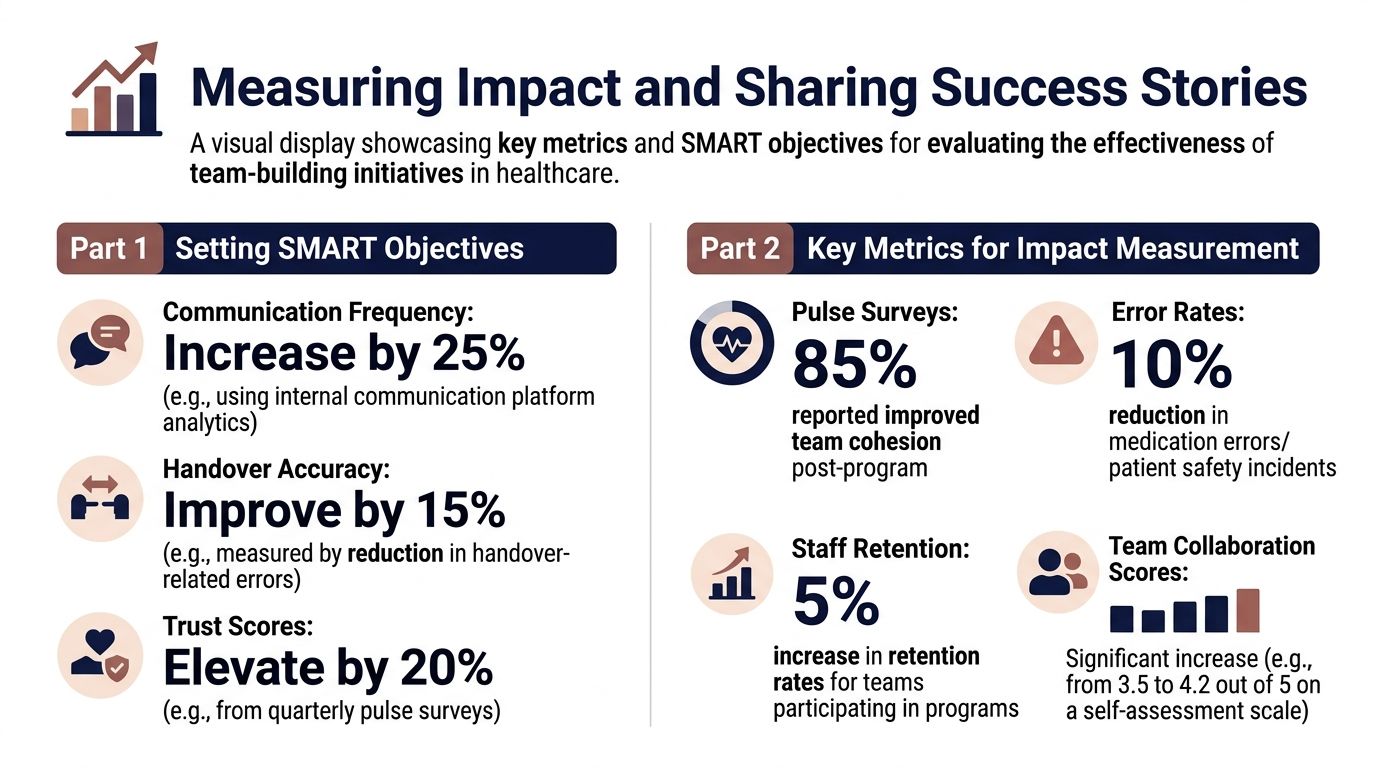
Useful objectives in healthcare settings are usually behavioural. Examples include improving the consistency of handovers, increasing cross-role problem-solving, strengthening trust between clinical and non-clinical teams, or helping new leaders facilitate clearer communication.
A simple measurement mix can include:
Pulse surveys: ask whether staff feel more confident speaking up, collaborating across roles, or clarifying expectations.
Manager observations: note changes in meeting quality, escalation behaviour, or handover discipline.
Operational indicators: where appropriate, review local patterns such as incident themes, coordination delays, or retention concerns.
Debrief records: capture the actions teams committed to and whether they were tried later.
Use evidence carefully
A systematic review and meta-analysis covering 1,390 healthcare teams across 31 studies found that teams engaging in effective teamwork processes were 2.8 times more likely to achieve high clinical performance, with a sample-sized weighted mean correlation of r = 0.28 (95% CI 0.20 to 0.35) (BMJ Open systematic review). For executive audiences, that gives team building a stronger footing when it's part of structured teamwork development rather than a stand-alone morale event.
The same evidence base supports a broader leadership argument. Better teamwork is associated with stronger patient outcomes, operational efficiency, and workforce stability. That gives HR, People & Culture, and clinical leaders a shared language for decision-making.
Share stories that show behaviour change
The strongest internal success stories don't rely on grand claims. They show what changed in practice.
For example, a LEGO Legends session might help a mixed admin-clinical team visualise how patient flow breaks down when information gets trapped between functions. An Out of the Box program might reveal that one department dominates planning while another carries execution risk without enough voice. A Risk Reward activity might help senior clinicians and operational leaders discuss trade-offs more openly because the scenario is removed from real patient care but still structurally similar.
Reporting tip: Present team building outcomes as a chain. Activity design influenced behaviour in the room. That behaviour linked to a workplace habit. The habit supported a service objective.
For leaders who need to explain value to executives, finance partners, or boards, a practical framing of the ROI of play in workplace settings can help connect engagement outcomes with team performance and retention priorities.
Conclusion and Next Steps
Team building for healthcare professionals works best when it's purposeful, inclusive, and tied to the realities of care delivery. The strongest programs don't ask staff to forget the seriousness of their work. They create a lower-pressure setting where teams can practise communication, adaptability, problem-solving, and trust before returning to demanding environments.
For hospitals, clinics, aged care providers, allied health teams, and community health organisations, the priority isn't finding the loudest activity. It's choosing the format and facilitation approach that fits the team, respects safety requirements, and leads to behaviours leaders can observe.
Healthcare organisations looking for customized, play-based programs can explore Corporate Challenge Events for healthcare-friendly team building options designed around workplace goals, scheduling realities, and safe delivery across in-person, hybrid, and charity formats.