The surprising truth about team building activities for large groups is that the activity is rarely the problem. The design is.
Once a group grows beyond 100 people, formats built around individual turns, open-ended icebreakers or unstructured mingling quickly lose momentum. Too many people end up waiting or watching rather than actively participating.
As this guide to team building activities for large groups explains, successful large-group experiences create shared energy across the full room while using smaller teams and parallel activities for deeper participation. Clear instructions, defined time limits and structured transitions become increasingly important as the number of participants grows.
That design-first approach is particularly relevant for organisations operating in fast-moving and innovative environments. Large-group team building cannot simply keep people entertained. It needs to create a shared pace, encourage interaction across teams and give every participant a meaningful role in the experience.
When the structure is right, hundreds of people can play, collaborate and contribute at the same time without the energy or purpose becoming lost in the crowd.
Table of Contents
Why Most Large Group Team Building Falls Apart
Large group team building gets a bad name when organisers treat it like a bigger version of a small-team activity. That's usually where the wheels come off. A trivia round, a scavenger hunt or a relay can work beautifully with the right structure, but if the guest list has grown and the format hasn't changed, half the room ends up waiting for their turn while the other half does all the work.
The real failure mode is idle time
The most common breakdown is serial participation. One person speaks, one person performs, one person presents, and everyone else watches. By the time the next round starts, energy has already leaked out of the room.
A second problem is unstructured mingling. It sounds inclusive, but large rooms rarely self-organise well. People cluster with familiar colleagues, quieter participants drift to the edges, and the event ends up reinforcing existing silos instead of widening connection.
Practical rule: once the group is large, the format has to let many people do something at the same time.
That's why experienced organisers think in terms of pace, participation and flow rather than “what game should we play?” If you want inspiration at the activity level, fun team building ideas for work can be useful, but the large-group question is different. The challenge is not finding something popular. It's building a format that stays inclusive when the room gets noisy, the stakes feel visible and the number of participants starts to climb.
The most effective large team building ideas usually begin with a whole-group energiser, move into small-team challenge work and finish with a shared reveal or finale. That structure keeps attention moving and avoids the long dead zones that make even a strong concept feel slow.
For leaders planning conference team building, leadership days or end-of-year functions, the shift in mindset is simple. Stop asking whether an activity is fun in theory. Start asking whether it can hold the room in practice. One useful lens for that decision sits alongside Corporate Challenge Events' view of one-size-fits-all engagement.
What Makes a Team Building Activity Work at Scale
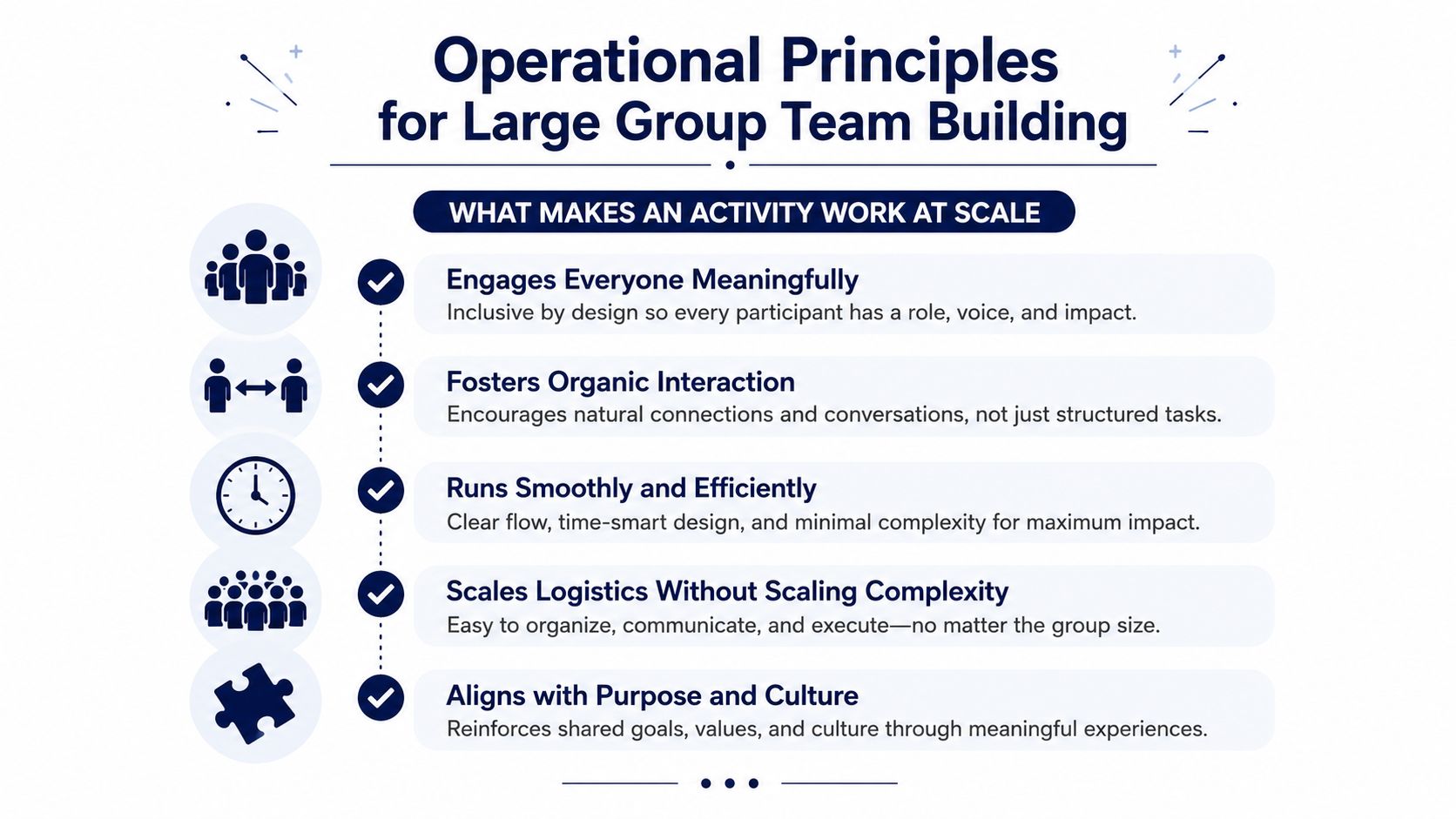
At scale, the structure carries the event. The activity matters, but the mechanics matter more. If the briefing is unclear, the room is badly zoned, or teams are too large to contribute properly, even a strong concept loses pace and participation.
Build for parallel participation
The strongest large-group formats allow small teams to play and problem-solve at the same time, rather than forcing hundreds of people to wait for their turn.
As this guide to corporate team building ideas for large groups explains, activities need to be designed differently once participant numbers increase. Rotating stations, simultaneous challenges and structured breakout groups help maintain involvement while preventing bottlenecks.
In practice, dividing participants into smaller teams gives more people an active role and makes communication, collaboration and decision-making easier. The wider event can still feel unified through shared instructions, visible scoring, coordinated transitions and a common finish.
The venue and facilitation also need to support that structure. Clear instruction areas, adequate sound, visible screens and separate activity zones reduce confusion and help teams move through the experience without collisions or lost momentum.
The best formats do more than accommodate a large number of people. They create a rhythm the whole room can follow, with clear moments of action, progress and celebration.
Design around pace, roles and space
Large-group activities need more than enough room. They need a structure that helps people understand where to look, when to move and how to contribute.
Instructions should come from one clear focal point before teams move into defined activity zones. The facilitator needs to remain visible enough to hold the room, while giving each group enough space to communicate and complete the challenge without competing noise or confusion.
The structure within each team matters just as much. Sharing roles prevents one confident participant from carrying the entire activity and gives more people a meaningful way to contribute. Participants might manage materials, track progress, coordinate decisions, complete physical elements or present the final result.
Visible progress helps bring those smaller team experiences together. A live score, build stage, relay handover or final reveal gives the whole room something to follow. It creates anticipation, maintains momentum and allows participants to remain connected to the wider experience, even when their team is not completing the most visible part of the challenge.
This reflects the principles explored in The Science of Play. Structured play holds attention because it combines clear goals, active participation, feedback and a visible end point. Those elements make the experience easier to follow and give people an immediate reason to stay involved.
The test is straightforward. If an activity requires constant explanation, relies on one person at a time or cannot be divided into smaller working units, it is unlikely to hold a group of more than 100 people for long. If it moves quickly, shares responsibility and builds towards a clear finish, it has a much stronger chance of keeping the entire room involved.
Choosing Between Competitive and Non Competitive Formats
The wrong question is whether competitive or non-competitive team building is “better”. The right question is what behaviour the organiser wants the group to practice. Competitive formats are strong when the aim is pace, energy, decision-making under time pressure and visible collaboration between small teams. Non-competitive formats work better when the goal is connection, calm participation, reflection or shared purpose without rankings.
Competitive formats energise, but they don't suit every room
A competitive program gives a room a storyline quickly. Teams know where they stand, natural leaders emerge and the event gets a shape that people can follow without much effort. That makes competition useful for leadership days, conference energisers and staff celebrations where organisers want movement and lift.
The trade-off is obvious. Some participants switch off if the whole event feels like a contest, especially if they don't like being judged, timed or ranked. Large groups can also turn competitive formats into a spectator sport if the scoring isn't designed carefully.
Non competitive formats lower the social cost of joining in
Non-competitive activities reduce pressure. They make it easier for quieter people to enter the room, contribute at their own pace and feel useful without worrying about performance. That matters in culture sessions, mixed-tenure groups and events where psychological safety is part of the brief.
A strong reference point for this broader framing sits in Corporate Challenge Events' inclusive play approach, which treats participation as a design issue rather than a personality trait. The same principle is useful when event planners want a calmer, lower-pressure format that still feels structured.
Some events need rivalry. Others need room to breathe.
The smartest large programs often combine both. A Christmas function might start with a competitive energiser, move into a shared purpose activity and finish with a reflective closer. A leadership offsite might pair a challenge-based session with a mindfulness block or wellness element. For CSR-led days, a purpose-led team activity can carry the emotional weight better than a scoreboard ever could.
The decision lens is simple. Choose competitive formats when the room needs momentum and shared story. Choose non-competitive formats when the room needs inclusion, reflection or a lower entry barrier. If the group is mixed, blend the two so the event serves more than one kind of participant.
Seven Competitive Play Based Programs for Large Groups
The best competitive large-group team building ideas don't just entertain. They create clear rules, shared responsibility and enough structure for many people to participate at once. These seven programs from Corporate Challenge Events are built around that logic, but they suit different room sizes, venues and energy levels.
Play Offs and Survivor keep large groups moving
Play Offs is one of our most flexible options for large groups because everyone competes in rotating challenges at the same time. Teams take on a mix of communication, coordination, problem-solving and trust-based activities, with each round adding points to the leaderboard.
The activities can be selected to suit the group, venue and desired level of physicality, making Play Offs a strong choice for conferences, company celebrations and large-scale team days. The format is short, sharp and energetic, with enough variety to give different personalities and strengths a chance to emerge.
Survivor brings more twists, strategy and tribal rivalry into the experience. Teams compete across mental, physical and creative challenges, so success depends on more than speed or athletic ability. Participants need to allocate roles, adapt their approach and use the strengths available within their tribe.
It works particularly well for groups that want an outdoor experience with a strong theme, plenty of movement and a memorable final result.
Minute to Win It, It’s a Knockout and City Scramble bring different kinds of energy
Minute to Win It turns everyday objects into a series of fast-paced, 60-second challenges. Teams must quickly decide who is best suited to each task before the clock begins, adding strategy and shared decision-making to what initially looks like simple fun.
The indoor format can run as a standalone event, conference energiser or entertainment between dinner courses. It is particularly effective when organisers want quick instructions, visible action and a room full of people cheering each other on.
It’s a Knockout takes the energy outdoors with colourful relays, oversized props, coordination games and playful physical challenges. Teams rotate through activities and collect points, while participants contribute by competing, problem-solving, supporting teammates or bringing the all-important team spirit.
It is energetic without being reserved only for elite athletes. The emphasis is on play, laughter and full-team involvement, making it suitable for outdoor celebrations and large groups ready to embrace a little organised chaos.
City Scramble uses the surrounding city as the playing field. Teams navigate between locations and complete creative, interactive and problem-solving challenges to earn points.
The program is adaptable to different fitness levels and does not require local knowledge. It suits conferences, leadership groups and workplace teams looking for an active experience that combines navigation, time management, creativity and connection.
Operational note: Outdoor and movement-based programs need a suitable event space, clear participant briefings and a wet-weather plan. The activities should also be tailored to the group’s accessibility requirements and preferred level of physicality.
Bikes for Tykes and LEGO Legends turn teamwork into community impact
Bikes for Tykes combines playful competition, problem-solving and hands-on teamwork with a powerful charity outcome. Teams complete challenges to earn the tools and bike parts they need before assembling bicycles for children in the local community.
The program still delivers the energy and rivalry of a team building event, but the final result brings everyone back to a shared purpose. It is a strong option for organisations that want team connection, corporate social responsibility and tangible community impact within the same experience.
LEGO Legends offers a more creative and highly accessible charity experience. Teams complete fast-paced challenges to earn LEGO pieces, then work together to design and construct an original sculpture around a chosen theme.
The final reveal shows participants that their efforts have also helped provide new LEGO sets to children through a local charity partner. Because people can contribute through planning, building, storytelling, creativity or keeping the team on track, LEGO Legends works particularly well for large, mixed groups with different roles, ages and physical abilities.
Three Inclusive Non Competitive Options
Large-group events do not have to rely on ranking to hold attention. The better design choice is often energy without pressure, or connection without putting quieter people on the spot. These three formats work well when the room includes different fitness levels, mixed personalities or participants who contribute more comfortably in a calm setting. For a deeper look at how inclusive play brings every team member in, see Corporate Challenge Events' guide to inclusive engagement.

Wellness, volunteering and mindfulness serve different needs
Not every large-group experience needs a scoreboard. Wellness, volunteering and mindfulness provide alternative ways for people to connect, contribute and reset, with each format serving a different purpose.
A workplace wellness session can restore energy and introduce practical wellbeing strategies without asking participants to compete. It can work well at the beginning of a conference, as a mid-afternoon reset or after a demanding block of presentations. The strongest sessions remain connected to workplace realities, giving people ideas they can use beyond the event rather than delivering a broad or generic wellness talk.
A community volunteering experience gives the group a shared purpose and a tangible outcome. Participants can contribute through hands-on tasks, planning, logistics, organisation or quality control, allowing different abilities and confidence levels to be included. This makes volunteering particularly suitable for CSR days, company offsites and organisations that want their time together to create value beyond the immediate team.
The same principle can be seen in other purpose-led corporate event formats. For example, these golf tournament ideas demonstrate how charity and corporate golf days can use team formats, accessible participation and fundraising elements to create a more inclusive shared experience. The setting may be different, but the planning lesson is similar: the format should make it easy for people with different skill levels to contribute.
A guided mindfulness workshop serves a quieter purpose. It creates space for participants to pause, regulate stress and regain focus after strategic planning, leadership discussions or a full conference agenda. These sessions are usually most effective when they are concise, professionally facilitated and positioned as a practical support for attention and performance, rather than a test of someone’s personal approach to wellbeing.
The right choice depends on what the group needs. Wellness can restore energy, volunteering can create shared purpose, and mindfulness can help people slow down and refocus. None requires traditional competition to deliver a meaningful team experience.
Planning the Day Around the People in the Room
The activity is only half the job. A large-group event succeeds or fails on the planning layer around it, especially when the room includes different mobility levels, mixed departments, hybrid attendees or participants who care about how the day is staged as much as what they'll do.
Indoor, outdoor and hybrid choices all carry trade-offs
The best setting depends on the group, the objective and the type of participation the activity requires.
Indoor venues make it easier to control sound, deliver clear instructions and avoid weather disruptions. They are often better suited to problem-solving activities, creative challenges and physically lighter formats, particularly when the group includes different mobility or accessibility needs.
Outdoor venues create more space for movement, exploration and high-energy play. However, they also require more operational planning. Organisers need to consider weather contingencies, ground conditions, shade, hydration, participant comfort and whether instructions will remain visible and audible across a larger area.
The activity should still be chosen for what it helps the team achieve, rather than simply where it can be held. This broader collection of team building activities shows how formats can range from short communication exercises to more involved collaborative experiences. The right choice should feel natural for the team and create genuine interaction, not become an activity people are expected to endure.
Hybrid and distributed teams introduce a different challenge. The goal is not to recreate an in-person event through a screen, but to design an experience that gives remote participants a meaningful way to contribute. As this guide to virtual team building activities explains, effective virtual formats are intentional, accessible and respectful of people’s time. They may include live challenges, smaller breakout groups or asynchronous activities that allow people in different locations and time zones to participate.
For hybrid groups, remote participation cannot be treated as an add-on. Everyone needs access to the instructions, materials, discussion and progress of the activity. If the people in the room receive the full experience while remote participants simply watch, the format is not truly hybrid.
Indoor, outdoor and hybrid experiences can all work for large groups. The important question is whether the setting supports clear communication, active participation and an experience in which everyone has a genuine role.
Accessibility and inclusion need to be planned, not assumed
Accessibility isn't just about wheelchair access. It includes mobility, sensory load, neurodiversity, dietary needs and the comfort people feel when the facilitator gives instructions. Cultural inclusion matters here too, especially when catering, language and team allocation can either widen or narrow participation.
A practical planner will mix departments and levels into smaller teams so clique effects weaken and people don't just sit with their usual circle. That choice also helps leaders avoid overloading one social group or one senior cohort with all the visible responsibility.
Good briefs help large rooms faster than loud voices do.
Time, facilitators and transitions need the same attention
Large groups need more time than most organisers first budget for. The day has to absorb welcome, briefing, set-up, activity blocks, transitions, breaks and a finale without rushing the room. That pacing is where a skilled facilitator earns their keep, because they hold momentum, read energy shifts and decide when to tighten the room or slow it down.
For a useful planning benchmark, a strong large-group event should feel deliberate from the first briefing to the final reveal. If the transitions are messy, the room feels it. If the instruction is clear and the movement is intentional, the whole day feels easier.
Choosing the Right Activity and What Comes Next
The best large group team building ideas are rarely the most complicated ones. They're the ones that match the room, the occasion and the behaviour the organiser wants to reinforce.
A simple comparison for decision-making
| Activity | Style | Best suited to |
|---|
| Play Offs | Fast-paced and flexible | Large conferences, mixed groups and rotating participation |
| Survivor | Strategic and adventurous | Communication, adaptability and team decision-making |
| Minute to Win It | Quick-fire and playful | Indoor events, conference energisers and celebrations |
| It’s a Knockout | Active and high-energy | Outdoor events, company celebrations and playful competition |
| City Scramble | Exploratory and interactive | Urban events, navigation and creative problem-solving |
| Bikes for Tykes | Purpose-led | Charity impact, connection and shared contribution |
| LEGO Legends | Creative and purpose-led | Mixed-ability groups, collaboration and community impact |
| Workplace wellness session | Restorative | Energy, practical wellbeing and conference resets |
| Community volunteering experience | Purpose-led | Social impact, inclusion and meaningful contribution |
| Guided mindfulness workshop | Reflective | Focus, stress regulation and a calmer conference close |
Choosing the activity is only part of the process. The real difference comes from how well the experience is matched to the people, the purpose and the practical realities of the event.
Corporate Challenge Events has been designing and facilitating team building experiences across Australia and New Zealand since 1994. Our team helps organisations move beyond a generic activity menu by recommending the right format for the group size, venue, accessibility needs, desired outcomes and level of energy.
From planning and logistics through to professional facilitation on the day, we shape each experience to keep people involved and create a result that feels right for the team.
If the brief is for conference team building, staff celebrations, charity team building or a large leadership offsite, speak with Corporate Challenge Events about the right large-group format for the room, the goals and the people who need to be included.