
The brief arrives with a date, a headcount estimate, and a short note from leadership saying the conference needs to “land well”. That's usually the moment an HR manager or executive assistant realises venue selection isn't an admin task. It's the decision that shapes attendance, energy, pacing, networking, and whether the event feels organised or improvised.
Brisbane gives corporate planners real choice, which is helpful and risky at the same time. The city has everything from smaller CBD meeting rooms to large hotel venues and dedicated conference floors, but a long venue list doesn't solve the harder question. The harder question is which space supports the outcome the organisation wants.
A useful way to approach conference facilities in Brisbane is to treat the venue as part of the event strategy. The room configuration affects discussion quality. The location affects punctuality. The technical setup affects credibility. The catering and breakout flow affect how much attention people still have after lunch.
Table of Contents
Finding the Right Brisbane Conference Venue
Most first-time corporate planners start by comparing room photos, package inclusions, and day rates. That's understandable, but it often leads to the wrong shortlist. A venue can look polished online and still be awkward for registration flow, breakout movement, leadership presentations, or post-session networking.
The better starting point is to decide what the event must achieve, then screen venues against that outcome. A leadership offsite needs different space dynamics from a compliance training day or a company-wide conference.
A venue doesn't rescue a weak event design, but it can absolutely undermine a strong one.
A practical starting framework sits in this guide to finding a great venue for your conference. It helps shift the conversation from “what's available?” to “what supports the agenda, audience, and experience the organisation is trying to create?”
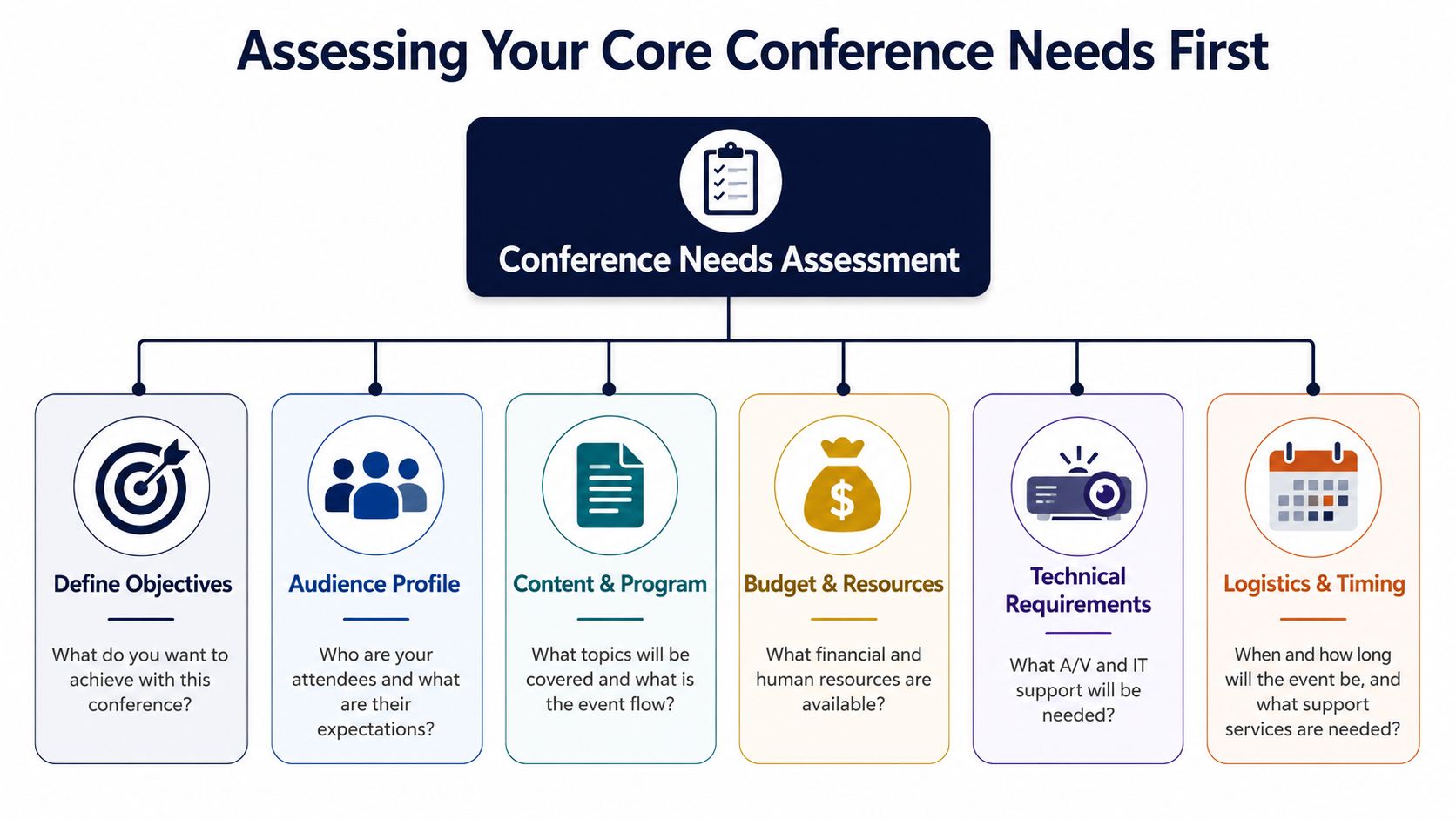
Assessing Your Core Conference Needs First
Before any shortlist is built, the internal brief has to be sharper than “we need a conference room in Brisbane for about this many people”. Vague briefs produce vague proposals. Good venues can only respond well when the organiser is clear about objectives, attendee profile, timing, and programme design.
Start with the business outcome
A training event, a strategy day, and a sales conference may all need a main room and catering, but they don't need the same environment. Training benefits from visibility, note-taking space, and breakout discipline. Strategy sessions need privacy and discussion-friendly layouts. A conference with multiple stakeholders needs smoother transitions, stronger staging, and better circulation.
Use space planning, not guesswork
Industry guidance in Australia commonly uses approximately 2–4 square metres per person for meeting and function room capacity planning, and in practice a 1,800 m² purpose-built conference centre can support up to about 300 guests when configured with a pillar-less ballroom, breakout rooms and support spaces, according to Accor's Brisbane event planning guidance. That's useful because it reminds planners that capacity depends on layout, circulation and support areas, not just the headline number on the brochure.
A venue brief should lock down these points before enquiries go out:
Primary objective: Training, communication, planning, recognition, networking, or a blend.
Realistic headcount: Confirm likely attendance, not just invited numbers.
Room style: Theatre, classroom, cabaret, boardroom, or mixed set-ups across the day.
Breakout demand: Small group workshops change the venue requirement fast.
Programme rhythm: Registration, plenary sessions, breaks, meals, and informal interaction all need space.
Teams that need help structuring the internal side of the event can use this framework on the five fundamentals of your internal company conference.
Understanding Brisbane Venue Types and Locations
Brisbane's market is broad enough that the right answer usually depends on format, not prestige. Smaller corporate sessions often work well in compact CBD facilities. Larger conferences or accommodation-heavy programs usually lean toward hotel venues. Multi-stream training and exhibition-style events often need something more specialised.
CBD conference centres and meeting facilities
Brisbane has a concentrated CBD cluster that gives planners range without forcing delegates out of the city centre. Accor offers a variety of meeting spaces within the Brisbane CBD, accommodating different group sizes. In the private market, Christie Spaces advertises rooms for up to 250 people, while Karstens Brisbane reports 12 conference rooms across 980 square metres and states the full floor has hosted up to 300 attendees.
That kind of density is useful for corporate planners because it supports different event scales in one area. For conferences with sponsor zones or display requirements, it's often worth speaking with specialist partners such as exhibition stand builders Brisbane early, because booth footprint, traffic flow, and bump-in access can influence venue choice before contracts are signed.
Hotel venues and integrated event sites
Hotels suit events where accommodation, catering, and function delivery need to sit under one roof. Sofitel Brisbane Central is described by Accor as Brisbane's largest fully integrated hotel functions and meeting facility, with 11 conference venues catering for 10 to 1,100 delegates on its conference and convention venue page.
The practical trade-off is simple:
| Venue type | Usually works well for | Watch for |
|---|---|---|
| CBD conference centres | Training, workshops, professional learning, multi-room day events | Limited accommodation integration |
| Hotels | Multi-day conferences, interstate delegates, gala-linked programs | Shared public spaces and competing guest traffic |
| Flexible corporate venues | Smaller internal sessions, team planning days | Support depth and room adaptability |
Analysing Technical and Audiovisual Capabilities
The AV checklist shouldn't stop at “screen, projector, and handheld mic”. Modern corporate events rely on stable connectivity, clear audio, presentation confidence, and support staff who can fix issues fast without derailing the room.
Brisbane venues now compete on infrastructure. Top-tier facilities promote integrated high-spec AV, reliable connectivity, natural light, and accessible design, with planners advised to prioritise venues that support hybrid-ready conferencing, rapid room reconfiguration, and smooth logistics, as outlined on Crystalbrook Vincent's events information.
What to verify before signing
A venue walk-through should include technical questions in plain language:
Wi-Fi performance: Can the network cope with delegates, presenters, and production demands at the same time?
On-site support: Is there a technician on hand during key sessions, not just on call?
Hybrid delivery: Can remote speakers join cleanly, and can virtual attendees hear audience questions?
Room re-set speed: How quickly can the space shift between plenary and workshop modes?
For teams planning hybrid sessions, this guide to Premier Broadband video call requirements is a useful planning reference before talking to venue technicians. It also helps to compare the venue offer against practical conference tech considerations such as those outlined in six technology solutions for your next conference.
Practical rule: If the AV answer sounds generic, the support probably is too.
Considering Accessibility and Transport Logistics
A polished venue in the wrong place creates a stressed audience. Delegates arrive late, registration compresses, speakers lose prep time, and the day starts behind schedule. Transport planning is part of event design, not a final checklist item.
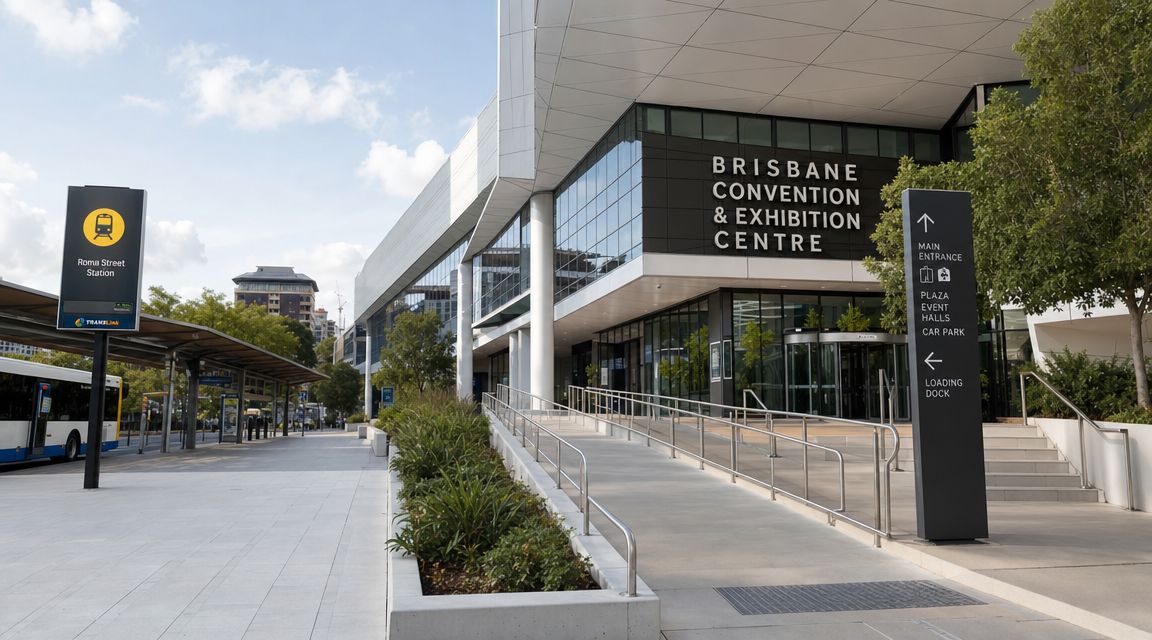
Brisbane planners need to factor in current network conditions, not just map distance. Venue pages rarely do this well. According to Amora Hotel Brisbane's meetings and events information, planners should account for Cross River Rail disruptions, temporary access changes, parking constraints, and peak-hour travel risk because business travel decisions are increasingly cost- and time-sensitive.
Questions that improve attendance and punctuality
Ask venues for operational answers, not marketing language:
Arrival pattern: Where do taxis, rideshare, buses, and private vehicles drop delegates?
Parking reality: Is there on-site parking, nearby parking, or just “parking available in the precinct”?
Accessible access: Are lifts, entries, toilets, and room transitions easy to move through?
Disruption planning: What route advice does the venue currently give to attendees?
A venue can be central and still be inconvenient on the day. This is why many organisers now build transport checks into the early shortlist, not the final review. The planning discipline in this article on choosing transport for events is useful when comparing otherwise similar Brisbane options.
Planning for Catering
Food choices have a significant effect on concentration, often more than planning teams anticipate. Slow service can lead to long queues and delays in starting sessions. Inadequate catering can result in an afternoon slump, and unclear dietary options can reduce trust.
Catering should align with the program
Different events require distinct catering arrangements. A leadership workshop will need a different food schedule compared to a conference with sponsor networking or a full-day training session. The timing of morning tea, availability of coffee, and whether lunch is designed for mingling or quick consumption all influence the day's atmosphere.
A simple decision table can guide choices:
| Factor | Description | Best Used When | Trade-off |
|---|---|---|---|
| Working lunch | The agenda is tight and content-heavy | Less informal connection | |
| Buffet or shared service | Networking is a priority | Requires efficient crowd flow | |
| Canapés or standing format | Event concludes with mingling or sponsor interaction | Not suitable for fatigued attendees |
For events with multiple days, catering becomes even more critical. This is especially true when attendees include interstate staff or executives, or when early starts follow evening functions. Ensuring safety, convenience, and punctuality can be enhanced by integrating food service with the event venue. Larger events also require consideration of movement and queue areas. Practical advice, such as this expert guidance on event crowd management, can be valuable in assessing meal service locations, foyer congestion, and registration flow.
Integrating Team Building and Outdoor Spaces
Conference agendas often fail in the same place. They ask delegates to sit, watch, and absorb for too long. Even strong content starts to flatten when the space only supports passive listening.
The venue should make active participation possible. That may mean breakout rooms with enough room for collaboration materials, a foyer suitable for rotating team challenges, or nearby outdoor access that lets the program shift energy without losing structure.
Space changes the quality of interaction
A room that works for keynote delivery may be poor for trust-building or cross-functional collaboration. If the conference includes a team-based element, planners should test whether the venue can handle movement, noise separation, storage, and reset windows between sessions.
Options vary. Some organisations use short energisers between plenary blocks. Others build in a structured team challenge, charity activity, or problem-solving session. Providers such as Corporate Challenge Events can support conference-format team engagement in Brisbane when the venue can physically accommodate the program. The key planning lens isn't the activity itself. It's whether the environment allows people to connect in a way that still feels professional and purposeful.
The best conference spaces don't just hold content. They create enough flexibility for people to interact with it.
This guide to team building activities to break up your conference is useful when assessing whether a venue can support more than a lecture-style agenda.
Finalising Budgets and Reviewing Contracts
Venue quotes can look comparable while hiding very different assumptions. One may include standard AV, staffing, and furniture. Another may price the room attractively, then add costs for technicians, lecterns, microphones, resets, or minimum catering commitments.
What to isolate in every proposal
Review each quote line by line and separate these items:
Room hire: Main room, breakouts, registration area, storage, green room if needed.
Included equipment: Screen, projector, lectern, microphones, staging, and basic sound.
Labour charges: Venue supervisors, AV technicians, security, and after-hours staffing.
Food and beverage conditions: Package inclusions, dietary handling, minimum spends, and service timing.
Contract points that deserve attention
Cancellation terms, deposit schedules, insurance requirements, access times, and bump-in windows should all be clear before approval. So should liability for third-party suppliers and any penalty tied to revised numbers.
A contract should also state what happens if the venue changes room allocation, support staffing, or service timing. If the agreement is vague on any of those points, the organiser is carrying risk the organisation may not realise it has accepted.
Your Essential Brisbane Venue Brief Template
A strong venue brief saves time because it gives sales teams enough information to respond accurately. It also makes proposals easier to compare. If one venue is pricing a theatre-style plenary with minimal AV and another assumes cabaret with breakouts and catering, the quote comparison won't be useful.
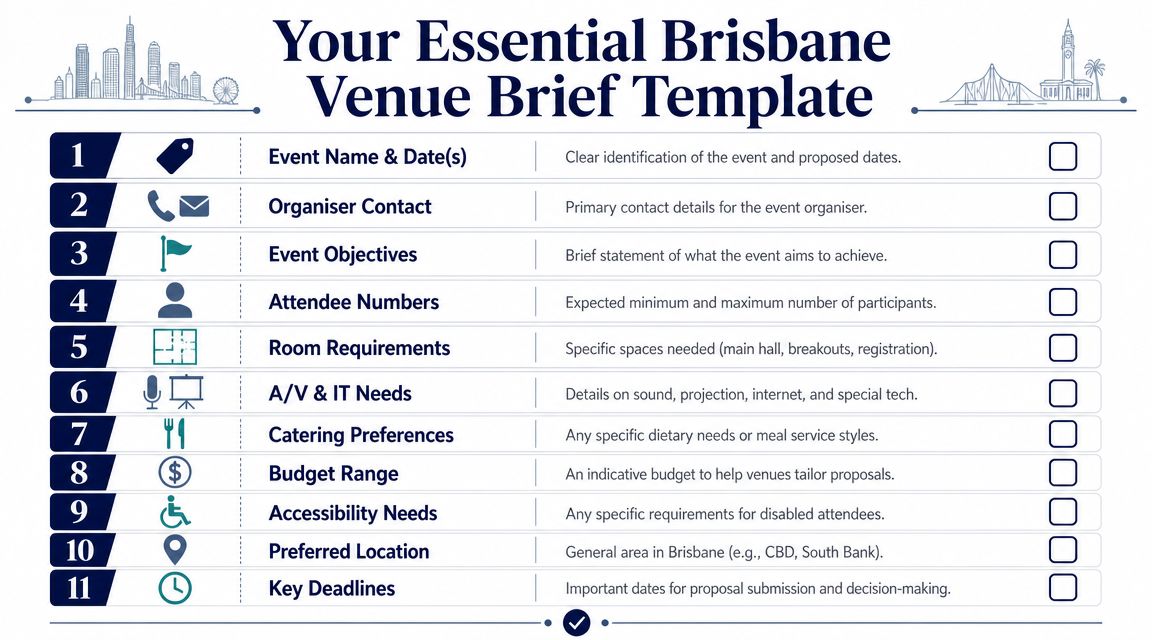
Include these details in the first enquiry
A practical brief should contain:
Event identity: Event name, preferred date range, and decision deadline.
Audience scope: Expected attendance range, attendee profile, and whether accommodation is needed.
Program outline: Start and finish times, session structure, breaks, networking periods, and any dinner or social component.
Room requirements: Main plenary, breakout rooms, registration zone, exhibitor space, storage, and team activity space if relevant.
Operational needs: AV, streaming, accessibility, dietary requirements, signage, and loading access.
Budget guidance: A realistic range helps venues tailor suitable options instead of overscoping or underscoping.
Short, clean briefs usually produce stronger replies than long narrative emails. Venues need specifics, not storytelling.
The Ultimate Brisbane Conference Booking Checklist
The final decision should come after the shortlist has been tested in person, not just online. Photos won't reveal noise bleed, awkward foyer flow, low ceilings, or cramped registration positions.
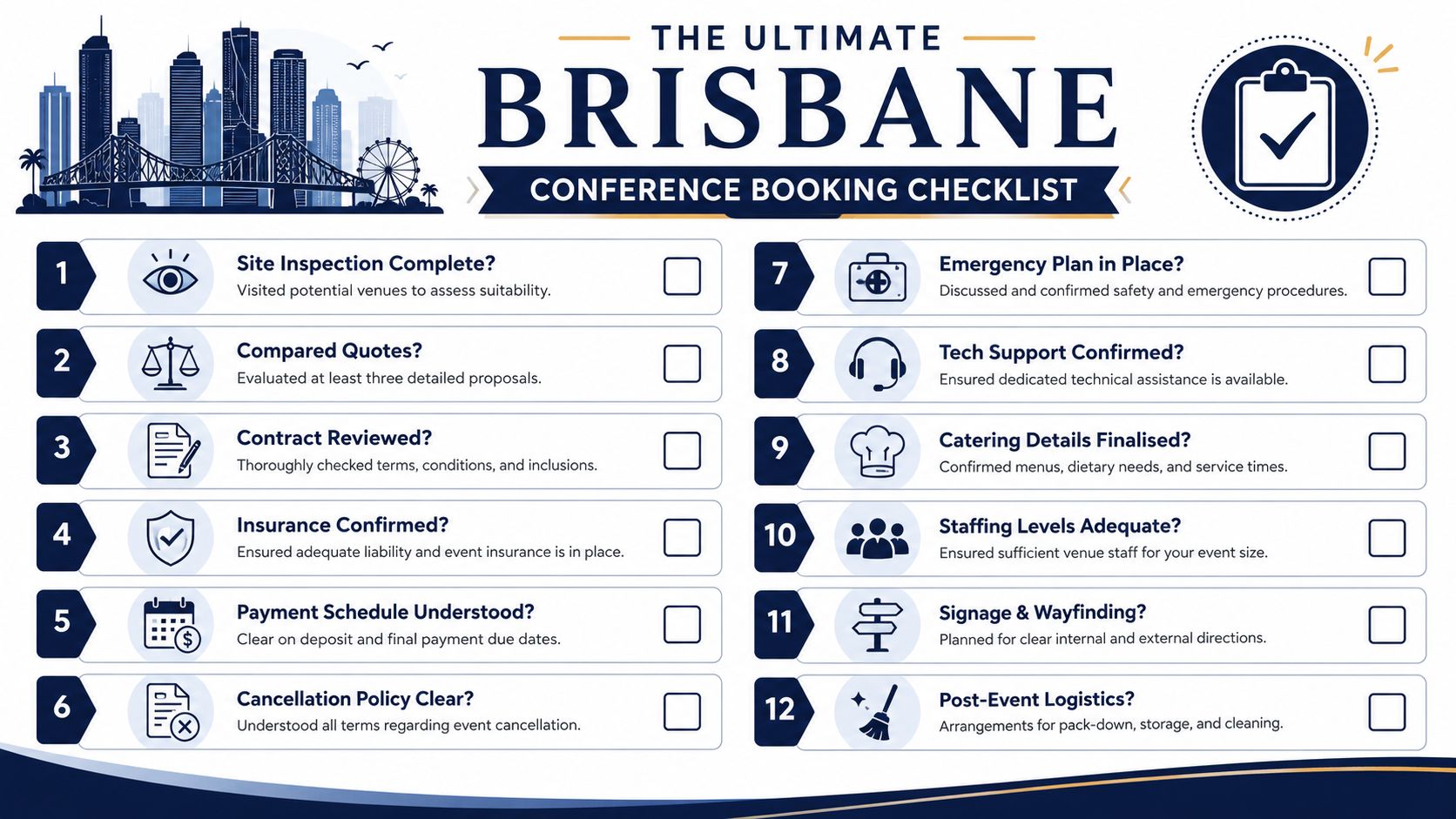
Before signing, confirm these points:
Site inspection complete: Walk the actual rooms and delegate journey.
Quotes compared properly: Check inclusions and exclusions, not just total price.
Operational support confirmed: AV help, catering timing, staffing, and emergency procedures.
Contract understood: Deposits, cancellation, liability, access windows, and final numbers.
Delegate experience tested: Arrival, accessibility, signage, comfort, and post-event pack-down.
A venue that survives this checklist is usually a venue that will perform well on the day.
Conclusion The Venue as a Strategic Partner
The strongest Brisbane conference bookings come from planners who treat venue selection as an outcome decision. Room count matters, but room function matters more. Location matters, but arrival experience matters more. Price matters, but operational fit usually decides whether the event feels smooth or strained.
That's the opportunity in the Brisbane market. There's enough variety to match venue type to business purpose if the organiser asks better questions early. The venue then stops being a backdrop and starts acting like a partner in delivery, culture, and conference impact.
For organisations planning a Brisbane conference and wanting to add structured team connection, charity-based engagement, or conference energisers into the agenda, Corporate Challenge Events offers play-based corporate programs designed for meetings, conferences, and workplace events across Australia.