
If a team is missing deadlines, struggling through meetings, or losing good people, is the answer a bonding activity or a building program?
Many leaders treat those terms as interchangeable. They aren't. One strengthens the relationships that let people work well together. The other strengthens the capabilities that let them execute well together. Confusing them usually leads to the wrong intervention. A team with low trust won't benefit much from a skills-heavy workshop. A team with solid rapport but weak execution won't improve just because everyone had lunch together.
That distinction is especially important in Australia, where team-based work is standard. In 2021, 56% of employed Australians usually worked in a team, while 32% usually worked individually and 12% worked both ways, according to Australian workplace data on team-based work. For leaders deciding where to invest time and budget, the practical question isn't whether team bonding is worthwhile. It's whether the team needs connection first, capability second, or a deliberate combination of both. Recent workplace shifts have only sharpened that judgement, as outlined in The State of Work in 2026.
Table of Contents
Team Bonding and Building Why Knowing the Difference Is a Skill
Leaders often ask for a team day when the underlying need is diagnosis. The issue may be trust. It may be role clarity. It may be friction between departments. It may be a capable team that hasn't learned how to collaborate under pressure.
That's why the difference between team bonding and team building is a management skill, not a language preference. Bonding improves the quality of connection between people. Building improves the way those people work together toward a result. The sequence matters because capability develops faster when people feel safe enough to contribute, challenge, and recover from mistakes.
A fast leadership test
A simple way to tell them apart is to ask what success should look like after the intervention.
| Question | Team bonding answer | Team building answer |
|---|---|---|
| What should improve first? | Trust, rapport, openness | Coordination, decision-making, execution |
| What problem is being solved? | Disconnection, low morale, weak relationships | Performance gaps, process friction, skill gaps |
| What should people leave with? | Stronger relationships and belonging | Clearer tools, habits, and ways of working |
| What usually fails if this is skipped? | Honest communication | Consistent performance |
Practical rule: If people don't yet feel comfortable with each other, don't start with a heavy performance intervention.
A strong team development strategy uses both. It just doesn't use them blindly.
Defining Team Bonding The Foundation of Connection

What improves first when a team is polite in meetings but guarded in their actual tasks?
Team bonding improves the quality of connection between people so they can work with more honesty, trust, and social ease. It does not aim to fix process, role design, or operating rhythm. It creates the conditions that make those later improvements easier to implement.
Leaders sometimes dismiss bonding as a soft culture activity. That is usually a diagnosis error. If people do not know each other well enough to speak candidly, ask for help, or raise concerns early, performance work slows down because the team is still protecting itself.
Bonding changes the human conditions around work. New joiners settle faster. Existing colleagues interpret tone and intent with less suspicion. Managers hear about tension, risk, and confusion earlier, while those issues are still manageable. In merged teams, cross-functional groups, or teams coming off a difficult period, that shift often matters before any formal capability program begins.
The sequence matters. Bonding comes first when the team's main constraint is hesitation, low familiarity, or weak trust. Building comes first when relationships are already sound and the actual issue is execution. Leaders who choose the wrong intervention usually get a short-term morale lift and no lasting operating change.
Good bonding work is specific. It might involve facilitated conversations after a restructure, shared experiences for a newly formed leadership group, or onboarding moments that help people understand how colleagues communicate under pressure. For practical planning, why team bonding matters at the start of the year offers a useful view of timing, especially before deadlines and delivery pressure harden team habits.
Bonding also shapes identity. In large offsites, internal communities, or multi-team events, visible shared cues can help people feel part of the same group. Resources designed to support that goal can be beneficial when the format suits the event and the culture.
Defining Team Building The Framework for Performance

Team building is the structured process of improving how a team performs. It focuses on capability, not just connection. That can mean better problem-solving, clearer communication under pressure, stronger decision-making, tighter execution, or improved understanding of roles and working styles.
If team bonding is the foundation, team building is the frame, systems, and structure built on top of it. It turns goodwill into coordinated action.
Where team building earns its keep
This is the right intervention when a team already has enough trust to work transparently, but still isn't operating effectively. Perhaps meetings drift. Perhaps ownership is blurred. Perhaps a new strategic priority requires people to collaborate in a different way than before.
The commercial case is hard to ignore. In Gallup's reporting for Australia and New Zealand, 14% of employees were engaged in 2023, and Gallup's broader workplace research shows highly engaged business units can achieve 14% higher productivity, as summarised in these team building statistics. That doesn't mean every workshop lifts performance automatically. It does mean the quality of team experience and team capability has business value.
What strong team building looks like
Effective programs are specific. They target one or two operational outcomes rather than trying to fix everything at once.
Examples include:
Workflow alignment: Clarifying handovers, decision rights, and escalation points.
Collaborative problem-solving: Using structured challenges that expose how the team plans and adapts.
Role-based insight: Tools such as Belbin profiling to improve how people contribute to shared tasks.
Execution practice: Simulations that mirror the pace, ambiguity, or pressure of the team's real environment.
Leaders assessing options often start with the business benefits of team building because the right program should map back to a performance need, not just an event brief.
Team Bonding vs Team Building A Comparison for Leaders
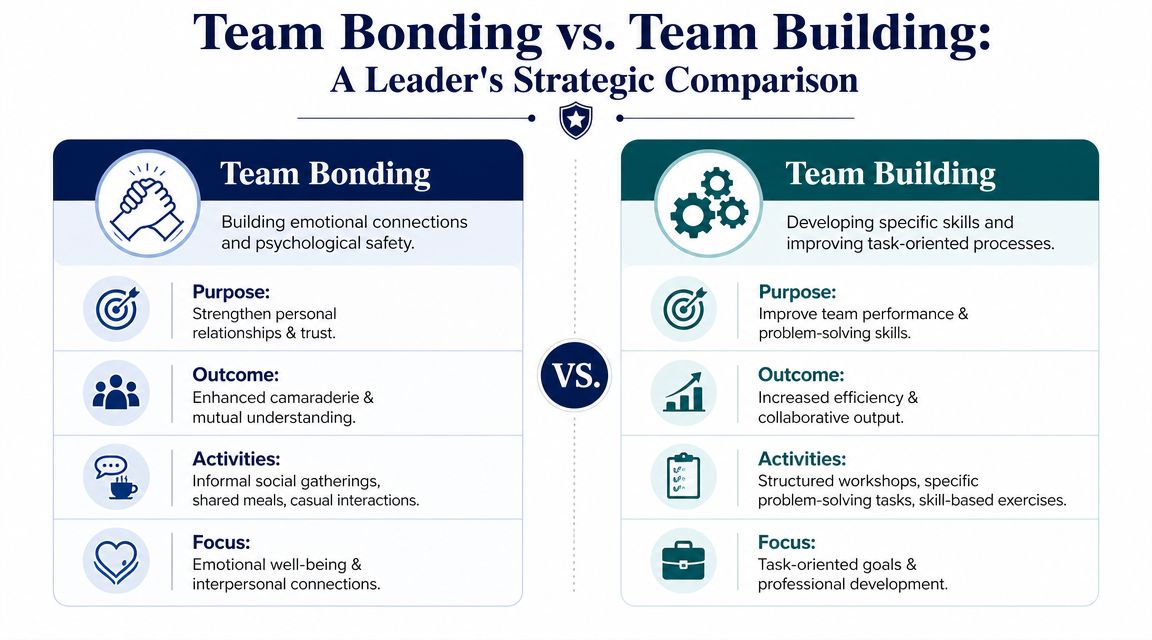
The easiest way to choose between bonding and building is to compare what each one is designed to produce. Most wasted budget comes from asking one to do the job of the other.
Team bonding is about strengthening the who of the team. Team building is about improving the how of its work.
Side-by-side comparison
| Area | Team bonding | Team building |
|---|---|---|
| Primary purpose | Strengthen relationships and trust | Improve team capability and output |
| Core focus | Psychological safety, rapport, belonging | Communication methods, coordination, execution |
| Typical trigger | New team, conflict, disconnection, hybrid distance | New project, stalled performance, process issues |
| Activity style | Shared experiences, social connection, low-barrier interaction | Structured exercises, simulations, facilitated problem-solving |
| What leaders should measure | Coworker support, openness, participation quality | Clarity, collaboration quality, speed, consistency |
| Risk if used at the wrong time | Pleasant event with no operational shift | Resistance, guarded participation, low transfer back to work |
The practical difference in outcomes
Bonding helps people feel safer with each other. Building helps them operate better with each other. Both influence performance, but through different routes.
This distinction also helps HR and People & Culture teams evaluate outcomes more rigorously. Australian evidence from the National Return to Work Survey shows psychosocial risks such as poor support are linked to longer time off work, which is why support and connection shouldn't be treated as cosmetic issues, as discussed in this analysis of bonding, support and work outcomes.
A useful decision lens
Leaders can usually choose the right intervention by answering three questions:
Is the main issue relational or operational?
Does the team trust each other enough to handle challenge well?
Will a structured performance exercise help, or will it expose problems the team isn't ready to process yet?
When the answers are mixed, the right design is often mixed too. A well-run offsite may start with bonding, then move into building once people are engaged and open.
When to Prioritise Team Bonding Activities
The right time for team bonding is usually when the human fabric of the team has weakened, or hasn't formed yet. Leaders often feel the symptoms before they can name them. Meetings become transactional. Cross-functional goodwill drops. New hires stay on the edge of conversations. Minor misunderstandings start carrying more weight than they should.
Australian workplace data consistently show that mental health and stress are leading causes of lost work time, which gives social connection practical relevance at team level. A sensible way to assess bonding efforts is through measures such as perceived coworker support and psychological safety, as outlined in this discussion of team bonding and workplace strain.
Scenarios where bonding should come first
A newly formed or merged team: People may understand the org chart without understanding each other.
Hybrid teams with weak informal contact: Distance reduces the casual moments that build familiarity.
Periods of low morale: Energy is flat, but the problem isn't necessarily a lack of technical skill.
After conflict or organisational change: Teams often need to restore trust before tackling ambitious goals.
Siloed functions: Shared experience can soften unhelpful departmental assumptions.
A team rarely collaborates at a high level when people are still protecting themselves socially.
What works better than forced fun
Bonding lands best when it feels purposeful and accessible. Shared challenge, light competition, community impact, and conversation formats usually outperform awkward spotlight activities. Charity programs can be especially useful because they give people a common task and a shared reason to cooperate without making the event feel overly personal.
For leaders seeing subtle warning signs, the hidden signals of team disconnection can help confirm whether connection is the issue that needs attention first.
When to Invest in Team Building Programs
What should a leader do when people trust each other, but work still slows down?
That is usually the point where team building earns its budget. The team does not need more social connection first. It needs better ways of working. I see this in teams that are friendly, committed, and busy, yet still lose time to vague decisions, duplicated effort, slow handovers, and meetings that create discussion without clear ownership.
The sequence matters. Bonding creates the conditions for honest collaboration. Building turns that goodwill into repeatable performance. If a team has enough trust to challenge ideas, ask for help, and surface problems early, the next intervention should focus on execution.
Situations where building is the better call
A team building investment is usually the stronger choice when:
A major project or transformation is about to start: The team needs shared operating rules before pressure exposes weak coordination.
Results have stalled despite reasonable morale: The problem sits in execution quality, not team sentiment.
A new system, process, or workflow has been introduced: People need structured practice using it together under realistic conditions.
Meetings create motion but not decisions: The team needs clearer decision rights, tighter agendas, and stronger follow-through.
Leaders need observable behaviour change: The intervention should improve how the team plans, solves problems, and holds accountability at work.
This is also where poor design shows up quickly. A high-energy offsite can create short-term enthusiasm and still miss the issue if the team lacks role clarity or decision discipline. A smaller workshop with live problem-solving may produce more value because it targets how the team works.
Match the format to the business problem
Good team building starts with diagnosis, not activity selection. Leaders should ask three practical questions. What behaviour needs to change? What pressure is the team under right now? What evidence would show the program worked 30 days later?
Those questions usually lead to a better format choice. Some teams need a half-day session on decision-making and accountability. Others need several shorter sessions built into existing rhythms so learning transfers into real work. For planners comparing formats, creative ways to boost team morale can help widen the option set, but the final choice should still match workload, trust level, and the operating issue you are trying to fix.
If the brief is tied to business outcomes, use a provider that can shape the session around those outcomes rather than deliver a generic away day. Team building aligned with business objectives is a stronger starting point because it frames the intervention around performance needs.
Conclusion A Unified Strategy for High-Performing Teams
High-performing teams usually aren't built in one move. They connect, then they coordinate. They establish trust, then they test capability. They use bonding and building as separate tools inside one system.
That sequence helps leaders avoid a common mistake. When a team needs trust, a capability-heavy intervention can feel premature. When a team needs sharper execution, a purely social event can feel pleasant but incomplete. The most effective strategy is cyclical. Leaders assess what the team needs now, design the intervention accordingly, then measure whether connection or performance shifted.
Strong teams don't choose between bonding and building. They use bonding to make building possible.
For this reason, mature organizations no longer view team development as an annual event but as an integral part of their operational structure. When teams are organizing destination programs or broader offsite formats, consulting external resources such as this guide to corporate team building activities can be helpful for aligning location, format, and objective.
Frequently Asked Questions
What should a leader do when a team says it needs “team building,” but the underlying issue is low trust, unclear roles, or simple fatigue from too much change? The answer starts with diagnosis. Bonding and building solve different problems, and the right choice depends on what is getting in the team's way right now.
Practical answers for leaders
| Question | Answer |
|---|---|
| Can one program include both team bonding and team building? | Yes, if the design matches the team's stage. Start with bonding when people are guarded, disconnected, or new to one another. Move to team building once there is enough trust for honest discussion, shared problem-solving, and clear accountability. |
| How should success be measured? | Measure the shift you wanted to create. For bonding, track signs such as participation quality, peer support, openness in discussion, and whether people start working across boundaries more easily. For building, look at delivery metrics, decision clarity, role alignment, meeting effectiveness, and follow-through on shared actions. |
| How often should teams run these programs? | Tie frequency to change, not the calendar. Newly formed teams, merged functions, new leaders, and groups under delivery pressure usually need more support than stable teams with strong working relationships. |
| What if the team is sceptical? | Treat that as useful information. Scepticism often comes from past sessions that felt generic, forced, or disconnected from real work. Leaders get better participation when they explain the business reason, choose a format that fits the team, and show how the session will improve day-to-day collaboration. |
| Should participation be mandatory? | Attendance expectations can be firm, but forced enthusiasm rarely helps. In practice, participation improves when people understand why the session matters, how their time will be used, and what outcome the team needs from it. |
| What's the best format for hybrid teams? | The best format is the one that gives remote and in-person staff equal access to the experience. If one group can contribute fully and the other cannot, the session can reinforce distance instead of reducing it. Design for participation equity, clear facilitation, and outcomes that can be observed after the session. |
A simple way to decide is to look at the pattern of failure. If the team avoids conflict, withholds concerns, or lacks interpersonal trust, start with bonding. If trust is reasonably intact but execution is inconsistent, invest in building. If both are weak, run them in sequence and measure each outcome separately.
For organisations that want a more deliberate approach to connection, collaboration, and performance, Corporate Challenge Events provides play-based corporate programs that can be matched to offsites, conferences, charity initiatives, and broader culture objectives.