
R U OK? Day can change behaviour, not just awareness. People exposed to the campaign are up to six times more likely to reach out to someone experiencing personal difficulties than those who aren't exposed, according to Talked's workplace guide to R U OK? Day. That's the strongest reason to treat workplace participation as more than a themed morning tea.
R U OK? Day is a nationally recognised Australian awareness day held on the second Thursday in September, and R U OK? confirms 10 September 2026 as the next R U OK? Day. In many organisations, though, the effort still stops at cupcakes, posters, and a short email from leadership. The awareness is useful. The carry-through is often weak.
Strong R U OK? Day activities for work create a low-pressure starting point for real conversations, then connect those conversations to manager habits, peer support, and visible help pathways. That's the difference between a symbolic event and an operational culture practice. The ideas below are built for HR leaders, People & Culture teams, executive assistants, office managers, and decision-makers who want something more structured, practical, and worth repeating.
Table of Contents
1. R U OK? Day Check-In Circles
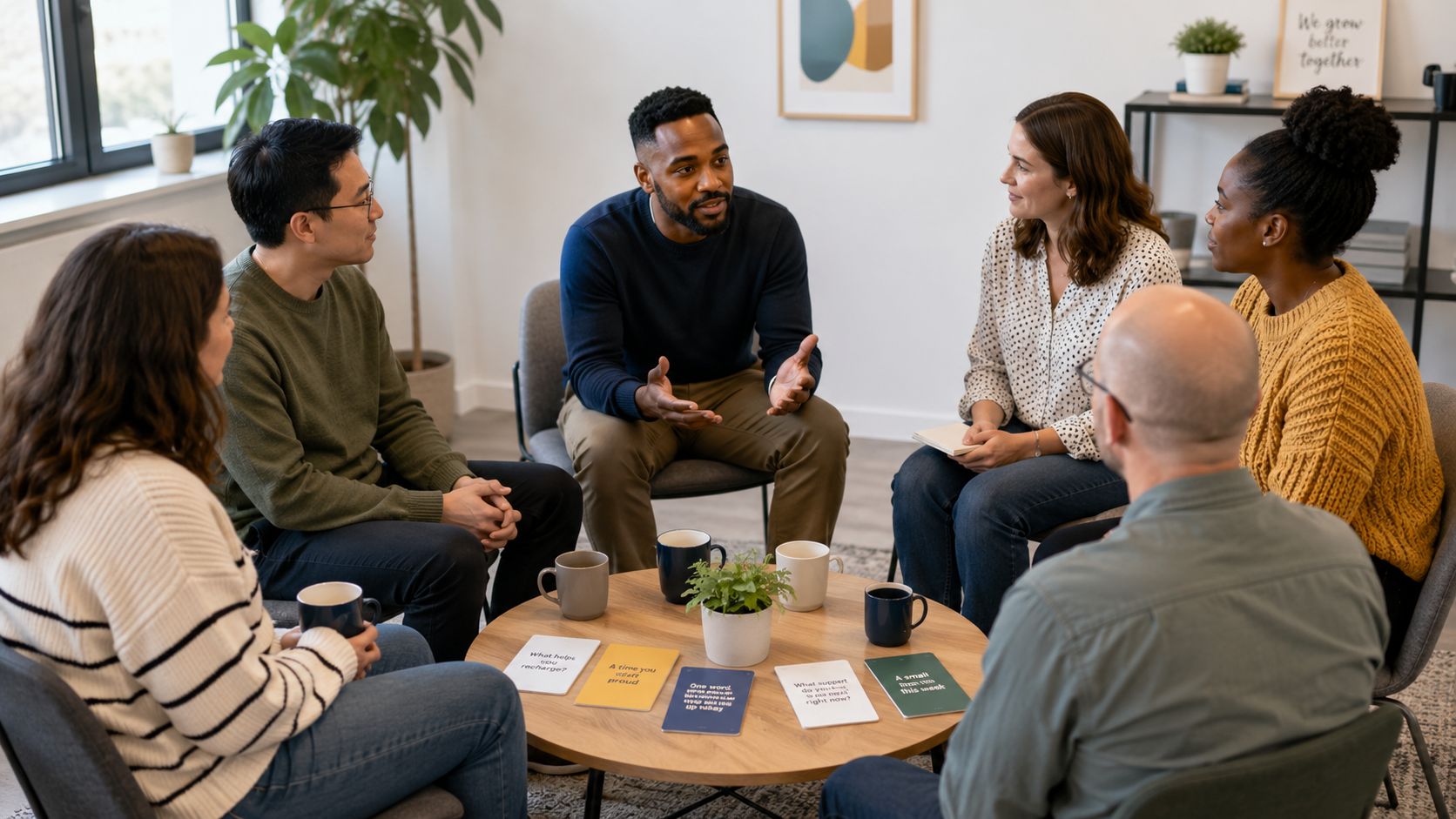
Check-in circles work best when they're small, optional, and properly facilitated. Instead of gathering everyone into one broad morning tea and hoping meaningful conversations happen, organisations can create short, guided discussions in groups where people have room to speak.
This format suits teams that already know each other but haven't built a habit of talking about pressure, workload, or support. It's especially useful in professional services, tech, and healthcare environments where teams often look functional on the surface while carrying a lot privately. A circle gives people a clear prompt, a time boundary, and permission to talk without making the moment feel clinical.
Keep the structure light but clear
A strong format usually includes a facilitator, a clear opening script, one or two questions, and a visible next step if someone needs support. That's more effective than asking people to “share anything” in front of colleagues. For teams wanting a low-barrier format, short interactive connection exercises can help settle the room before the conversation starts. Corporate Challenge Events' Micro Play sessions fit that role when the intent is to lower tension and open people up to talking.
The practical mistake is making circles feel compulsory or therapeutic. They aren't therapy, and the facilitator shouldn't act like a counsellor. The job is to create enough safety for honest peer-to-peer conversation, then direct people to proper support where needed.
Practical rule: Keep attendance voluntary, hold sessions during paid work time, and brief facilitators on listening, boundaries, and referral pathways before the day starts.
Useful design choices include:
Small groups: Keep circles intimate enough that people can speak without performing.
Simple prompts: Ask about workload, energy, support, or what helps during busy periods.
Visible support cards: Place EAP details and external help contacts in the room so the next step is obvious.
Theme capture without names: Record recurring issues such as workload pinch points or manager communication gaps, but never identify individuals.
2. R U OK? Day Charity Team Challenge
A charity challenge can do something a standard awareness event often can't. It gives people a shared task, a reason to collaborate, and a sense that the day has practical value beyond internal messaging. For many workplaces, that mix of purpose and participation gets better engagement than a passive talk or catered break.
This works particularly well for larger offices, cross-functional groups, and organisations trying to connect wellbeing with CSR. A team challenge can involve problem-solving, movement, creative builds, or time-based collaboration, as long as the activity is accessible and the charity link is credible. The point isn't to turn R U OK? Day into a fundraising spectacle. The point is to create a collective experience that opens conversation while supporting a relevant cause.
Design the debrief, not just the event
The best version of this idea includes a short facilitated debrief after the activity. Without that, teams often remember the challenge but not the reason it was attached to R U OK? Day. With a debrief, leaders can connect what just happened to trust, asking for help, shared responsibility, and the way support shows up at work.
For companies already exploring purpose-led experiences, charity team building programs in Australia can provide a structure that feels more substantial than a themed lunch. A mental-health-aligned adaptation works well when leadership clearly explains where support or donations are going and why the organisation chose that cause.
What doesn't work is using charity as a branding exercise. If the event has high energy but no explanation, no support messaging, and no follow-up, employees see it for what it is.
The strongest charity-based R U OK? Day activities for work create connection first, then use that connection to make support conversations easier.
Practical examples include a bank running cross-department team tasks tied to a mental health fundraiser, a professional services firm adapting an obstacle-style challenge around collaboration and support, or a distributed workforce joining a hybrid giving challenge with local participation options for field teams and office staff alike.
3. Wellbeing Resource Stations & Interactive Displays
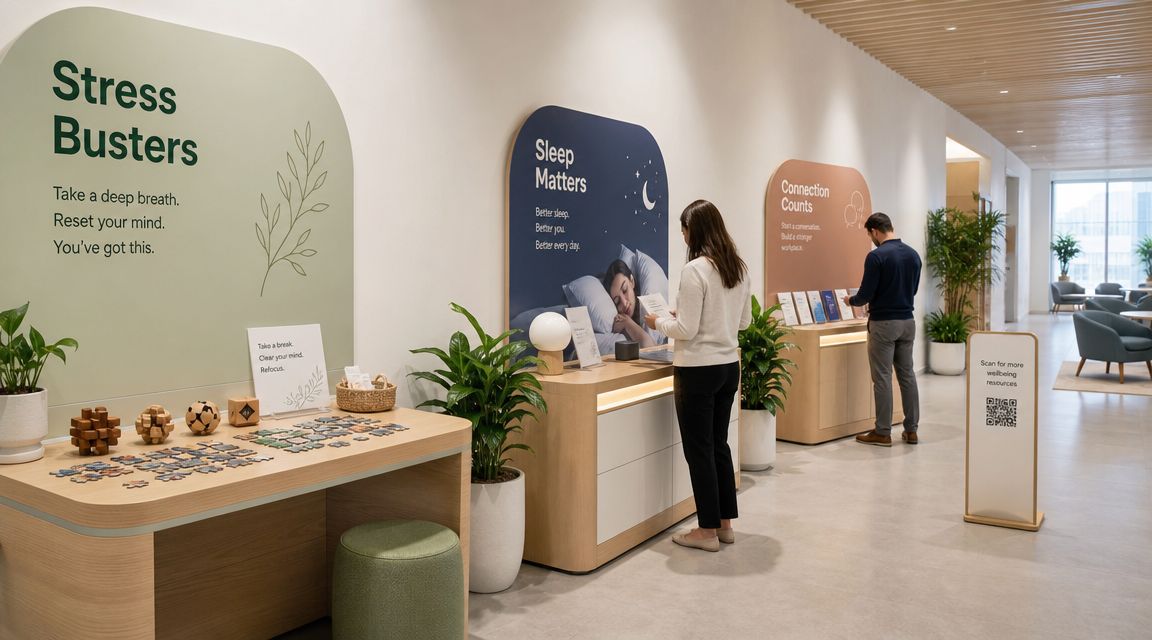
Resource stations are useful when a workforce won't all engage in the same format. Some employees will join a panel. Some will attend a team event. Others will only interact privately, quickly, and on their own terms. A station-based setup respects that difference.
Done well, these displays don't feel like a wall of brochures. They use short prompts, QR codes, conversation starters, manager guidance, and support-pathway signage people can absorb in a few minutes. R U OK?’s workplace resources are built around posters, practical guides, and conversation starters to help people ask the question safely, as outlined in the organisation's workplace resources.
Make support easy to find and easy to use
A good station belongs in high-traffic areas such as kitchens, entry zones, breakout spaces, or near lifts. It should also appear in digital form for hybrid teams. That may include intranet tiles, downloadable prompt cards, short videos from leaders, and QR access to internal wellbeing pages.
Independent guidance also recommends making support-system visibility part of the activity itself, including EAP access details and using short post-event surveys or confidentiality-protected monitoring to assess whether the day had any practical effect. That makes stations more than decoration. It turns them into a measurable intervention.
A useful complement is practical training content that helps leaders understand why mental health capability belongs inside business operations, not beside them. Corporate teams exploring that link can review Corporate Challenge Events' mental health training perspective alongside support resources. For employees seeking private help outside workplace channels, services such as Interactive Counselling online show how accessible remote support can be.
Keep dwell time short: Most employees will give a station a few minutes, not half an hour.
Use plain language: “Need support today?” works better than policy-heavy wording.
Offer anonymous access: QR codes reduce the social friction of picking up a printed resource.
Refresh the content: If the station looks unchanged year after year, people stop seeing it.
4. Manager Facilitation Training for R U OK? Day Conversations
Many R U OK? Day activities for work fail at the exact point they should get stronger. Someone opens up, a manager feels unprepared, and the moment stalls. That's why manager training is one of the highest-value investments around the day.
Australian workplace guidance increasingly treats R U OK? Day as part of a longer culture strategy. HR Leader's coverage of workplace wellbeing notes psychologist Dr Natalie Flatt's point that genuine connection reduces isolation and lowers psychological distress, while also helping issues surface earlier before they escalate into crises or prolonged absences. For leaders, that means conversation skill is not a soft extra. It's part of risk management, team performance, and people care.
Train for the second conversation
One training session before September won't solve everything, but it can change how managers handle the first and second conversation. The first conversation is the check-in. The second is the follow-up after someone has disclosed pressure, distress, or personal difficulty. That's where many managers lose confidence.
Useful training includes role-play, escalation guidance, confidentiality boundaries, and scripts that sound human rather than scripted. It should also cover what not to do, such as overpromising secrecy, trying to diagnose someone, or turning a wellbeing conversation into a performance meeting.
Leadership teams that want to build broader capability can pair R U OK? Day preparation with leadership development training so managers practise listening, follow-up, and decision-making under real workplace conditions. Supplementary reading on starting mental health conversations can also help managers prepare for common hesitation points.
A manager doesn't need to have the perfect words. They need enough confidence to ask, listen, stay calm, and connect the person to support.
Strong manager training usually includes:
Realistic scenarios: Busy periods, behavioural changes, return-to-work conversations, and workload stress.
Escalation maps: Clear internal and external referral pathways.
Follow-up prompts: Short check-in language managers can use.
Alignment with HR: Managers need to know who to call when a conversation becomes more serious.
5. R U OK? Day Team Relay or Obstacle Course
Not every wellbeing activity needs chairs in a circle. For some teams, movement creates a better entry point than sitting still and talking. A relay or obstacle course can work well when the activity is framed around mutual support, communication, and inclusion rather than pure competition.
This format tends to suit sales teams, frontline groups, site-based teams, and organisations that want visible energy on the day without defaulting to a social function. The strongest design includes mixed challenge types, such as physical tasks, problem-solving stations, communication drills, and collaborative builds. That keeps participation broader and avoids turning the event into a test of fitness.
Keep competition in its place
The risk with this idea is obvious. If the event becomes too competitive, the wellbeing intent disappears. Fast teams dominate, less physical employees step back, and the symbolic link to support gets lost. Good facilitation fixes that. Scoring can reward communication, inclusion, strategy, and encouragement, not just speed.
The Victorian Education Department's RU OK? Day toolkit recommends intentionally low-friction, conversation-led formats such as team walks, quick games, picnics, or barbecues to create informal conditions for check-ins rather than formal training. It also suggests broader routines like time-out activities, buddies, and social committees in the toolkit PDF. That logic applies here too. The activity should lower barriers and create openings for conversation, not overwhelm people.
A facilitated outdoor challenge such as Survivor team building days can work when organisers build in accessible modifications, short debriefs, and mixed-role team composition. In practice, the most effective version isn't the hardest course. It's the one where colleagues notice who offers help, who asks for it, and how the team responds under pressure.
6. R U OK? Day Peer Support Network Launch
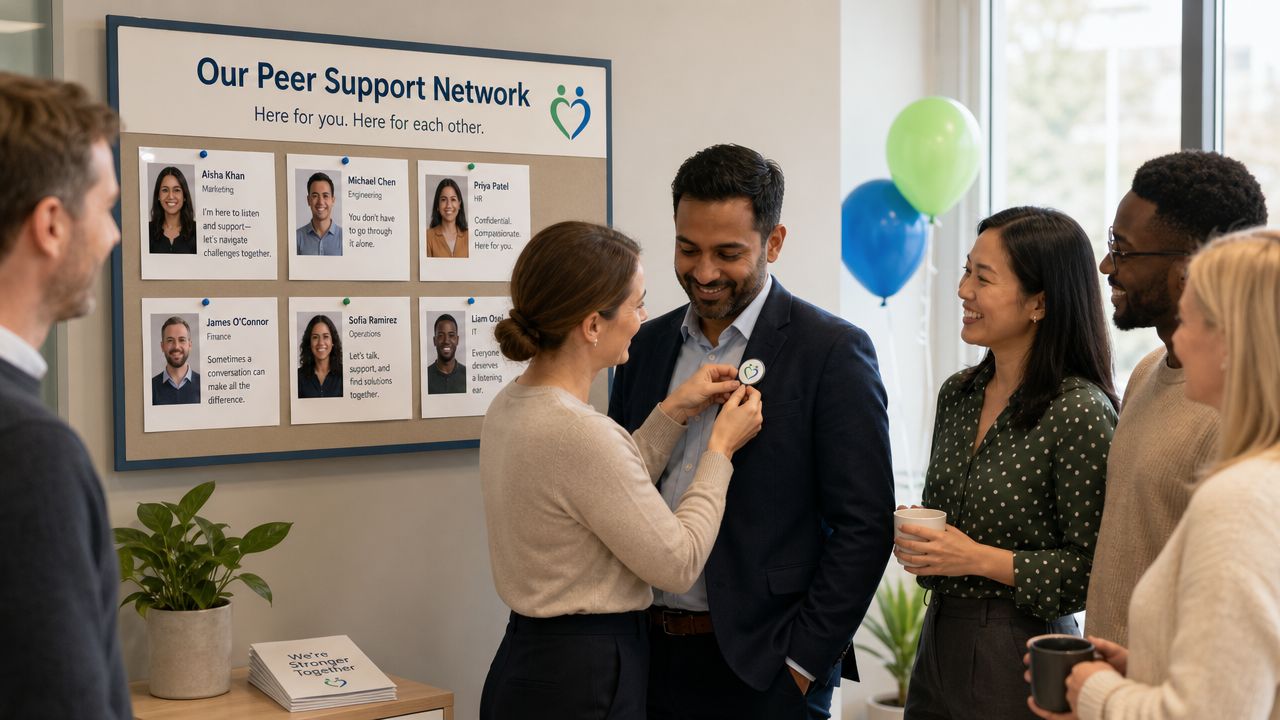
Launching a peer support network on R U OK? Day gives the organisation something many one-off activities don't. It creates an ongoing structure people can use after the campaign messaging is gone.
This approach suits workplaces where employees may hesitate to speak with a direct manager first. That's common in hierarchical environments, large matrix organisations, and teams with younger employees or dispersed reporting lines. A peer supporter isn't a counsellor, and shouldn't be positioned as one. The role is to listen, notice when further support is needed, and guide a colleague toward the next step.
Visibility matters as much as training
A peer network only works if employees know it exists, understand its boundaries, and can access it without awkwardness. Launch day should include photos, names, contact routes, role descriptions, and a clear explanation of confidentiality limits. If people have to hunt through the intranet to find a supporter, usage will stay low.
One of the biggest gaps in workplace R U OK? content is what happens after the social event. Official guidance emphasises safe, practical conversation and follow-up, not just staging an event, as highlighted on R U OK? Day workplace guidance. That makes a peer network especially valuable because it creates a pathway after the morning tea, lunch, or panel has ended.
Useful implementation choices include:
Cross-level recruitment: Include supporters from different teams, tenures, and levels of seniority.
Boundary training: Teach listening, referral, documentation rules, and self-care.
Manager and HR alignment: Everyone should understand when peer support hands over to formal support.
Ongoing recognition: Keep the network visible after September through internal communications and awareness campaigns.
A healthcare organisation might launch peer supporters in high-pressure teams. A technology firm might combine the launch with digital office hours for remote staff. A finance business might place supporters across departments so employees can choose someone outside their reporting line.
7. R U OK? Day Leadership Panel or Conversation Series
A leadership panel can either shift culture or backfire badly. The difference comes down to honesty, preparation, and restraint. When senior leaders speak in polished corporate language about resilience while avoiding anything real, employees switch off. When leaders share appropriately, acknowledge pressure, and point clearly to support, the event can reduce stigma and strengthen trust.
This format works best when it's moderated well and includes more than one perspective. A useful mix might include a senior executive, a people leader, a mental health professional, and an employee speaker who has chosen to share lived experience with proper support around them. The purpose isn't emotional theatre. It's to model what a respectful, boundaried conversation looks like at work.
Use stories carefully
Panellists need briefing before the event and support after it. They should know what topics are in scope, what's off-limits, and how to pause if the conversation becomes difficult. Audiences should also hear clear guidance at the start about available support, especially if any stories touch on distress, burnout, or recovery.
One persistent gap in current R U OK? content is inclusion for hybrid, field-based, and time-poor teams. Office morning teas often miss the very employees who need practical access the most. EatFirst's discussion of workplace R U OK? ideas points to the need to consider remote teams, but many organisations still stop short of designing equal-participation formats. A panel solves some of that if it's streamed live, recorded for later access, and paired with digital Q&A or team discussion prompts.
Good panels don't ask leaders to be vulnerable on command. They ask them to be credible, specific, and useful.
A conversation series can be even stronger than a one-off panel. One session may focus on manager support, another on remote work and isolation, and another on recovery, boundaries, or team pressure during peak periods.
8. R U OK? Day Customised Problem-Solving Challenge
If the organisation wants R U OK? Day to generate action rather than sentiment, a customised problem-solving challenge is one of the best options. Teams work on real barriers to support inside the business, then propose changes leaders can review and implement.
This idea works particularly well in organisations that already have employee listening channels but struggle to convert feedback into visible action. Instead of asking employees to “share ideas” in a vague way, the challenge gives them a specific question. That might be how to improve check-ins for shift teams, how to make EAP access more visible, or how to help new managers respond when someone says they're not OK.
Turn ideas into operating changes
The quality of this format depends on the brief. If the challenge is too broad, teams produce slogans. If it's specific, they produce workable solutions. Good prompts are operational, local, and tied to something employees can observe in their daily work.
For organizations already using play-based ideation, The Pitch team challenges would be a natural fit. Instead, the concept can be adapted through facilitated team problem-solving methods commonly used in corporate offsites and culture workshops. The stronger pattern is to involve HR and operational leaders in advance, provide teams with enough context, and commit to reporting back on which ideas will progress.
What often fails is the follow-up. Employees contribute thoughtful ideas, then hear nothing again. That damages trust more than not asking in the first place.
Useful prompts include:
Support access: How can employees find help quickly during busy or off-site work?
Manager habits: What should a monthly wellbeing check-in look like in this team?
Hybrid inclusion: How can remote and frontline employees participate equally in R U OK? Day activities for work?
Referral pathways: What should happen after a colleague says they're struggling?
R U OK? Day: 8 Workplace Activities Compared
| Item | Implementation complexity | Resource requirements | Expected outcomes | Ideal use cases | Key advantages |
|---|---|---|---|---|---|
| R U OK? Day Check-In Circles | Medium, needs trained facilitators and scheduling | Low–Medium, facilitator training, quiet space or virtual room, simple materials | Increased psychological safety, practice of supportive conversations, stronger team trust | Small to medium teams, hybrid teams, preparatory sessions for R U OK? Day | Normalises mental health dialogue, low cost, scalable |
| R U OK? Day Charity Team Challenge | High, event coordination, fundraising logistics and safety planning | Medium–High, event staff, equipment, charity partners, fundraising systems, prizes | Tangible funds raised, high engagement, strengthened team pride and CSR visibility | Large all‑staff events, CSR-driven campaigns, high-energy engagement days | Generates measurable impact, energises teams, strong external messaging |
| Wellbeing Resource Stations & Interactive Displays | Low–Medium, design and placement planning; simpler to deploy | Low–Medium, displays, QR codes, optional staff, small budget for materials | Broad reach to diverse employees, accessible mental health info, engagement metrics | High-traffic workplaces, awareness weeks, sites needing low-barrier options | Non-intimidating access to resources, multi-sensory engagement, easy scalability |
| Manager Facilitation Training for R U OK? Day Conversations | Medium, curriculum design and experiential delivery | Medium, trainers, workshop time (half/full day), role-play resources, follow-up coaching | Improved manager confidence, consistent wellbeing conversations, earlier referral to support | Leadership development programs, organisations aiming for sustained culture change | Builds lasting capability, reduces manager anxiety, improves psychological safety |
| R U OK? Day Team Relay or Obstacle Course | High, safety, logistics and inclusivity planning required | High, physical space, equipment, safety staff, first aid, insurance | High-energy bonding, mood uplift from physical activity, trust through teamwork | Outdoor/all-staff active events, teams seeking memorable experiential activities | Memorable shared experience, physical wellbeing benefits, strong engagement |
| R U OK? Day Peer Support Network Launch | Medium, selection, training and governance setup | Medium, training sessions, recognition materials, integration with EAP/HR, ongoing support | Sustainable peer-level support, reduced stigma, increased help-seeking | Organisations wanting long-term, distributed support infrastructure | 24/7 informal support presence, cost-effective, builds internal capacity |
| R U OK? Day Leadership Panel or Conversation Series | Medium–High, panellist recruitment and safeguarding, expert moderation | Medium, moderator, tech for hybrid/recording, support personnel, safety protocols | Leadership modelling vulnerability, stigma reduction, emotional resonance with staff | Large audiences, culture-change signalling, hybrid or recorded events | Demonstrates senior commitment, relatable stories, wide organisational reach |
| R U OK? Day Customised Problem-Solving Challenge | High, pre-event design with leadership and skilled facilitation | Medium, facilitators, time for ideation/prototyping, materials, leadership buy‑in for follow-up | Actionable employee-generated solutions, increased ownership, strategic wellbeing insights | Organisations seeking concrete improvements and employee-driven ideas | Produces implementable ideas, aligns wellbeing with strategy, fosters accountability |
From a Day to a Dialogue Sustaining the Conversation
R U OK? Day works best when leaders stop treating it like a standalone event. Awareness has value, but workplace culture changes when people know how to ask, how to listen, what to do next, and where support sits inside the organisation. That's why the strongest R U OK? Day activities for work are structured, repeatable, and connected to visible systems.
Morning teas still have a place. R U OK? itself recommends practical workplace formats such as morning teas, lunches, casual team events, conversation resources, and manager check-ins through its workplace-focused guidance referenced by Talked. The point isn't to reject those ideas. It's to build around them so the social moment leads somewhere useful.
In practice, that means asking a few hard planning questions. Which groups are likely to be missed by an office-based event. Which managers need extra support before the day. What should happen if someone discloses they're struggling. How will employees find peer support, HR help, or EAP details after the event is over. If those answers aren't clear, the activity may still feel positive on the day, but it won't do much to strengthen the culture around it.
The most reliable pattern is simple. Use R U OK? Day to create a low-pressure opening. Pair the activity with conversation prompts, trained leaders, and visible support pathways. Follow it with regular check-ins in one-on-ones and team meetings. Measure something more meaningful than attendance, such as perceived psychological safety, awareness of support options, or whether employees know what to do when a colleague appears to be struggling.
That approach positions wellbeing where it belongs. Not as a side initiative owned only by HR, but as part of how the organisation leads, communicates, and performs under pressure. Trust, connection, and mutual support are cultural assets. They influence retention, collaboration, decision-making, and how early teams surface problems before they become performance or safety issues.
For organisations wanting external support, Corporate Challenge Events is one option for facilitated workplace activities and team-based event formats that can be adapted to a broader R U OK? Day program. The ultimate test, though, isn't who runs the event. It's whether the event makes the next conversation easier.
If the goal is to turn R U OK? Day into a practical culture-building moment, Corporate Challenge Events can help design and facilitate workplace activities that go beyond passive awareness. Their play-based corporate programs can support connection, conversation, and structured team engagement as part of a broader wellbeing strategy.