
Someone is explaining a client problem while the person listening checks an email, scans a notification or mentally prepares a response. The conversation technically happens, but an important detail is missed and neither person leaves feeling fully understood. In workplaces filled with back-to-back calls and competing demands, how much friction begins because people are physically present but mentally somewhere else?
FISH! Philosophy: Be There offers a simple response: give the person in front of you your genuine attention. It is one of the four FISH! Philosophy practices, alongside Play, Make Their Day and Choose Your Attitude, and it provides teams with a practical way to strengthen listening, communication and everyday connection.
Distraction does not always come from a device. Mental noise can be just as disruptive, and understanding the relationship between overthinking and anxiety can help leaders recognise why someone may struggle to remain focused even when external distractions have been removed. Being present at work is not about achieving perfect concentration. It is about noticing when attention has drifted and deliberately bringing it back to the conversation that matters.
What Be There Means in Practice
Presence Is a Behaviour, Not a Mood
A team member joins a meeting, spends the first few minutes answering messages and then asks for the main point to be repeated. They may care about the discussion, but their behaviour communicates something different. Presence is not measured by intention. It is demonstrated through attention.
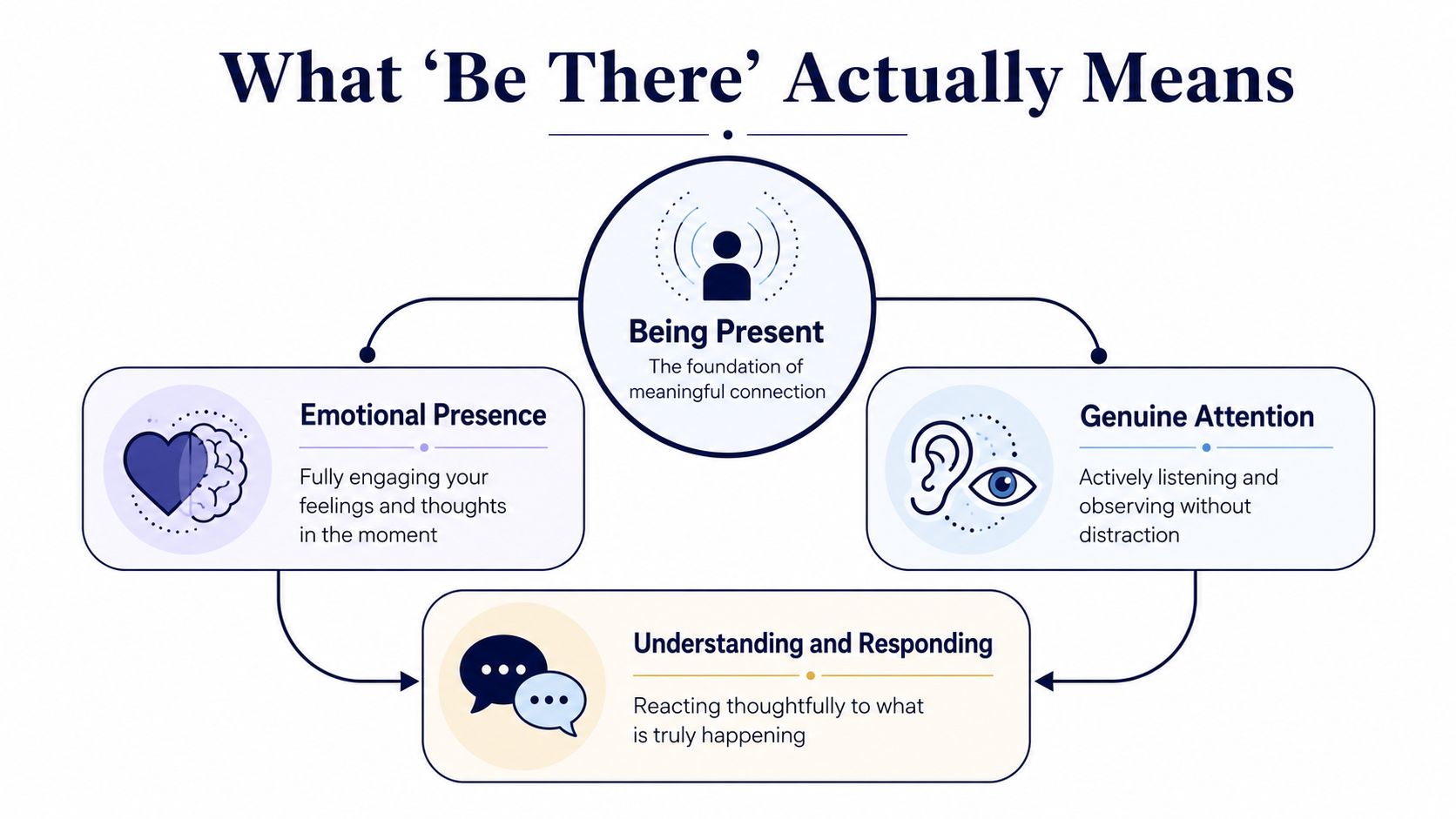
In the FISH! Philosophy, Be There means being emotionally present for the person in front of you. At work, that involves putting competing distractions aside long enough to listen, understand and respond to what is actually being said.
Leaders can recognise presence through observable behaviours. It appears in the clarifying question that uncovers the real issue, the accurate summary that confirms understanding and the thoughtful response that considers both the words spoken and the way they were delivered. Active listening is not simply remaining quiet until it is your turn. It means listening to understand rather than preparing a reply while the other person is still speaking.
This overlaps closely with emotional intelligence in the workplace. Reading the room, recognising another person’s emotional cues and regulating the impulse to react all require enough presence to notice what is happening. Without attention, even strong communication skills have little information to work with.
Presence is also a skill that can be developed over time. Resources that introduce present-moment awareness in simple, accessible ways reinforce the same underlying habit: noticing when attention has wandered and deliberately returning it to the person, conversation or task in front of you.
This is what makes Be There practical. It is not an abstract value or a personality trait. It is a collection of behaviours that people can practise, observe and reinforce in everyday interactions.
Respect Shows Up in the Small Things
Being present does not mean being permanently available. A person can set clear boundaries and still give someone their full attention when a conversation begins.
In fact, saying, “I want to give this the attention it deserves. Can we speak at 2 pm?” may be more respectful than listening while answering emails or rushing towards another deadline. The first response protects the quality of the conversation. The second creates the appearance of availability without genuine attention.
This distinction is particularly useful for hybrid teams, where online status and quick replies can easily be mistaken for connection. Deliberate presence communicates, “I am here for this exchange,” without expecting people to remain constantly reachable.
Often, respect is visible in small choices: closing the laptop, silencing a notification, asking a thoughtful follow-up question or remembering something that mattered to the person. A useful test is whether they leave the interaction feeling clearer and understood, rather than as though they were competing with everything else for attention.
Why Presence Is Difficult in the Modern Workplace
Modern work is designed around constant communication. Meetings, emails, messages and notifications make it easier to reach people, but they also compete for the attention required to listen and think clearly.
Microsoft’s research into the infinite workday found that the 20% of Microsoft 365 users receiving the highest volume of communications were interrupted by a meeting, email or chat notification every two minutes during core working hours. Across the full day, this amounted to approximately 275 interruptions.
This does not mean every employee experiences the same level of disruption. It does illustrate the environment in which many people are being asked to concentrate, collaborate and respond thoughtfully. When attention is repeatedly redirected, being present requires a deliberate choice rather than happening automatically.
Hybrid Work Adds Another Layer
Hybrid work offers valuable flexibility, but it can make attentive communication more difficult. The Australian Bureau of Statistics reported that 36% of employed Australians usually worked from home in August 2024, meaning a significant proportion of workplace interaction now takes place through screens, chat platforms and virtual meetings.
In this environment, responsiveness can easily be mistaken for presence. A team member might reply quickly without fully understanding the question, while a manager can attend every virtual meeting and still miss the concern behind someone’s words.
Video calls create their own demands. Sustained screen focus, limited non-verbal cues and back-to-back scheduling can make it harder to remain engaged across the day. Our guide to Zoom fatigue and how to avoid it explores practical ways leaders can reduce that strain and make virtual communication more effective.
The challenge is not simply that people are distracted. It is that many workplaces expect them to remain reachable, responsive and focused while the tools they use continually divide their attention. Be There gives teams permission to slow the exchange down, reduce avoidable distractions and prioritise understanding over the appearance of constant availability.
What Be There Looks Like in Practice
In Conversations and Customer Calls
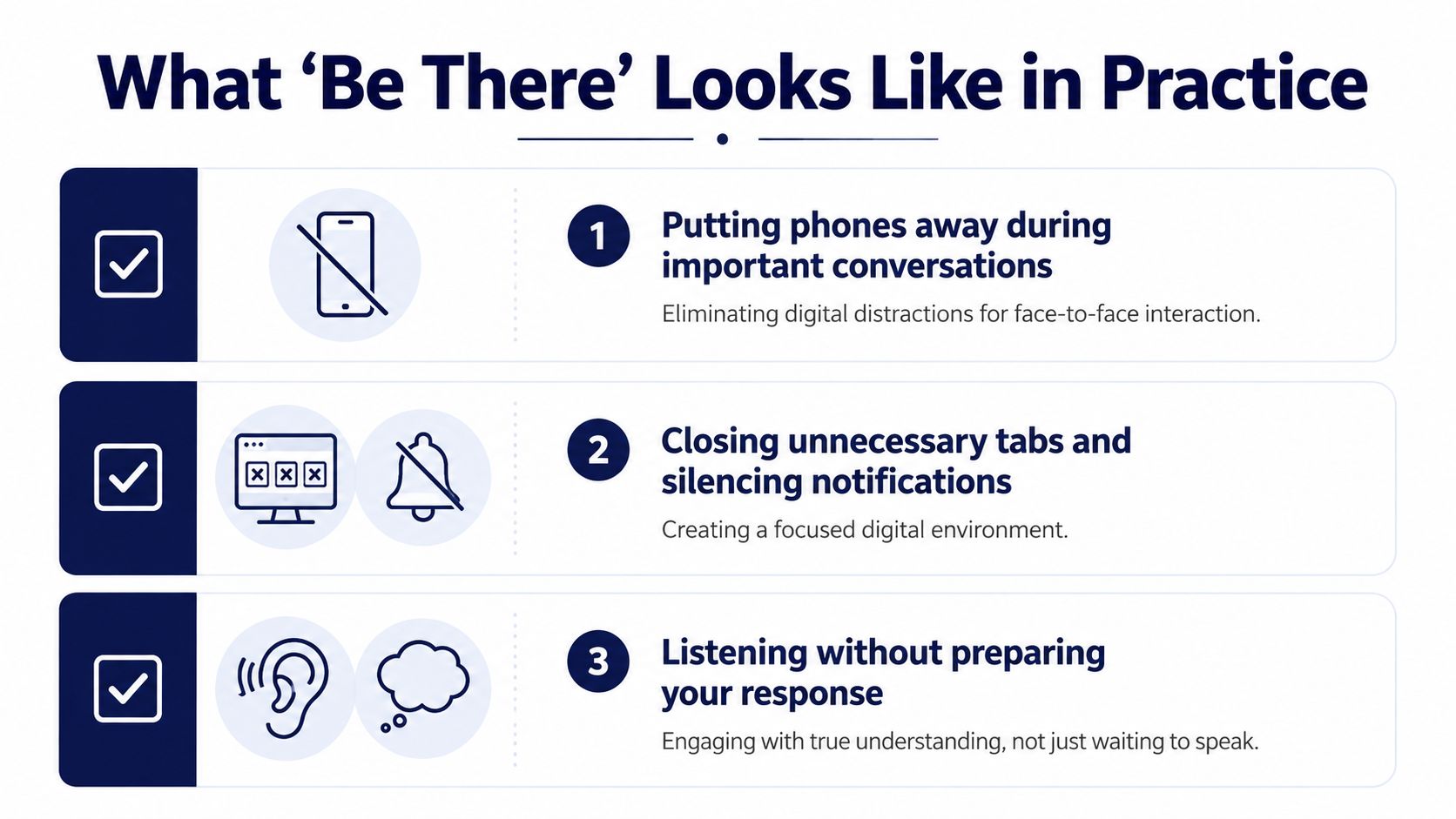
Presence begins before the other person speaks. Put the phone away, close unnecessary tabs and silence notifications that do not require immediate attention. If the conversation matters, create enough space to hear it properly.
During the discussion, listen for understanding rather than preparing your response. One useful habit is to ask a clarifying question before offering advice or a solution. This creates a pause, checks your interpretation and often reveals an important detail that would otherwise have been missed.
Summarising the key point can also prevent misunderstandings:
“What I’m hearing is that the main issue is the delay between approval and delivery. Is that right?”
Customer calls require the same discipline. If you need to type notes or access information while the customer is speaking, explain what you are doing. A simple comment such as, “I’m taking notes so I capture this correctly,” prevents useful activity from being mistaken for disengagement.
Attention between conversations matters too. Moving directly from one call to the next can carry distraction and stress into the new interaction. A short reset, even standing up, taking a breath or briefly shifting attention, can help people return ready to listen. Our guide to micro-play at work offers simple ways to create these small moments of recovery during the day.
Finally, follow up on what mattered. Remembering a concern, asking how something went or returning with the information you promised demonstrates that the conversation was retained, not merely processed. For managers, that can communicate genuine attention more powerfully than a polished response in the moment.
In Meetings and Team Discussions
Being present does not require longer meetings. It requires clearer ones. People are more likely to stay engaged when the purpose is understood, the discussion is relevant and everyone knows how they can contribute.
Leaders can support presence by inviting input from people who have not yet spoken, addressing side conversations and allowing an idea to be understood before it is challenged. Remote participants also need active inclusion. Being able to hear the meeting is not the same as having a genuine opportunity to join it.
Respecting attention also means recognising when a meeting has served its purpose. Finish with a clear summary of the decision, responsibilities and next steps, then end on time rather than extending the discussion unnecessarily.
These behaviours become more effective when they are shared across the team rather than left to individual preference. Our guide to practising FISH! in the workplace provides simple ways teams can turn the four practices into consistent workplace habits.
What Be There Does Not Mean
Be There is not a demand for constant availability. It does not require people to attend every meeting, respond immediately or put every interruption ahead of their own priorities. It also does not mean agreeing with everything another person says or taking responsibility for how everyone else feels.
Presence is about the quality of attention given during an interaction, not the number of interactions someone accepts. A person can listen carefully, understand another perspective and still disagree. They can also recognise that they do not have the capacity to give a conversation proper attention at that moment.
Healthy boundaries support the principle. Rescheduling an important discussion is often more respectful than continuing with divided attention. Be There asks people to be intentional about where their attention goes. It does not ask them to ignore workload, recovery or competing responsibilities.
Turn Be There into a Team Habit
Presence becomes part of workplace culture through small, repeated behaviours. A team does not need to transform every meeting at once. It can begin by choosing one interaction where greater attention would make a meaningful difference.
For example, the team might:
-
Keep phones away during one weekly meeting.
-
Begin one-on-ones with a genuine check-in.
-
Ask a clarifying question before responding to a concern.
-
Summarise decisions and next steps at the end of conversations.
-
Create a short pause between important customer calls.
-
Follow up on something a colleague previously shared.
Start with One Small Experiment
Choose one behaviour and practise it consistently for a few weeks. Then ask whether it changed the quality of the team’s interactions. Did fewer points need to be repeated? Were next steps clearer? Did more people contribute? Were misunderstandings identified earlier?
The aim is not perfect concentration. It is helping people recognise when a colleague, customer issue or decision deserves deliberate attention, then protecting that attention long enough for the interaction to be useful.
Useful habit: if a conversation matters enough to revisit later, it probably deserves your full attention the first time.
For organisations wanting to introduce all four practices, our guide to the FISH! Philosophy explains how Be There works alongside Play, Make Their Day and Choose Your Attitude. Leaders can then use the principles in our guide to measuring culture change to look for observable shifts in behaviour rather than relying only on whether the team enjoyed the conversation.
Corporate Challenge Events also delivers facilitated FISH! workshops that help teams translate the four practices into everyday actions. The goal is not to make people perform presence. It is to create a shared understanding of what genuine attention looks like and why it matters.
Corporate Challenge Events designs facilitated experiences that help teams practise Be There, improve workplace communication and build stronger habits around attention, trust and follow-through. For HR leaders, People & Culture teams and managers who want a practical way to turn the FISH! Philosophy into everyday behaviour, visit Corporate Challenge Events and explore the workshop options that fit your team.