
Small teams do not need scaled-down versions of large corporate events. They need activities designed to make every person part of the experience. With fewer people in the room, communication becomes more visible, participation is harder to avoid and each person’s contribution can directly shape the result.
The best small group team building activities reflect what the team actually needs, whether that is sharper problem-solving, stronger relationships, more energy or simply an opportunity to enjoy working together away from everyday pressures. There are plenty of innovative team-building activities for businesses, but the strongest choice will always suit the team’s personalities, available time, preferred level of competition and comfort with physical activity.
The following eight activities work particularly well for small teams because they provide clear roles, shared challenges and plenty of opportunities for everyone to contribute.
Table of Contents
- 1. Safe Crack
- 2. Pipeline
- 3. Risk Reward
- 4. Minute to Win It
- 5. LEGO Legends
- 6. Out of the Box
- 7. City Scramble
- 8. Bikes for Tykes
- How to Choose the Right Activity for a Small Team
- Why Professional Facilitation Still Matters
- Frequently Asked Questions
- What are the best team-building activities for small groups?
- How many people are considered a small group?
- How long should a small-group team-building activity last?
- Can team-building activities be held in the workplace?
- What activities work for teams with mixed fitness levels?
- Are small-group activities suitable for remote or hybrid teams?
- How much do facilitated small-group team-building activities cost?
- How do you make team building feel less awkward?
- Beyond the Activity Choosing an Event with Lasting Impact
1. Safe Crack
Safe Crack turns a small team into an investigative unit working to uncover the people behind a diamond-smuggling operation. Participants analyse evidence, complete challenges and piece together clues, making it a natural fit for team building activities for small groups where every person needs to contribute.
The mystery reveals how different people approach an unfamiliar problem. Some participants identify patterns quickly, while others question assumptions, check details or keep the group focused on the evidence. Success depends on sharing those observations rather than solving each part alone.
This makes Safe Crack useful for teams wanting to strengthen collaborative problem-solving and decision-making. The principles in Recepta.ai’s problem-solving guide, including defining the problem, considering different perspectives and evaluating possible solutions, can all be seen in action as the mystery unfolds.
A facilitated debrief can then connect the experience to workplace situations involving incomplete information, competing theories or changing assumptions. For leaders wanting to develop these skills further, our guide to problem-solving training for employees explores how structured practice can help teams approach challenges more effectively.
2. Pipeline
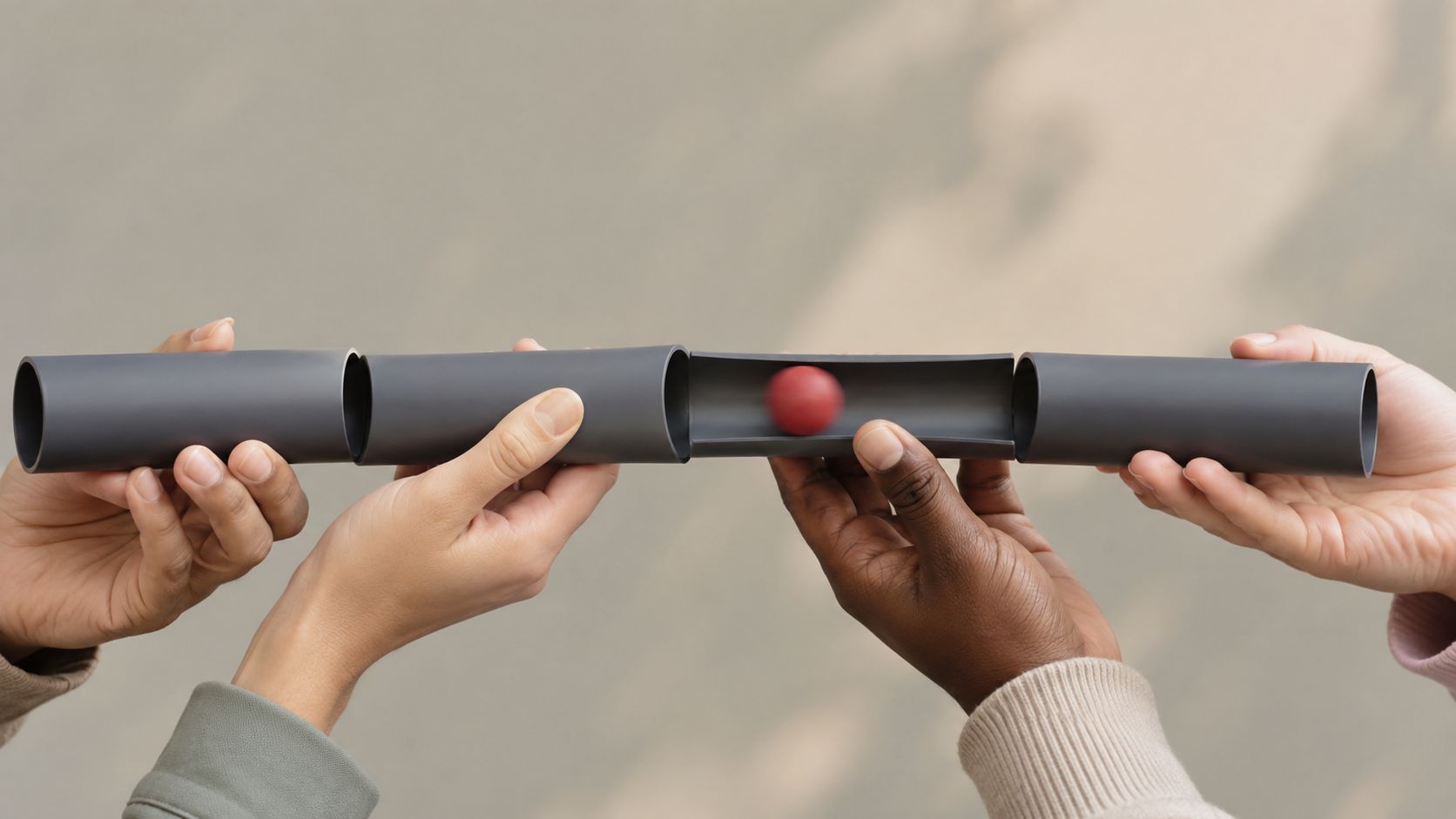
Pipeline gives small teams a clear demonstration of how individual actions affect a shared result. Participants use sections of pipe to transport an object from one point to another, with success depending on timing, communication and coordination across the entire group.
Every handover matters. Moving too early can disrupt the process, while uncertainty or unclear instructions can bring progress to a stop. As teams repeat the challenge, they begin adjusting their approach, communicating more clearly and anticipating what others need.
The activity creates a useful parallel with workplace projects involving multiple people or departments. A delay, missed handover or unclear responsibility at one stage can affect everything that follows. During the debrief, the team can use a creative problem-solving model to examine what changed between attempts and which decisions improved the result.
Pipeline works particularly well as a small team activity because every participant is connected to the outcome. There are no passive roles, and the team receives immediate feedback each time its process succeeds or breaks down.
3. Risk Reward
Small teams often make better strategic decisions when everyone has to commit, and Risk Reward is built around that pressure. Teams create fictional businesses, then decide how to invest company funds across challenges with different levels of risk and possible return. It feels familiar to leaders because the conversation mirrors real business trade-offs, only with less career risk and more room to test judgment.
The best version of this activity pushes the team to explain its thinking before it commits. That makes the discussion more valuable than the points or the pretend money. People reveal how they weigh uncertainty, how quickly they reach consensus, and whether the loudest voice drives the decision or the group thinks together.
A useful debrief asks what the team did when information was incomplete. In small groups, those moments come quickly because there's nowhere to disappear. That's why the activity suits executive teams, project groups, and cross-functional teams that need to align on priorities before they take action.
For leaders planning workplace activities for small groups, this is one of the cleaner choices for strategy, commercial awareness, and team accountability. It's not about creating a perfect investment model. It's about making the team talk like decision-makers instead of spectators.
4. Minute to Win It
Minute to Win It works because it keeps the pace high without forcing a big-group spectacle. Teams tackle quick challenges using everyday objects, and the short rounds give different people chances to step up. That makes it a strong fit for team bonding ideas for small groups where energy matters, but attention spans are limited by the schedule.
The structure also helps quieter participants join in more naturally. A fast round can be less intimidating than a long workshop because each challenge has a clear beginning and end. The group gets immediate feedback, laughs, resets, and moves on.
Small-group formats work best when the activity is short, readable, and role-rich. If one person can dominate for twenty minutes, the design needs work.
For workplaces, this is an easy way to balance fun with purpose. The pressure packed game show perfect for team building reference fits the format well, because the game-show structure rewards quick decisions, light competition, and visible contribution. The best rounds are the ones that invite different strengths, such as coordination, observation, or timing, instead of making the whole team rely on one type of personality.
A good debrief is simple. Ask which team member's approach helped most, and what the group did when a round went badly. That keeps the energy high without letting the session drift into empty entertainment.
5. LEGO Legends

LEGO Legends blends creativity, teamwork, and charity in a way that small groups can really use. Teams complete challenges to earn LEGO pieces, then design and build a final creation. Brand new LEGO sets are donated to children through a charity partner, which gives the activity a clear outcome beyond the room.
Small teams handle hands-on building well because everyone can touch the process. One person can shape the concept, another can manage structure, and someone else can check stability or detail.
The top charity team building programs in Australia context matters here because the social impact isn't just a nice add-on, it gives the team a shared reason to care about the build. Before the challenges begin, it helps to show examples of creative builds, then during construction assign roles so the group doesn't default to one builder doing everything.
The strongest finish is visual. Photograph the final creation, share the donation story, and make the recipient outcome part of the debrief. That keeps the event grounded in something tangible and gives the team a reason to remember the session after they've gone back to work.
6. Out of the Box
Out of the Box is one of the clearest examples of play with a purpose. Teams complete challenges to earn essential items, which are then packed into Good Boxes for Australians experiencing homelessness. It combines collaboration, time pressure, and direct community impact in a way that makes the work feel connected to a real-world need.
That structure suits small teams because the donation purpose creates focus without needing a large crowd. People know exactly what they're contributing to, and the packing phase gives them a moment to slow down and reflect on the outcome of their effort. It's one thing to finish a task. It's another to see that task become a practical contribution.
For organisers, the charity partner aligns with your CSR framework conversation matters before the event. The charity angle should feel credible, not decorative. Brief the team on the community need, highlight the items being earned, and use the packing stage to reinforce who benefits from the session.
This is a strong choice for organisations that want small group team building activities to support culture and CSR at the same time. It keeps the tone purposeful without becoming heavy-handed, and it gives the team a shared result they can point to afterwards.
7. City Scramble
City Scramble gives active small groups a reason to move with intent. Teams explore a local area using a customised map and booklet full of clues, checkpoints, and creative challenges. It suits workplace groups that like strategy, light competition, and the feeling of discovering a familiar place from a new angle.
The format works especially well when the team is co-located for an offsite or conference program. A smaller group can make route decisions quickly, divide roles on the move, and adapt without waiting for dozens of people to catch up. That keeps the pace lively and the decisions visible.
A good organiser scouts the area, checks accessibility, and builds flexibility into the route so different teams can move at different speeds. The debrief should focus on how the group made decisions, not only on who finished first. That helps leaders turn a fun outing into a discussion about judgement, pacing, and teamwork under mild pressure.
8. Bikes for Tykes
Bikes for Tykes is a strong fit for small groups that want charity team building with a clear finish line. Teams complete challenges to earn bicycle components, then assemble bikes that are donated to children or families through a charity partner. The format is hands-on, practical, and easy for participants to understand from the start.
Small teams get more out of it because the build can be divided in a real way. One person may manage the parts, another may lead assembly, and someone else may keep track of the sequence or quality checks. That keeps the group active without forcing constant coordination or leaving anyone with nothing to do.
The charity angle also gives leaders a clear story to bring back to the organisation. The team did not just spend time together. They built something useful and donated it.
For workplaces planning small group team building activities around CSR, this format works because effort is tied to outcome. The strongest version includes a short explanation of the donation pathway, then a clear finish that lets the team see the result before leaving the room.
How to Choose the Right Activity for a Small Team
The best choice starts with the team's objective, not the activity catalogue. A group that needs sharper decision-making should not be pushed into a purely social exercise, and a team that needs trust may not benefit from a purely competitive format. The right small group team building activities support what the team needs to practise.
Physical access matters too. Indoor and outdoor settings each create different levels of energy, movement, and comfort. If the team includes mixed fitness levels or mobility needs, the activity should let everyone contribute without turning the event into a physical test.
Time is another hard constraint. A 60-minute window calls for a tightly facilitated format with fast setup and quick feedback. A half-day or offsite gives room for layered challenges, reflection, and more complex collaboration. The workplace leader who respects that constraint usually gets a better result than the one who stretches a simple exercise too thin.
Competition, creativity, problem-solving, and social impact each pull the team in a different direction. The best organisers name the goal first, then choose the format that matches it.
Why Professional Facilitation Still Matters
Small groups can lose focus quickly without a skilled facilitator. Someone has to keep the timing tight, draw quieter voices into the discussion, and stop competition from turning into a dominance contest. That matters most when the activity is meant to change behaviour at work, not fill a session.
Professional facilitation also connects the exercise back to day-to-day work. Teams may enjoy the game in the moment, but the value usually lands in the debrief, where participants examine communication habits, decision-making patterns, and how they respond under pressure. A good facilitator can make those links clear without overexplaining them or turning the conversation into a lecture.
Frequently Asked Questions
What are the best team-building activities for small groups?
The strongest choices give every person a real job to do. Problem-solving formats like Safe Crack and Pipeline, creative builds like LEGO Legends, and purpose-led programs like Out of the Box work well because small groups can speak up, test ideas, and stay involved instead of waiting for a turn.
How many people are considered a small group?
In workplace team building, small groups are often treated as roughly 3 to 8 participants per team, with many formats also working well for 5 to 25 people overall. The right number depends on the activity, but compact groups usually lead to better participation and clearer communication because no one can hide in the background.
How long should a small-group team-building activity last?
The right length depends on the goal and the format. Short challenges fit into a brief conference slot, while strategy-based or charity-based programs usually need more time for setup, play, and debrief. A good facilitator matches the activity length to the team's schedule and energy, so the session feels focused rather than stretched.
Can team-building activities be held in the workplace?
Yes, many can. Indoor problem-solving, collaboration games, and low-space formats work well in offices, meeting rooms, or conference venues. The main requirement is a space that supports the activity safely and gives everyone enough room to take part properly without crowding or distraction.
What activities work for teams with mixed fitness levels?
Activities that rely on communication, strategy, or hands-on collaboration usually work best. Formats like Risk Reward, Safe Crack, LEGO Legends, and Out of the Box let people contribute through thinking, planning, and coordination rather than physical intensity. That makes them practical for teams with different energy levels and different comfort zones.
Are small-group activities suitable for remote or hybrid teams?
Yes, especially when the format is built for mixed participation. App-based challenges, virtual problem-solving, and structured facilitated sessions can keep remote and on-site participants involved at the same time. Clear instructions matter, and the debrief matters even more in hybrid settings because it helps separate the fun of the activity from the habits the team needs to change.
How much do facilitated small-group team-building activities cost?
Costs depend on group size, location, duration, and program requirements. The safest approach is to request a customised quote rather than assume a standard rate. For planning support, contact Corporate Challenge Events.
How do you make team building feel less awkward?
Keep the activity purposeful, well-briefed, and short enough to avoid drift. People settle faster when they know what they are doing, why they are doing it, and how the session connects to work. Facilitated formats usually feel smoother because participants are not left guessing about the point, and that reduces the awkwardness that can make small-group sessions stall.
Beyond the Activity Choosing an Event with Lasting Impact
The best small group team building activities are chosen around what the team needs, not simply how many people will attend. A team wanting to improve problem-solving requires a different experience from one looking to strengthen communication, rebuild relationships or contribute to a charitable cause.
Smaller groups create more opportunities for every person to participate, but thoughtful planning still matters. As this guide to team collaboration and event planning highlights, effective collaboration begins with clear roles, shared information and a process that allows people to contribute.
Professional facilitation can help turn those principles into a structured experience. It keeps the activity inclusive and focused while giving the team an opportunity to recognise how it communicates, makes decisions and responds to challenges together.
Corporate Challenge Events offers problem-solving, creative, charity and recreational programs for small teams across Australia and New Zealand. Start with the outcome you want to achieve, then choose an experience that gives everyone a meaningful role and a reason to play.
Bring your small team together with a program that fits your goals, your timing, and your workplace culture. Corporate Challenge Events designs facilitated experiences across Australia and New Zealand that combine play, connection, and practical team outcomes. Visit Corporate Challenge Events to explore options and start planning a small group session that works for your people.