Why do so many leadership offsites feel productive on the day, then leave the executive team operating exactly as it did before?
The usual problem isn't effort. It's design. Senior teams don't need another generic away day built around surface-level interaction. They need a structured intervention that helps them make better decisions together, clarify where accountability starts and ends, and deal with the friction that sits underneath strategy execution.
In Australia and New Zealand, maintaining certain standards is crucial due to low employee engagement. According to Gallup's State of the Global Workplace 2026 report, global employee engagement dropped to 20% in 2025, marking the lowest level since 2020 and the second consecutive year of decline. The global engagement distribution is as follows: 20% of employees are engaged, 64% are not engaged, and 16% are actively disengaged. Gallup estimates that low engagement resulted in a US$10 trillion loss in global productivity in 2025, equivalent to 9% of global GDP. This data highlights the significant impact of engagement on productivity, emphasizing the importance for leadership groups to focus on effective communication, aligning priorities, and consistent follow-through.
Table of Contents
Why Most Team Building Fails for Leadership Teams
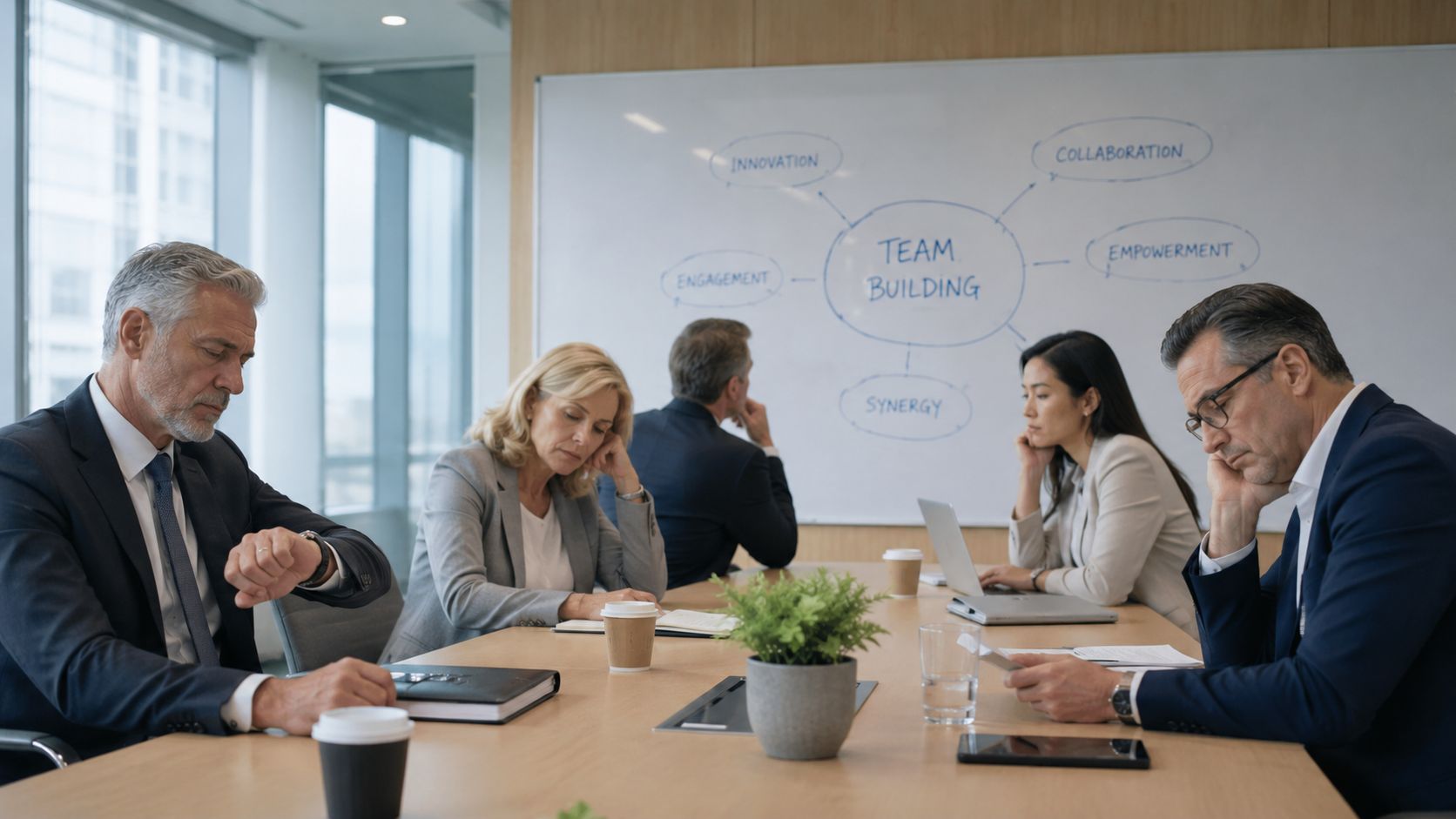
Most team building fails at the leadership level because it treats executives like any other group. That's the wrong brief. A senior team already has authority, competing scorecards, political history, and a direct influence on how the rest of the organisation works.
A relaxed activity can create rapport, but rapport on its own won't fix a team that avoids hard conversations, duplicates decisions, or leaves meetings with five interpretations of the same priority. Leadership teams need sharper outcomes. They need shared judgement, role clarity, candid communication, and trust under pressure.
The wrong target
A surprising number of offsites are still built around the idea that leaders only need time away together. Time away can help, but it doesn't automatically change behaviour. If the team's real problem is unresolved tension between functions, poor escalation discipline, or unclear ownership, then a loosely planned day often masks the issue rather than surfacing it.
One useful way to frame the problem is to look at why teams are misaligned. The practical pattern is familiar. Teams aren't only misaligned because people disagree. They're often misaligned because goals, decision rights, and communication rhythms were never made explicit in the first place.
Leadership team building works when it improves how leaders work together on live business issues, not when it briefly distracts them from those issues.
What leadership teams actually need
The strongest offsites are built as operating interventions. That means every exercise, scenario, and debrief is there to improve how the executive group functions back at work.
Start with Diagnosis Not Activities
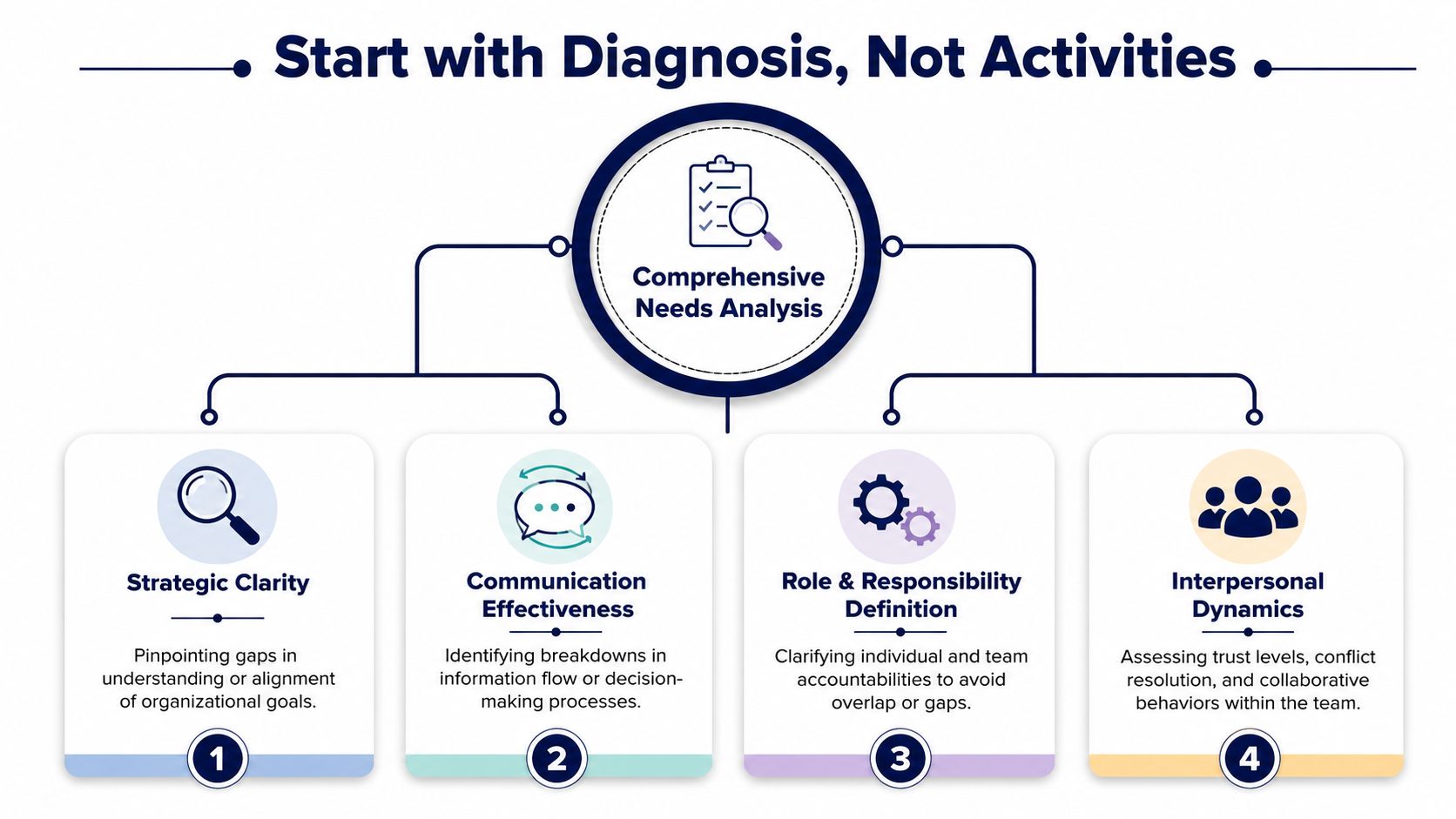
The first mistake is picking the activity before naming the operating problem. A leadership offsite shouldn't begin with “Which program would suit the team?” It should begin with “What is this team struggling to do together that the business needs it to do better?”
In Australia, that diagnostic step has become more important because leaders can't rely on daily proximity to smooth over weak communication. The Australian Bureau of Statistics confirmed that around 36% of employed people worked from home in 2024, up from 8% in 2016 (Australian work from home shift). That structural change means trust, alignment, and clarity need to be built far more intentionally.
Four areas to diagnose
A useful diagnosis usually sits in one or more of these categories:
Strategic clarity: Leaders may agree on the broad plan but hold different assumptions about priorities, trade-offs, or sequencing.
Communication effectiveness: Information may move unevenly across functions, or debates may happen in side conversations rather than in the room.
Role definition: Teams often confuse input, recommendation, approval, and ownership. That creates overlap in some areas and neglect in others.
Interpersonal dynamics: Respect may be present, but candour may be missing. Some teams are polite in workshops and guarded in executive meetings.
A practical diagnostic process
The most reliable process combines several inputs rather than relying on one survey or a sponsor's view.
Interview key stakeholders confidentially
Speak with the team leader, selected executives, and a small number of adjacent stakeholders. Listen for repeated themes, especially around decision bottlenecks, conflict patterns, and execution drift.Review current business friction
Look at issues the team already feels. Delayed initiatives, recurring escalation loops, duplicated work, and inconsistent messaging are often stronger design inputs than generic engagement questions.Observe the team in a real meeting
Watching one executive meeting often reveals more than a long planning brief. Who speaks first, who gets deferred to, what gets avoided, and what remains vague all matter.Write a problem statement
The output should be plain and specific. For example: “The executive team defaults to functional advocacy, which slows cross-functional decisions and leaves implementation ownership unclear.”
Practical rule: If the problem statement could apply to any team, it isn't sharp enough yet.
Teams that want more behavioural detail can add tools such as profiling and role-based analysis. This overview of how behavioural profiling can transform your team is useful when the challenge involves communication preferences, friction styles, or uneven participation.
Designing a High-Impact Leadership Session
A good leadership session doesn't try to fix everything at once. It chooses the primary outcome and builds the day around it. That discipline matters because executive teams usually arrive with too many open issues, too little time, and a habit of treating every topic as urgent.
The Australian HR Institute's 2024 trends report identified leadership capability as a top organisational challenge (leadership capability as an organisational issue). That puts pressure on offsite design. Activities need to develop leadership capability in practice, not just create a positive atmosphere.
Match the format to the leadership outcome
Some teams need stronger trust so they can disagree well. Others need role clarity because decisions are stalling between functions. Others need a shared planning discipline because strategic discussions keep collapsing into operational updates.
That's why the design should map to one dominant outcome.
| Leadership Outcome | Activity Type | Example Program |
|---|---|---|
| Strategic alignment | Scenario-based planning challenge | Pipeline |
| Interpersonal trust | Shared-build or collaborative challenge with interdependence | LEGO Legends |
| Role and responsibility clarity | Structured simulation that reveals hand-offs and ownership gaps | Out of the Box |
| Collaborative problem-solving | Time-bound team challenge requiring cross-functional coordination | Mission Impossible |
| Shared purpose | Charity team building connected to contribution and coordination | Bikes for Tykes |
The program itself is only one part of the design. The stronger variable is whether the facilitator frames the activity around the team's real operating tension. Pipeline, for example, is useful when a leadership group says it values collaboration but protects function-first behaviour. Bikes for Tykes can work well when the team needs a shared result that shifts the mood from internal negotiation to collective contribution.
For teams reviewing retreat formats more broadly, this perspective on strategic team building investments is a helpful reminder that senior sessions should be judged by organisational payoff, not entertainment value.
Build an agenda with pressure points
A high-impact session usually needs more than one block. It needs a sequence that creates insight, tests behaviour, and converts that into operating agreements.
A practical agenda often includes:
Opening alignment discussion: Establish the business issue behind the session and define what better team performance would look like in observable terms.
Core activity or simulation: Use a task that forces the team to reveal habits around communication, decision-making, escalation, and ownership.
Structured reflection: Pull patterns out of the activity while the evidence is still fresh.
Operating reset: Translate the insight into agreements for meetings, cross-functional decisions, conflict handling, and follow-through.
One option for this kind of design work is strategic planning workshop support, especially when the offsite needs to blend facilitation, team building, and live planning rather than running as a standalone event.
What doesn't work
Leadership teams rarely respond well to activities that feel random, over-explained, or disconnected from their level of responsibility. They also lose patience when the session stays abstract.
A better standard is simple. Every exercise should answer one question: How will this help the team lead the business more effectively next month?
Facilitation Techniques for an Executive Audience
Senior audiences don't need more energy from the front of the room. They need stronger containment. The facilitator's job is to keep the group honest, maintain pace, and surface the pattern underneath the conversation without letting the session drift into performance or theatre.
That's why facilitation often determines whether team building for leadership teams produces business value or becomes a well-run event with no behavioural consequence.
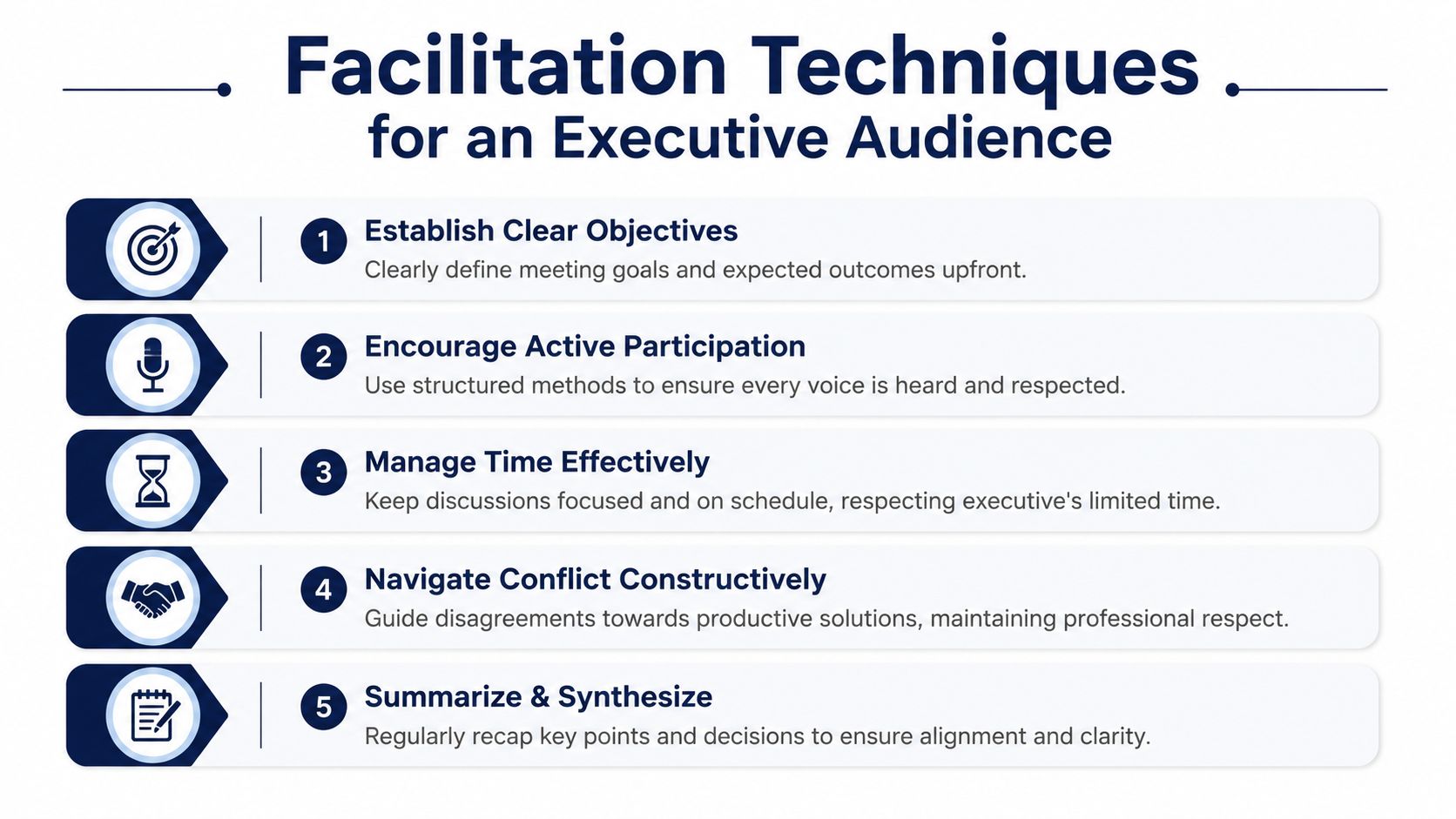
Five techniques that work better with executives
Set the behavioural contract early: Name the standard for participation. Speak plainly about candour, listening, challenge, and confidentiality.
Use structured turns, not open invitations: Senior teams often default to the same voices. Round robins, paired reflections, and written responses create a more balanced read on the room.
Interrupt drift quickly: When the discussion slips into updates, defensiveness, or abstraction, redirect it to decisions, trade-offs, or observed behaviour.
Separate issue content from team pattern: Sometimes the argument isn't the problem. The repeated way the team handles disagreement is.
Close loops in real time: Summarise decisions, tensions, and agreements before moving on. Executives notice when ambiguity is left hanging.
Ask three questions in the debrief: What happened in the task, what pattern did that reveal about this leadership team, and where does that same pattern show up in live business decisions?
Handling status and conflict
Executive groups often include strong personalities, uneven formal power, and old unresolved frustrations. Facilitation needs to make challenge safe without making it soft. That means protecting the discussion, not protecting people from discomfort.
A well-designed play-based session can help because it gives the team a live shared experience to analyse rather than forcing direct accusation. In that setting, even established leaders are more willing to discuss avoidance, control, poor delegation, or weak listening because the behaviour has just been observed, not inferred.
Measure Impact and Drive Lasting Change
How do you know a leadership offsite worked if the next executive meeting still runs long, decisions still stall, and the same two functions keep colliding?
Start with business behaviour, not satisfaction scores. A positive reaction can be useful, but it is a weak success measure for senior teams. The standard is whether the leadership group makes clearer decisions, resolves cross-functional tension faster, and follows through on what it agreed to do.
The measurement model I use has three points. Capture a baseline before the session. Record a small number of specific operating commitments in the room. Review progress 4 to 8 weeks later against the same indicators.
What to measure instead of satisfaction
For executive teams, the best indicators are visible in how leadership work gets done. Focus on signals the business can observe:
Meeting quality: Are priorities clearer by the end of the meeting? Are fewer issues carried over because no one owned the call?
Role clarity: Do leaders know who decides, who recommends, and where authority starts to overlap?
Decision speed: Are cross-functional decisions getting made faster, with fewer side conversations after the meeting?
Escalation discipline: Is the team raising the right issues at the right level, or pulling the executive group into problems that should have been handled lower down?
Commitment follow-through: Are agreed actions moving, or being informally renegotiated a week later?
A short pulse survey works well before and after the offsite, but I would not stop there. Review meeting notes, decision logs, action trackers, and stakeholder feedback from direct reports. Senior teams often rate themselves more positively than the operating evidence supports. The gap between perception and execution is usually where the useful discussion sits.
The debrief is where the return gets created
The activity is only the input. The debrief is where the team converts that experience into an operating change. Research on team development interventions found better performance when teams used structured reflexivity and review, which fits what experienced facilitators see in practice: without a disciplined debrief, even a well-designed session fades quickly into anecdote (team development review on structured team reflexivity).
For leadership teams, a good debrief produces three outputs:
A shared reading of the pattern. What did the team do under pressure?
A business translation. Where does that same pattern show up in strategy, governance, or execution?
A named commitment. What will change in the way this team meets, decides, escalates, or communicates?
That third step matters most. If the offsite ends with broad intent such as “communicate better” or “trust each other more,” the work will dissolve under daily pressure. Strong commitments are concrete, owned, and reviewable. For example: “For the next six executive meetings, strategic decisions will end with a named owner, deadline, and explicit record of dissent.” That is measurable. It also improves accountability and reduces the re-litigation that slows senior teams down.
For teams that want the shift to hold after the event, this guide on how to ensure team building benefits last sets out the follow-through disciplines that keep commitments alive.
From Connection to Commitment
Effective team building for leadership teams doesn't chase a temporary sense of togetherness. It builds a sharper way of working. The shift is subtle but important. The offsite stops being a break from business and becomes part of how the business gets led.
When the session starts with diagnosis, uses activities that reflect executive reality, and ends with measurable commitments, the result is more than a good day away. It creates operating discipline the team can carry into strategy, meetings, and cross-functional execution. That's the standard worth aiming for, and it's the one most likely to hold under pressure.
For organisations looking to turn offsites into measurable operating interventions, team building that aligns with business objectives offers a practical benchmark for what that design should include.
Corporate Challenge Events helps organisations design play-based leadership experiences that connect team building to real business outcomes, including strategic alignment, communication, trust, and role clarity. For HR teams, executive assistants, and leaders planning an offsite, Corporate Challenge Events is one option for building a session around the team's actual operating challenges rather than defaulting to a generic activity day.