
The brief usually lands the same way. A senior leader wants the annual conference to align the business, lift engagement and sharpen execution. HR needs it to support culture, not just fill a calendar slot. Operations needs it to run without friction. Finance wants confidence that the spend is disciplined. By the time venue options appear, the event already carries strategic weight.
That's why conference event planning can't be treated as a transport-and-catering exercise. A conference is one of the few moments when leadership has people's full attention in the same place, around the same priorities, with a chance to influence behaviour in real time. If the design is weak, attendees sit through content and return to work unchanged. If the design is disciplined, the conference becomes a lever for alignment, connection and performance.
A more useful starting point is to treat the conference as an organisational intervention. The room design, content flow, registration experience, speaker brief, accessibility planning and networking format all shape what people notice, what they remember and what they do differently after the event.
Table of Contents
Introduction The Modern Conference Mandate
Corporate conferences used to be judged on whether the room was full, the stage looked polished and the day ran on time. That standard is too low now. Most organisations are asking far more from their events. They want people to understand strategy, build relationships across silos, absorb change faster and leave with clearer expectations.
That shift changes what good conference event planning looks like. The planner's role isn't just to coordinate suppliers. It's to convert business intent into a live experience that people can effectively act on. A leadership summit and a sales kick-off might both use a ballroom, an AV team and a registration desk, but the design logic should be completely different because the outcomes are different.
A smooth conference is useful. A conference that changes behaviour is valuable.
The most effective planners work backwards from that distinction. They ask what leadership wants people to understand, discuss, question and commit to. Then they shape every planning decision around those outcomes, from the first invitation to the final follow-up note.
Defining Your Conference Goals and Audience
Two weeks before a conference, the warning signs are usually obvious. The executive sponsor wants stronger cross-functional collaboration. HR wants connection and morale. Sales wants sharper product messaging. The event team is still choosing between a panel, a workshop and an awards segment because the brief never forced a decision. That is how budgets get spread thin and events end up polished, busy and strategically weak.
A strong brief sets the job the conference has to do. It should be specific enough to settle trade-offs early, not broad enough to accommodate every request. “Run a successful conference” is too vague to guide programming. “Align national managers to the new operating model, increase peer problem-solving across regions and build visible leadership commitment to the change” gives the planning team something concrete to design against.
Define the business outcome before the event format
Start with the organisational result you need after the conference, not the event components you want on the day. Senior leaders often jump to themes, speakers or venue style too early. That creates an attractive event concept without a clear performance purpose.
In practice, most conferences are built to do one leading job:
Alignment event
The organisation needs consistent understanding of strategy, priorities and accountability. The agenda should favour message clarity, repetition, manager discussion and time to test understanding.Capability event
People need to leave able to do something better than they could before. Session design should prioritise application, practice, tools and feedback rather than a high volume of presentations.Culture event
The business is trying to rebuild trust, strengthen connection or support change across teams. Shared experiences, facilitated discussion and structured interaction matter more than adding another keynote.Recognition event
The company wants to reinforce behaviours, celebrate results and make success visible. Storytelling, peer acknowledgement and leadership framing become central to the design.
Many conferences include all four. One objective still needs to lead. Without that hierarchy, every stakeholder gets a piece of the agenda and no outcome gets enough weight to change behaviour.
Used well, they can reset norms, strengthen manager confidence and accelerate adoption of a new way of working. Play-based engagement can support that goal if it is used with intent. The point is not to make the event feel recreational. The point is to create low-risk participation, honest discussion and faster relationship formation so people practise the behaviours leadership wants back in the workplace.
Build an audience brief that changes real planning decisions
“Audience” is usually too blunt to be useful. A room may include senior leaders, people managers, technical specialists and new hires, all with different levels of authority, context and confidence speaking in front of peers. If the brief treats them as one group, the agenda usually defaults to the safest possible content and loses relevance.
A better audience brief includes the operational details that affect design:
| Audience factor | Planning implication |
|---|---|
| Seniority mix | Changes language, case studies, Q&A structure and the level of strategic detail |
| Functional mix | Affects table allocations, networking goals and whether content needs translation across departments |
| Travel load | Influences start times, session energy management, arrival design and dinner expectations |
| Confidence with participation | Determines whether sessions need facilitation, prompts, smaller group work or anonymous input tools |
| Access needs | Shapes registration fields, venue setup, signage, communication format and pacing across the day |
The test is simple. If the audience brief would not change at least five planning decisions, it is still too generic.
Inclusion deserves more than a compliance check. An accessible conference is not just a venue with the right entrance and facilities. It is an event people can register for easily, move through without friction, participate in comfortably and recover from when the schedule is demanding. That can mean clearer pre-event communication, quieter breakout areas, captioned content, lower-sensory spaces, well-timed breaks and session formats that do not rely on speaking up in a crowded room.
Match goals and audience before you approve content
This is the point where weak planning often shows up. A leadership team asks for alignment, then approves an agenda dominated by passive keynote sessions. A company wants culture repair, then leaves no time for peer interaction. A business wants capability uplift, then fills the day with inspiration instead of practice.
The right question is not “Will this session be engaging?” The right question is “Will this session help this audience do the thing the business needs after the event?”
That standard produces better decisions. It also helps defend trade-offs with senior stakeholders. If a proposed speaker, activity or format does not support the stated goal for the defined audience, it should be changed or removed. That discipline is what turns conference event planning from logistics into a business performance tool.
Building Your Master Timeline and Checklist
A conference rarely fails because one big decision was missed. It fails because dozens of smaller decisions were made too late, by the wrong person or without understanding the dependencies. That's why a master timeline is the planner's control system, not just an admin document.
The most reliable approach is reverse planning. Start with the event date, then map backwards through all critical approvals, supplier deadlines, content milestones and attendee communications. Australian conference planning guidance supports this approach and also stresses the operational importance of attendance forecasts, minimum guarantees and rooming controls. Some hotels allow only a small overage above the guaranteed minimum, noted as up to 5% in conference planning guidance, which makes accurate forecasting commercially important in catering and accommodation planning, as outlined in the conference planning guidelines.
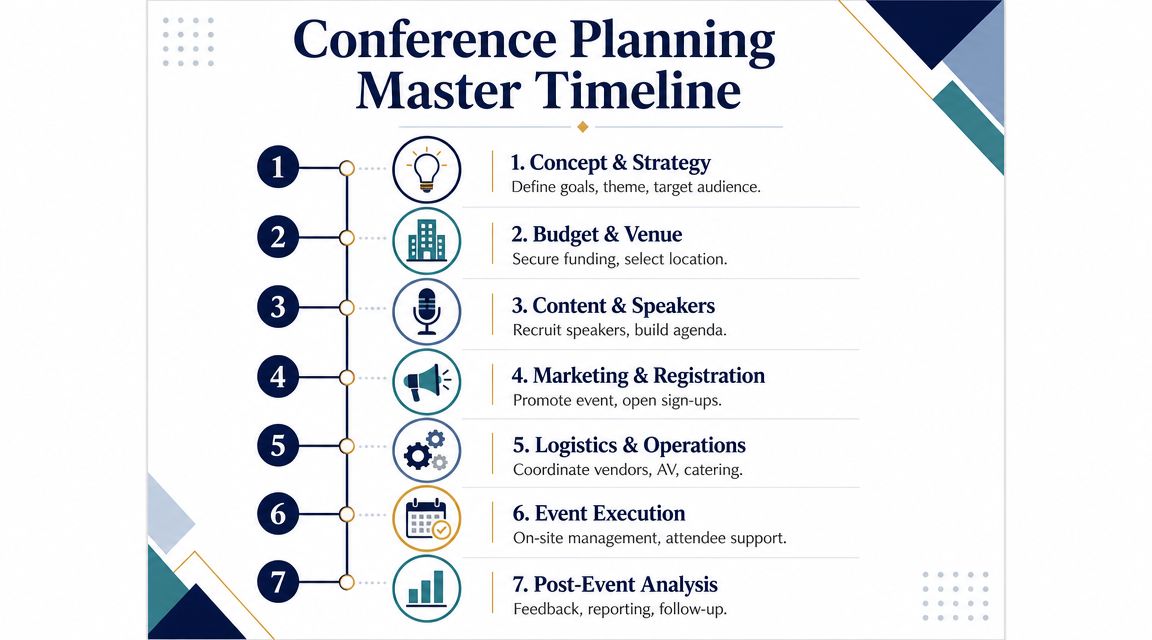
Reverse-plan from the non-negotiables
Not every deadline carries the same risk. The timeline should be built around the items that are hardest to recover if they slip.
Start with these anchors:
Venue and contract date
Until this is locked, floorplans, room allocations and supplier coordination remain unstable.Speaker confirmation and briefing deadlines
Good speakers need time to tailor content. Late briefing produces generic presentations.Registration launch
Delays here reduce forecasting confidence and compress communications.Menu, accommodation and guaranteed numbers
These are often tied to venue deadlines and financial exposure.Production sign-off
AV, staging, graphics and run sheets need final decisions before rehearsal windows.
A useful timeline doesn't just show dates. It shows dependencies. If the session format changes, the AV scope may change. If registration data shows stronger breakout demand than expected, room allocations may need to move. That kind of visibility stops the team from treating each task in isolation.
Turn the checklist into an ownership tool
Most event checklists fail because they're too broad. “Confirm AV” isn't a task. It's a category hiding a dozen tasks. Strong checklists break the work into visible, assigned components.
A functional checklist often works best when grouped like this:
Venue operations
Floorplan, access times, loading dock details, storage, furniture, cleaning, security.Content and speakers
Briefs, decks, bios, session transitions, moderator notes, rehearsal slots.Registration and attendee services
Name badges, check-in flow, dietary flags, special requirements, help desk process.Production
Screens, microphones, confidence monitors, internet support, clickers, recording.People and staffing
Run sheet owners, escalation contacts, volunteer briefing, roaming support.
The right checklist gives each task an owner, a due date and a consequence if it slips.
That last point matters. Conference event planning becomes easier when the team can see which late task is inconvenient and which one creates downstream operational risk. A checklist that shows ownership and impact keeps the planning team focused on execution, not just activity.
Developing a Realistic Budget and Selecting Vendors
The budget tells the truth about the event faster than any mood board will. It shows what the organisation values, where the pressure points sit and whether the ambition matches the available resources. When the budget is weak, teams make reactive cuts late in the process. Those cuts almost always damage attendee experience because they hit visible delivery items after strategic decisions have already been made.
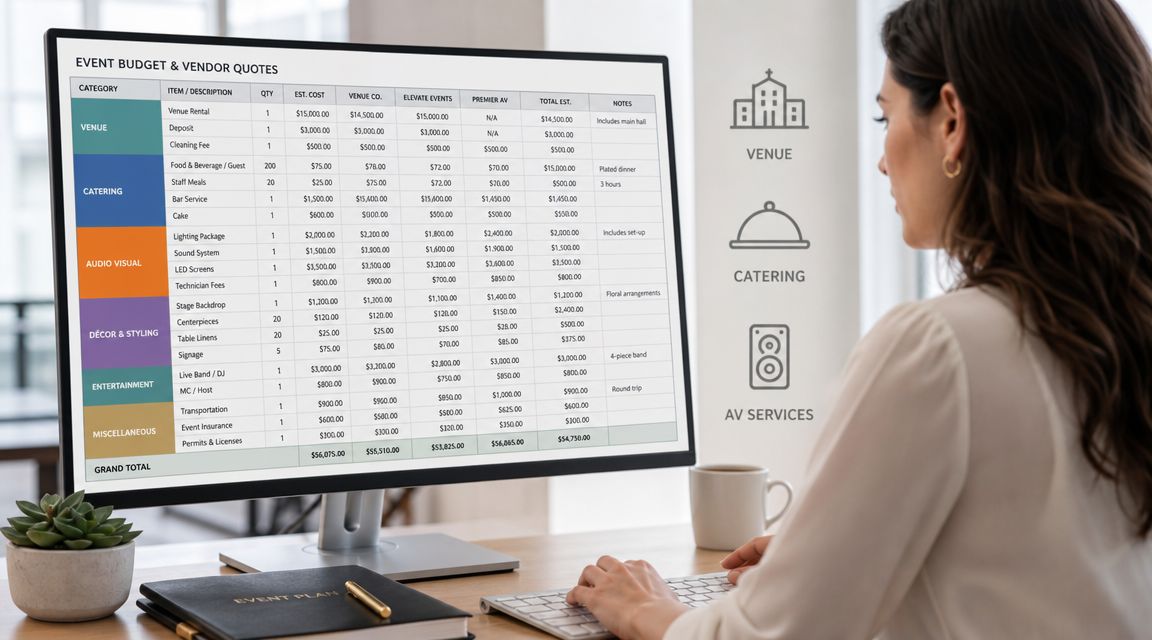
In Australia, resilient budget design deserves more discipline than it usually gets. Existing event planning content often says to have a contingency plan, but rarely explains what to protect first. With continued pressure on costs and supplier availability in the business events sector, contingency allocation isn't just sensible housekeeping. It's operational protection, as noted in this industry commentary on event planning volatility.
Budget by decision category, not by habit
A practical conference budget should separate fixed commitments from variable items and strategic investments from hygiene items.
A cleaner way to structure it looks like this:
| Budget layer | What belongs here | Why it matters |
|---|---|---|
| Core infrastructure | Venue, AV, registration platform, staffing | The event can't function without it |
| Experience design | Networking formats, activation zones, branded touchpoints | Shapes memory and engagement |
| Content delivery | Speakers, facilitators, rehearsal support, materials | Determines whether the message lands |
| Guest services | Catering, transport support, signage, help desk | Affects comfort and confidence |
| Contingency | Protected reserve for change, disruption or late needs | Prevents rushed cuts elsewhere |
This structure improves decision-making because it stops teams from treating every cost as equally optional. If a budget revision is required, the planner can protect the elements linked directly to the event objective instead of cutting indiscriminately.
Choose vendors who reduce operational risk
The cheapest quote often becomes the most expensive choice once delivery risk is included. Vendor selection should test capability, responsiveness and judgement, not just price.
Useful evaluation criteria include:
Clarity of proposal
A good supplier explains scope, exclusions, assumptions and deadlines without needing translation.Operational maturity
The supplier can explain setup requirements, escalation paths and backup arrangements.Corporate fit
Experience in business events matters. A supplier who understands executive audiences, internal stakeholders and approval processes will usually perform better.Problem-solving behaviour
The most useful suppliers identify risks early rather than waiting to be asked.Communication discipline
Slow replies during quoting often signal slow replies during delivery.
Strong vendors don't just provide a service. They stabilise the event.
Reference checks should focus on what happened when pressure increased. Did the supplier adapt? Did they communicate? Did they protect the client from surprises? In conference event planning, that operational behaviour is often worth more than a small saving on the quote.
Designing an Engaging Agenda and Managing Speakers
An agenda can look balanced on paper and still lose the room by mid-morning. That usually happens when the design treats time as the main variable. Time matters, but attendee energy is the primary organising principle.
Corporate audiences arrive with cognitive load, device distraction and competing priorities. They don't need a longer sequence of presentations. They need a programme that earns attention, varies the mode of participation and gives the content room to land. A useful reference point for that thinking sits in structuring a great conference agenda, especially for planners trying to improve engagement without making the day feel over-produced.
Design for energy, not just sequence
The best agendas alternate between listening, discussing, reflecting and connecting. That pattern prevents passive fatigue and helps people process information rather than passively receive it.
A practical rhythm might include:
a high-clarity opening session that explains why the event exists
a shorter keynote rather than an overloaded one
facilitated table discussion immediately after major strategy content
breaks that create recovery time rather than queue pressure
interactive sessions placed before energy dips, not after them
a stronger close that converts insight into next-step commitment
That structure works because it respects how people participate in real settings. Even excellent content loses force if it arrives in the wrong slot or with no processing time attached.
Brief speakers like delivery partners
Speaker management is usually underdone. Teams book a speaker, collect a bio, request slides a few days out and hope the content will fit. That approach creates inconsistency and leaves the MC trying to patch together transitions on the day.
A stronger process includes:
A written brief that defines the audience, event purpose, tone and essential requirements
A content checkpoint where the organiser reviews outline direction before the final deck
A rehearsal window for any speaker using video, audience interaction or complex staging
A session owner who can manage timings, intros and handovers
The speaker isn't delivering an isolated talk. The speaker is carrying one part of a larger message architecture.
Conference event planning improves noticeably when each speaker understands where their session sits in the full journey. That's how the programme starts to feel coherent instead of episodic.
Crafting the Attendee Experience and Engagement
A conference can hit every timing marker and still miss its business goal.
That usually happens when the event is planned as a set of logistics instead of a managed behaviour journey. Attendees do not separate registration, arrival, content, networking and follow-up into internal workstreams. They judge the event as one experience, and that experience shapes how seriously they take the strategy, the leadership message and each other.

Every touchpoint shapes culture in real time
Senior leaders often want a conference to strengthen alignment, improve collaboration or support culture change. Those outcomes are not created by stage content alone. They are reinforced, or undermined, by what people experience around that content.
If attendees arrive to unclear signage, crowded check-in, poor sound, nowhere quiet to regroup, and networking that feels socially risky, the organisation sends a message. It says speed mattered more than attention, and output mattered more than people. That weakens trust fast.
Accessibility sits inside this discussion, not beside it. Good attendee experience design covers communication, movement, information access, dietary confidence, seating choice and low-stimulus options. Teams that treat accessibility as a planning standard usually improve the event for everyone, not only for attendees with disclosed needs.
A stronger design brief covers:
Pre-event communication people can act on
Joining instructions, session timings, dress expectations and venue details should be clear on first read.Registration that reduces uncertainty
Ask for requirements early, confirm what has been arranged, and avoid making people repeat personal information on site.Arrival and wayfinding that lower cognitive load
People should know where to go, where to sit, and what happens next without hunting for help.Break environments with a purpose
Some attendees want conversation. Others need recovery time, privacy or a quieter corner before the next session.Room setups that support different participation styles
A high-energy plenary can work well. So can smaller zones where people can reflect, talk, or process before they rejoin the main flow.
Design engagement around outcomes, not activity
Engagement has a job to do. It should help people absorb strategy, test ideas, build working relationships and commit to action. If an activity cannot support one of those outcomes, it does not belong in the programme.
I advise clients to stop asking, “How do we make this more fun?” and ask, “What do we need people to do differently after this event?” That question changes the design. It moves engagement from entertainment to performance support.
Play-based formats can be highly effective in corporate conferences when they are used with discipline. The point is not novelty. The point is to create the conditions for better participation. A well-timed challenge can expose decision bottlenecks, surface leadership habits, and give cross-functional groups a low-risk way to work together before a serious planning discussion.
Here is where these formats tend to earn their place:
| Format | Best use in a conference |
|---|---|
| Facilitated table challenges | Turning strategic priorities into peer interpretation and discussion |
| Purposeful energisers | Restoring attention before a decision-heavy or collaborative session |
| Charity-based team experiences | Connecting culture messages to shared action and social contribution |
| Problem-solving activities | Testing collaboration, communication and decision-making under time pressure |
The trade-off is real. More interaction means less room for passive content. That is usually the right trade if the conference objective includes adoption, alignment or culture change. Senior teams rarely need another full day of presentations. They need a format that helps people process the message, discuss implications and leave with stronger commitment.
The strongest attendee experiences feel intentional from start to finish. People know why they are there, how to take part, and what the organisation expects them to carry back into the business. That is what turns a conference from a calendar event into a tool for performance improvement.
Managing Logistics Technology and Risk
The most polished conference experiences are usually built on disciplined backstage systems. Delegates notice the keynote, the hospitality and the networking. They don't see the loading schedule, the technician call sheet, the spare microphones, the backup laptop or the emergency contact tree. That hidden layer is what makes the visible layer feel calm.
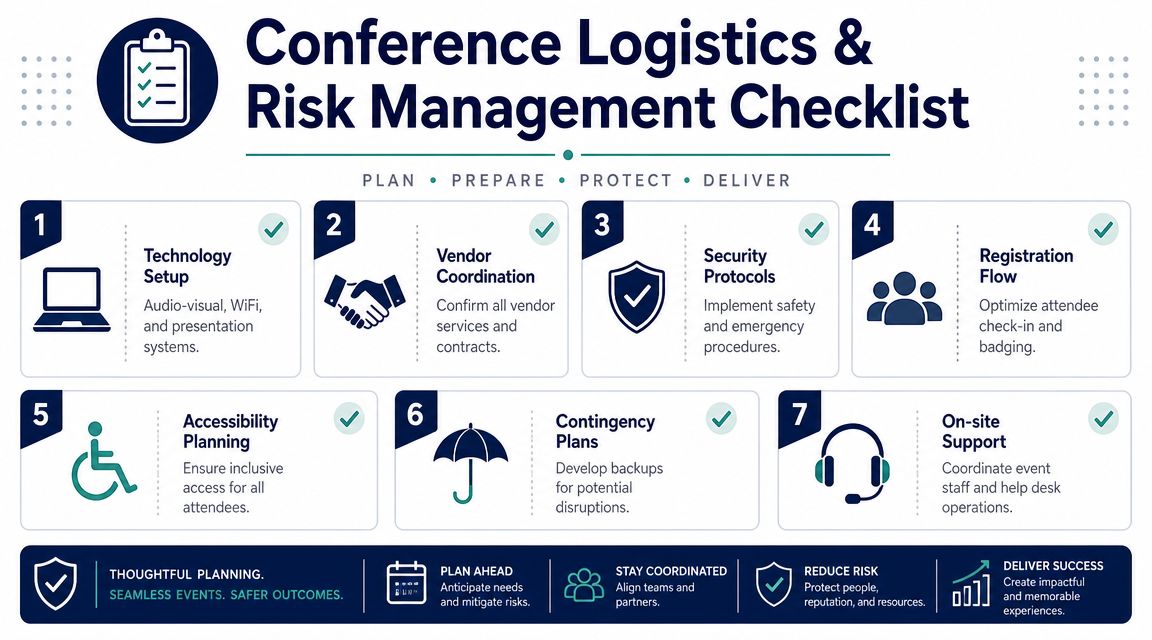
Inspect the venue through an operational lens
Venue choice shouldn't be driven by appearance alone. Conference event planning requires a site inspection that tests delivery conditions, attendee movement and compliance exposure.
In Australia, the Disability Discrimination Act 1992 and the Disability (Access to Premises, Buildings) Standards 2010 require non-discriminatory access to buildings and services. In practical terms, planners should build accessibility checks into the venue and supplier brief before contracts are signed, including step-free routes, accessible toilets, hearing augmentation options and evacuation arrangements, as outlined in this accessibility planning guidance.
A serious site inspection should test:
Arrival and entry flow
Can attendees find the entry, queue comfortably and move through registration without congestion?Room suitability
Do breakout rooms match the session style, not just the headcount?Production readiness
Is there enough power, rigging access, internet support and technician workspace?Back-of-house practicality
Can suppliers load in efficiently, store materials securely and reset spaces on time?
Accessibility shouldn't be a late-stage check. It should be treated as a design specification embedded in venue selection, supplier briefing and rehearsal.
Build risk controls into delivery, not into hope
Risk planning often appears in event documents as a generic note at the end. That's not enough. Effective control measures need named owners, trigger points and clear alternatives.
A practical risk register usually covers:
speaker cancellation and replacement options
AV failure and redundant playback systems
attendee health or security incidents
travel disruption affecting arrival patterns
weather impacts for any outdoor component
data handling risks in registration and communications
For teams reviewing security frameworks or adapting ideas from larger international markets, examples of a structured risk assessment for LA events can be useful as a reference point for scenario thinking, even when the final operating plan needs to match the local venue and legal context. Technology choices also sit inside that same risk conversation. The right event stack should support communication, schedule visibility and operational control without creating tool sprawl, which is why many organisers review dedicated technology solutions for conferences before locking suppliers.
The backup plan only works if the team knows when to activate it and who makes the call.
That's the standard to aim for. Not a folder labelled contingency, but a conference team that can respond without confusion when conditions change.
Executing Promotion Registration and Communication
Internal and external promotion often gets left until the major operational work is underway. That sequencing feels logical, but it weakens attendance quality because the message becomes rushed and generic. Good promotion starts from the event's business value, not from a list of speakers or venue features.
Promotion should answer why this event deserves time
Busy professionals don't register because the event exists. They register because the value proposition is clear. For a corporate conference, that usually means answering three questions fast. Why attend, why now and what will be different afterwards?
A stronger communication plan uses multiple channels, but with one central message. Internal comms, email campaigns, leader talking points and intranet content should all reinforce the same case for attending.
Where broader visibility matters, corporate teams can borrow useful structure from guidance on crafting impactful conference PR. The main lesson is simple. Lead with the significance of the event, not with administrative detail.
A practical promotion sequence might include:
Leadership announcement that frames the event in business terms
Registration launch with a clear attendee promise
Content reveal showing the agenda logic, not just names
Reminder communications that increase urgency and clarify logistics
Registration and communication should lower friction
Registration is often the first active experience an attendee has with the event. If it's clunky, trust drops quickly. People start to assume the conference itself may be disorganised.
A registration system should do more than collect names. It should support segmentation, capture operational needs and give organisers clean reporting. Teams comparing options often start with the basics in why a good event registration system matters, then assess whether the platform fits internal approval and privacy requirements.
Good attendee communication usually includes:
Confirmation messaging
What's booked, what happens next and where to get help.Pre-event updates
Agenda highlights, travel details, venue access and preparation notes.On-the-day messaging
Arrival times, check-in instructions and urgent changes if needed.Support pathways
One clear contact point beats several vague ones.
The standard is simple. By the time attendees arrive, they should know where to go, what to expect and why the event is worth their attention.
Measuring Success and Post-Event Follow-Up
The room is full, the sessions run on time, and feedback at the door sounds positive. A week later, leaders still need an answer to a harder question. Did the conference change anything people will do differently at work?
That answer should be built into the event plan from the start. If success measures are vague, post-event reporting usually defaults to attendance numbers, speaker ratings and a few favourable comments. Those metrics have some use, but they do not tell a senior leader whether the event improved alignment, strengthened cross-functional relationships or accelerated execution.
Measure against the original brief
The review should mirror the business objective.
If the conference aimed to align leaders around a strategy shift, measure whether attendees left with a shared understanding of priorities, clearer decision rights and specific next steps. If the goal was cultural change, look for signs that people are using the same language, forming new working relationships and carrying agreed behaviours back into teams. For conferences that use play-based formats, the test is practical. Did those moments increase participation, surface issues faster, or help people practise better collaboration in a low-risk setting?
Useful evidence often includes:
| Measure type | What it can show |
|---|---|
| Attendee feedback | Whether the content felt relevant, clear and worth acting on |
| Participation patterns | Which sessions sustained attention and which formats lost the room |
| Stakeholder debriefs | Whether the event met leadership expectations and supported the brief |
| Operational review | Where time, budget or delivery effort was wasted |
| Follow-up activity | Whether commitments, introductions or project conversations continued |
Use a small set of measures well.
A short survey tied to the event objectives will usually outperform a long generic form. Teams building their own survey or follow-up capture process may find practical value in tutorials that show how to build user forms with Static Forms, particularly when a lightweight post-event workflow is needed without adding another heavy system.
Follow-up is where value compounds
Strong conferences do not end at closing remarks. They continue through the systems that help people apply what they heard.
That matters even more when the event is intended to shift culture or performance. A good follow-up plan keeps the message active, gives managers material they can use with their teams and turns event energy into specific action. Presentation decks, recap notes, recordings, team discussion prompts and owner-assigned action summaries all help extend the return on the event investment.
A practical follow-up sequence often includes:
Immediate thank-you communication with key resources and agreed actions
Session recaps for attendees, sponsors and internal stakeholders
Manager discussion prompts to translate conference themes into team behaviour
Internal reporting that links outcomes, lessons and next decisions back to the brief
The standard is straightforward. People should be able to act on what they learned without having to reconstruct the event for themselves.
Conference event planning proves its value when the live experience, the follow-up process and the business objective all point in the same direction. That is how a conference becomes more than a well-run gathering. It becomes a tool for better decisions, stronger connection and measurable change.
Corporate conferences work harder when they're designed to change something, not merely to host something. Corporate Challenge Events helps organisations turn conferences, meetings and offsites into high-impact experiences through play-based team building, energisers and facilitated programs that strengthen connection, communication and performance. For leaders planning a conference that needs to land beyond the room, that kind of design support can turn a solid event into one that people carry back into work.