
Global engagement fell to 20% in Gallup's 2025 workplace reporting, with managers and younger workers showing the sharpest declines, a signal that many organisations are trying to lift connection while people are already stretched thin (Gallup workplace reporting). For Australian leaders, that reframes understanding employee engagement. The issue isn't just whether people feel positive about work. It's whether the organisation has created the conditions, energy, and social connection that allow people to engage at all.
That's why engagement belongs in board conversations. It sits at the intersection of performance, retention, manager capability, workload design, and culture. It also sits in the body. Teams don't collaborate well when trust is low, ambiguity is high, and every initiative feels like one more demand. People engage when the environment supports focus, belonging, and shared progress.
Australian organisations are navigating that tension in a labour market shaped by hybrid work, dispersed teams, and rising attention to psychosocial risk. A broader workforce lens appears in Corporate Challenge Events' state of work in 2026 perspective, which reflects the same practical challenge many HR and People & Culture teams are managing. Build performance without adding friction.
Table of Contents
An Introduction to Employee Engagement in Australia
Australian leaders rarely struggle with the language of engagement. Most can describe it in broad terms. The key challenge is operational. They need to know what engagement looks like in a modern workforce, how it differs from morale, and which levers deserve investment.
The strongest national historical lens comes from the HILDA Survey, which has tracked working-life conditions since 2001 and provides a long-running foundation for understanding engagement-related factors such as job satisfaction, manager support, autonomy, and work intensity (HILDA overview in Employment Hero's discussion). That longitudinal view matters because understanding employee engagement in Australia can't rely on one-off snapshots. It has to account for how work has changed across service-based roles, shifting job security expectations, and newer hybrid arrangements.
Engagement is broader than a sentiment score
Engagement is usually inferred through a combination of signals such as satisfaction, motivation, involvement, and intention to stay. In practice, that means a team can report that people are “fine” while still carrying low trust, weak connection, or low discretionary effort. Boards often miss this because annual surveys compress a complex system into one headline number.
A more useful leadership lens looks at conditions, not slogans:
Manager support: Whether people feel backed, coached, and clear on what good performance looks like.
Autonomy: Whether employees can make decisions and manage work without unnecessary friction.
Work intensity: Whether the pace of work leaves enough capacity for thoughtful contribution rather than constant recovery.
Connection: Whether teams experience enough shared interaction to sustain trust and collaboration.
Board-level test: If an organisation can't explain which conditions are suppressing engagement, it doesn't yet have an engagement strategy. It has a reporting habit.
Why the Australian context changes the conversation
Hybrid work has made engagement easier to misread. A team may still deliver, attend meetings, and hit deadlines while becoming less connected over time. That's one reason engagement should be treated as an organisational design issue rather than a communications campaign.
For HR, People & Culture, executive assistants planning internal events, and leaders shaping offsites, the practical question isn't “How do people feel?” It's “What in the system is helping people contribute with energy, trust, and commitment, and what is getting in the way?”
What Is Employee Engagement Really
Employee engagement is often described as enthusiasm or commitment. That's incomplete. A better definition is this: engagement is the psychological state that emerges when people believe they can do meaningful work, with capable support, inside a trustworthy environment.
That framing changes accountability. It stops leaders from treating engagement as an attitude problem inside the employee and places responsibility where it belongs, in the design of work, leadership behaviour, and team environment.
Think of engagement as a workplace ecosystem
A useful analogy is an ecosystem. Plants don't grow because someone tells them to. They grow when the soil, light, water, and temperature are right. Teams are similar. When leaders ask for more initiative, more collaboration, and more commitment without addressing the environment, they're demanding outcomes without building conditions.
The strongest ecosystems usually contain four psychological pillars.
| Pillar | What it looks like at work | What undermines it |
|---|---|---|
| Safety | People can speak up, ask for help, and contribute ideas | Punitive responses, politics, public blame |
| Belonging | Employees feel included and socially connected | Silos, exclusion, transactional management |
| Purpose | Work feels linked to something that matters | Busywork, weak communication, unclear priorities |
| Trust | People believe leaders are consistent and credible | Mixed messages, poor follow-through, opaque decisions |
What engagement is not
It isn't permanent happiness. It isn't compliance. It isn't a pulse score with a cheerful internal campaign wrapped around it.
A workforce can be satisfied and still disengaged. It can also be highly committed and close to overload. That distinction matters because some organisations respond to low engagement with more recognition messages, more content, and more events when the actual issue is unclear roles, weak line management, or exhausted teams.
Engagement grows when organisations remove friction, not when they simply ask for more enthusiasm.
Why some interventions fail
Programs fail when they target symptoms rather than causes. A polished values launch won't fix a team that doesn't trust its manager. A new survey platform won't improve connection if teams rarely share meaningful experiences together. Free lunches won't build commitment where people don't see a future.
What works is more specific. Leaders diagnose the environmental barriers. Then they choose interventions that match the problem. If a team lacks clarity, management rhythm matters. If a team lacks social cohesion, shared challenge and interaction matter. If a team lacks energy, work design has to change before another initiative gets added.
That's the heart of understanding employee engagement. It's something organisations cultivate, not something they demand.
The Measurable Business Case for Engagement
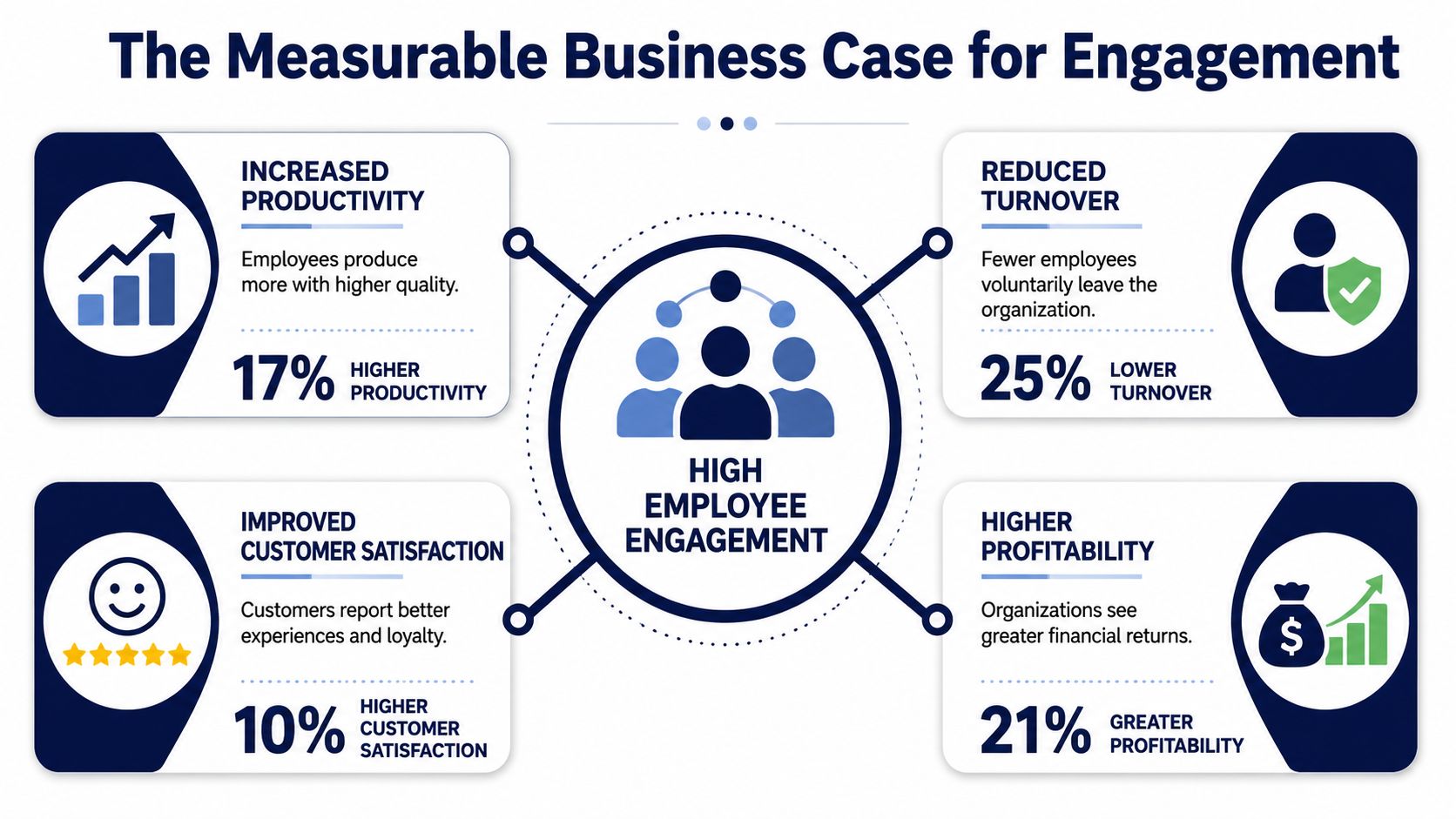
Boards usually support engagement when it becomes clear that the issue is operational, not symbolic. The strongest case comes from outcomes leaders already care about. Attendance. Retention. Productivity. Profitability. Engagement influences each of them.
Gallup's workplace research, as cited in Australian workplace strategy commentary, shows that highly engaged business units experience 78% less absenteeism, 21% less turnover in high-turnover organisations, and 51% less turnover in low-turnover organisations, while also delivering higher productivity and profitability (Your Thought Partner summary of Gallup figures). Those numbers give executive teams a practical way to think about engagement. It affects workforce stability and output quality, not just mood.
What leaders should take from the data
The main point isn't that every organisation will see the same outcome. It's that engagement has a measurable relationship with avoidable workforce drag. In an Australian context, where many teams are dispersed and specialist talent can be difficult to replace, that relationship has direct budget implications.
Three board-relevant conclusions follow.
Absenteeism is not only an attendance issue: It can reflect disengagement, stress, weak connection, or poor management conditions.
Turnover is not purely a recruitment problem: A portion of churn is often generated internally through preventable experience failures.
Productivity is not only a process issue: Teams produce better when people trust each other, understand their role, and feel supported.
The false economy of underinvesting
Some organisations still classify engagement work as discretionary because the return feels hard to isolate. That's usually because they're measuring the wrong thing. If leaders only ask whether employees liked an initiative, they miss the larger question of whether key operational pressures improved.
A more commercially useful approach links engagement activity to workforce signals such as manager capability, connection across locations, collaboration quality, and intention to stay. That's also why many organisations are reconsidering the return on investment of play at work. The decision isn't between “serious business” and “fun.” It's between interventions that alter trust and team behaviour, and interventions that leave the system untouched.
Engagement earns investment when leaders connect it to risk reduction and performance protection, not when they present it as a cultural extra.
The Neuroscience and Psychology of Connection
Engagement feels cultural, but it's also biological. Human beings don't decide to trust, contribute, and collaborate in a purely rational way. The nervous system is constantly scanning for cues. Is this environment safe enough to participate? Is this team supportive enough to take a risk? Is there enough reward, progress, and social connection to stay invested?
That's why connection matters so much. When leaders create experiences that build trust and shared achievement, they aren't just improving atmosphere. They're influencing the conditions that support attention, motivation, and resilience.
The DOSE lens in the workplace
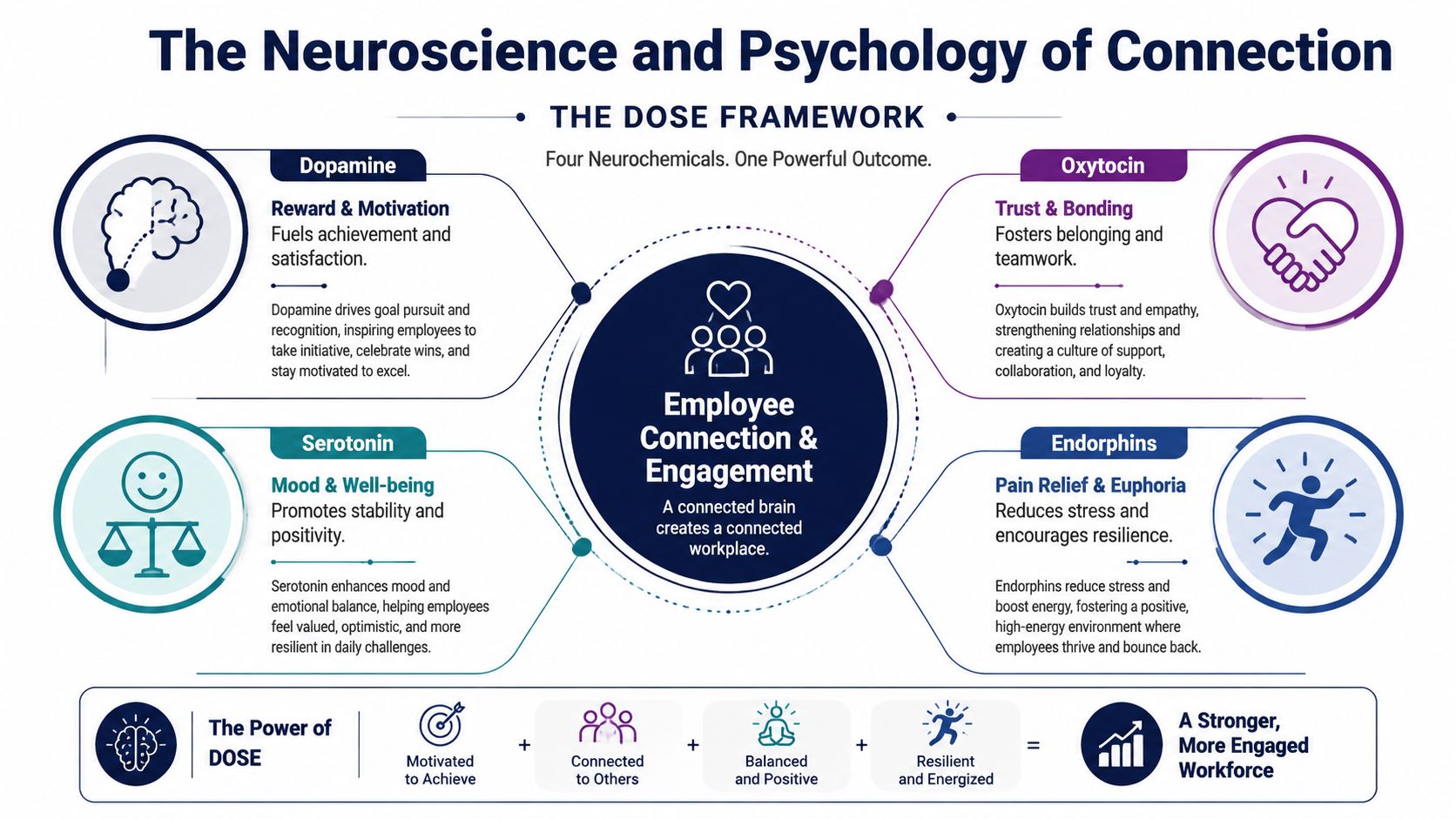
A practical way to explain this is the DOSE framework. It refers to dopamine, oxytocin, serotonin, and endorphins. In workplace terms, these are useful shorthand for the chemistry behind motivation, bonding, emotional steadiness, and stress relief.
Dopamine is linked to reward and progress. Teams experience it when a challenge has a clear goal, visible momentum, and a satisfying sense of achievement.
Oxytocin supports trust and bonding. It tends to rise when people cooperate, help each other, and share positive social experiences.
Serotonin is associated with mood regulation and stability. At work, that aligns with respect, status, and a sense of being valued within the group.
Endorphins help reduce strain and support resilience. Movement, laughter, and energetic shared activity can all contribute.
This doesn't mean every engagement strategy needs a neuroscience lesson attached to it. It means leaders should stop designing work as though people are machines. Human performance improves when the environment supports healthy social and motivational states.
Why shared challenge works better than passive messaging
The strongest engagement moments are often participatory. Not because activity is in itself better than communication, but because people build trust faster when they do something together. Shared challenge compresses the distance between colleagues. It creates real-time cooperation, visible contribution, and mutual reliance.
That's also why purely informational interventions can disappoint. A webinar can inform. A policy can clarify. A survey can diagnose. None of those, on their own, create the embodied experience of being part of a capable, connected team.
A useful workplace application appears in this discussion of why teams need a dose of play, which links play-based design to the biological state that supports connection. The core idea is simple. If leaders want people to collaborate more effectively, they need environments that generate trust and positive social energy, not only environments that transmit instructions.
Teams don't build connection by hearing about collaboration. They build it by experiencing collaboration under the right conditions.
The psychological payoff
When those biological and psychological cues line up, engagement becomes more likely. People contribute more freely. They read each other more accurately. Managers spend less time dragging participation from the group. The workplace feels less defensive and more generative.
That's where play earns its place in serious organisations. Not as entertainment, and not as a cure-all. As a structured way to activate the social and emotional conditions that better work depends on.
How to Measure Employee Engagement Effectively
Many organisations still rely on a single annual score and then wonder why the action plan feels vague. The problem isn't that surveys are useless. The problem is that a lone number doesn't diagnose much. It tells leaders there's a temperature, not what's causing it.
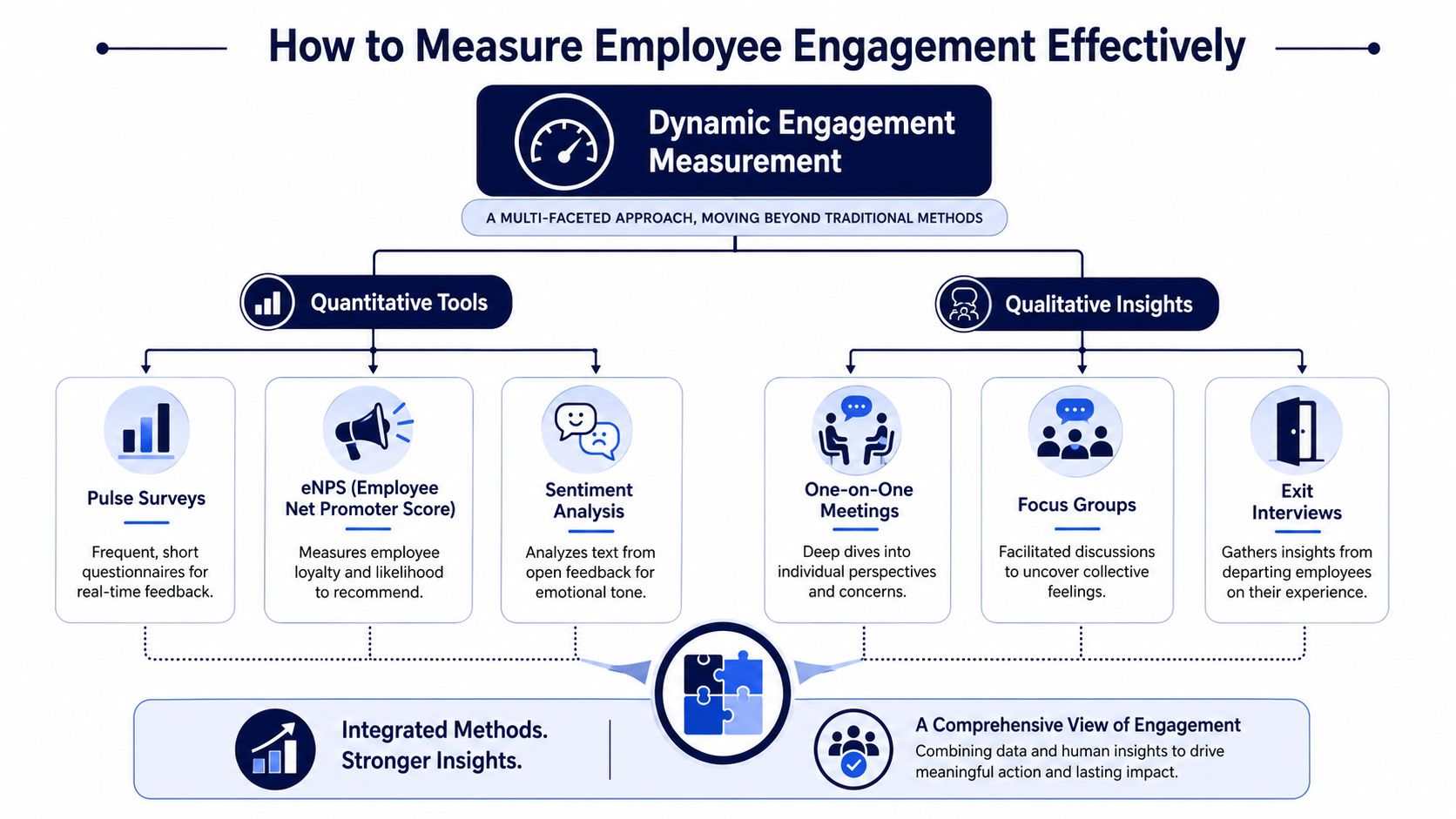
Australian practice offers a better model. The APS Employee Census uses a multi-item engagement construct and reports results by workforce segment, allowing leaders to isolate driver effects such as leadership, inclusion, and growth rather than relying on one satisfaction score (APS measurement approach discussed by ContactMonkey). That's a more mature way of understanding employee engagement because it points leaders toward causes, not just symptoms.
What good measurement looks like
Strong engagement measurement combines frequency, segmentation, and context. It doesn't try to measure everything at once, and it doesn't stop at sentiment.
A practical model looks like this:
Use a multi-item core measure: Include commitment, motivation, involvement, and intention to stay rather than a single “How engaged are you?” question.
Track drivers separately: Measure conditions such as leadership quality, workload, inclusion, role clarity, manager support, and growth.
Segment the data: Compare results by team, level, location, function, and demographic groups where appropriate.
Add qualitative evidence: Use stay interviews, manager check-ins, listening sessions, and structured comments to explain the pattern.
Why Australian benchmarks matter
The HILDA lens is especially useful for reminding leaders that work conditions shift over time. It tracks long-run patterns in working life rather than isolated moments, which makes it valuable for understanding structural changes in autonomy, support, and intensity. Organisations don't need to replicate a national longitudinal study. They do need to think longitudinally.
That means asking different questions from the typical engagement survey.
| Weak measurement question | Stronger measurement question |
|---|---|
| Are people happy? | Which conditions are helping or blocking contribution? |
| What is the overall score? | Which teams or workforce segments are under pressure? |
| Did the score move? | Which drivers moved, and what changed in the work environment? |
A practical cadence
Good measurement is lighter and more deliberate than many leaders expect. A full survey once or twice a year can work if the organisation is prepared to act. Shorter pulse checks between those points help monitor a small set of known drivers. Qualitative conversations fill in the gaps, especially where manager behaviour or workload design appears to be the issue.
For teams planning culture activity, offsites, or engagement initiatives, this matters because interventions should follow diagnosis. Organisations often get better value when they identify one or two friction points, act on them, and then review what changed. A practical example of that mindset appears in Corporate Challenge Events' approach to employee engagement activities, where the format is matched to the team problem rather than treated as a generic morale exercise.
Evidence-Based Strategies to Boost Engagement
When budgets tighten, engagement programs usually split into two camps. One side pushes long-form development, broad frameworks, and heavy communication plans. The other side looks for short interventions that can quickly improve connection and morale without creating another burden. Both have value, but they solve different problems.
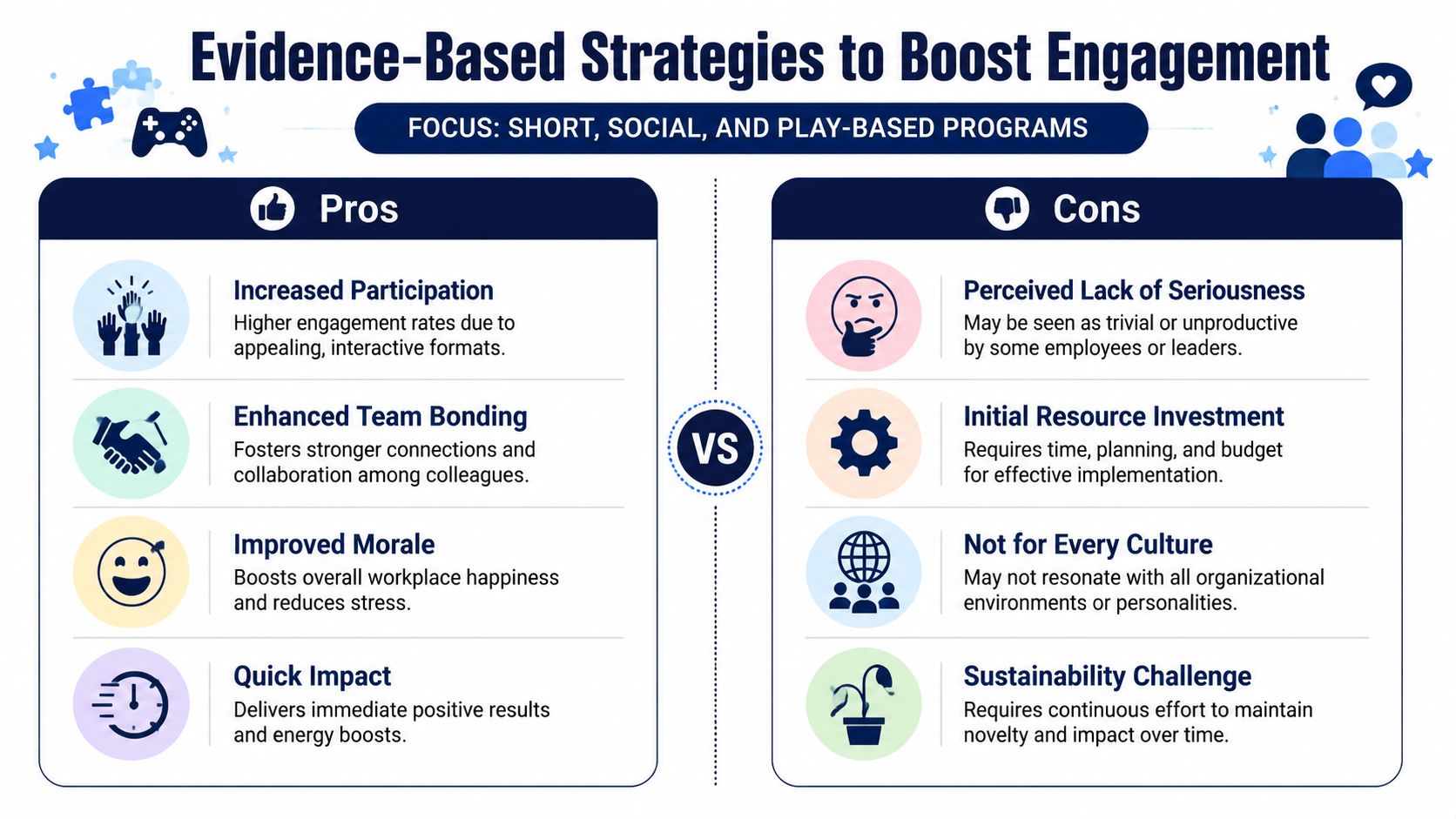
Recent Australian workforce commentary points to persistent pressure on collaboration and morale, and a data-aligned perspective is that engagement is not only an attitude problem but a social system problem. Interventions that create shared experiences, such as short, social, play-based activities, can sometimes do more than another survey or policy refresh (Kesem discussion of engagement and shared experience). That's an important trade-off for leaders. If a team already knows the issues, another diagnostic layer may add less value than a well-designed experience that rebuilds trust.
What works when energy is low
Short, social interventions work best when the organisation needs to restore interaction, strengthen cross-team relationships, or reset stale meeting culture. They are especially useful in hybrid environments where people have enough contact to transact, but not enough shared experience to trust each other easily.
Three approaches are consistently more useful than passive morale tactics.
Play-based team building with a business purpose
Play-based team building works when it is structured around cooperation, problem-solving, time pressure, and visible contribution. Those ingredients support the psychological and biological conditions discussed earlier. They can help teams practise communication and coordination in a way that feels lived rather than theoretical.
The mistake is treating play as random entertainment. Poorly designed activity can feel awkward, compulsory, or disconnected from work. Well-designed activity creates a shared reference point. Teams leave with stronger recall of who contributed, how decisions were made, and where communication broke down or improved.
CSR-linked experiences that create meaning
Charity programs add a second layer. They build internal connection while directing effort toward a concrete external outcome. That combination can lift engagement because the team experiences both social cohesion and purpose.
For organisations looking at this category, a provider such as Corporate Challenge Events offers play-based and charity team-building formats used in conferences, offsites, and culture programs. The value for leaders isn't the activity alone. It's that a well-designed shared challenge can support trust, communication, and a stronger sense of contribution without becoming another content-heavy initiative.
Event design that treats connection as an outcome
Conferences and offsites often waste their best engagement opportunity. Leaders fill the agenda with presentations, then wonder why people leave informed but unchanged. If connection is one of the goals, the agenda has to make room for it. That means purposeful interaction, mixed-team collaboration, and moments where participants rely on each other rather than just consume information.
A packed agenda can still produce a disconnected workforce if nobody actually experiences the team.
What usually doesn't work
The weakest engagement strategies tend to share one flaw. They ask employees to absorb more rather than connect more.
Over-surveying without action: People stop trusting the process when feedback produces little visible change.
Recognition without redesign: Appreciation helps, but it won't solve overloaded roles or poor management habits.
One-size-fits-all programming: Different teams need different interventions based on their friction points.
Events with no follow-through: A strong experience fades if leaders don't link it to day-to-day behaviours afterward.
For smaller organisations building an engagement approach with fewer layers of structure, this guide to employee engagement for small businesses is a useful complementary resource because it keeps the focus on practical action rather than policy volume.
A Sample Engagement Action Plan
An Australian professional services firm notices a pattern in its people data. Overall engagement looks stable, but one business unit reports weaker collaboration, more frustration between locations, and lower confidence in day-to-day communication. The issue isn't broad dissatisfaction. It's social friction.
The People & Culture team avoids launching another large survey. Instead, it runs structured manager conversations and a short pulse focused on role clarity, team trust, and cross-office support. The picture becomes clearer. Employees understand the work. They don't feel well connected to the people doing it.
The intervention
The firm plans a half-day offsite built around a charity team-building challenge. The design mixes people across offices and levels, gives each group a shared objective, and requires collaboration under time pressure. Leaders are briefed in advance to participate as team members, not commentators.
Communication before the day is specific. The event is positioned as a working investment in trust and collaboration, not as a reward or social extra. That framing changes attendance energy immediately.
The follow-through
In the following weeks, managers hold short debriefs with their teams. They ask what the activity revealed about communication habits, decision-making, and how work gets stuck. The team then selects two behavioural changes to carry forward, one related to meeting rhythm and one related to cross-location responsiveness.
A month later, the organisation repeats a targeted pulse. It doesn't ask whether the event was enjoyable. It asks whether team communication feels easier, whether colleagues are more willing to ask for input, and whether support across locations has improved. That's the level on which engagement becomes manageable. Diagnose the barrier, match the intervention, then review what shifted. Leaders looking to build that kind of practical rhythm can start with approaches that focus on connection and follow-through, such as creating a highly engaged team and staff culture.
For organisations that want to turn engagement from a survey topic into a practical team strategy, Corporate Challenge Events provides play-based team building, charity programs, conference experiences, and culture-focused formats designed to strengthen connection, communication, and shared momentum at work.