
In Australia, 37% of employed people usually worked from home in August 2024, up from 31% in 2023 according to the Australian Bureau of Statistics data cited here. That single shift changes how leaders should think about culture. A people and culture strategy can't rely on office energy, informal observation, or one-off engagement campaigns when a significant share of work now happens across distributed teams.
The practical question isn't whether culture matters. It's whether the organisation has translated culture into operating decisions, manager behaviours, team norms, and measurable priorities. That's where many businesses stall. They have values on the wall, a few annual initiatives, and good intentions, but no coherent system that connects people decisions to performance, retention, capability, and risk.
Table of Contents
What Is a People and Culture Strategy
A People and Culture strategy is the business plan for how an organisation attracts, supports, organises, develops, and retains its workforce so the business can execute its goals. It's broader than HR administration and more deliberate than isolated culture initiatives. Recruitment, onboarding, learning, leadership, performance, communication, inclusion, work design, and employee experience all sit inside it.

Traditional HR often becomes reactive. A manager resigns, so hiring starts. Conflict escalates, so a policy gets updated. Engagement drops, so a survey goes out. A people and culture strategy works the other way around. It asks what the business is trying to achieve, what kind of workforce and leadership model that requires, and what systems need to be built before problems become expensive.
Strategy is an operating system, not a calendar of programs
In a hybrid environment, surface-level culture signals don't travel well. Team members don't all experience the same workplace in the same way, at the same time, or in the same location. That means leaders need to design culture through mechanisms that hold up across distance. Clear team agreements, manager capability, meeting quality, decision rights, communication rhythms, recognition habits, and workload design become far more important than office-based symbolism.
A useful test is simple. If the organisation removed every poster, value statement, and annual engagement event tomorrow, would employees still experience a consistent standard of leadership and collaboration? If the answer is no, the business may have culture messaging rather than a people and culture strategy.
Practical rule: If a culture priority can't be seen in hiring decisions, manager expectations, performance conversations, and resource allocation, it isn't strategic yet.
What a strong definition looks like in practice
A sound people and culture strategy does three jobs:
It aligns people to business direction by linking workforce decisions to growth, service delivery, transformation, or operational stability.
It creates consistency so employees don't depend on luck to get a good manager, fair process, or development opportunity.
It turns culture into execution by embedding expected behaviours into routines, structures, and leadership accountability.
That's why the discipline sits closer to business architecture than to employee perks. The strongest strategies don't ask, “What should HR run this year?” They ask, “What workforce conditions does the business need in order to perform well?”
Why Your Business Needs a People and Culture Strategy
Australian businesses are operating in an active labour market. In August 2024, 67.6% of people aged 15 to 74 were participating in the labour force, employment was 64.0%, unemployment was 3.9%, full-time employment was 68.4%, and part-time employment was 20.5% according to the ABS labour force data referenced here. For leaders, that means talent attraction and retention aren't side issues. They're operating pressures.
When the labour market is active, weak people systems show up quickly. Good employees leave because career paths are vague. New hires underperform because onboarding is inconsistent. Managers burn time handling preventable friction because roles, norms, and expectations were never properly designed. Those aren't HR problems in isolation. They affect delivery, customer outcomes, risk, and leadership capacity.
The cost of having no real strategy
Many organisations still rely on fragmented effort. One team focuses on engagement. Another updates policies. A separate learning plan runs in parallel. Senior leaders discuss culture during planning cycles, but line managers aren't given practical tools to lead it. The result is usually familiar: too many initiatives, too little traction.
A proper people and culture strategy fixes that by setting priorities and trade-offs. It helps leaders decide where standardisation is needed and where flexibility should remain. It also forces harder questions, such as whether the business is asking managers to carry too much cultural weight without the training, authority, or time to do it well.
Strong culture rarely comes from adding more activity. It usually comes from removing inconsistency.
Why human connection has become a business issue
As work becomes more digital, interpersonal quality becomes easier to neglect and more valuable when it's done well. That's one reason the discussion around human connection in the AI era is useful for workplace leaders. It reframes connection as economic and organisational infrastructure, not just a wellbeing topic.
For hybrid teams, coordination, trust, feedback quality, and belonging all depend on intentional human interaction. If leaders leave those to chance, teams don't become autonomous. They become disconnected.
For organisations planning ahead, the state of work in 2026 is a helpful prompt because it pushes the conversation beyond immediate hiring needs and toward workforce design, leadership readiness, and changing employee expectations.
What leaders gain when strategy is done properly
A well-built people and culture strategy gives a business:
| Business need | Strategic people response |
|---|---|
| Growth | Build capability, succession depth, and clearer role design |
| Retention | Improve manager quality, mobility pathways, and employee experience |
| Hybrid coordination | Set communication norms and accountability across locations |
| Performance | Align goals, feedback, recognition, and development |
| Risk reduction | Strengthen reporting pathways, behavioural standards, and leadership oversight |
The commercial value sits in coherence. When people systems reinforce each other, leaders spend less time compensating for avoidable organisational drag.
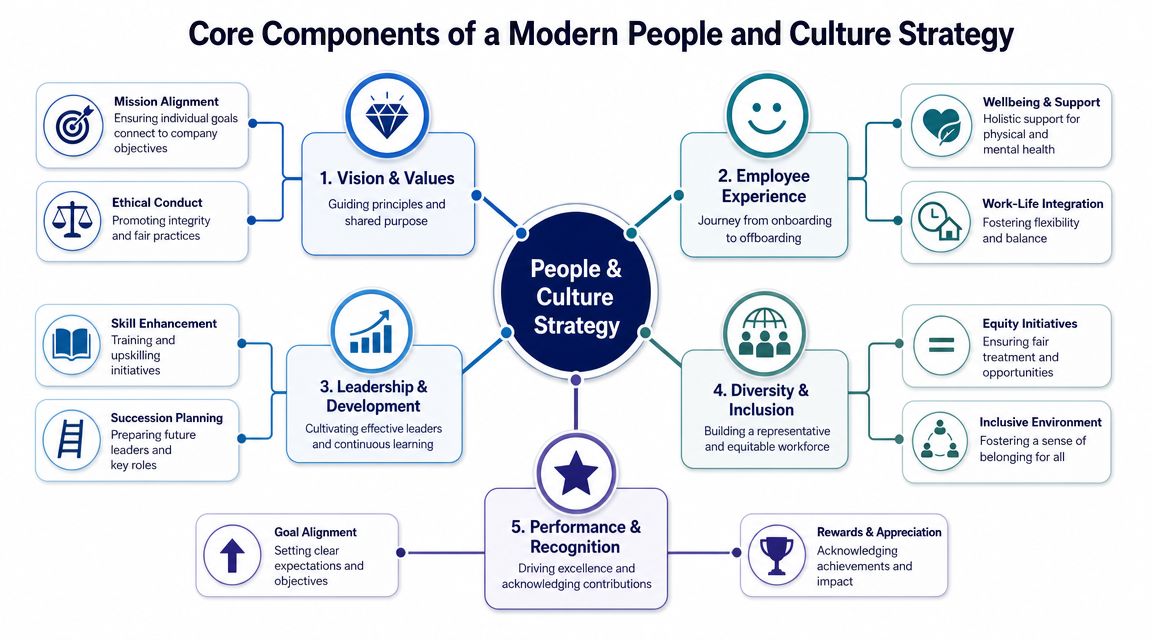
Core Components of a Modern People and Culture Strategy
A modern people and culture strategy works best when leaders treat it as a connected architecture rather than a list of HR activities. The specific priorities will vary by organisation, but the underlying components are usually consistent. If one pillar is weak, the others start to underperform because employees experience the workplace as a whole, not as separate programs.
Vision, values, and operating standards
Values only become useful when they guide decisions. That means translating them into practical standards for hiring, promotion, collaboration, and conduct. Teams need more than broad words like respect or excellence. They need examples of what those expectations look like under pressure, during change, and across functions.
This is also where employer identity starts. Leaders trying to attract top talent using employer branding often focus on external messaging, but the brand holds up only when the internal employee experience reflects it. A people and culture strategy closes that gap.
Employee experience and work design
Employee experience isn't just a sentiment measure. It includes how work feels and functions across the full employment lifecycle. Onboarding quality, meeting load, role clarity, access to information, flexibility, manager availability, and workload design all shape whether people can do their best work.
Poor experience often comes from process clutter rather than lack of effort. Businesses add systems, approvals, and communication layers over time. If nobody redesigns the work, employees carry the burden through confusion and fatigue.
Leadership, capability, and progression
Culture becomes real through managers. Employees rarely judge culture by executive speeches. They judge it by whether their manager sets clear expectations, handles conflict well, coaches fairly, and follows through. That's why leadership development should focus less on abstract inspiration and more on applied management capability.
A practical capability agenda usually includes:
Manager essentials such as feedback, prioritisation, performance conversations, and team communication
Career pathways that show employees how progression works, not just that progression is encouraged
Succession discipline so critical roles don't rely on a small number of people
Inclusion, safety, and accountability
This component can't be treated as a branding exercise. According to a 2022 Australian Human Rights Commission national survey, the figures illustrate the gap between harm and formal escalation in workplaces.
A credible strategy therefore needs trusted reporting pathways, prevention capability, manager judgement, and visible accountability. Without those, inclusion messaging won't carry much weight.
For leaders working on belonging and equity in practical terms, this guide to fostering DEI in the workplace is a useful complement because it brings the conversation back to behaviour and team practice.
Culture becomes credible when employees believe the organisation will act, not just communicate.
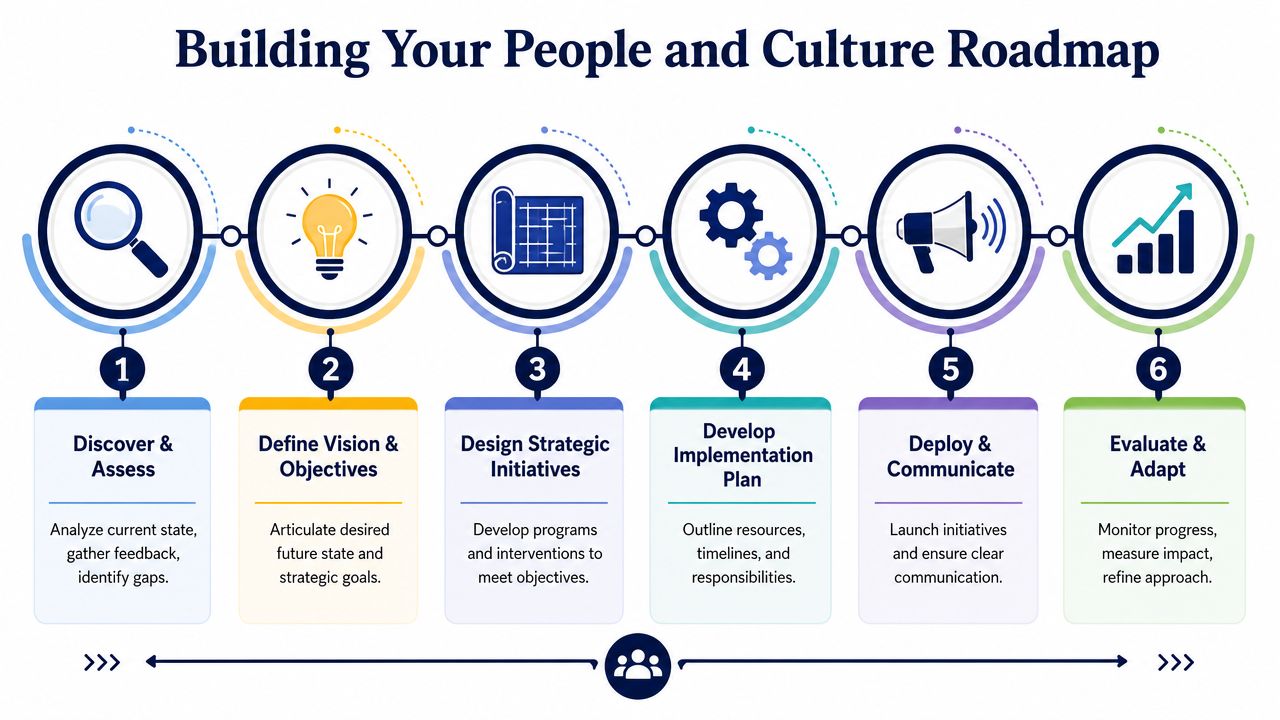
How to Build Your People and Culture Roadmap
The majority of people and culture strategies fail in the transition from ambition to sequencing. The diagnosis is broad, the priorities are too many, and implementation gets reduced to a list of disconnected initiatives. A roadmap solves that by forcing order. It says what comes first, what can wait, who owns each action, and how the organisation will know whether it's working.
Start with diagnosis, not aspiration
A roadmap should begin with evidence. That includes workforce data, employee feedback, operational pain points, manager observations, and business priorities. The point isn't to collect every possible metric. It's to find where organisational friction is most concentrated.
One useful example comes from work design and absence analytics. The ABS reports that 3.7 million people worked part-time in August 2024, about 27% of all employed people, and female employees averaged 4.4 days of illness, injury or leave compared with 2.9 days for males in the four weeks to late June 2024, according to this people analytics summary using ABS data. That kind of pattern tells leaders not to design workforce policy around a single standard employee. Segmenting by hours worked, leave behaviour, and workforce group often reveals where flexibility, manager support, or workload redesign is most needed.
Build the roadmap in phases
A practical roadmap usually follows four working phases:
Diagnose the current state
Gather the minimum viable evidence set. Review turnover patterns, employee voice themes, role design issues, absence trends, and manager capability gaps.Set strategic priorities
Choose the few themes with the strongest business relevance. Examples might include manager quality, internal mobility, hybrid coordination, or reporting trust.Translate priorities into initiatives
Define actions, owners, resources, and timeframes. Replace broad intentions with decisions. Which processes will change? Which leaders are accountable? What gets stopped?Review and adjust
Check whether implementation is changing team experience and business performance. If not, change the intervention rather than defending the plan.
Execution test: If an initiative has no owner, no timeline, and no behaviour change attached to it, it's still a concept.
Keep the roadmap narrow enough to survive contact with reality
A common mistake is trying to modernise every people process at once. That usually overwhelms managers and weakens adoption. Better roadmaps have a clear spine. They identify a small number of core priorities and phase the rest.
That's also why senior leaders need visibility. If people strategy only sits inside HR, implementation tends to stall when competing business priorities emerge. A stronger model gives the executive team and operational leaders a clear role in sponsorship and decision-making. For HR teams trying to strengthen that influence, how HR gets a seat at the C-suite table offers a useful perspective on positioning people work as business work.
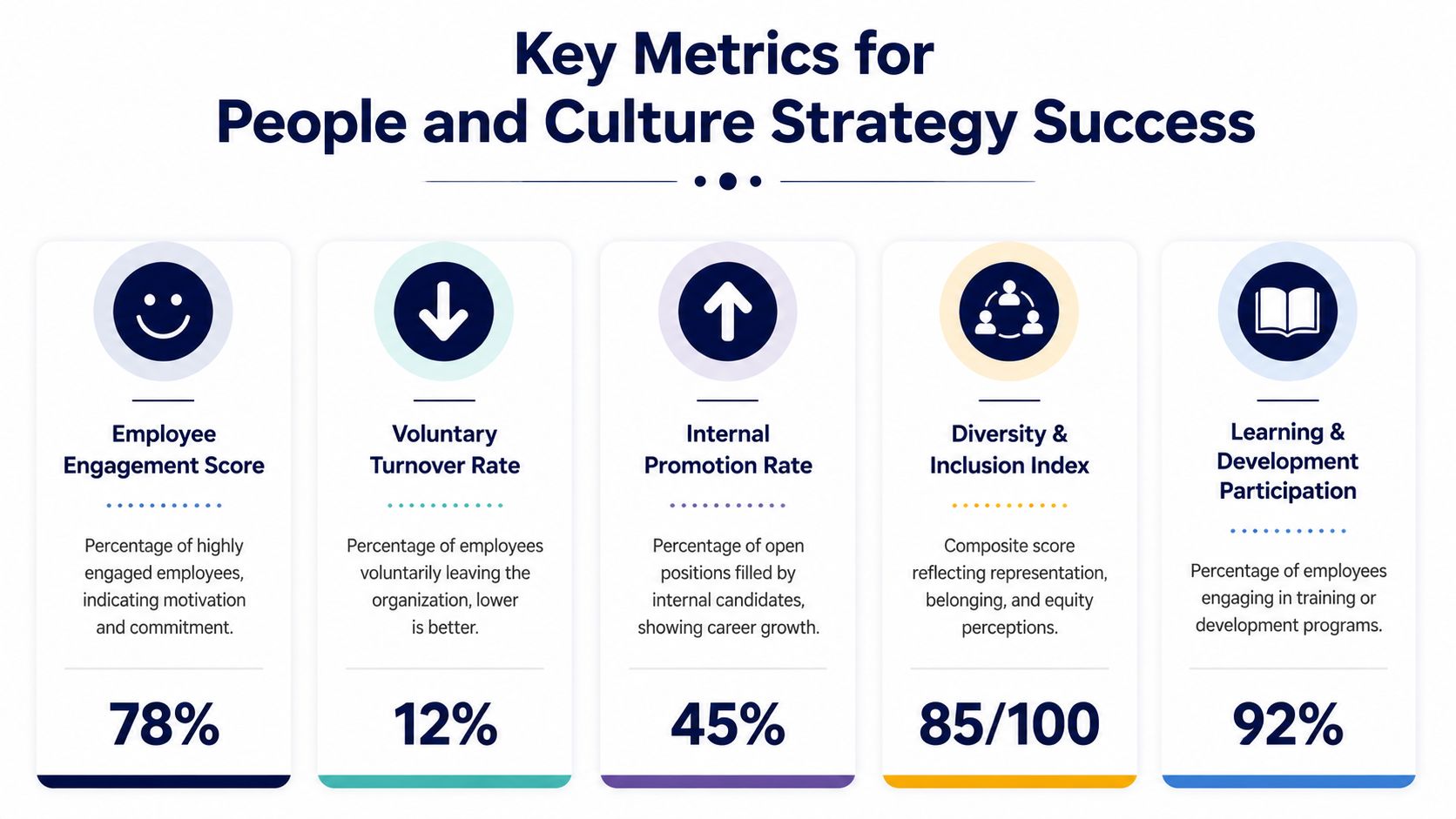
Setting and Measuring People and Culture KPIs
A people and culture strategy becomes credible when leaders can show whether it's changing anything that matters. The problem is that many scorecards are dominated by lagging indicators. Turnover gets reported after people have left. Engagement gets reviewed after trust has already weakened. Those measures still have value, but they don't give leaders much room to intervene early.
Focus on indicators that support action
A more useful KPI set combines business outcomes with leading indicators of team health and capability. For Australian organisations, internal mobility should be high on that list. The ABS Job Mobility release shows the job mobility rate for employed people was 7.7% in February 2024, and this Australian people strategy analysis argues that internal fill rate, time-to-productivity for moved employees, and manager-level retention risk are among the most actionable measures.
That's a strong starting point because internal movement can mean two very different things. It can reflect healthy development and succession depth, or it can conceal instability, poor management, and churn. The KPI only becomes useful when paired with context.
A practical KPI mix
Instead of building a giant dashboard, leaders are usually better served by a smaller set of measures with clear decision value.
Internal fill rate tracks whether the organisation is developing and moving people into opportunities.
Time-to-productivity for promoted or moved employees shows whether transitions are being supported well.
Manager-level retention risk helps identify where avoidable exits may be forming.
Engagement or employee voice measures can reveal whether teams feel clear, supported, and heard.
Capability build indicators show whether critical leadership and role-based skills are improving.
A good scorecard should also distinguish enterprise trends from local management issues. If one function consistently has stronger exits, weaker feedback, or lower internal movement, the response shouldn't be generic. It should be targeted.
Don't measure everything at the same altitude
The most effective approach is to separate KPIs into three levels:
| Level | What to track | Why it helps |
|---|---|---|
| Enterprise | Retention, internal mobility, capability trends | Shows strategic health |
| Team | Manager-level risk, engagement themes, onboarding quality | Surfaces local issues |
| Initiative | Adoption, completion, behaviour change | Tests whether interventions are landing |
For leaders refining this mix, employee retention strategies is a practical reference because retention becomes far more manageable when it's treated as a manager, mobility, and experience issue rather than a headline number alone.
How Team Building Activates Your Culture Strategy
Hybrid work has made culture harder to see and easier to misread. In many Australian organisations, people can meet deadlines while trust, coordination, and decision quality weaken underneath. That is why team building still matters, but only when it is designed as a business intervention rather than a morale exercise.
A people and culture strategy becomes real when teams practise the behaviours it expects. If the strategy calls for better cross-functional work, stronger manager communication, or more accountability in hybrid settings, teams need situations where those habits are visible. Well-designed team experiences create that test environment. Leaders can observe how people share information, handle pressure, include quieter voices, and recover when plans change.
The design choice matters more than the activity itself.
A generic social event may create a short-term lift. It rarely changes how work gets done on Monday. A stronger approach starts with a specific problem, then builds the session around it. That could mean improving collaboration between sales and operations, rebuilding trust after rapid growth, or helping a newly blended team establish working norms across office and remote staff.
Where team building becomes useful
Team building is most useful when leaders need behavioural evidence, not just opinion. A workshop can tell you that cross-functional coordination feels weak. A live task shows where it breaks down. You see who clarifies roles, who holds information, who steps in too late, and whether the team defaults to speed over alignment.
Programs such as Pipeline are useful in that context because they put planning, resource allocation, communication flow, and role clarity under pressure. Those are not abstract culture themes. They are operating conditions.
The same applies to purpose-led work. If part of the strategy is to build stronger connection to community impact, a charity-based build such as Bikes for Tykes can support that goal while still testing coordination, ownership, and shared contribution. Done well, the team leaves with more than goodwill. It leaves with a clearer view of how people worked together.
Shared experiences create value when they reveal working habits teams do not usually stop to examine.
What works and what usually falls flat
The strongest interventions usually have three elements:
A clear behavioural objective linked to a real business need such as better collaboration, stronger trust, faster decision-making, or more inclusive participation
Facilitation that turns activity into insight so teams examine what happened, not just whether they finished
Follow-through with managers and leaders so observations become team agreements, meeting norms, role clarity, or local action plans
What usually falls flat is the isolated event with no brief, no observation criteria, and no follow-up. People may enjoy it. The organisation still learns very little. In hybrid teams, that is an expensive trade-off because disconnected experiences can reinforce cynicism if employees see no link to daily work.
Leaders assessing team building that aligns with business objectives should judge it the same way they judge any other culture investment. What behaviour is this meant to improve? Which team needs it most? What needs to happen afterwards for the effect to last?
Corporate Challenge Events is one provider used by organisations that want play-based formats matched to outcomes such as problem-solving, charity impact, conference engagement, and team collaboration. The value is not in the format alone. It sits in whether the experience is tied to a defined workplace goal and reinforced by leaders afterwards.
The practical role of play in culture work
Some executives still treat play as separate from serious work. In practice, play is often one of the fastest ways to expose how a team functions. Pressure arrives quickly. Communication patterns become obvious. Informal leaders emerge. So do bottlenecks, avoidance, and uneven participation.
That is particularly useful in Australia's hybrid workforce, where many friction points stay hidden behind calendars, chat tools, and polite status updates. Teams can look functional from a distance while carrying unresolved issues around responsiveness, trust, or decision rights. A well-run team building session gives those issues shape. It gives managers something concrete to discuss and improve.
Team building does not replace manager capability, clear operating rhythms, or good job design. It supports them by turning cultural intent into observable behaviour. That is the point. Strategy should not only describe the culture an organisation wants. It should create repeatable opportunities for people to work that way.
Your Strategy Is a Living Document
A people and culture strategy earns its place by improving how work runs, not by sitting neatly in a slide deck.
Direction should stay steady. Application should change as the business changes. Priorities shift, teams reorganise, managers come and go, and hybrid work keeps changing where friction shows up. In Australian organisations, that often means the formal culture story sounds consistent while the day-to-day employee experience varies sharply by team, location, and manager capability.
Treat the strategy as an operating system for people decisions. Review the assumptions behind it. Check whether your interventions still match current business risks, workforce patterns, and leadership behaviour. If a priority no longer supports performance or retention, change it. If a visible program is getting attention but not changing behaviour, stop funding the optics and redesign the work.
That is the difference between performative culture activity and practical culture management.
Ownership matters here. People and Culture teams can set the structure, measures, and decision rules, but they do not control the daily employee experience on their own. Executives signal what matters. Managers turn that into meeting habits, feedback quality, workload decisions, and accountability. Employees judge culture by whether those signals line up.
The strongest strategies are specific enough to guide action and flexible enough to survive real conditions. They use data to identify where problems sit, especially in hybrid teams where issues are easy to miss until performance, engagement, or turnover starts moving in the wrong direction. That is how strategy becomes a business asset. It informs decisions, shapes behaviour, and gives leaders a clearer way to improve how work feels and how work gets done.
When organisations want to turn culture priorities into practical team experiences, Corporate Challenge Events can support that work through play-based corporate programs designed for connection, collaboration, communication, and shared purpose across conferences, offsites, team days, and broader culture initiatives.