
36% of employed Australians usually worked from home in August 2024, so remote engagement is no longer an edge case. It is a management system problem. Gallup says managers account for 70% of the variance in team-level engagement (Gallup), which means leaders who keep treating remote work as a perk, a swag problem, or a calendar problem are chasing the wrong lever.
For Australian HR and People & Culture leaders, the job is to design a better operating rhythm. Engagement rises when remote and hybrid work are coordinated with clarity, fairness, and trust, not when leaders add another round of video calls. The best remote teams do not depend on office presence to create alignment. They build it through written norms, predictable cadence, and small rituals that people can sustain across time zones, caregiving loads, and uneven connectivity.
Table of Contents
Design a Communication Charter That Replaces Ad Hoc Check-ins
Build the Weekly Rhythm That Holds a Distributed Team Together
What Remote Engagement Really Looks Like in Australia
Gallup's manager-variance finding and the ABS work-from-home figure should kill the old assumption that remote engagement is a perks issue. If 37% of employed people usually worked from home in August 2024, then remote work is mainstream, not a side arrangement. If managers drive most of the engagement difference, then the quality of management, not the amount of time on camera, is what separates a healthy distributed team from a drifting one.
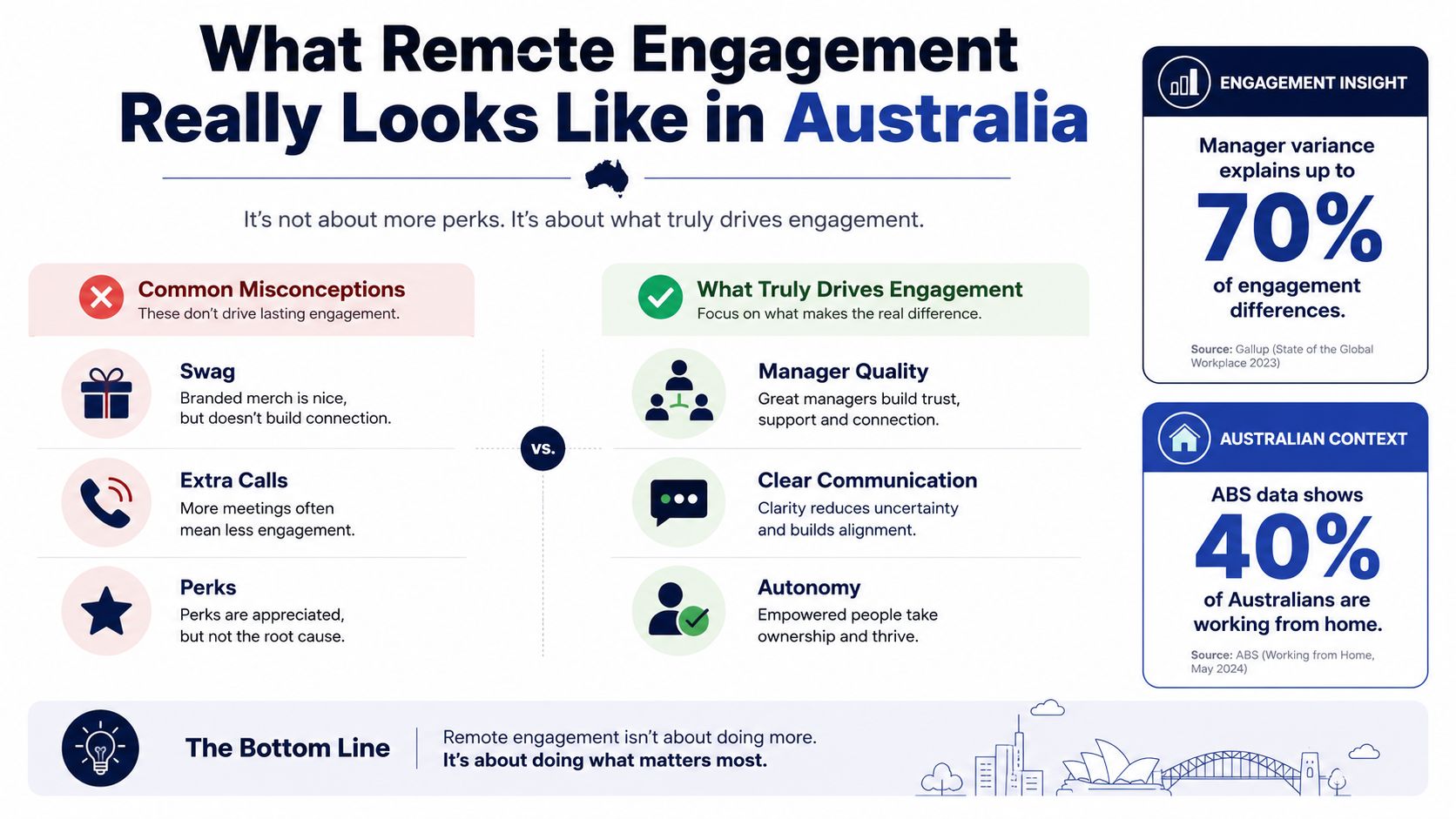
The trust gap is visible in the data too. Gallup found that only 54% of managers strongly agree they trust remote employees to be productive, while only 57% of employees strongly agree they feel trusted (Gallup). That tells leaders something blunt, remote teams do not need more surveillance, they need better operating norms.
What the actual engagement problem looks like
Ad hoc check-ins feel active, but they usually hide weak design. Team members end up interpreting silence differently, carrying unanswered questions longer, and relying on memory instead of shared standards. That is where disengagement starts, not in a lack of virtual trivia.
The better reference point is a team that knows exactly which channel to use, how quickly to respond, when to raise an issue, and how meetings work. That is why a design-led approach beats a “keep the cameras on” mindset. For teams that want a practical benchmark, Hosted Telecommunications on remote team alignment is a useful external read because it sits squarely in the communication and coordination lane.
Practical rule: if remote staff need to ask, “Is this urgent, or should this wait?”, the team charter is already too vague.
The historical lesson is simple. Remote engagement improves when leaders replace reactive contact with shared operating rhythms, clear expectations, and team-owned norms. For a broader view on the people side of engagement, see Corporate Challenge Events' guide to employee engagement.
The rest of this playbook sits on four levers, communication design, operating rhythm, social connection, and measurement. Get those right and remote engagement stops depending on physical proximity.
Design a Communication Charter That Replaces Ad Hoc Check-ins
A communication charter should be the first document a remote team writes down. Without it, people fall back on the quickest habit available, usually a DM, a meeting invite, or a long email thread that nobody fully reads. The charter turns communication into a shared system instead of a string of individual preferences.
Build the rules before the confusion starts
Keep the charter to one page and cover four areas, channel choice, response times, meeting etiquette, and escalation paths. Teams do not need a legal document. They need enough clarity that a Brisbane manager, a Perth analyst, and a Sydney executive assistant can make the same call without checking three people first.
Leapsome recommends 25-minute meetings instead of 30 and 50 instead of 60, with agendas shared 24 hours in advance and meetings ending with documented owners and deadlines (Leapsome). That approach works because it cuts drift. It forces the team to decide why the meeting exists before everyone joins it.
A solid 60-minute charter workshop can be run with the whole team or with team leads first. Start by sorting message types into buckets, urgent operational issue, routine update, decision needed, or relationship-building conversation. Then agree which channel each bucket belongs in, and what response speed is realistic for each one.
Use live time for decisions, not announcements. If the information can be written once and read twice, it should stay out of the calendar.
The charter also needs to fit Australian working patterns, especially hybrid schedules and uneven connectivity. Be explicit about what happens when someone is on-site, in transit, in a different state, or working around care responsibilities. Clarity lowers friction because people stop guessing what “normal” means.
If your team needs help with the people side of the charter, communication skills in team settings gives a useful reference point for the behaviours that keep it working. For the meeting side of the charter, Corporate Challenge Events' meeting agenda template sits naturally alongside the written norms. Use it to keep meetings lean and accountable, then test the whole charter for two weeks before locking it in.
What the first draft should include
Channel Guidance: use one channel for quick, urgent questions, another for decisions, and another for documents that need review.
Response Expectations: spell out what “soon”, “today”, and “by end of week” mean for the team.
Escalation Rules: define when an issue jumps from message to call, and from call to manager.
Meeting Standards: require agendas, note owners, and cut meetings that do not end with a decision or a next step.
The revision should be based on friction, not opinion. If people keep missing deadlines because they did not know where to look, fix the channel map. If meetings keep overrunning, cut the length and tighten the agenda. The charter only works when it gets used.
Build the Weekly Rhythm That Holds a Distributed Team Together
A distributed team needs a clear weekly rhythm more than it needs another standing meeting. The job is not to cram the calendar with calls. The job is to make live time count and let written updates carry the routine load. That matters in Australian teams where people are split across states, time zones, and work patterns, and where caregiving and regional connectivity can shape when people are available.
Keep sync time narrow and intentional
A strong weekly cadence has four anchors. Monday sets focus, mid-week 1:1s clear obstacles, Friday reviews progress, and one monthly connection session keeps the human side alive. Each one needs a distinct purpose. None of them should become a catch-all.
The Monday session should answer one question, what has to move this week. Keep it short and decision-focused. Use it to confirm priorities, surface dependencies, and call out where support is needed.
Mid-week 1:1s are for the things public meetings miss, workload, confidence, and blockers. They should not become status theatre. Managers should ask what is stuck, what needs escalation, and what support would make the week easier to finish well.
Friday retros are where the team learns from the week instead of repeating it. Cover what landed, what slowed the work, and what needs to change in the next cycle. Recognition belongs here too, because remote staff need to hear what went well while the work is still fresh.
A monthly connection session plays a different role. Keep it lighter, more relational, and free of heavy work updates. That is the right place for a small shared challenge, a team celebration, or a play-based moment that gives people a reason to show up without feeling like they are being dragged into another meeting.
Monday is for alignment, Friday is for learning. Everything else should support those two outcomes.
Split live and async with intent
A team can only sustain a healthy rhythm if it stops treating every update like a meeting topic. Routine status belongs in written formats. Live time should be reserved for decisions, coaching, and connection. The Corporate Challenge Events' meeting agenda template is useful here, because it keeps live sessions tight and forces a clear purpose before anyone joins.
Microsoft's 2024 Work Trend Index reports that employees spent 60% of their workday in meetings, email, and chat (Perceptyx). That is a clear signal to stop adding more calls by default. Put routine updates into async written formats, then use live time where people need to talk through decisions or problems.
A 12-person hybrid team spread across Sydney, Brisbane, and Perth can still run the same rhythm. The Sydney lead can handle Monday focus-setting early, the Brisbane manager can run mid-week 1:1s, and the Perth staff member can join Friday review with a written update already posted. The cadence flexes around location without splitting the team into separate working worlds.
The point is predictable coordination. One team. One rhythm. Fewer meetings that drift, more live time that produces a decision or a next step.
Layer Social Connection So It Respects Real Lives
More optional video calls do not fix remote disconnection. They often add another burden to teams that are already overloaded. Microsoft's work trend data and Gallup's stress findings point in the same direction, remote engagement has to be designed around capacity, not wishful thinking.
Gallup's 2054 findings show fully remote workers are the most engaged at 31%, but they also report higher stress, with 45% saying they experienced a lot of stress the previous day compared with 39% of on-site remote-capable workers and 38% of on-site non-remote-capable workers (Gallup). That is the wrong environment for mandatory social overload. It is the right environment for lightweight, layered rituals that people can enter without pressure.
Use layers, not one-size-fits-all events
Start with always-on async channels for informal contact. A shared thread, a team channel, or a lightweight recognition space gives people somewhere to drop a quick note without scheduling anything. That is the remote equivalent of passing someone in a corridor, except it works across locations.
Add a weekly micro-ritual that takes almost no coordination. A 15-minute Friday “wins and oddities” thread can work well because people can join in text, voice, or both. It rewards participation without requiring the whole team to be free at the same time.
Monthly shared experiences should be small and purposeful. A play-based team building session can work here because it creates a common memory without pretending everyone has the same energy level. The key is optional participation with a low-friction format, not another compulsory fun block on the calendar.
Quarterly connection should be broader and more intentional. For some teams, that will be a virtual event. For others, it will be a charity team building experience that creates a collective goal while supporting a community outcome. Corporate Challenge Events offers online team building and hybrid team building formats that can support that kind of connection, which makes them relevant for teams that need something more structured than a casual chat.
Build for caregiving, geography and time zones
Remote teams in Australia often carry different realities at the same time. Some people cannot do late-afternoon calls. Some are in regional areas with weaker connectivity. Some are working around care loads that make synchronous social time unrealistic. A layered model respects those differences instead of pretending everyone can participate equally in the same moment.
A useful rule is simple, every social ritual should have a text option, a replay option, or a no-pressure way to contribute later. That keeps culture inclusive. It also stops leaders from confusing attendance with belonging.
For a practical starting point on lightweight remote social connection, Corporate Challenge Events' micro-play ideas fit neatly into this layered approach.
Bring Play-Based Team Building Into the Operating Week
Play is not a break from performance. It is a way of changing the team state so people think better together. Corporate teams do not need childish activities. They need short, structured moments that create trust, stretch problem-solving, and reset attention inside the normal workweek.
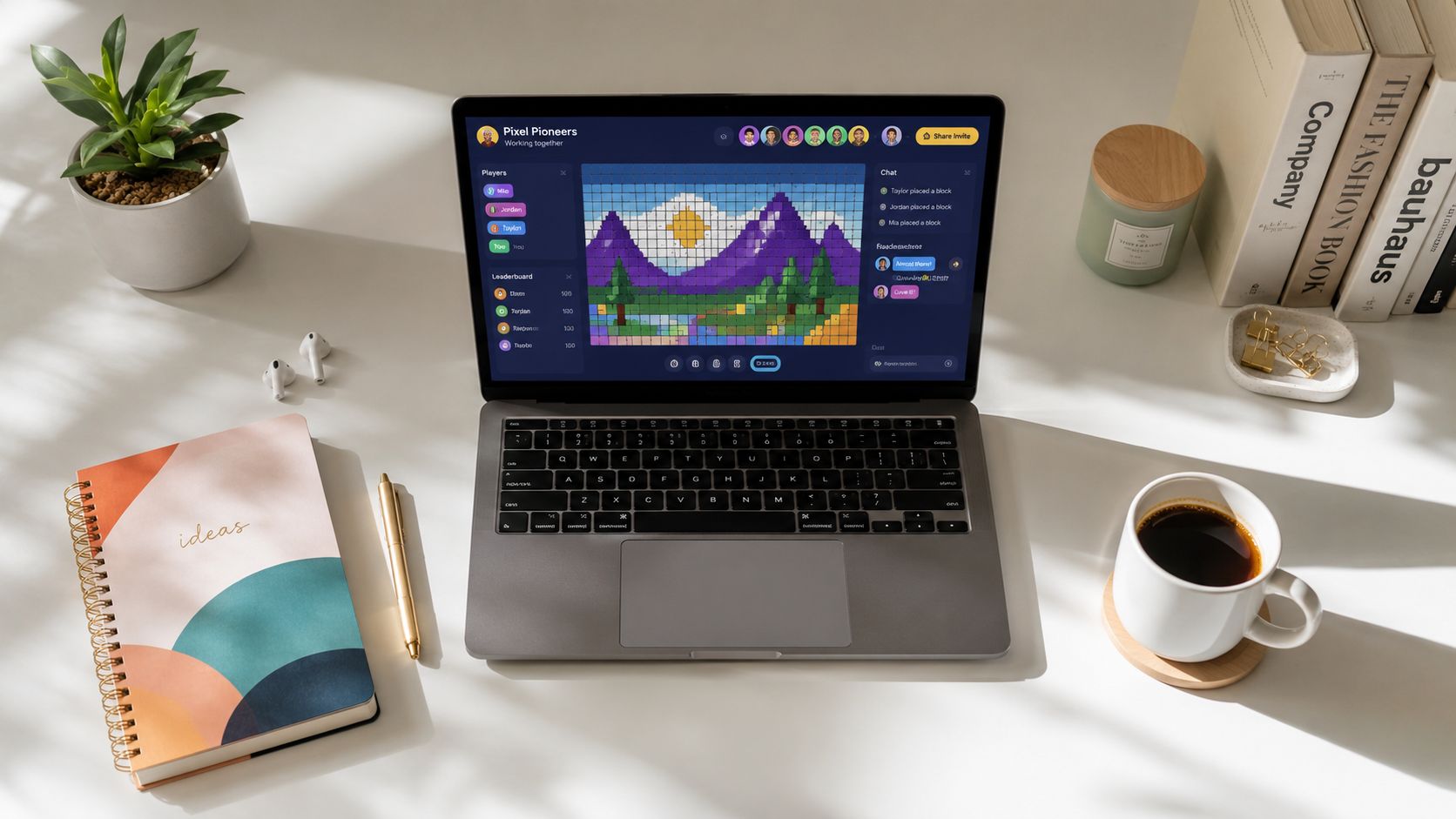
A remote team manager can treat play as a design tool. A 30-minute block can be enough if it has a clear purpose and a tight brief. The point is to create a shared task with enough novelty to pull people out of passive consumption and into actual collaboration.
What this looks like in a working week
A short problem-solving sprint inspired by LEGO Legends works well when a team needs to surface different thinking styles. One group gets a brief, builds under constraints, and then explains the logic behind the result. That format is useful because it makes collaboration visible, not abstract.
Creative constraint exercises modelled on Out of the Box are just as effective when the team needs to solve a real business challenge from a new angle. The facilitator gives a tight limitation, time, materials, or role rules, and the team has to adapt. That pressure is safe, contained, and often reveals who holds structure, who improvises, and who spots risk early.
Charity-linked micro-challenges inspired by Bikes for Tykes or Play it Forward can work for teams that want a shared outcome with social value. The team is still engaging in problem-solving, but the task has a community frame that makes the energy feel purposeful rather than decorative.
For leaders who want more remote-ready examples, virtual team building for HR is a useful contextual read. It sits in the same operational lane as this approach, connection through structure, not novelty alone.
Keep the format adult and useful
The biggest mistake is making play too loose. Remote teams disengage when a facilitator over-explains the “fun” part and under-explains the point. The better version is crisp, time-bound, and linked to how the team works.
If the team cannot explain what the exercise changed, the exercise was too vague.
Use play to improve communication, adaptability, and shared language. A team that has built something together, solved a constraint together, or contributed to a cause together has more to talk about in the next project meeting. That is the carryover, not the activity itself.
Corporate Challenge Events is one option for teams that want play-based team building built into a corporate calendar rather than bolted on as entertainment.
Measure Engagement Without Surveying Your Team to Death
Long surveys are easy to launch and hard to act on. Remote teams need a leaner measurement stack that leaders can review quickly and use to change behaviour. The right goal is not more data. The right goal is a clearer feedback loop.
Measure three things and keep the rest light
Start with three pulse questions run monthly. Ask whether people feel trusted, whether they have clarity on priorities, and whether they would recommend the team to a peer. Those questions are simple enough to answer and specific enough to drive action.
Then track three behavioural signals from existing tools. Look at whether meetings end with owners, whether written updates arrive on time, and whether escalations are being handled in the right channel. These are practical signs that the operating system is working or slipping.
Finish with one team-level outcome reviewed quarterly. That could be engagement sentiment, retention risk, or a team climate summary, depending on what the organisation already tracks. The point is to keep the review focused enough that leaders use it.
For leaders who want to compare metrics more broadly, browse engagement KPIs is a useful reference point for what to keep an eye on without overcomplicating the process. For a deeper internal lens on culture tracking, Corporate Challenge Events' guide to measuring culture change sits well alongside this measurement stack.
| Signal | Source | Cadence |
|---|---|---|
| Trust, clarity, recommend-to-peer | Monthly pulse questions | Monthly |
| Meeting ownership, update timeliness, escalation routing | Existing team tools | Weekly review |
| Team-level engagement or climate summary | Team review | Quarterly |
Use a 30-60-90 day review
At 30 days, look for obvious friction. Are meetings still too long, are channels still unclear, and are people still asking the same questions twice. Fix the biggest blockage first.
At 60 days, check whether the charter is being followed. If not, the issue is usually leadership behaviour, not team memory. Managers need to model the new rhythm or the team will revert.
At 90 days, decide what to keep, what to tighten, and what to stop. Share the results back to the team without naming individuals, then act on at least one issue within two weeks. If feedback vanishes into a spreadsheet, the team stops answering openly.
Your One-Page Operating Playbook
The strongest remote teams run on four visible levers. They write a communication charter, keep a weekly rhythm, layer social connection, and measure with a light-touch loop. That combination creates trust, clarity, and fairness, which is what remote engagement depends on.
The next 30 days should be simple. Write the charter, shorten the longest recurring meeting, add one weekly written update, and trial one play-based or charity-linked ritual that works across locations. Then review what changed and remove what people do not use.
For teams ready to go further, specialist play-based team building, the Science of Play keynote, and Belbin or Positive Teams workshops can deepen the work around communication and team dynamics. The point is not to add more content. The point is to build a team system that people can trust.
Corporate Challenge Events helps Australian organisations turn remote engagement into something practical, not theoretical, through online team building, hybrid programs and play-based experiences that support trust, communication and morale. If the next leadership priority is making remote teamwork feel clearer, fairer and more connected, visit Corporate Challenge Events and explore what fits the team's current rhythm.