
Some teams don’t fall apart. They just go quiet.
Replies take longer. Meetings stay polite but thin. Fewer people challenge weak ideas. Managers carry more of the emotional load. Cross-functional work becomes slower because people stop reaching across the aisle unless they have to. On paper, nothing looks broken. In practice, the organisation starts paying for distance.
That’s why employee engagement can’t be treated as an optional culture extra. Gallup defines engaged employees as people who are “highly involved in and enthusiastic about their work and workplace” in its employee engagement indicator. For busy People & Culture leaders, EAs, office managers and team leaders, low engagement rarely creates a dramatic moment that forces action. It creates drag.
Table of Contents
Low Engagement Rarely Arrives Loudly
A team can still hit deadlines while losing energy.
That’s what makes disengagement hard to escalate. Leaders usually notice it first in the texture of work rather than in a major performance failure. Brainstorms become narrower. Updates become transactional. People stick to role boundaries more tightly. New starters take longer to feel included. Strong contributors stop volunteering ideas unless they’re asked directly.

The early signals leaders tend to miss
The pattern often looks like this:
-
Communication slows: messages are answered, but not with the same pace or care.
-
Participation narrows: the same few people speak in meetings while everyone else stays cautious.
-
Silos harden: teams collaborate only when a process forces them to.
-
Managers absorb more strain: they spend more time chasing clarity, smoothing conflict and prompting follow-through.
These are engagement employee signals, even when no one uses that language internally.
A practical starting point is to pair instinct with better listening. Tools such as Formbricks customer insight surveys can help teams explore why energy is dropping instead of just measuring whether people attended something. For leaders already seeing subtle warning signs, Corporate Challenge Events has also outlined the hidden signals of team disconnection in a way that’s useful for managers trying to name what feels off.
Low engagement usually enters through everyday habits. Less candour, less initiative, less willingness to stretch.
Why this gets misread
Because output may still be acceptable, leaders often label the issue as workload, change fatigue or a rough quarter. Sometimes that’s true. Often, those pressures are exactly what expose weak connection and low trust.
The risk isn’t only morale. The risk is that a team starts operating at minimum safe effort and no one calls it disengagement until key people leave or performance slips enough to show up in a report.
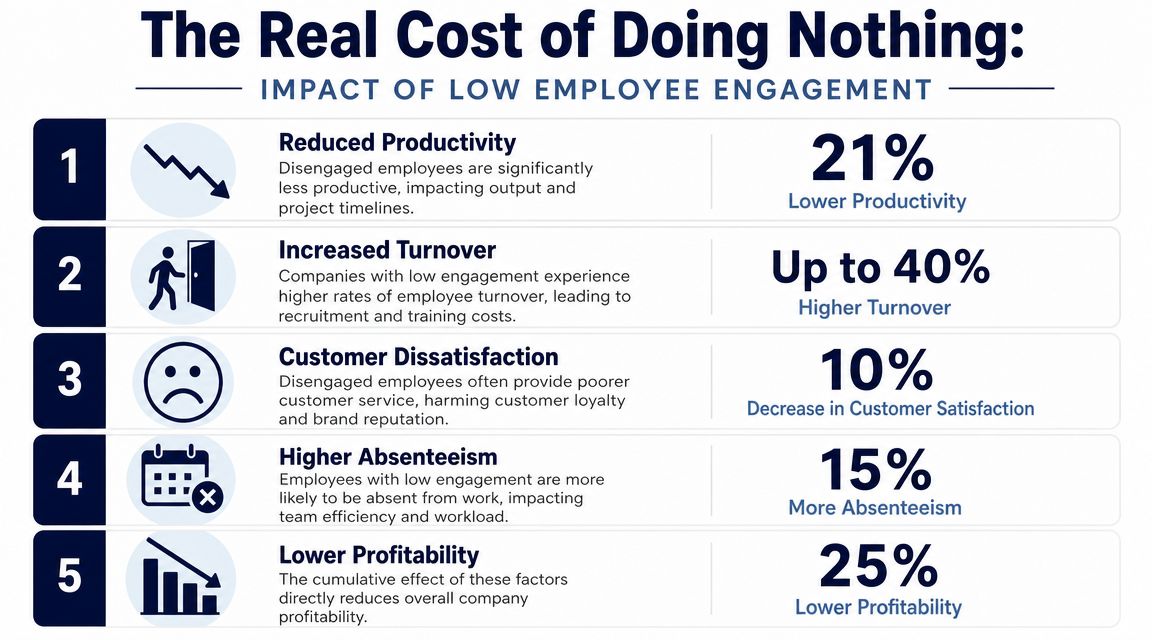
The Real Cost of Doing Nothing
Once engagement drops, inaction isn’t neutral. It becomes an operating choice.
Gallup-linked workplace findings show that engaged teams have been associated with 23% higher profitability, 18% higher productivity in sales records, and 10% higher customer loyalty or engagement according to this summary of Gallup workplace research. The same source notes that highly engaged business units see a 41% reduction in absenteeism.
What those costs look like in practice
Most organisations don’t feel disengagement as a single line item. They feel it through secondary effects that spread across teams.
| Business area | What low engagement often looks like |
|---|---|
| Delivery | More follow-up, slower decisions, weaker handovers |
| Customer experience | Less discretionary effort, less consistency under pressure |
| Management load | More prompting, more conflict buffering, more energy spent on basics |
| Retention | Capable people become easier to lose, especially when they feel unseen |
That’s why engagement shouldn’t sit in a dashboard as an isolated sentiment score. Australian HR analytics guidance recommends linking engagement data to HRIS, performance, payroll and business outcomes so leaders can identify which drivers are affecting retention, productivity or profit in Visier’s guidance on employee engagement data.
Inaction compounds quietly
A disengaged team doesn’t only do less. It often requires more management effort to maintain the same output.
Commercial reality: every week spent tolerating avoidable drag raises the cost of coordination.
If retention is already a concern, broader evidence-based retention strategies are worth reviewing alongside engagement work, because disengagement and turnover pressure often travel together. For a wider workplace context, Corporate Challenge Events also explores the state of work in 2026, including the conditions that are making connection harder to sustain.
Why Leaders Delay Action
Most leaders don’t ignore engagement because they don’t care. They delay because the problem feels hard to pin down and easy to postpone.
There’s usually a more visible fire burning. Revenue pressure. Restructures. A major event. Hybrid coordination issues. Hiring gaps. Engagement gets pushed down the list because it doesn’t always announce itself with a crisis.

The hesitation is often rational
Leaders are also right to be sceptical of shallow signals. Current guidance notes a key challenge in Australian hybrid teams is measuring engagement without confusing activity with engagement. Attendance at virtual events or survey participation doesn’t automatically reflect genuine connection, especially when engagement is influenced more by workload, management quality and flexibility in this analysis of employee engagement beyond perks.
That creates a familiar set of objections:
-
Time pressure: nobody wants to add another initiative to an already crowded quarter.
-
Budget caution: culture spend gets challenged if the outcome sounds vague.
-
Programme fatigue: teams have seen surveys or workshops that generated talk but no shift.
-
Approval friction: even a sensible intervention can stall if the business case isn’t clear.
What doesn’t help
Leaders usually lose support when they present engagement as a broad aspiration instead of an operational issue. “We need to boost culture” is too abstract. “Managers are spending too much time repairing preventable friction” is easier for a business to understand.
Why Connection Does Not Rebuild Itself
A team can look stable on paper and still be drifting apart in practice.
The work is getting done. Meetings are full. Deadlines are mostly met. Yet people start choosing the safe comment over the honest one, solving problems inside silos, and keeping requests narrowly transactional. That shift is easy to miss because it rarely shows up as a dramatic event. It shows up as more hesitation, more manager mediation, and less willingness to help beyond the task at hand.
Modern work creates relational drift unless leaders interrupt it
Hybrid work, constant reprioritisation and heavy workloads all push teams toward efficiency. They do not automatically produce trust.
Without deliberate moments of shared attention, people reduce each other to roles. Finance becomes the blocker. Operations becomes the bottleneck. The manager becomes the person who escalates issues nobody wants to raise directly. Once that pattern sets in, collaboration gets slower and more brittle, even if output still looks acceptable for a while.
I see this often in growing businesses. Leaders assume regular contact is enough because people are technically in touch all week. It usually is not. Contact maintains workflow. Connection supports candour, goodwill and fast recovery when something goes wrong.
Teams rarely rebuild trust through routine work alone. Routine work tends to reinforce whatever level of connection already exists.
Waiting usually raises the cost of repair
A wait and see approach feels sensible when the business is under pressure. It is also a choice to let weak habits harden.
If disconnection lasts, people adjust to it. They stop giving honest feedback. Small tensions stay unresolved. New starters struggle to break in. Managers spend more time translating, smoothing over and chasing alignment that a healthier team would handle itself. None of that looks like a culture crisis. It looks like extra friction in dozens of ordinary moments.
That is why inaction is expensive. Not because morale drops in the abstract, but because coordination gets harder, trust takes longer to earn back, and any later intervention has more ground to recover.
A single event will not fix that either. Reconnection needs follow-through in team habits, manager behaviour and simple rituals that keep the experience alive.
Where Play Based Team Building Fits
A team does not usually need another meeting to talk about engagement. It needs a setting where people can work together differently long enough to interrupt the habits that have gone stale.
Play based team building fits best when the issue is not capability, but drag. People still know their jobs. What has slipped is energy, ease and willingness to contribute beyond the minimum. In that situation, asking for more openness in a boardroom often produces polite compliance and very little else.
A well-structured shared activity changes the conditions. It lowers the social risk of speaking up, gives quieter people a clearer way in, and lets colleagues see each other outside the narrow patterns of day-to-day delivery. That matters because disengagement rarely shows up as open resistance. More often, it shows up as hesitation, withdrawal and low discretionary effort. Good design gives leaders a way to address that early, before those patterns harden into team culture.
Why this format works when teams are flat
The strongest play based formats are not random fun added to a busy quarter. They create useful pressure in a different context. People solve, decide, support and communicate together, and that produces signals leaders can use afterwards.
Done well, these experiences can help teams:
-
Lower barriers to contribution. People who hold back in formal meetings often join in more easily when the task is practical and time-bound.
-
Reveal how the team works. You can spot who includes others, who listens, who takes over, and where coordination breaks down.
-
Loosen role rigidity. Titles matter less for an hour, which helps people build familiarity that carries back into the work.
-
Create shared reference points. Teams leave with a common experience that makes later conversations less guarded and more specific.
That is the commercial case. The value is not the event itself. The value is whether it reduces friction afterwards.
Performance infrastructure, not entertainment
Leaders often get this wrong in one of two ways. They dismiss play based work as too soft, or they buy a high-energy session with no clear business purpose. Both are expensive choices.
Used properly, play based team building sits inside a wider engagement plan. Feedback, manager observation and performance signals should still guide the decision. If the problem is weak trust, low participation or poor cross-team cooperation, a targeted shared experience can be a sensible intervention. If the problem is workload, role confusion or poor management discipline, no activity will compensate for that. The return depends on matching the format to the actual issue.
That is also why inaction is risky. If leaders can already see low energy affecting collaboration, delaying because team building feels optional is still a decision. It leaves the team carrying avoidable friction for another quarter.
One practical option in this space is Corporate Challenge Events, which runs play based team building experiences for conferences, offsites, culture programs and charity team building. The useful question is not which provider has the loudest pitch. It is whether the experience is designed to support a real shift in how people interact at work. For leaders weighing that decision, this guide to the ROI of play in team building is a better starting point than treating engagement activity as a morale extra.
How to Make Employee Engagement Worth the Investment
The most effective approach is usually smaller and more deliberate than leaders expect.
Employee engagement becomes easier to fund when it’s treated as a business decision with a clear operating purpose. Not “do something nice for the team.” More “remove friction, reconnect people and support better collaboration before costs rise further.”
A low-friction path forward
-
Name the current cost
Look at where low energy is already affecting work. Slow decisions, repeated misunderstandings, manager overload, weak cross-team cooperation or avoidable turnover risk all belong in the discussion. -
Choose one intervention with a clear job to do
Don’t launch a sprawling engagement programme if the team is already overloaded. Pick one well-designed experience that helps rebuild trust, participation or cohesion. -
Measure what changes afterwards
Track the next survey cycle, manager observations and the operational signals that matter to that team. Engagement should be linked to business outcomes, not left as a standalone sentiment score.
Practical rule: if an engagement activity can’t be tied to a real team problem, it will struggle to survive budget scrutiny.
There’s a strong case for starting with targeted experiences that help teams reconnect in a way that feels useful rather than performative. For leaders weighing that case, this perspective on the ROI of play is a sensible place to begin.
If connection is slipping and nobody has time for another heavy initiative, a well-designed shared experience can be the simplest place to start. Corporate Challenge Events offers play-based team building experiences that help organisations rebuild trust, lift energy and create the kind of shared momentum teams can carry back into work.