Most brain based learning content sounds persuasive until a training leader asks a harder question, which practice actually changes how people perform at work, and which claims are just repackaged good teaching with neuroscience language pasted over the top? For Australian HR, L&D and event teams, that distinction matters because an offsite, conference session or team day has to do more than feel polished. It has to support recall, transfer and behaviour back on the job.
Brain based learning is best understood as the use of neuroscience and cognitive science to inform instruction, not as a magic label for any engaging session. In workplace terms, that means designing learning around how adults take in information, manage attention and apply ideas under real pressure. The strongest programmes do not chase novelty for its own sake. They make content easier to process, easier to remember and easier to use.
Table of Contents
What Brain Based Learning Actually Means for Workplaces
A lot of brain based learning content is really just good instruction with a neuroscience gloss. That scepticism is healthy. The literature frames the field as an offshoot of educational neuroscience or mind, brain and education science, and one cited definition describes it as “learning in accordance with the way the brain is naturally designed to learn” (source).
For workplace leaders, that definition is useful because it narrows the conversation. It is not about turning every session into a sensory experience. It is about shaping training so people can take in information, organise it and apply it under normal work conditions. In practice, that means less emphasis on branding and more on cognitive design.
What it does and does not promise
The most defensible use of the term is as a design lens. It helps organisers ask whether a team day, leadership workshop or conference breakout respects attention, memory and prior knowledge. It does not guarantee better results just because it sounds scientific.
That is where the Australian workplace conversation gets sharper. If a leadership forum is built around glossy activities but no transfer plan, the event may still feel lively and leave little behind. A stronger approach starts with the learning problem, then chooses the format.
A useful starting point is to compare the idea with practical frameworks like the SCARF model, which also helps leaders think about how people respond in group settings. The overlap is real, but the language matters. Brain based learning should clarify design choices, not obscure them.
The Three Conditions That Drive Meaningful Learning
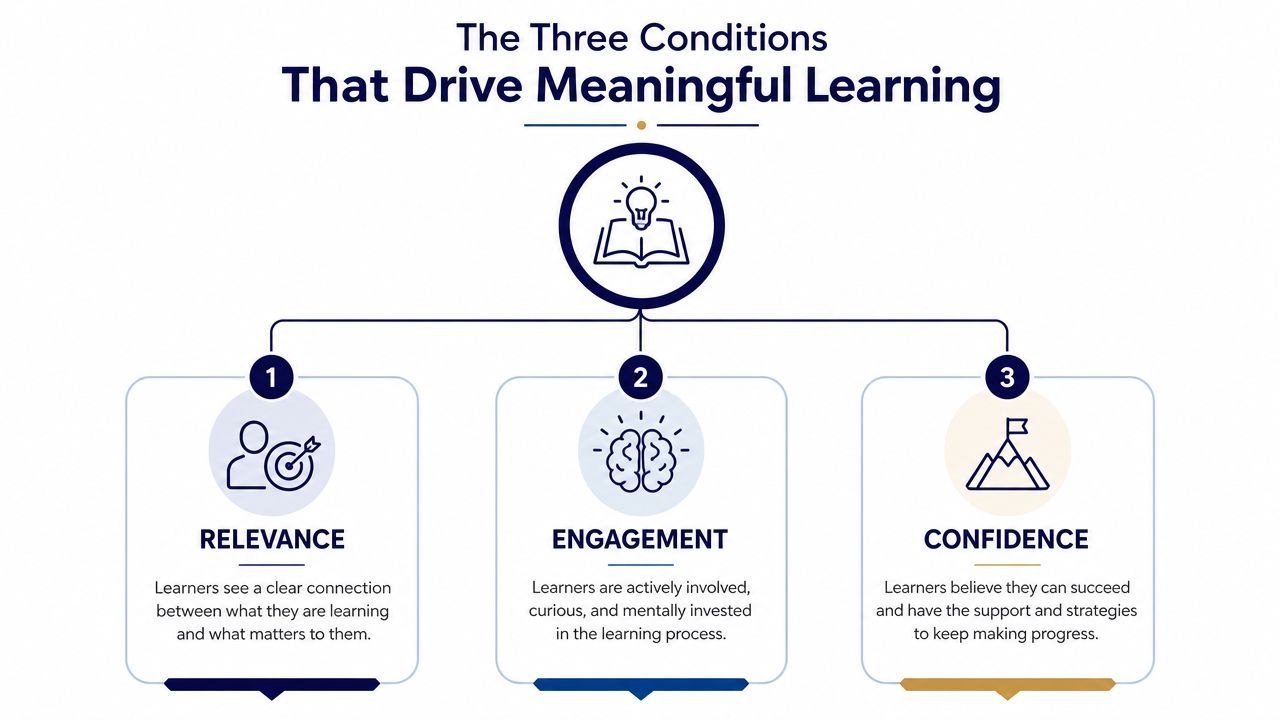
Brain based learning frameworks often point to three interactive conditions for meaningful learning, relaxed alertness, immersion and active processing (source). That trio is more useful than generic talk about engagement because it gives event planners a way to test whether a session is set up for learning.
Relaxed alertness
This is the balance between comfort and focus. In a corporate setting, it means people are not anxious, but they are not passive either. A room that feels overly formal can shut down contribution, while a chaotic environment can make it hard to think clearly.
Immersion
Immersion means people are fully involved with the task. It does not require drama or noise. It requires relevance, clear prompts and enough structure to keep attention anchored. That is why well-designed offsites often outperform long slide decks, especially when the activity requires participants to make choices together.
Active processing
Active processing is where learning becomes usable. People sort ideas, discuss them, test them and connect them to what they already know. The literature also emphasises relaxed alertness, immersion and active processing as interacting conditions, which means one missing element weakens the whole session (source).
Practical rule: if participants can leave a session with a neat folder but no discussion, rehearsal or decision point, the design is probably informational, not brain informed.
A useful internal reference point for leaders is psychological safety in the workplace, because people rarely process information thoroughly when they feel exposed or judged. The strongest learning environments combine challenge with enough safety for people to speak openly and try again.
Brain Based Learning Versus Simpler Alternatives
Brain based learning earns its place when the goal is to shape the whole learning experience, not just deliver information. For straightforward updates, simpler methods often do the job better. Retrieval practice, spaced repetition and feedback loops are not flashy, but they are effective because they target memory and behaviour directly.
The contrarian point is worth keeping in view. Much of the public discussion around brain based learning treats broad principles like multimodal input or chunking as though they are unique discoveries of neuroscience. The literature is less dramatic than the marketing. These are often general instructional principles, and the question for workplaces is which tools reliably improve performance under real constraints (source).
| Approach | Best suited for | Implementation complexity | Evidence strength |
|---|---|---|---|
| Brain based learning design | Culture change, leadership programmes, offsites | Moderate to high | Strong when tied to cognitive principles |
| Retrieval practice | Knowledge retention, post-session follow-up | Low | Strong |
| Spaced repetition | Onboarding, recurring capability building | Moderate | Strong |
| Feedback loops | Behaviour change, skill development, performance reviews | Moderate | Strong |
Where brain based design adds value
It adds value when a team day needs people to collaborate, reflect and apply ideas in context. It also helps when the event has emotional weight, such as leadership development or cross-functional alignment. In those settings, presenting content alone is rarely enough.
Where simpler methods are enough
If the task is to teach a policy, refresh a process or reinforce a basic operating rule, clean structure and repetition may be enough. There is no prize for turning every learning touchpoint into a neuroscience-inspired experience. Decision-makers save time and money when they match the method to the outcome.
Practical Design Rules for Corporate Sessions
Working memory has a capacity of about five to nine unrelated items, which is why chunking is one of the most practical design rules in the field (source). That number is especially relevant in conference settings, where organisers often try to cram too much into a single block. People do not remember more because the agenda is ambitious.
The design fix is simple, but not always easy. Break material into smaller units, connect each unit to something familiar and build in repetition. A source focused on instructional steps specifically lists connection to prior knowledge, clear organisation, repetition and review as part of the approach (source).
A practical sequence for workplace learning
Lead with prior knowledge. Start with what participants already know, then show where the new idea fits.
Separate content into digestible chunks. Keep each segment focused on one decision, one skill or one behaviour shift.
Use repetition with purpose. Repeat the core idea through discussion, practice and recap.
Make the output visible. Ask participants to decide what will change in their team, meeting or workflow.
Close the loop. Send a follow-up prompt or manager note that reinforces the same behaviour later.
For teams producing recorded learning, this is also where format matters. A short, well-structured training video can support recall better than an overstuffed deck. A useful reference on structure and production quality is corporate training video production, especially when the goal is to keep content tight and repeatable rather than theatrical.
How Play-Based Experiences Support Adult Learning
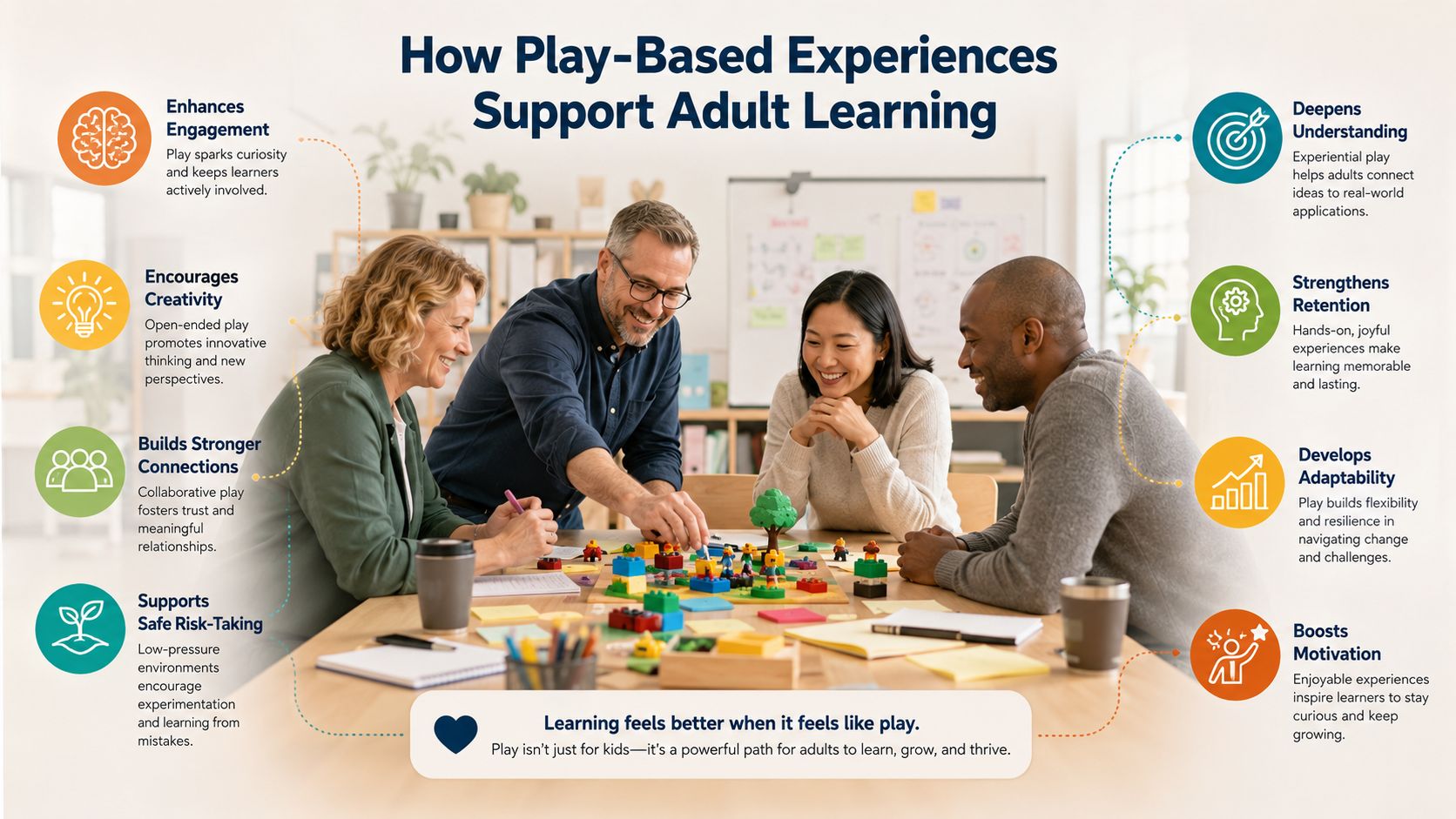
Play-based formats work in workplaces because they change the learning conditions, not because they are childish. For adults dealing with meeting fatigue, digital distraction and hybrid schedules, a structured, social activity can create a clearer attention state than another presentation room. That is one reason play deserves a serious place in corporate learning design.
The strongest case is not that play “activates the brain” in a vague way. It is that immersive, social and low-threat experiences can reduce friction around participation and help people engage with one another more authentically. For Australian workplaces, that matters when teams are stretched across sites, functions or time zones.
Why adults respond to structured play
Adults do not need novelty for novelty's sake. They need a setting where status concerns ease up enough for collaboration to happen. Play can create that opening when it is tied to a team objective, a decision-making task or a culture conversation.
The emerging evidence base also points towards multisensory and immersive learning interventions producing measurable changes in brain connectivity and cognitive outcomes, especially when practice is distributed and feedback is adaptive (source). That does not mean every activity needs to be high energy. It means the design should support attention, interaction and reinforcement.
A good internal lens is BDNF and play, particularly for leaders looking to connect play with adult learning rather than entertainment. The useful question is not whether an activity is fun. It is whether the format helps people think together, remember better and return to work with clearer shared language.
Implementing Brain Based Learning at Your Next Offsite
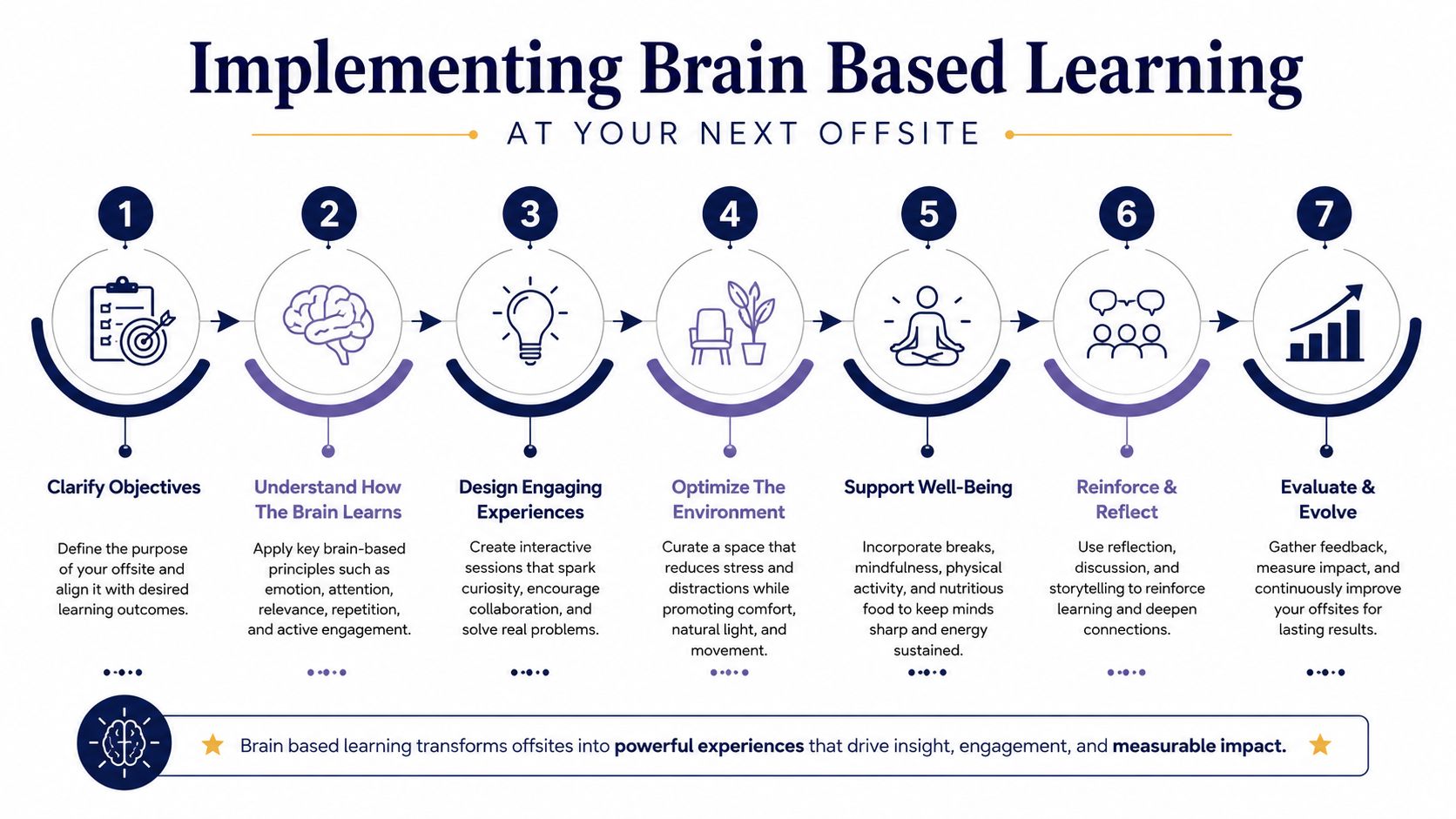
A strong offsite usually fails in predictable ways. The content is dense, the energy is flat by mid-afternoon and the follow-up never lands. A better design starts with the three conditions above, then sequences the day so attention and processing have a chance to recover between blocks.
A realistic corporate day shape
A leadership team might open with a short framing session, then move into a collaborative challenge that surfaces current assumptions. After lunch, the group can revisit the same theme through a different lens, with a guided reflection and a clear action decision at the end. That structure respects working memory limits and reduces the temptation to overload the morning with too much theory.
The transfer question becomes essential. A session that feels enjoyable but disappears by Monday morning has not done enough. A stronger event leaves participants with a shared language, a practice plan and a simple reinforcement mechanism for managers or team leads.
For organisers shaping the agenda, the strongest planning tool is often a disciplined sequence rather than a bigger activity list. A useful planning reference is how to develop a conference agenda that enhances team culture, because agenda shape usually determines whether the learning sticks. Measurement should focus on what people do differently after the event, not just how positive they felt in the room.
When to Invest in Brain Based Learning Design
Not every programme needs a full brain based learning treatment. Basic instructional design is often enough for compliance refreshers, short process updates and straightforward knowledge transfer. In those cases, clarity and repetition usually beat complexity.
The investment becomes worthwhile when the content is more abstract or the organisation needs behaviour change across a group. That includes leadership programmes, culture work and team interventions where transfer back to work matters more than a polished event feel.
A useful financial lens is the ROI of play, because the same principle applies here. Spend more where the learning task is complex and the organisational risk is high. Keep it simple where the objective is narrow and the message is stable.
Corporate Challenge Events designs play-based team experiences that help Australian teams turn learning into shared action, not just a memorable day out. For HR, P&C and event leaders planning offsites, conferences or culture programs, Corporate Challenge Events can help shape sessions that support connection, collaboration and practical transfer back to work.