
Finding the right Christmas party venue is not about choosing the space with the most impressive photos. It is about finding a venue that works for the event you are actually planning. A room may look perfect online, but if it cannot comfortably support your guest numbers, accessibility needs, event flow or planned activities, those limitations will quickly become apparent on the day.
For corporate organisers, the most effective way to compare Christmas party venues is to begin with a clear event brief. Consider what guests will be doing, how they will move through the space and which requirements are non-negotiable. This makes it much easier to rule out unsuitable options before spending time on site visits, proposals and supplier conversations. Our Christmas party planning guide can help you define those requirements and build a more focused shortlist.
Table of Contents
- Stop Searching for the Best Christmas Party Venue
- Start With the Event You Are Planning
- Capacity Is Not Just a Number on the Website
- Map the Full Guest Flow Before You Visit
- Check Whether the Venue Can Support the Activity
- The Details That Decide Who Actually Attends
- Build a Shortlist of Three, Not Twenty
Stop Searching for the Best Christmas Party Venue
The worst venue mistake is chasing visual impact first. A rooftop bar with no weather backup, a heritage hall with one tight entry, or a ballroom that needs half the floor cleared before anyone can dance can all look excellent online and still fail once the team arrives. Corporate Christmas events need more than atmosphere. They need capacity, flow, access and operational tolerance.
Practical rule: if a venue only looks good in still photos, it probably hasn’t been tested against a real event run sheet.
A venue search should begin by rejecting mismatch, not collecting options. That sounds blunt because it is. Most organisers already know how painful it is to inherit a polished venue that collapses under load-in, crowd movement or weather uncertainty.
One useful way to think about this is as a filtering exercise. Keep only spaces that can handle the event as it will run, not as the venue brochure imagines it. For corporate organisers who need a structured alternative to endless browsing, a planning resource such as the end-of-year event guide helps anchor the search around the event outcome, not the venue aesthetic.
The discipline here is simple. Lock in the essentials first, then walk away from anything that misses on capacity, accessibility, arrival logistics or activity support. That approach protects both the guest experience and the organiser’s time.
Start With the Event You Are Planning
Before looking at a single brochure, define the event in plain language. A corporate Christmas function can be a seated dinner, a cocktail reception, an activity-led celebration, or a hybrid of all three. Those formats need different spaces, different circulation, and different levels of support from the venue.
Ask the brief before asking the venue
The right questions come before the shortlist. What will guests actually be doing throughout the event? Will the program include speeches, awards, entertainment, a team activity or a formal meal? Consider how many areas you will need for arrival, dining, activities and quieter conversation, as well as how guests will move between them.
The makeup of the guest list matters too. Dietary requirements, accessibility needs, seniority levels and whether partners are invited can all influence the type of venue and layout required. A space suited to informal drinks may not work for an event that includes formal recognition, structured activities or several stages throughout the evening.
You should also identify anything the venue will need to accommodate beyond its standard setup. Reviewing typical event furniture and equipment hire options can help you anticipate requirements such as additional seating, tables, staging or service equipment. These details affect how much usable space remains and whether external suppliers will require additional access and setup time.
Once the event is clearly defined, comparing venues becomes much simpler. Spaces that cannot support the format, guest needs or event flow can be removed before you invest time in site visits and proposals.
Capacity Is Not Just a Number on the Website
Advertised capacity is the number that gets people into trouble. It usually describes the biggest possible crowd under a particular layout, not the capacity of a mixed-format Christmas function with dining, movement, presentation space and entertainment. Those are not the same thing.
Layout capacity is the number that counts
A venue may comfortably accommodate a large cocktail crowd but have far less capacity once the same space is configured for a seated dinner. Tables, a stage, dance floor, AV equipment, food service areas and clear access paths all reduce the number of guests the room can comfortably hold.
This is why the largest capacity displayed on a venue website can be misleading. Listings for Sydney Christmas party venues, for example, include different capacities, layouts, minimum spends and hire fees. These figures are useful for initial comparisons, but they do not confirm whether a venue will work with your specific event format.
Ask each venue to provide its capacity for the exact layout you are considering, ideally with a floor plan showing tables, entertainment, activity areas and guest circulation. The number that matters is not how many people can technically fit into the room, but how many can use it comfortably once every part of the event is in place.
Map the Full Guest Flow Before You Visit
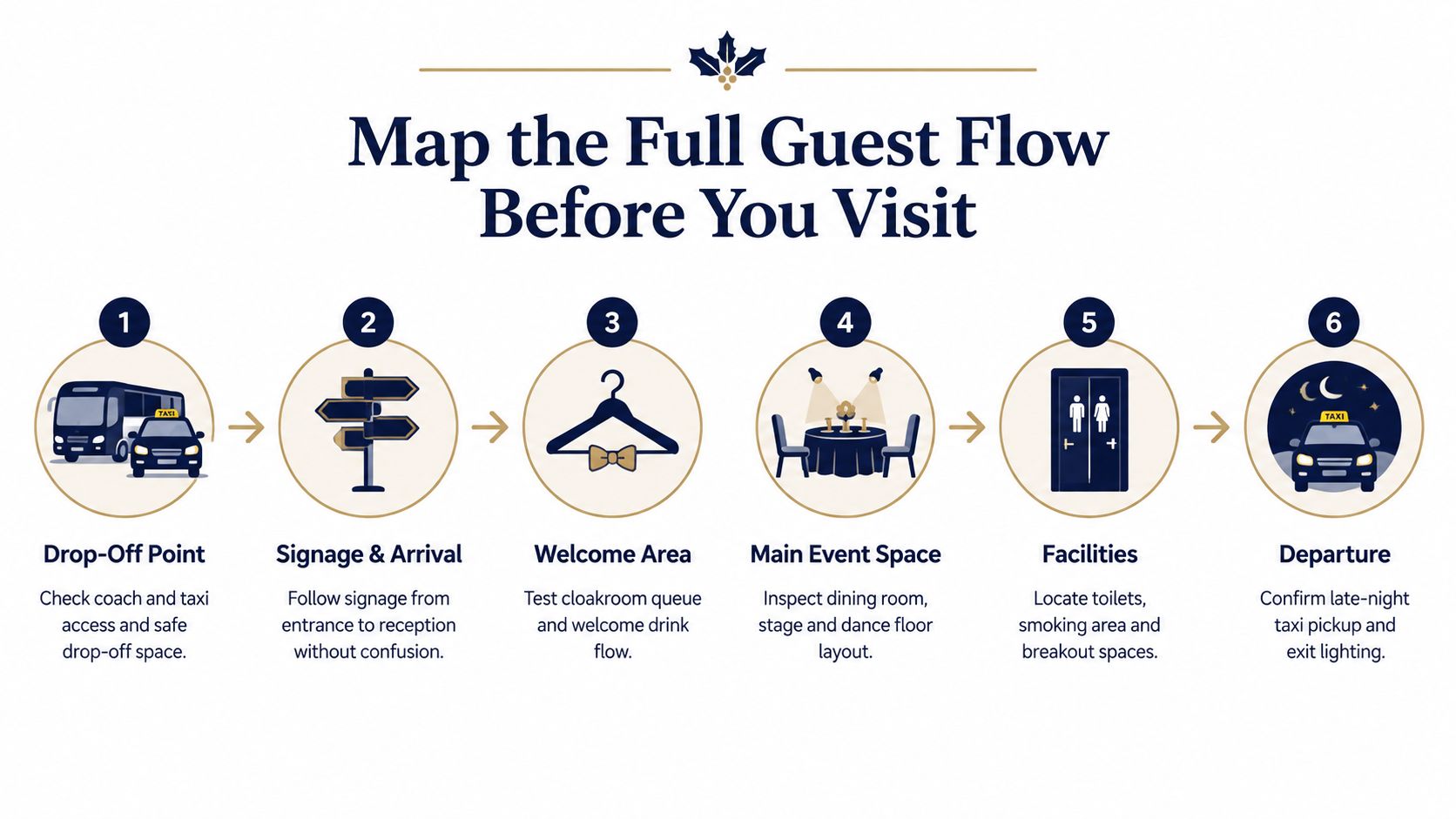
A venue tour that only inspects the main room misses the friction points that ruin the night. The guest experience begins at arrival and ends when the last person gets into a taxi or train, and every transition between those points can either feel smooth or clumsy.
Follow the journey, not just the room
The most useful site visit covers the whole guest path. That means the coach or taxi drop-off, signage, cloakroom queue, welcome drink circulation, transition into dinner or the main activity, and the way people leave at the end of the night. If 200 guests funnel into one corridor, or if doors swing into the service path, the room will feel smaller than it looked in the brochure.
A beautiful venue with poor flow quickly becomes tiring. People spend more time waiting, turning around and looking for the next area than participating. For Christmas functions that aim to build connection or recognition, that kills momentum.
Venue coordinators often know exactly where the bottlenecks are. Ask where queues form during peak events and what they changed after previous functions. A clipboard and a timed walkthrough are far more valuable than a stack of glossy PDFs.
For organisers coordinating travel as part of the night, the transport planning article is a helpful companion because it reinforces how transport decisions shape arrival and departure flow. That same logic applies to Christmas parties, where the handover from venue to transport can make or break the final impression.
Check Whether the Venue Can Support the Activity
Treat the venue as a container for the activity, not the activity itself. A room can look right and still fail once you add a DJ, live music, a photobooth, a team challenge, awards, or a surprise reveal. If the space cannot handle the mechanics, the experience falls apart fast.
Ask for the technical yes before the creative yes
Before committing to an activity or entertainment plan, confirm what the venue can physically and technically support. Ask about clear floor space, supplier access, setup times, power, AV capability, noise restrictions and wet-weather alternatives for outdoor areas. These details can determine whether an idea is achievable long before styling or entertainment choices are finalised.
Practical tip: If an activity relies on power, sound, equipment access or a particular setup window, ask the venue to confirm those requirements in writing.
Service areas need the same consideration. This guide to mobile bar service logistics demonstrates how access, equipment placement and service timing can affect the broader event setup. Similar considerations apply to Christmas functions involving temporary bars, food stations, entertainment or external suppliers.
If team participation is part of the celebration, assess the venue’s suitability for team-building activities early. There should be enough room for people to participate safely, suitable access to power and AV, and a practical way to transition between dining, activities and entertainment.
Ask the venue to demonstrate how the proposed setup would work in the space, ideally through a floor plan or examples of similar events. This gives you a much clearer indication of whether the venue can support the complete experience rather than simply accommodate the guest count.
The Details That Decide Who Actually Attends
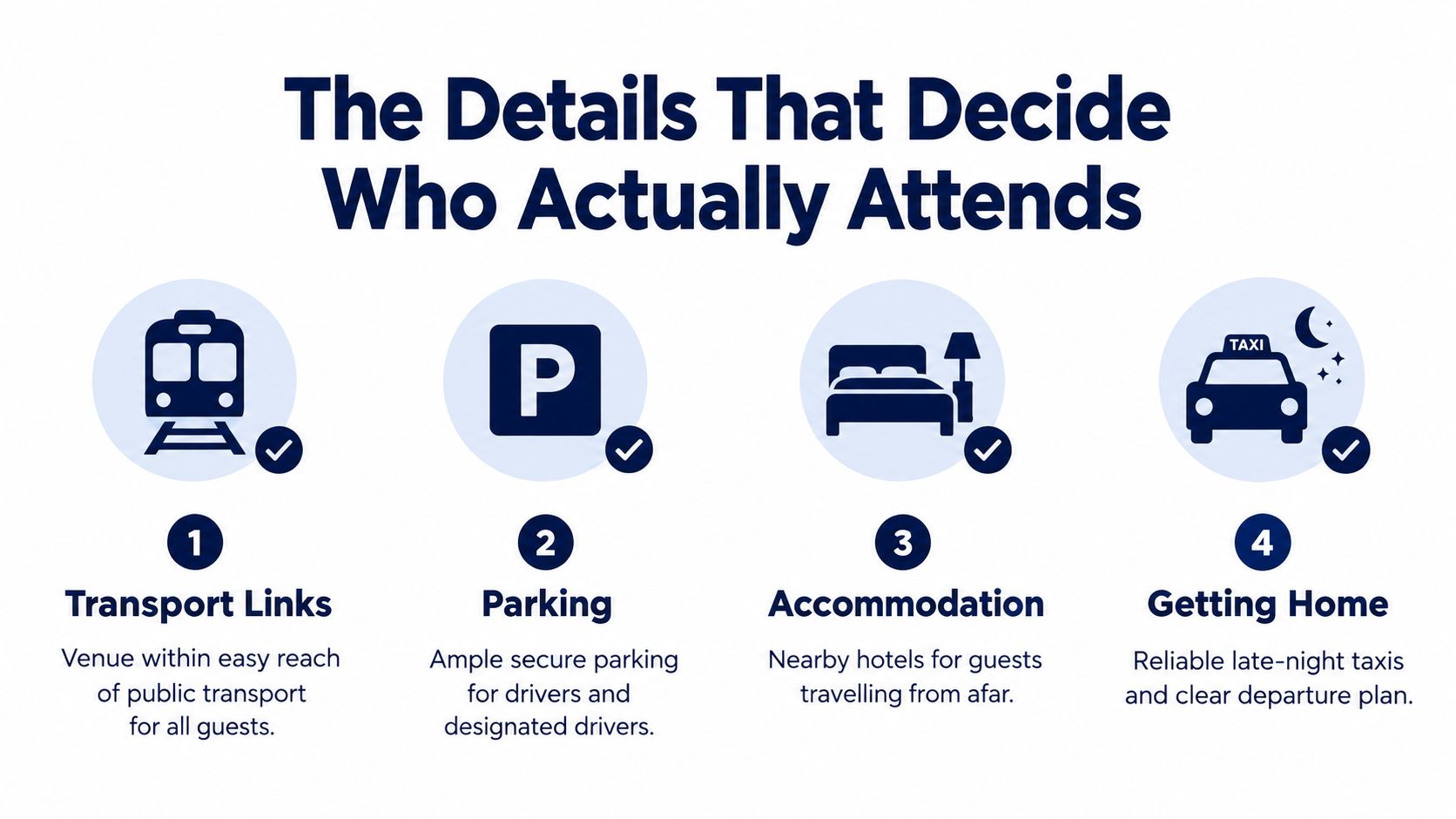
The most visually impressive Christmas function venues can still fail attendance tests. If the venue is hard to reach, awkward to park at, or difficult to leave after the finish time, people drop off. A room that photographs well but loses the tail end of the guest list is not a strong venue choice.
Attendance is a logistics question
A venue’s location can directly influence attendance. Consider public transport, parking, safe late-night travel and nearby accommodation for guests coming from further away. If attending requires complicated transport arrangements, some people may leave early or decide not to attend at all.
Accessibility checks should extend well beyond the front entrance. Look for step-free entry, accessible bathrooms, a continuous accessible path to all event areas and appropriate evacuation procedures for people with disability. Accessible parking and transport, quiet spaces and potential trip hazards should also be considered. Reviewing available venue accessibility information can help identify potential barriers before booking and ensure the whole team can participate comfortably and safely.
Who owns the work after the booking
Venue coordination is where organiser burnout starts. Clarify exactly what the venue owns and what stays with the organiser. Food, beverage, basic AV, security and front-of-house staff are often in-house, while entertainment booking, signage, transport coordination, table plans, photographer liaison and RSVP dietary collation may remain on the organiser’s desk.
A written responsibility matrix is essential. So is knowing who owns the load-in window, the bar cut-off and the clean-up timeline. If the venue does not hand over those answers clearly, December will.
For organisers building a practical pre-booking checklist, the Christmas party checklist is the right internal reference because it keeps attendance, access and handover issues in one place.
Build a Shortlist of Three, Not Twenty
Twenty venue options is not a shortlist, it’s delay disguised as diligence. December punishes indecision, and the organiser who keeps collecting options usually ends up with weaker comparisons and a tired team. Three finalists are enough if the criteria are right.
Compare like for like
Each finalist should be assessed against the same brief, the same date window and the same guest profile. That lets the organiser compare capacity fit, accessibility, event flow, food and beverage, supplier coordination, total cost and availability without getting distracted by unrelated strengths. A venue that is brilliant at one thing but weak on three essentials should drop out quickly.
The comparison should also include commercial terms. Minimum spend, exclusive catering, bar pricing, overtime charges, deposits and cancellation terms all affect the overall cost of the booking. There is no point choosing a room that seems affordable until the final invoice starts filling with extras.
Here’s a simple comparison matrix that keeps the decision honest.
| Criterion | Weight | Venue A Score | Venue B Score | Venue C Score |
|---|---|---|---|---|
| Comfortable capacity | High | |||
| Activity support | High | |||
| Accessibility | High | |||
| Guest flow | High | |||
| Food and beverage | Medium | |||
| Coordination scope | Medium | |||
| Total cost | High | |||
| Availability | High |
Use a curated shortcut when time is tight
A curated venue showcase is the sensible shortcut when the team doesn’t have time to tour, compare and renegotiate half the market. The Christmas Party Venue Showcase Guide gives organisers more than 60 handpicked options, spaces suited to different team sizes, direct venue connections and locations suited to corporate Christmas celebrations and team-building experiences. That is not a shortcut for laziness, it’s a shortcut for competence.
The cleaner approach is simple. Filter first, enquire second, and only compare venues that can support the event the company is trying to run. That is how a shortlist becomes usable.
Corporate Challenge Events can help shape a Christmas party around a team-building outcome instead of a generic venue hire brief, with play-based programs and event support that fit corporate goals. For organisers ready to stop sorting through unsuitable rooms, visit Corporate Challenge Events and use the Christmas Party Venue Showcase Guide to build a shortlist that works for the event.