
“Can you just organise something simple for Christmas?”
If you are the EA, People and Culture leader or workplace organiser hearing that request, you already know that “simple” rarely describes the work involved. Before anyone else has given the event another thought, you are mentally calculating the budget, availability, venue requirements, team expectations, accessibility, approvals, suppliers and all the small details people will assume have been handled.
The challenge is not that any single decision is particularly difficult. It is that dozens of interconnected decisions are now sitting with you, alongside the work you were already responsible for.
That is the hidden load of Christmas party planning. The event appears on everyone else’s calendar as one occasion. For the organiser, it becomes a web of decisions about people, money, logistics, inclusion, risk and the experience the organisation wants to create.
This article maps that workload into 47 decisions. Not because every Christmas party contains precisely the same 47 choices, but because making the volume visible is the first step towards managing it.
The organiser should not have to personally carry every decision from the first conversation to the final pack-down. Some require your judgement. Others can be combined, delegated, transferred to an accountable supplier or eliminated altogether.
These five moves provide a more manageable way to plan a corporate Christmas party without lowering the standard of the event or leaving one capable person to hold the entire thing together.
The 47 Decisions Hiding Inside a Simple Christmas Party
Why 47? Because once we started unpacking what sits behind “something simple”, that is where the list landed. Your event may involve 39 decisions or 63, but 47 makes the point: a Christmas party is never just one item on a to-do list.
Planning and logistics
Date
Backup date
Lunch, afternoon or evening format
Start and finish times
Venue type
Venue location
Transport
Parking
Room layout
AV requirements
Accessibility
Wet-weather contingency
People
Guest list
Whether partners are invited
Whether families or children are included
Dietary requirements
Mobility, sensory or individual requirements
RSVP deadline
RSVP follow-up
Seating or group-mixing approach
Money
Total budget
Per-person budget
Approval authority
Deposit and payment timing
Must-haves versus optional extras
Contingency allowance
Whether employees carry any personal costs
Experience
What the team should feel or remember
Activity or entertainment
Theme and styling
Facilitator or MC
Music
Recognition moments
Speeches and presenters
Photography or content capture
Gifts, prizes or awards
Food and service style
Culture and risk
Alcohol policy
Non-alcoholic options
Cultural and religious inclusion
Inclusion of new, quiet or remote employees
Behaviour and overconsumption management
Coordination and administration
Number of suppliers
Contracts and cancellation terms
Invitations and calendar holds
On-the-day responsibilities
Post-event communication
The list becomes even longer when plans change. Moving from an evening event to a daytime format can alter the venue, catering, transport, entertainment and attendance. Changing the location can reopen accessibility, parking, room layout and wet-weather planning.
When timelines are already compressed, the decisions do not disappear. They simply arrive faster. This last-minute Christmas party planning guide can help with the timing, but decision ownership still needs to be clear.
Why Decision Ownership Matters
The problem is not that 47 decisions exist. The problem begins when they are all treated as separate questions requiring the same person’s attention.
A capable organiser can quickly become the default approval point for everything from the event purpose to the table decorations. Even delegated tasks return for checking because nobody knows where their authority begins or ends. Suppliers complete individual tasks while the organiser remains responsible for coordinating every handover.
That is how a straightforward event creates dozens of open loops.
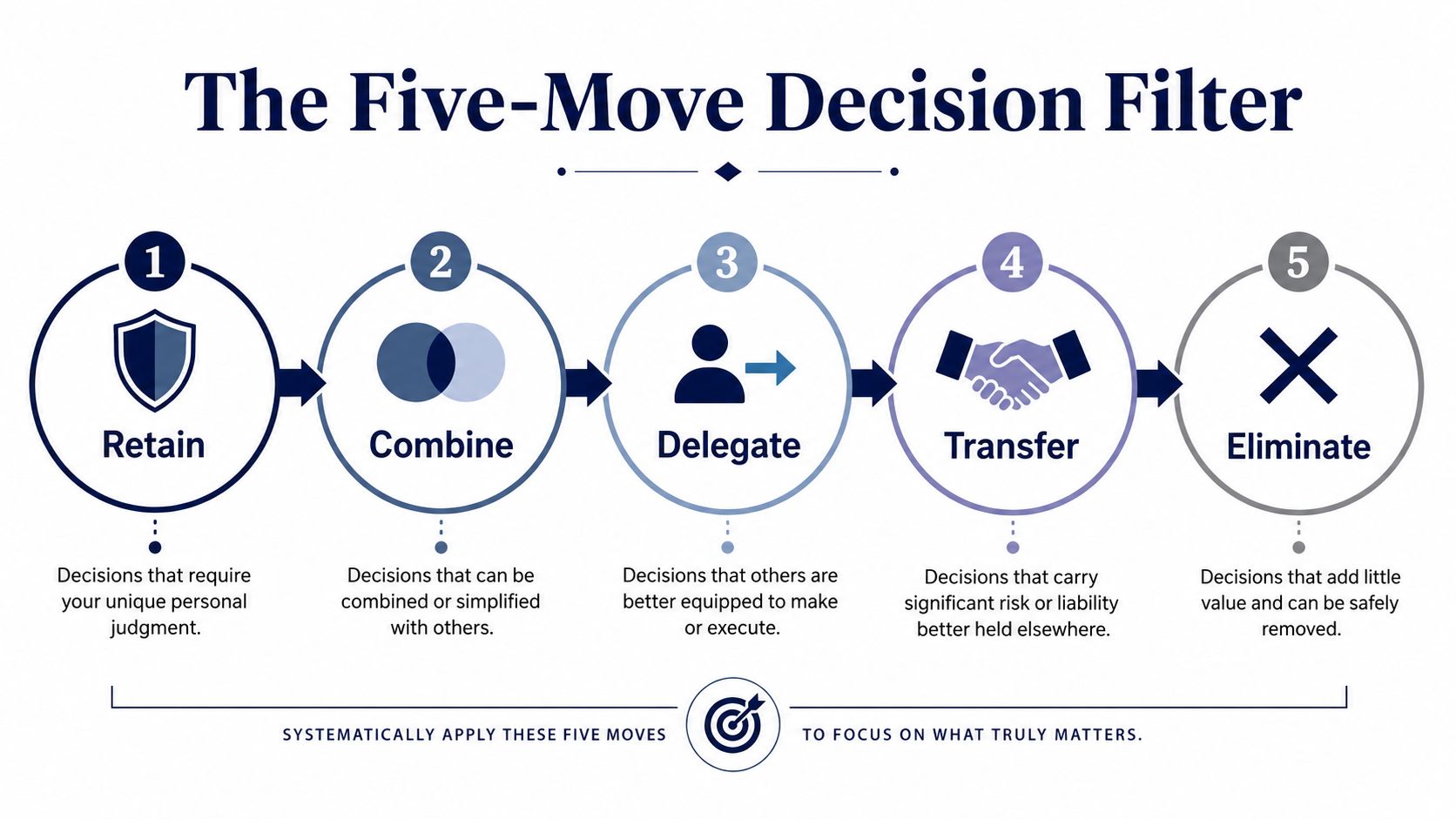
The solution is to route each decision through five moves:
| Move | What it does |
|---|---|
| Retain | Protects the decisions that require organisational judgement or authority |
| Combine | Brings connected choices together so they are resolved coherently |
| Delegate | Gives a named internal owner authority within clear boundaries |
| Transfer | Places delivery responsibility with an accountable supplier |
| Eliminate | Removes choices that do not materially improve the event |
There is no universal allocation. An organisation with an internal events team may retain more delivery decisions. A supplier-led event may transfer more of them. The purpose of the framework is to make every decision deliberate.
Move One: Retain the Decisions That Require Your Judgement
The goal is not to delegate everything. It is to protect the organiser’s attention for decisions where organisational knowledge and judgement genuinely matter.
Retain decisions such as:
What the event needs to achieve
What employees should feel or remember
Budget boundaries
Recognition priorities
Cultural and inclusion requirements
Organisational risk settings
Final approval
Use one test:
Does this decision require context, authority or judgement that only I possess?
If the answer is yes, retain it.
An organiser may decide that the event should thank employees after a demanding year, reconnect departments that rarely spend time together or create a shared experience for a hybrid workforce. They may choose whether the event should feel relaxed, energetic, purpose-led or celebratory.
Those decisions form the brief. Other people can work confidently once the intended outcome is clear.
Risk and inclusion settings also require organisational judgement, but they do not need to dominate the entire planning process. General Australian work health and safety guidance provides a starting point, while this overview of work Christmas party responsibilities highlights practical considerations such as conduct expectations, event times and transport.
The festive season does not remove ordinary workplace responsibilities. A summary of WorkSafe Victoria’s end-of-year safety data provides useful context for why safety settings should remain deliberate rather than assumed.
If alcohol is included, the organisation should decide its expectations before choosing the service model. Resources covering inclusive Christmas parties and alcohol and workplace alcohol risk management can inform that decision.
Accessibility requires the same early judgement. The MCEC event accessibility checklist and Australian Federation of Disability Organisations accessible-events checklist can help identify requirements before invitations and venue arrangements are finalised.
The organiser retains the standard. They do not need to personally administer every task needed to meet it.
Move Two: Combine Decisions That Belong Together
Some decisions become harder because they are discussed separately even though they affect the same outcome.
Imagine choosing the venue first, the activity three weeks later and the catering after RSVPs close. Each new decision may force the previous ones to be reopened. The activity needs more space. The catering format interrupts the event flow. The venue cannot support the preferred AV setup.
Combining connected decisions reduces that rework.
Experience cluster
Combine:
Desired outcome
Event format
Activity or entertainment
Facilitator or MC
Theme
Recognition moments
These choices define what employees will actually experience. Exploring corporate Christmas party ideas, Christmas team-building programs and Christmas party themes for New Zealand workplaces can help shape the direction, but the final choices should work together.
A purpose-led experience may also resolve several decisions at once. This guidance on turning a Christmas party into a charity event shows how the activity, shared purpose and community contribution can become one connected experience.
Hospitality cluster
Combine:
Venue
Food
Drinks
Timing
Room layout
Transport
The venue is not an isolated booking. It influences almost every hospitality decision. This guide to choosing a Christmas party venue that brings the team together can help organisers assess the location against the intended experience.
Governance cluster
Combine:
Budget
Approval
Contracts
Deposits
Contingency
Cancellation terms
Supplier cut-offs
Supplier availability often tightens in the lead-up to Christmas. Catering, equipment hire, transport and merchandise may each have different booking or ordering deadlines. Reviewing these dates together, including any published Christmas ordering cut-offs and holiday hours, helps organisers identify dependencies early and avoid a late change in one area disrupting the rest of the event.
Participation cluster
Combine:
Guest list
Accessibility
Dietary requirements
Invitations
RSVPs
Grouping or seating
An invitation is not complete if it does not give employees a clear way to share the information needed for them to participate.
Combining decisions means the organiser approves a coherent direction for each cluster instead of reopening six related choices across six separate conversations.
Move Three: Delegate Decisions With Clear Boundaries
Delegation is not sending a message asking, “Can someone help with Christmas?”
That creates activity without resolving ownership. Several people may assume they are assisting while the organiser still checks every detail and makes every final call.
Effective delegation gives one person authority to close a defined decision.
A clear delegation brief includes:
Named owner: One person who is accountable
Decision controlled: Exactly what they can resolve
Boundary: Budget, policy or quality limits
Deadline: When the decision must be closed
Escalation point: What requires further approval
RSVP management is a good example. Instead of asking someone to “help chase responses,” give them ownership of attendance confirmation by a set date, including authority to contact employees directly and update the final numbers.
The same approach works for dietary information, calendar invitations, internal communications, gift coordination and photography.
Where guest choices become complicated, a digital Christmas event booking and pre-order system may help collect attendance, meal selections or other details without creating another chain of emails.
Proper delegation removes a decision from the organiser’s active workload. Vague delegation merely adds another person to follow up.
Move Four: Transfer Delivery Decisions to an Accountable Supplier
Transferring is different from outsourcing a task.
If a supplier is asked to deliver equipment at 2 pm, the task has been outsourced. The organiser still owns the timing, setup, compatibility, handover and contingency decisions.
When responsibility is transferred, the supplier owns the delivery outcome within an agreed brief.
Depending on the event model, that may include:
Activity design and facilitation
Equipment
Event flow
Venue coordination
Catering coordination
AV requirements
Wet-weather adjustments
Supplier timing
The organiser retains the purpose, standards, constraints, budget approval and escalation points. The supplier manages the operational decisions needed to deliver them.
This is why the number of suppliers matters. Five separate suppliers may mean five contracts, five briefing processes, five arrival times and multiple handovers that still sit with the organiser.
A coordinated package can bring more event elements under one accountable partner. Broader event-planning best practices can help clarify what should remain internal and what can reasonably move to a provider.
Corporate Challenge Events can take responsibility for the team experience, facilitation, equipment and event flow, then coordinate agreed elements around them. The value is not simply having fewer tasks. It is having fewer delivery decisions and handovers return to the organiser.
Move Five: Eliminate Decisions That Do Not Improve the Event
Not every choice deserves a meeting.
A styling detail may matter when it reinforces the event concept. It matters less when three senior people are comparing almost identical shades of table linen while the participation plan remains unresolved.
Elimination does not mean lowering the standard. It means applying attention in proportion to impact.
Use this test:
Will this choice materially affect safety, inclusion, cost, participation or the experience we want people to have?
If the answer is no, choose a sensible default and move on.
Common candidates include:
Minor styling variations
Optional extras with no connection to the brief
Multiple versions of the same invitation
Elaborate prizes employees do not value
Customisation that creates cost without improving participation
Decisions already covered by a suitable venue or supplier default
Budget provides a useful discipline here. A clear Christmas party budget framework helps organisers protect the elements that matter and remove those that do not.
The event should feel considered. That does not mean every available choice needs to be made from scratch.
How to Apply the Five Moves
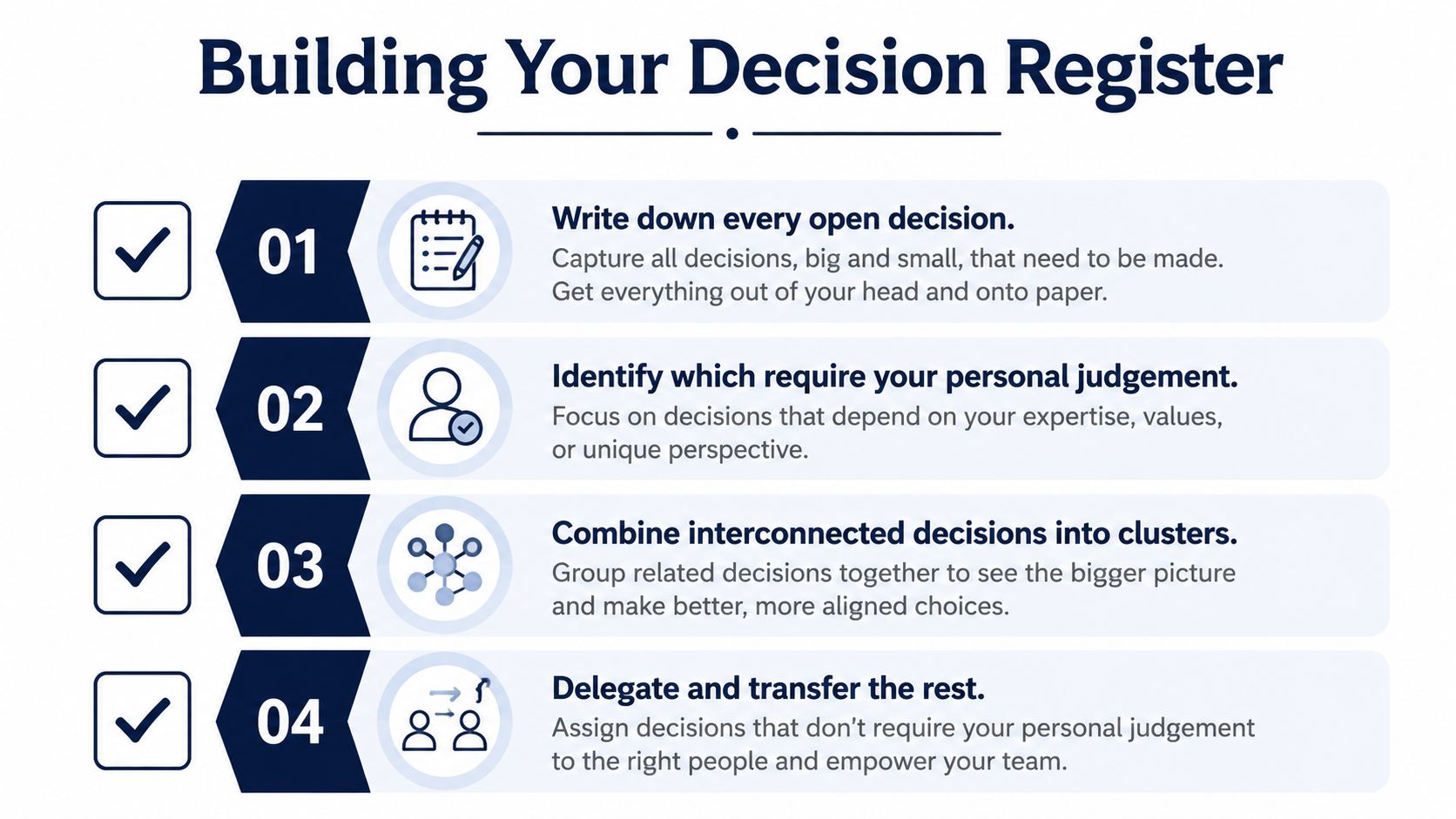
Start with every unresolved Christmas party decision, whether it is still in the organiser’s head, sitting in an email or waiting inside a supplier proposal.
Then:
Identify the decisions that genuinely require personal judgement.
Combine connected choices into experience, hospitality, governance and participation clusters.
Delegate defined internal decisions to named owners.
Transfer suitable delivery decisions to accountable suppliers.
Eliminate choices that do not materially improve the outcome.
Keep the remaining open loops in one short decision register:
| Decision | Move | Owner | Boundary | Deadline | Status |
|---|---|---|---|---|---|
| Event purpose and recognition priorities | Retain | People and Culture lead | Approved organisational objectives | Planning sign-off | Open |
| Venue, catering and transport | Combine | Event organiser | Approved hospitality budget | Venue deadline | In progress |
| Attendance and dietary information | Delegate | HR coordinator | Confirmed guest list and privacy requirements | Catering cut-off | In progress |
| Activity, equipment and event flow | Transfer | Event provider | Approved brief, timing and budget | Supplier confirmation | Awaiting proposal |
| Minor styling variations | Eliminate | No owner required | Use venue default | Immediate | Closed |
The register is not another project to manage. Its purpose is to stop decisions disappearing into inboxes, returning without context or remaining open because everyone assumed someone else owned them.
If an item keeps returning, check whether it belongs inside a larger cluster, lacks a clear boundary or sits with the wrong owner.
What Better Christmas Party Planning Looks Like
A well-managed Christmas party does not have less thought behind it. It has the right thought applied at the right level.
The organiser retains the purpose, standards and decisions that require organisational judgement. Connected choices are made together. Internal tasks have genuine owners. Suppliers are accountable for defined delivery outcomes. Low-value choices are allowed to disappear.
That is what “simple” should mean.
Not a lower-quality event. Not an experienced organiser reduced to providing a date and headcount. Not 47 separate questions waiting for one person’s approval.
It means a celebration where the complexity has been designed out of the organiser’s experience, even though considerable expertise still sits behind the result.
Corporate Challenge Events brings facilitation, experience design and key event elements together through coordinated Christmas party experiences, reducing supplier handovers and the number of delivery decisions held internally.
Explore Corporate Challenge Events and discover how the right event partner can make the entire celebration easier to coordinate without making it feel any less special.