
A colleague shares useful information before you have to ask. Someone follows through on a promise. Two departments combine their expertise to produce a better result. These are the everyday actions that make teamwork effective.
For leaders, developing teamwork skills starts with recognising those actions and helping people practise them. Asking everyone to be a better team player leaves too much open to interpretation. Clear expectations give people something they can use.
This guide explains eight teamwork skills, how they appear at work and practical ways to strengthen them within your team.
What are teamwork skills
Teamwork skills are the behaviours people use to coordinate their efforts and achieve a shared outcome. They include communicating clearly, listening, following through, adapting and supporting colleagues. People can develop these skills through practice and feedback.
Good working relationships help, but a team can enjoy each other’s company and still struggle with responsibilities or avoid difficult conversations. Effective teamwork requires people to understand how their contribution connects with everyone else’s.
Employers recognise the need. In the 2025 Hays Skills Report, 84% of hiring managers surveyed across Australia and New Zealand identified communication and teamwork as important skills for the future. Hays’ research into future workforce skills places them alongside critical thinking and adaptability as development priorities.
Team experience is also associated with engagement. ADP’s findings on team performance and engagement report that, in its global People at Work 2025 study, 52% of workers who felt part of a high-performing team were fully engaged, compared with 10% of those who did not.
Eight teamwork skills with workplace examples
Different people bring different strengths. One colleague may be particularly good at making complex information clear, while another notices when someone needs support. The aim is to build shared capability while allowing people to contribute in their own way.
1 Communication
Effective communication gives colleagues the information they need, in a form they can use and at the right time.
For example, a project coordinator preparing a handover explains what has been completed, what remains outstanding and which matters need attention. The colleague taking over can continue the work confidently without reconstructing the project from scattered messages.
To develop it: Agree on what a useful update contains and where it belongs. Consider the recipient’s needs before adding more detail. Our resources for making team communication more effective provide further ways to develop this skill.
2 Listening
Listening means giving someone enough attention to understand their point before deciding how to respond. It includes checking assumptions and being willing to reconsider your first interpretation.
A customer service employee might explain that customers repeatedly ask the same question. A colleague who listens carefully may discover an opportunity to improve the instructions, then work with them on clearer wording.
To develop it: Summarise what you have understood and check it before offering a solution. Allow thinking time. Someone who contributes after reflection may have just as much to offer as a person who thinks aloud. Understanding emotions and responses at work can also help colleagues listen without becoming defensive.
3 Reliability
Reliability means making commitments others can plan around. That includes delivering agreed work and communicating promptly when circumstances change.
When a colleague promises figures by Thursday, provides them in the agreed format and confirms they are ready, the next person can proceed without chasing. If an approval is delayed, an early update gives everyone time to adjust.
To develop it: Make commitments specific. Agree on the task, owner and timing, and check that the person has the capacity to deliver. Reliability becomes harder when people are expected to accept every request regardless of existing priorities.
4 Collaboration
Collaboration combines people’s knowledge and effort to improve a shared piece of work.
Consider a product launch. Marketing understands the audience, operations knows what can be delivered and customer service anticipates common questions. Involving all three while the plan is taking shape can produce a clearer offer and a smoother customer experience.
To develop it: Identify whose expertise will improve the work and involve them while their input can influence it. Give contributors a clear purpose and explain how their work connects. Collaboration does not require everyone to attend every discussion.
5 Adaptability
Adaptability helps people adjust their approach when circumstances change while keeping the purpose of the work clear.
A team preparing a workshop may discover that participants need more time on a particular topic. Instead of rushing through the original agenda, colleagues agree which sections to shorten and redistribute facilitation responsibilities.
To develop it: When plans change, clarify what still needs to be achieved, what can move and who needs an update. Invite colleagues to suggest alternative approaches. Adaptability should give people room to respond intelligently, rather than expecting them to absorb unlimited changes.
6 Constructive disagreement
Constructive disagreement allows people to question an approach and explore alternatives while maintaining respect for one another.
An analyst might question whether a proposed launch date allows enough time for quality checks. Explaining the concern and proposing a smaller first release gives the team something useful to consider.
To develop it: Ask people to explain their reasoning and what would resolve their concern. As a leader, examine the contribution before defending your position. Your response helps establish whether speaking openly feels safe within the team.
7 Offering and asking for help
Working effectively with others includes recognising when support would help and being clear about what is needed.
A new account manager might ask an experienced colleague to review a complex renewal. The colleague can explain their reasoning as they review it, helping complete the task and building the account manager’s understanding for next time.
To develop it: Make requests specific: explain the task, the difficulty and the assistance required. When offering help, ask what would be useful rather than assuming. Leaders should also check whether repeated requests indicate a wider workload or resourcing problem.
8 Shared accountability
Shared accountability means taking an interest in the team’s overall result as well as your own responsibilities. Reliability concerns your commitments; shared accountability includes how you respond when work depends on several people.
A designer may have delivered the artwork for an event but notice that signage approval remains outstanding. Raising it with the responsible colleague helps the wider team meet its deadline without taking over that colleague’s role.
To develop it: Review progress against the shared outcome. Make it clear how people should raise an issue outside their responsibilities and who can resolve it. Ownership should remain clear while colleagues help one another succeed.
Teamwork skills at a glance
| Skill | What to look for | A useful practice |
| Communication | Information reaches the right people in time | Agree on a useful update format |
| Listening | People check understanding before responding | Summarise and invite clarification |
| Reliability | Commitments are clear and dependable | Confirm capacity and timing |
| Collaboration | Relevant expertise shapes the work | Involve contributors early |
| Adaptability | People adjust while keeping the goal clear | Revisit priorities when plans change |
| Constructive disagreement | Concerns receive thoughtful consideration | Discuss reasoning and alternatives |
| Offering and asking for help | Support is requested and provided appropriately | Be specific about the help needed |
| Shared accountability | People notice how the whole task is progressing | Review shared outcomes together |
How leaders can develop teamwork skills
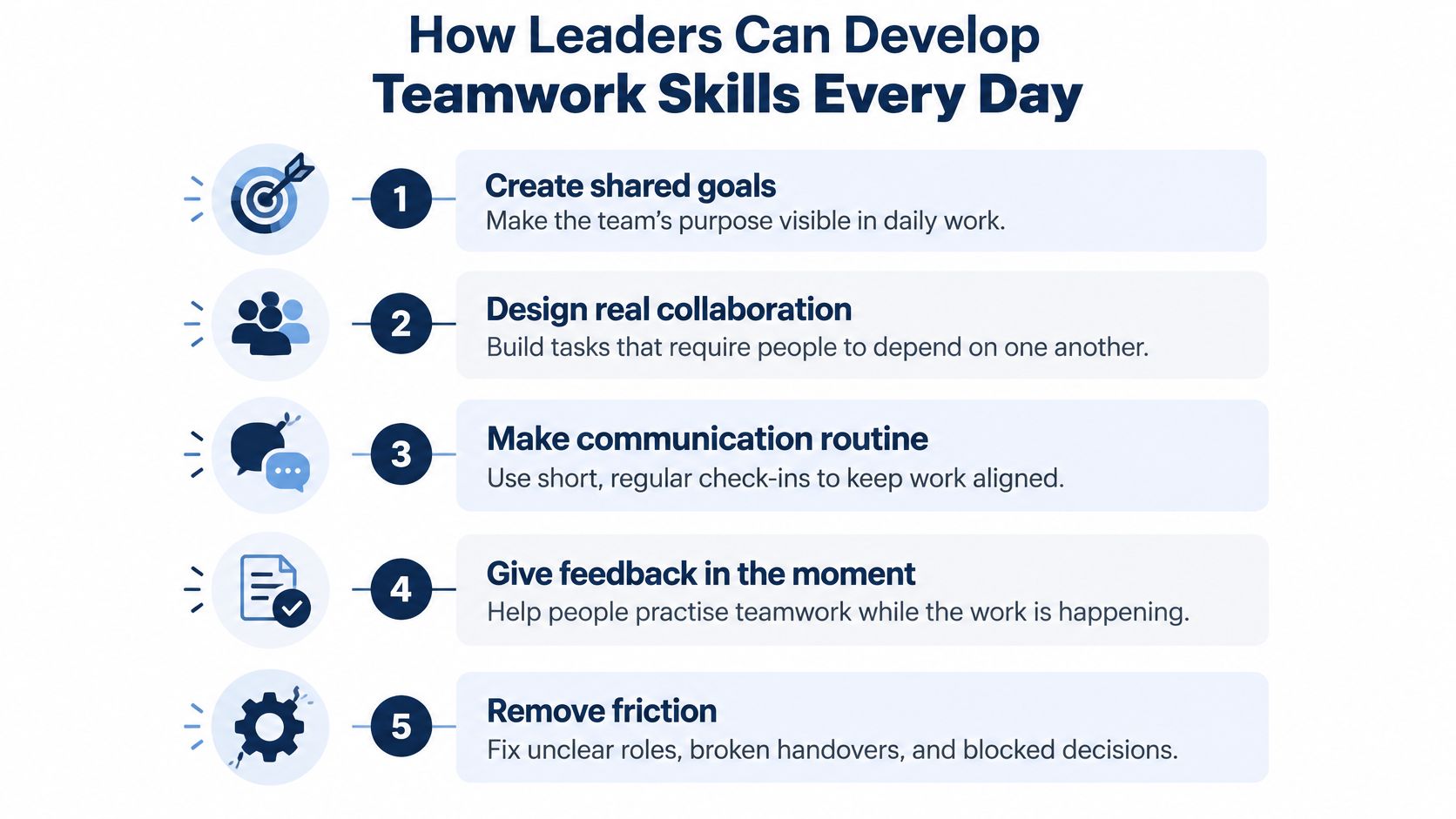
Choose a skill that will help your team with work already underway. If two departments struggle to coordinate, agree on what information they need from each other and when. Practise that approach on the next shared task, then review how it worked.
Give feedback on the behaviour you observed. Explaining that an early update helped another department prepare is more useful than describing someone as a great team player. Apply the same expectations to your own communication and commitments.
These practices form part of developing your team’s broader people skills. Managers also need opportunities to practise coaching, delegation and feedback, supported by approaches that connect management development with everyday responsibilities.
Check the systems supporting the work. Asana’s Australian findings on cross-team collaboration highlight process improvement alongside communication. A shared record of responsibilities and progress can help; configuring monday.com around team workflows is one example of the support available. Agreeing how people maintain and use the information remains essential.
Check whether the obstacle is a skill or a working condition
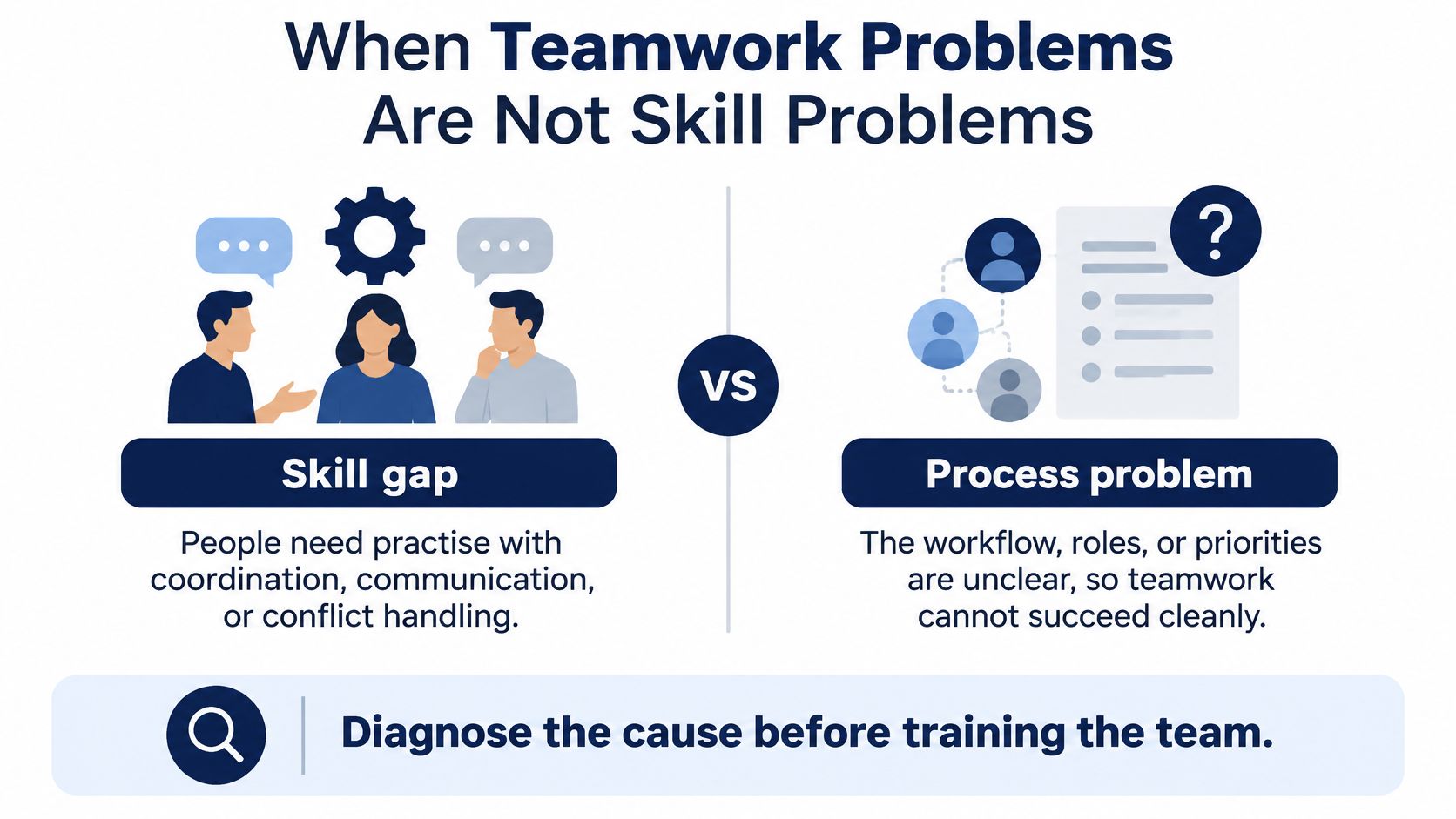
Before recommending training, ask what is making teamwork difficult. A missed handover could reflect unclear ownership. Silence might follow previous dismissive responses. Competing deadlines may leave capable employees unable to help one another.
Australian research published by NCVER in 2008 examined the relationship between work organisation and skill requirements. It offers context for considering the way work is structured alongside employee capability.
Where the obstacle is workload, authority or process, address it directly. People need a fair opportunity to use the skills you are asking them to develop.
Where team building fits
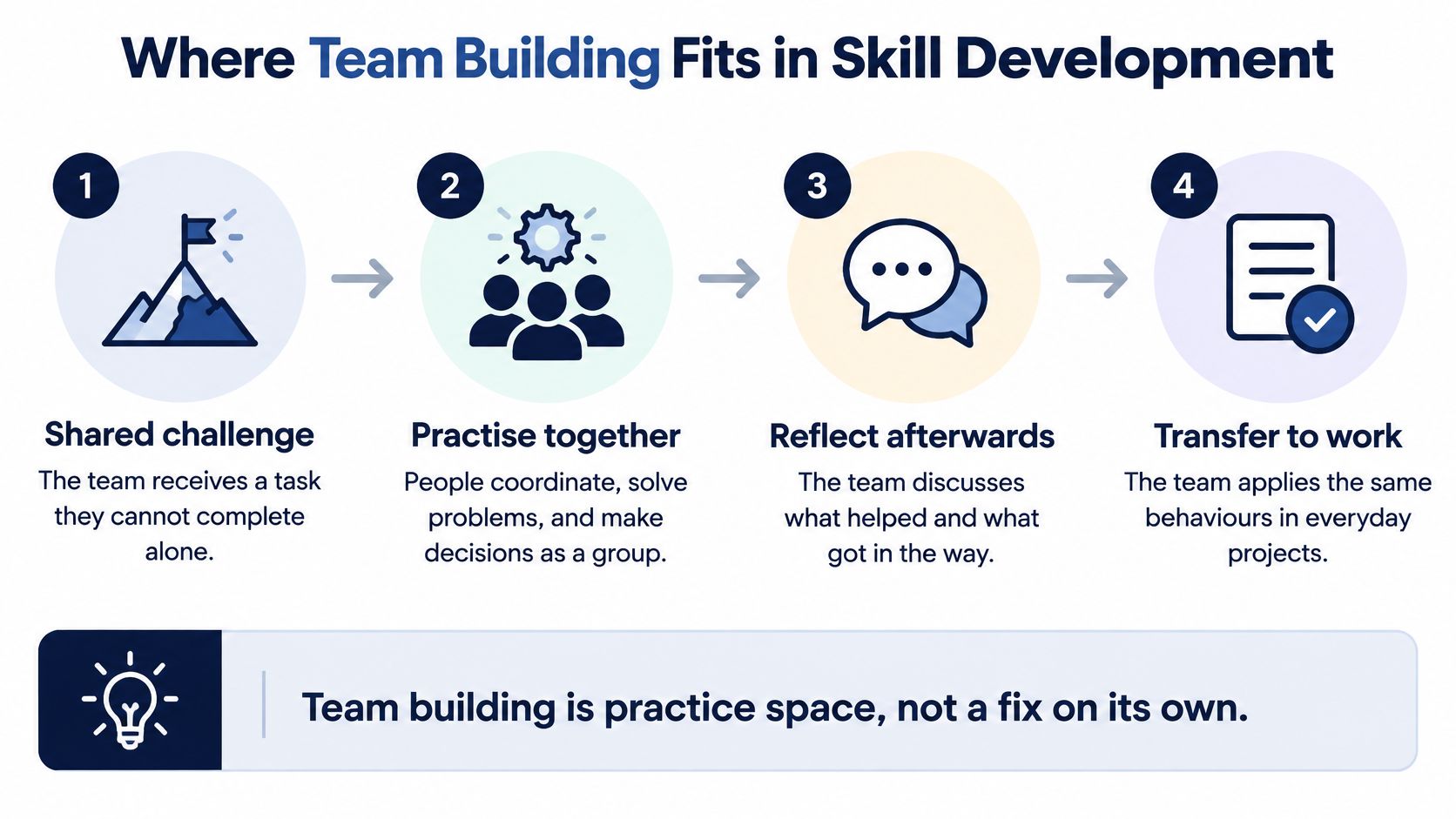
A facilitated team-building experience can give colleagues a shared opportunity to practise these skills outside familiar routines. Selecting an activity starts with understanding what you want people to work on. That principle applies across formats, including planning an outdoor team experience.
Imagine a challenge where each group holds different information needed to complete a shared task. Participants must explain what they know, listen to others and coordinate their contributions. The facilitator can then help them examine which approaches worked and where a different response might have helped.
Our facilitated experiences for workplace teams create opportunities for shared participation and problem-solving. Bringing play into working relationships can give colleagues a different setting in which to explore how they communicate and contribute. Where familiarity is the main priority, activities that help colleagues get to know one another may be a useful starting point.
The next step is to choose something worth carrying back into work. A team might agree to ask for missing information earlier or involve another department before finalising a plan. Managers then need to support that behaviour through ordinary work and follow-up conversations.
Start with a skill your team can practise
Identify one current task where better teamwork would help. Discuss the skill involved, agree on what it would look like and give people time to practise. Review the experience together, including anything that made the behaviour difficult to sustain.
If you are planning a team day or offsite, talk with CCE about your team’s development goals. A clear brief helps us design an experience around what your people need to practise and how you want to build on it afterwards.