
A team can look aligned on paper and still lose time in meetings, project handovers and decision-making. One person wants more detail. Another wants momentum. Someone else is reading the room and trying to keep the group together. That friction often gets labelled as a personality clash when it's really a communication mismatch.
The DOPE personality test gives workplace leaders a simple way to name those differences without turning every discussion into a personal critique. For People & Culture teams, internal organisers and leaders planning team building workshops, that simplicity is usually the point. The model is easy to remember, quick to introduce and practical enough to use in real conversations about how work gets done.
Table of Contents
What Is the DOPE Personality Test
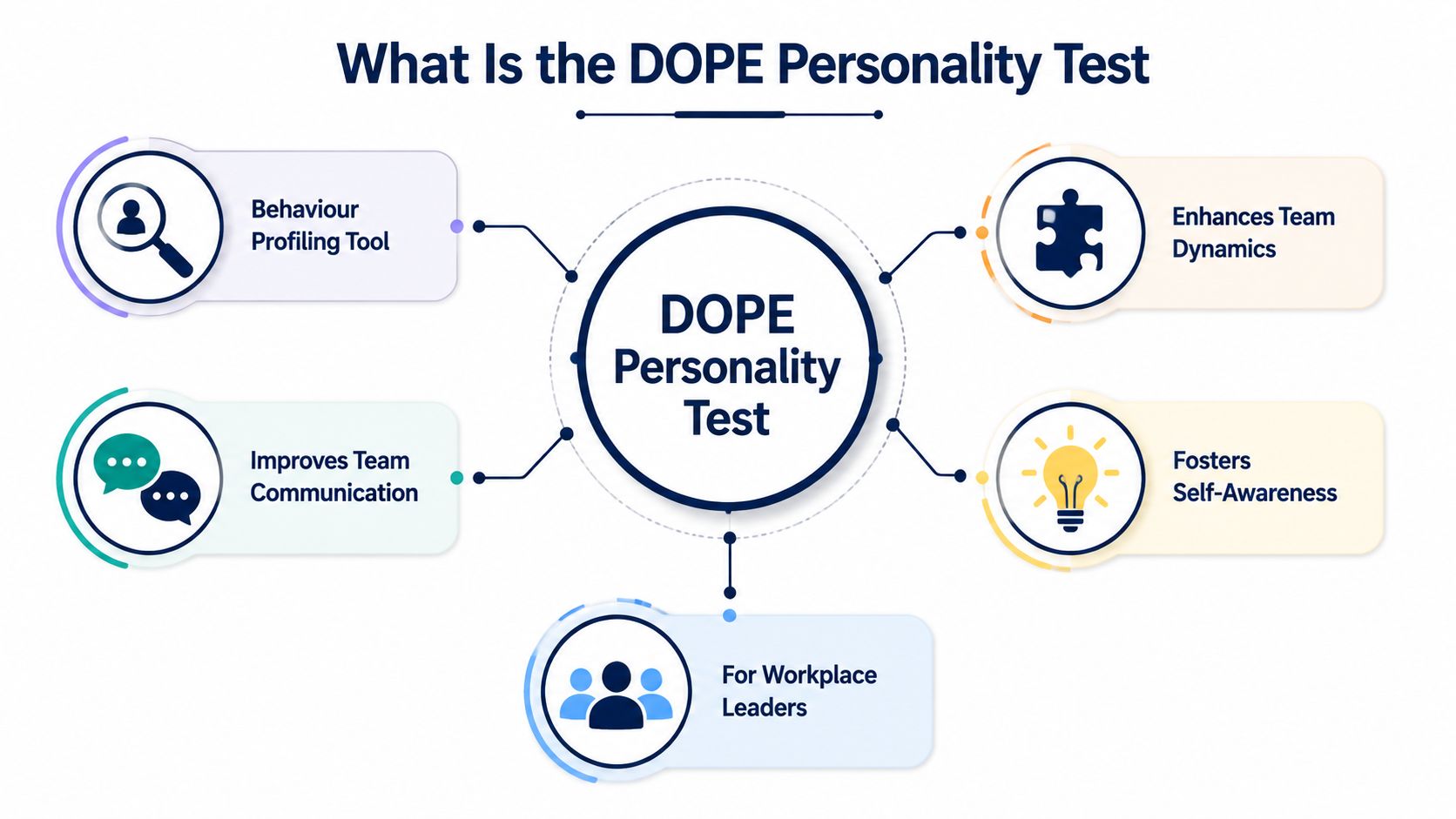
The DOPE test is a simple behaviour profiling framework built around four bird types: Dove, Owl, Peacock and Eagle. In workplace settings, it's used to help teams talk about communication style, decision preferences and ways of working in language people can remember and use.
A widely circulated handout describes the framework as developed by Dr. Gary Couture using Marston's basic principles, and outlines a common version with 40 forced-choice items where respondents choose one word in each row and total the columns to identify a dominant style, as outlined in the DOPE test handout. That origin is useful context because it positions the DOPE behaviour profile as an applied discussion tool rather than a formal psychometric diagnostic.
Why workplace teams use it
Leaders usually don't need a complicated assessment to start a better conversation. They need a shared language that helps people say things like:
Need for detail: “This needs more structure before sign-off.”
Need for connection: “The team hasn't had enough input yet.”
Need for energy: “The message is right, but it won't land if the delivery is flat.”
Need for speed: “The group has enough information. It's time to decide.”
That's where the dope bird personality test is useful. It lowers the temperature in conversations about style because it gives people a neutral frame.
Practical rule: Use DOPE to discuss observable work preferences, not to label capability, potential or suitability for a role.
There's also a practical distinction between a short profiling tool and broader research methods. Teams comparing formats may find this guide on key distinctions between questionnaire and survey useful when deciding how they want to gather and discuss information.
What it is and what it isn't
DOPE works well when the objective is awareness, reflection and team communication. It doesn't work well when leaders try to treat it like a clinical measure or a hiring screen.
A better use is to let people test their own communication style through a simple format, then discuss the implications in a facilitated setting. That's the practical value behind tools such as the DOPE communication profile quiz, which gives teams an accessible starting point for conversation.
The Four DOPE Personality Types Explained
The four DOPE types are most useful when teams treat them as working preferences, not fixed identities. In practice, people can show more than one style, but most have a clear default in how they communicate, make decisions and respond to pace, detail or disagreement.
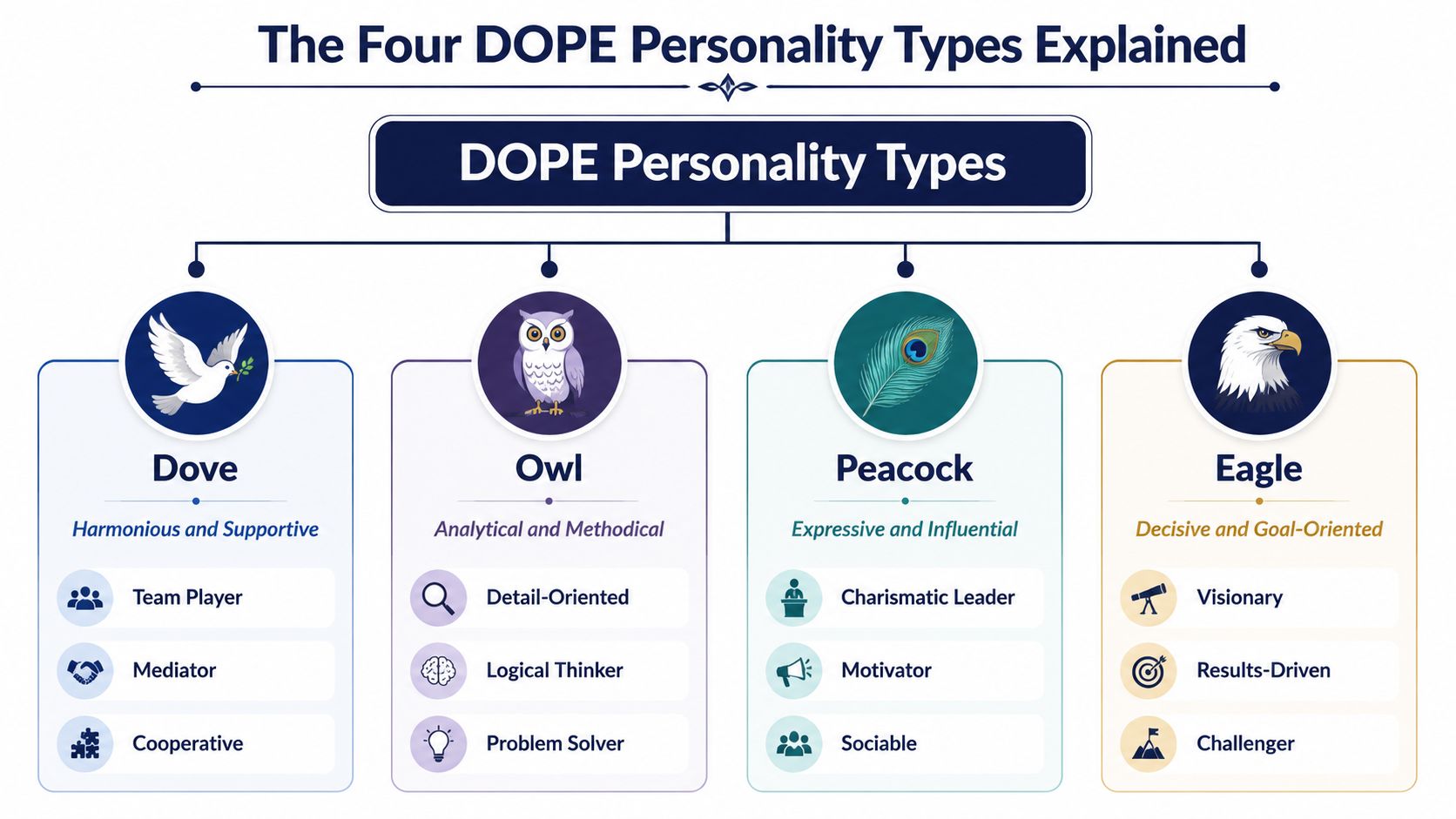
For HR teams and workshop facilitators, that distinction matters. The point is not to label someone once and leave it there. The point is to give a group a practical language for discussing why one person wants more input, another wants faster decisions, and another keeps pushing for clearer facts before they commit.
Dove
A Dove is people-aware, steady and tuned in to how decisions affect trust. In meetings, Doves often notice the reactions that others miss, especially when a plan is technically sound but buy-in is weak.
They add value in collaboration-heavy work. Change communication, stakeholder conversations, team support and cross-functional coordination often improve when a Dove is involved early.
The trade-off is predictable. Doves can hold back hard feedback or delay conflict that the team needs to address. In a corporate setting, they are most effective when leaders invite them to voice concerns clearly rather than smoothing everything over.
Owl
An Owl is analytical, methodical and focused on accuracy. This style tends to ask for definitions, assumptions, dependencies and proof before signing off on a decision.
That can slow a conversation down, and sometimes it should. Owls are often the reason a team catches vague scope, weak logic, unrealistic timelines or avoidable risk before those issues turn into rework. In facilitated sessions, I often see Owl preferences become visible as soon as the group shifts from ideas to execution.
Their challenge is pace. In a fast-moving project, Owl behaviour can be read as hesitation when it is often an attempt to protect quality and clarity. For a broader example of how the DOPE model is used to discuss these style patterns in group settings, see this Australian discussion of the DOPE framework.
Peacock
A Peacock is expressive, enthusiastic and comfortable influencing a room. Peacocks often help teams create momentum, especially in workshops, presentations, brainstorming sessions and stakeholder-facing discussions.
They are useful when a message needs energy, when a group is stuck in overly cautious debate, or when an idea needs advocacy to gain support. A Peacock can help people engage with the work, not just understand it.
The trade-off is consistency. Peacocks may lose interest in detail-heavy follow-through or move past structure too quickly. Teams get the best from this style when strong ideas are paired with clear owners, deadlines and process support.
Eagle
An Eagle is direct, decisive and strongly oriented toward outcomes. In project work, Eagles often push for clarity on priorities, ownership and next steps when everyone else is still discussing options.
That bias toward action is useful. Teams need people who can make calls, set direction and keep work moving when discussion starts to drift.
The risk is relational friction. If an Eagle moves too quickly, others may experience that style as dismissive or blunt, especially when the group still needs context, consultation or detail.
A healthy team uses all four styles well. Doves protect trust. Owls improve thinking. Peacocks create engagement. Eagles create momentum. The practical goal is balance, because better collaboration usually comes from using the right style at the right moment, not from having more of one type than another.
How Behaviour Profiles Improve Team Communication
Misunderstanding in teams usually starts with interpretation. A direct message gets heard as impatience. A request for detail gets heard as resistance. A push for inclusion gets heard as delay. Without a shared language, people explain behaviour in personal terms instead of practical ones.

Behaviour profiles help because they depersonalise the conversation. A team member can say that a plan needs more Owl thinking, more Dove consultation, more Peacock energy or more Eagle direction. That language is easier to hear than criticism aimed at an individual.
What changes in practice
Before a team has shared language, feedback often sounds like this:
Too personal: “You're overcomplicating it.”
Too vague: “We need to communicate better.”
Too reactive: “That meeting went off the rails.”
After a framework like DOPE is introduced, the conversation becomes more specific:
About style, not blame: “The team moved into Eagle mode before the Owls had enough information.”
About balance, not fault: “There wasn't enough space for Dove concerns during the rollout discussion.”
About delivery, not intent: “The message needed more Peacock energy to land with the room.”
That's one reason behavioural profiling is often used in facilitated team settings. It gives leaders a practical tool to discuss friction while staying constructive. The workplace view of behavioural profiling and team transformation reflects this same core advantage. Teams can talk about difference without making difference feel threatening.
Leader's lens: The goal isn't to make everyone communicate the same way. The goal is to help people adjust their style without losing what makes them effective.
What the DOPE Test Reveals Under Pressure
Pressure doesn't create personality. It amplifies default habits. That's why the DOPE personality test can be especially useful when a team is heading into deadlines, change, conflict or unclear decision-making.
Under pressure, a Dove may become more conflict-avoidant. Instead of naming a concern early, they might soften it too much or hold it back to keep the peace. In a project environment, that can leave risks unspoken until they become harder to manage.
An Owl under strain may keep searching for more certainty. That often shows up as rechecking details, asking for more evidence or delaying commitment until the logic feels complete. In the right context, that protects quality. In the wrong context, it slows a team that already has enough information to move.
Typical pressure patterns
A Peacock can respond to stress by becoming scattered or overly expressive. Ideas may keep flowing, but focus can slip if the team needs disciplined follow-through rather than stimulation.
An Eagle under pressure may become more blunt, controlling or impatient. That can help in a crisis when speed is critical, but it can also close down input that the team still needs.
| Bird type | Likely pressure response | Team impact if unmanaged |
|---|---|---|
| Dove | Avoids conflict or over-accommodates | Concerns stay hidden |
| Owl | Seeks more data or more certainty | Decisions slow down |
| Peacock | Loses structure or overtalks | Focus becomes diluted |
| Eagle | Pushes harder and gets more directive | Others disengage or stay quiet |
How leaders can respond
The point isn't to diagnose stress. It's to recognise patterns early and adjust team support accordingly.
For Doves: Ask directly for concerns and give permission to disagree.
For Owls: Clarify the decision standard so they know what “enough information” looks like.
For Peacocks: Narrow the brief and anchor energy to specific actions.
For Eagles: Reinforce pace while inviting input before closure.
When leaders know these pressure responses, they can read behaviour with more accuracy. The conversation becomes less about personality conflict and more about what the team needs from each person in the moment.
How DOPE Works in a Team Building Workshop
A DOPE workshop is most useful when it moves beyond the quiz result and into team application. The test itself creates self-awareness. The facilitated discussion is what turns that insight into better working habits.
A common online version of the DOPE personality quiz uses 20 questions, is not timed, and typically takes 5–6 minutes with immediate results, according to the online DOPE test format overview. That short format is one reason it fits so easily into a leadership session, project kick-off or team-building workshop.
What a facilitated session includes
In practice, the strongest format combines individual results with guided discussion and team activities. That way, participants don't just learn their bird type. They learn how the mix of birds affects meetings, projects and pressure points across the group.
Corporate Challenge Events offers DOPE for Teams as a facilitated session built around the free quiz and team discussion. The program is one hour, interactive, available online or in person across Australia and New Zealand, and suited to groups of 6 to 500 participants, as outlined on the team building workshop overview. It's positioned for use before a project launch, leadership session, team-building day, conference or offsite.
What works and what doesn't
What works is using the workshop to create a common vocabulary, then applying it to real team situations. That includes decision-making, communication habits, pressure responses and role expectations.
What doesn't work is stopping at the novelty of the result. If participants leave saying “that was interesting” but the team never uses the language again, the value fades quickly.
The workshop should answer one practical question: how will this team communicate differently next week because it understands itself better today?
Strong facilitation matters because it keeps the conversation grounded. Doves bring empathy, Owls bring precision, Peacocks bring enthusiasm and Eagles bring drive, but teams get the best outcome when those strengths are discussed in relation to actual work, not as abstract labels.
Who Is the DOPE Test Best Suited For
Some tools are too detailed for a short offsite. Others are too generic to change behaviour. The DOPE test sits in a useful middle ground for organisations that want a fast, accessible way to improve team communication.
It tends to suit teams that need a practical shared language more than a deep technical assessment. That makes it relevant in several common workplace scenarios.
Strong use cases in a corporate setting
Teams with communication challenges: DOPE helps surface style differences without turning them into personal criticism.
Newly formed teams: It gives people a quick way to understand how colleagues prefer to engage, contribute and make decisions.
Leadership groups: Senior teams often benefit from seeing how different styles shape debate, alignment and execution.
Project teams: The model helps clarify who may naturally drive pace, protect quality, maintain cohesion or energise stakeholders.
Teams under pressure: It gives leaders a simple language for discussing visible stress responses.
Conference groups: The framework works well as an interactive session that creates insight without taking over the agenda.
Teams preparing for a larger team building day: It can act as a useful warm-up before broader collaboration activities.
Teams needing a shared language for collaboration: This is often the clearest fit. The model is memorable enough to keep using after the session.
Where it's less suited
DOPE is less suited when the organisation needs a formal psychological assessment or a high-stakes evaluation tool for selection decisions. It's also not the right fit when the group expects detailed role mapping or highly technical reporting.
For many People & Culture teams, that's not a weakness. It's the appeal. The model is simple enough to use quickly and practical enough to carry into day-to-day work.
How to Use DOPE Insights After the Session
The value of a workplace personality test isn't in the session alone. It's in whether the team keeps using the insight once the workshop is over.
The strongest follow-through is light, visible and built into existing routines. Teams don't need a major process change. They need consistent prompts that make the language useful.
Practical ways to keep it alive
Use bird language in meetings: A leader might ask whether a proposal needs more Owl detail or whether the group is moving into Eagle decisions too early.
Pair different styles intentionally: A Peacock and an Owl can work well together when an idea needs both energy and refinement.
Adapt communication to the audience: A concise action summary may suit Eagles, while Owls may need fuller context and Doves may want clarity on impact across the team.
Use profiles during project planning: Discuss where each style can contribute most during planning, stakeholder engagement, delivery and review.
Reflect on pressure responses: When a project tightens, teams can ask which behaviours are showing up and what support is needed.
Revisit the report during check-ins: Use team discussions to refresh awareness rather than treating profiling as a one-off event.
Teams get more value from DOPE when they use it as live language, not archived workshop material.
A simple operating rule
Leaders should keep the framework flexible. If someone says they're acting out of character in a particular context, that should be treated as useful information, not a contradiction. People adapt. Roles change. Pressure changes behaviour too.
The most effective use of DOPE is to improve understanding, not to predict every action. That keeps the tool practical and prevents teams from using it as a shortcut for assumptions.
DOPE vs Deeper Profiling Tools
A leadership team has 90 minutes before a planning session goes off track again. They do not need a dense assessment report. They need a shared way to spot why one person pushes for decisions, another asks for detail, and a third is watching team impact. That is where DOPE earns its place.
DOPE is a behavioural shorthand. It helps teams talk about communication patterns quickly, which makes it useful in workshops, team resets, and project kick-offs. In corporate settings, that speed matters. HR leaders and facilitators can introduce the model, test it in live discussion, and start changing meeting behaviour in the same session.
When DOPE is the right tool
Use DOPE when the goal is practical behaviour change, not formal measurement.
It works well for:
Fast team alignment: Groups can adopt the language quickly and use it in meetings straight away.
Workshop discussion: The model gives facilitators a low-friction way to surface differences without making people feel analysed.
Project collaboration: Teams can identify where style differences may help or slow delivery, then agree on better ways of working.
That simplicity is also the limit. DOPE is useful because it stays light. It does not map team roles in detail, measure traits with high precision, or support clinical interpretation.
When a deeper tool is the better choice
Choose a deeper profiling option when the business question is more specific than communication awareness. If a team needs role balance, succession insight, validated psychometric data, or a stronger basis for selection decisions, DOPE will not give enough depth on its own.
Belbin, for example, is often used to examine contribution patterns across a team. Other assessments sit in a more formal psychometric or clinical category. The contrast is clear in material such as achieve better patient outcomes with PAI, which serves a very different purpose and requires a different standard of use.
A useful comparison is the difference between quick behavioural profiling and more structured assessment. This guide to psychometric testing and behavioural profiling for teams helps clarify that choice.
A practical decision rule
Ask one question first. What decision does the organisation need this tool to support?
If the answer is better day-to-day communication, stronger workshop participation, or fewer style-based misunderstandings in meetings, DOPE is often the better fit. If the answer is formal assessment depth, hiring risk, role design, or detailed team composition analysis, choose a tool built for that job.
I use DOPE as a starting point, not the full diagnosis. For many corporate teams, that is the right trade-off. It gets people talking in plain language, gives facilitators something usable in the room, and creates enough insight to improve how the team works together.
Corporate Challenge Events delivers DOPE for Teams as a one-hour interactive workshop, online or in person across Australia and New Zealand, helping teams turn self-awareness into stronger communication, connection and collaboration.