
A People & Culture lead often knows something is off before a dashboard confirms it. Meetings feel polite but unproductive. Handoffs drag. Managers say the team is “fine”, yet energy is clearly down and collaboration feels thinner than it should. That's usually the moment someone starts searching for team building workshops and discovers a crowded field of options that all sound useful.
The problem isn't a lack of choice. It's that most comparisons start with workshop names instead of team problems. A team with unclear roles needs a different intervention from a leadership group that can't align, and both need something different again from a hybrid team that has lost connection. The better question is the one that should guide every decision: what is happening in your team, and which workshop will help?
A more practical way to think about selection is to diagnose first, then choose format. The article on choosing the right team building activity for your team follows that same logic. The workshop should fit the behaviour that needs to shift, not just the style of event someone happens to prefer.
Table of Contents
Choosing Team Building That Actually Works
Most workplace teams don't ask for a workshop because they want an activity. They ask for one because something in the day-to-day operating rhythm has started to slip. It may be low morale after a demanding quarter. It may be tension between functions. It may be a leadership group that has stopped sending consistent signals to the wider business.
That's why effective team building workshops need to be treated as a development tool, not as a generic morale event. The strongest workshops create a shared language, surface patterns the team can discuss, and give leaders a practical way to carry those insights back into work. If the experience ends when the event ends, it was probably the wrong intervention or the wrong design.
Practical rule: choose the workshop that addresses the cause of friction, not the symptom people talk about most loudly.
For some teams, that means a structured framework such as Belbin Team Roles or DOPE to clarify how people contribute and communicate. For others, it means a session that gives leaders credible language for why play matters in modern performance, or a facilitated shared experience that rebuilds trust through doing rather than discussing.
The strongest selection decisions are usually quiet and specific. They sound less like “the team needs something fun” and more like “the team needs clearer role expectations”, “the leaders need alignment”, or “the group needs a low-pressure way to reconnect”.
Start With the Team Need Not the Workshop Name
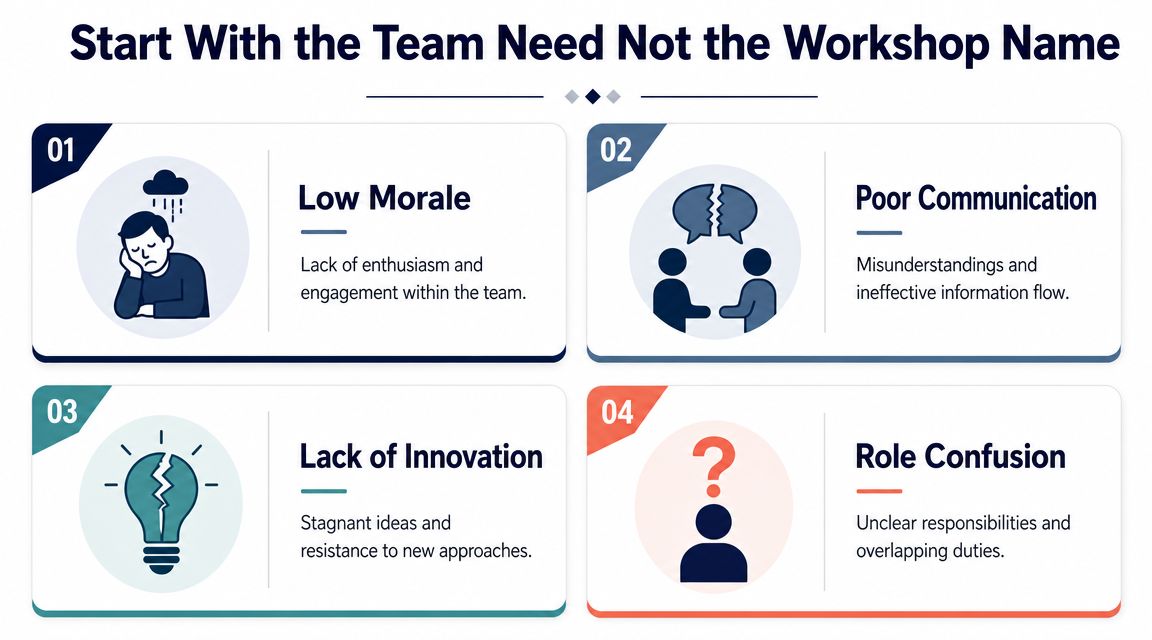
The fastest way to waste a workshop budget is to start with program titles. The better starting point is a diagnosis of what the team is dealing with right now, in real work, under current pressure.
What leaders should diagnose first
A useful diagnostic usually begins with one question: what is happening in your team, and which workshop will help? That question stops organisers from booking whatever sounds engaging and starts pushing the conversation toward business need.
Common patterns tend to show up clearly:
Low connection or morale: the team has gone through pressure, change, or distance, and people feel less connected to each other.
Poor communication: misunderstandings, unclear expectations, and patchy follow-through are slowing work down.
Lack of role clarity: people overlap, hold back, or duplicate effort because contribution boundaries aren't clear.
Leadership misalignment: managers and senior leaders aren't modelling a shared direction.
Change fatigue: the team is tired, sceptical, and less open to yet another initiative.
Low engagement: people are present, but energy and discretionary effort feel thin.
Remote or hybrid disconnection: the team interacts, but doesn't feel cohesive.
Unclear working styles: colleagues keep misreading each other's pace, tone, or decision style.
Need for culture rhythm: the business doesn't need a one-off reset. It needs repeatable habits.
Need to understand the science of play: leaders want a more credible explanation for why play based team building supports performance.
The commercial case for targeted workshops
In the 2026 results from Gallup, there is a practical reason for the increasing popularity of this diagnostic approach.
The data indicates that 20% of employees are engaged globally, while 64% are not engaged, and 16% are actively disengaged.
The findings also indicate that teams with high engagement levels achieve 15% higher productivity and 25% higher profitability. Consequently, many leaders now view workplace team building workshops as essential for enhancing performance rather than as optional activities.
In Australia, that thinking sits alongside a labour market where retention pressure remains real. The same verified source notes a national unemployment rate of 4.1% in 2024, which keeps pressure on organisations to hold onto capability, maintain culture, and support stronger team connection.
A workshop should solve a live workplace issue. If the team problem can't be named clearly, the workshop choice usually won't be clear either.
For organisers who need practical ideas around rebuilding connection and momentum, the resource on team bonding for workplace groups is a useful next read. It helps translate broad culture concerns into clearer event intentions.
Team Development Workshops A Detailed Comparison
A leadership team has just come through a restructure. Meetings feel polite but unproductive. Two managers dominate discussion, ownership is blurred, and morale has dipped. In that situation, choosing a workshop by title or popularity is a fast way to waste budget. The better question is simpler. What is the actual performance problem, and which workshop is built to address it?
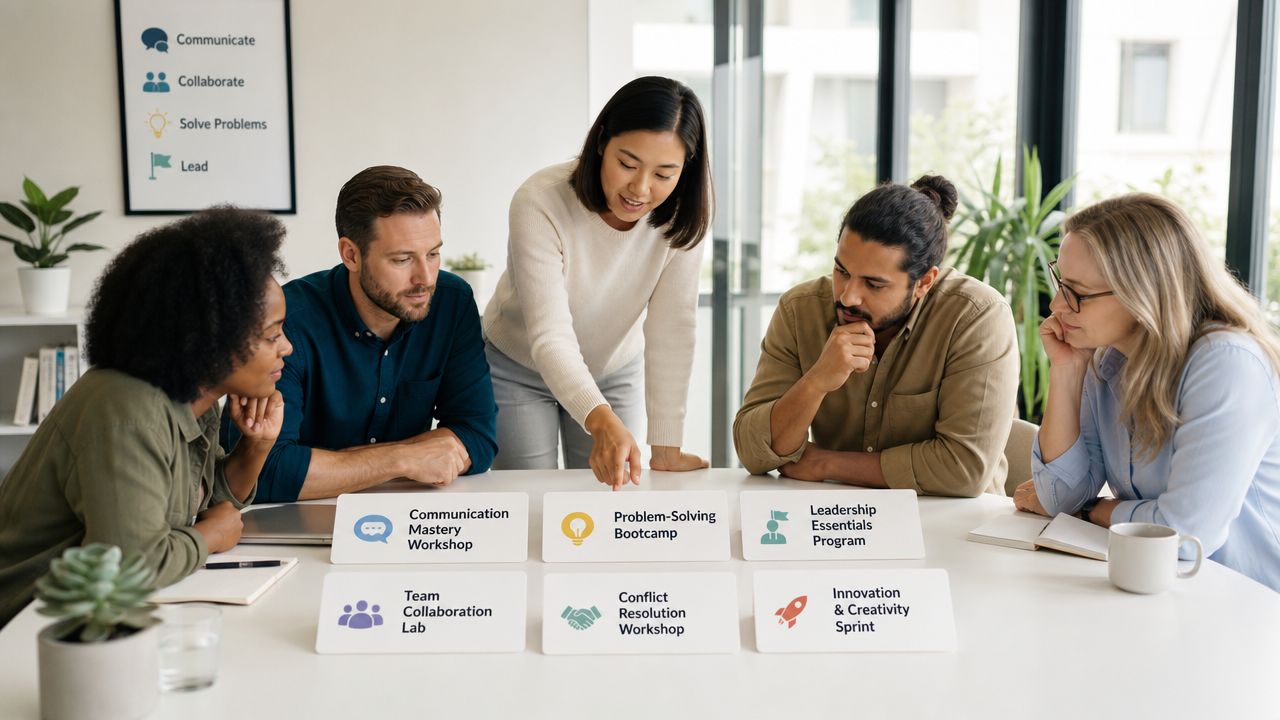
That diagnostic lens matters because these workshops solve different problems. Some create shared language. Some improve behaviour in the room. Some help teams clarify contribution, reset energy, or build habits over time. Good selection depends on the issue, the maturity of the team, and how much follow-through the business is prepared to support. For a broader view of what buyers notice in well-run facilitation, 5on4 Group Training reviews on Testimonial show the kinds of outcomes participants tend to value in structured group learning.
Science of Play: Realising Human Potential
This workshop fits leadership groups, conference audiences, and mixed teams that need a credible explanation for why play has a place in performance conversations.
Science of Play: Realising Human Potential is a practical, science-backed team experience that reframes play as a biological and public health necessity, and the missing performance infrastructure that helps teams build connection, adaptability, and sustainable high performance. Most organisational interventions try to improve performance by teaching behaviours on top of the current operating environment. But when teams are under constant load, the problem is rarely knowledge. It is the state people are operating from. That is why well-intended initiatives struggle to stick.
This session focuses on the conditions that performance runs on. It shows leaders what degrades when play drops out and why culture becomes fragile under pressure. The result is a clear, evidence-led way to restore the operating conditions that allow people to think well, work well together, and sustain high performance without relying on motivation alone.
It ends with practical tools, shared language for buy-in, and a clear pathway forward, supported by optional resources to help the shift carry beyond the event.
Choose it when the team needs a shift in belief before it can change behaviour. That often applies in three situations:
senior leaders want a business rationale before approving team development
a conference agenda needs more than an energiser
managers need common language for why human connection affects execution
Play Principles Workshop
Some teams already agree that culture matters. Their problem is inconsistency.
The Play Principles Workshop is useful when a team needs practical habits rather than more theory. It focuses on how culture shows up in ordinary work. Meetings, rituals, onboarding, leadership behaviour, communication patterns, and shared norms all sit inside that scope. The value is in making culture visible and repeatable.
Culture isn’t built in one big moment, it’s shaped daily through how teams communicate, collaborate and care for one another. The PLAY Principles is a practical half-day workshop that helps your team do exactly that.
Backed by neuroscience and behavioural psychology, this session equips teams with the mindset and habits to positively influence culture from within. Through a mix of guided reflection, energising play, and peer-led discussion, participants explore four core principles that drive human connection and high performance.
This workshop is usually the better choice when people say things like, “We talk about culture, but it depends on which manager you work for,” or “Team energy is good after offsites and gone again by Monday.” Those are rhythm problems. They call for routines, not inspiration.
Choose this workshop when the team is ready to use specific practices and leaders are willing to model them consistently.
DOPE The Four Birds Workshop
Communication friction often looks personal when it is really a style mismatch.
The DOPE: The Four Birds Workshop gives teams a simple, memorable language for understanding working preferences. That makes it useful for groups that keep misreading one another's intent. One person wants speed. Another wants detail. A manager sees resistance where a team member is asking for clarity. A colleague reads directness as bluntness when it is brevity. DOPE for Teams session brings everyone’s Dove, Owl, Peacock and Eagle traits together in one powerful, practical experience. It’s where self-awareness becomes connection. When teams see how each person communicates, leads and reacts under pressure, collaboration starts to feel easier and more natural.
Through playful, facilitator-led activities, your team will explore what each bird type contributes from the empathy of Doves and precision of Owls to the enthusiasm of Peacocks and drive of Eagles. It’s a session full of “aha” moments that help people appreciate differences and use them as strengths.
This workshop suits teams that need self-awareness quickly and do not have the appetite for a heavier diagnostic tool. It is particularly effective with mixed seniority groups because the framework is easy to remember and easy to use after the session.
Use DOPE when the core problem is communication friction, feedback avoidance, or lack of awareness about different working styles.
Belbin Team Roles Workshop
Some teams communicate well enough. They still underperform because contribution is unclear.
The Belbin Team Roles Workshop is designed for that problem. It helps teams examine how people contribute, where strengths overlap, which roles are missing, and how work should be distributed more effectively. That makes it a strong option for project teams, leadership groups, and departments that keep circling the same workload issues.
It is especially useful when the symptoms include duplicated effort, decision bottlenecks, uneven workload, or frustration about who should be driving what. In those cases, a communication workshop may improve tone without improving execution. Belbin gets closer to the source of the issue.
For organisers weighing those distinctions, the article on how team building workshops create high-performing teams explains why shared language and structured reflection often matter more than choosing the most entertaining activity.
Belbin empowers individuals and organisations to maximise their performance through truly understanding how each team member works. Revolving around the highly acclaimed profiling theory “Belbin Team Roles”, this workshop will help individuals better understand themselves and how they and their colleagues fit within a team.
Through Belbin, new teams can be assembled, existing teams can be improved, and everyone can understand the difference they make in the workplace
Positive Teams Masterclass
A single workshop can create momentum. Culture change usually takes more than one session.
The Positive Teams Masterclass is a better fit when the organisation needs a development path rather than a once-off intervention. It supports teams over time, helps managers reinforce clear habits, and gives the business a framework it can return to as team norms shift. That matters after growth, restructure, leadership change, or a period of cultural drift.
This is the right choice when the issue is broad and persistent. Morale may be uneven. Collaboration may depend too heavily on a few individuals. Managers may be trying to improve culture without a common method. In those cases, the business needs continuity, not a one-day reset. Delivered over a twelve month period, the Positive Teams Masterclass combines the very best of our programs to support your workplace culture, allowing your team to thrive and grow as time goes on. Consisting of a combination of Team Building Programs, both virtual and in person, as well as Team Building Workshops, the Positive Teams Masterclass provides you with the tools and support to build and maintain your workplace culture long after the programs conclusion.
The trade-off is commitment. This option asks for time, attention, and follow-through. Teams that invest in that process usually get a stronger behavioural shift because the work continues after the workshop ends.
FISH Training
Some teams know exactly what the standards are. They are just not bringing the right energy to the work.
FISH! Training is well suited to that kind of challenge. It focuses on visible behaviours that affect team climate, ownership, service mindset, and day-to-day interactions. For customer-facing teams, support functions, and service environments, that can make it a practical reset when the group feels flat or transactional.
This workshop works best when leaders can point to behavioural drift. Energy is inconsistent. Initiative is low. Service feels mechanical. Colleagues or customers notice the difference. FISH gives teams a direct way to talk about the behaviours they want more of.
Built on four simple yet powerful practices, this interactive session explores how to create a workplace where people feel connected, appreciated, and inspired to make a difference. It’s about putting people first and giving them the tools to play with purpose.
From the moment your team walks in, they’ll learn how small shifts in mindset can create massive ripples in workplace culture. This isn’t a theory session. It’s practical, playful, and proven.
Play based team building with facilitated reflection
Low trust and low morale rarely improve through discussion alone. Teams in that state often need a shared experience that changes the quality of interaction in the room.
Play based team building with facilitated reflection is strongest when a team has become disconnected, emotionally flat, or overly cautious with one another. The activity creates interaction and gives people a chance to collaborate under different conditions. The reflection is what makes the session useful at work. It turns behaviour during the activity into evidence about communication, inclusion, trust, leadership, and problem-solving.
This format is often the right fit for teams dealing with hybrid disconnection, change fatigue, low morale, or weak cross-functional relationships. It also works well for offsites and conference groups that need shared experience before they can have honest conversations. Without reflection, it is just a break from work. With reflection, it becomes a practical diagnostic and a starting point for better team habits.
Comparison Table Which Workshop Fits Your Team
For many organisers, a side-by-side scan makes the decision easier than reading program descriptions in isolation. The guide on selecting a team building event for your organisation supports that same comparison approach.
| Workshop | Best for | Common team challenge | What the team experiences | Best setting | Ideal outcome |
|---|---|---|---|---|---|
| Science of Play: Unlocking Human Potential | Leaders, conferences, offsites | Need for credible language around play and performance | Evidence-led education session | Conference, leadership offsite | Shared understanding of play as performance infrastructure |
| Play Principles Workshop | Leaders and teams building everyday culture habits | Need for culture rhythm | Practical application of play to meetings, rituals and communication | Team workshop, manager development | Repeatable culture behaviours |
| DOPE: The Four Birds Workshop | Teams needing simple language for styles | Unclear working styles, communication friction | Memorable working-style framework | Team day, offsite, manager session | Better awareness and communication |
| Belbin Team Roles Workshop | Teams needing role clarity and collaboration | Overlap, gaps, unclear contribution | Structured reflection on team roles and contribution patterns | Project team, leadership team | Stronger collaboration and clearer contribution |
| Positive Teams Masterclass | Organisations seeking sustained development | Culture drift, habit inconsistency | Longer-term development pathway | Multi-session culture program | Practical culture change over time |
| FISH! Training | Teams needing energy and ownership | Flat service mindset, low day-to-day energy | Behaviour-focused culture session | Customer-facing or support teams | Stronger ownership and service culture |
| Play based team building with facilitated reflection | Teams needing connection through shared experience | Low morale, trust gaps, hybrid disconnection | Active shared experience plus reflection | Offsite, conference, team day | Renewed trust, communication and connection |
Measuring the Impact of Your Workshop
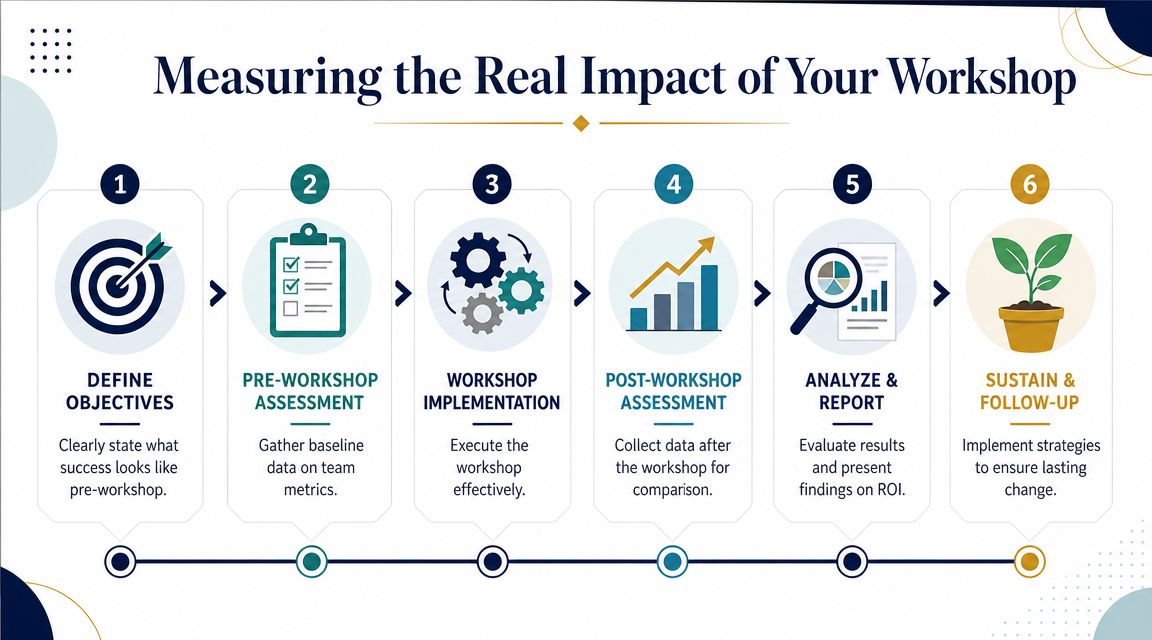
A workshop earns its budget when it changes how people work together after the event. Enjoyment matters, but it is a weak success measure on its own. Teams can leave energised and still return to the same unclear roles, hesitant conversations, or poor handoffs on Monday.
Measure behaviour change, not event satisfaction
The strongest evaluation method starts with the problem you were trying to fix. If the team came in with communication friction, measure communication quality. If the issue was role ambiguity, measure clarity of contribution and decision ownership. If morale was low after a difficult quarter, track engagement alongside observable signs of collaboration and follow-through.
A practical measurement plan usually includes four layers:
Baseline measures: short pulse data on communication quality, role clarity, collaboration, and engagement before the event.
Immediate follow-up: the same questions shortly after the workshop to capture early movement.
Operational signals: project-cycle flow, cross-team responsiveness, meeting quality, or handoff consistency over time.
Leader observation: structured notes from managers on whether the language and behaviours from the workshop are showing up in work.
This approach gives leaders something they can defend. It shifts the conversation from whether people liked the session to whether the team is working with less friction and better consistency.
What to track after the workshop
Different workshop formats produce different kinds of evidence. A Belbin session should show up in clearer role contribution, better delegation, and fewer duplicated efforts. A FISH! program should appear in service behaviour, ownership, and day-to-day energy. Play based team building with facilitated reflection should improve trust, communication, and willingness to reconnect across a fragmented team.
The measure should match the diagnosis. Teams often get this wrong. They run a workshop to solve one problem, then evaluate it against a different one because morale is easier to ask about than accountability or clarity.
Format also affects value. For distributed teams, virtual or hybrid delivery can be the better commercial choice when the goal is broad participation, lower travel cost, and easier follow-through across locations. For leadership groups working through trust, conflict, or role tension, an in-person format often gives facilitators more to work with because the quality of discussion matters as much as the content.
If you need to connect a play-based workshop to business outcomes, this guide to the ROI of play at work is a useful reference point.
A simple rule helps here. Measure what the team needed to improve, then check whether that change held long enough to affect performance.
Quick Guide Which Team Building Workshop Should You Choose
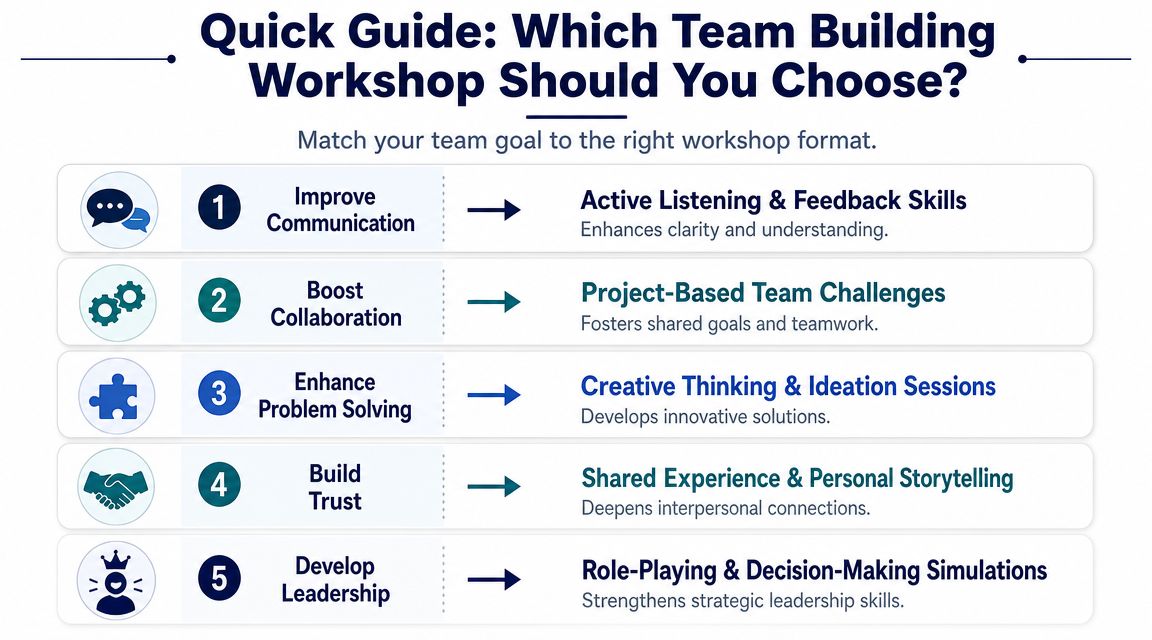
When the shortlist is still crowded, a simpler decision filter helps. The strongest choice usually becomes clear once the organiser names the current team condition rather than the event preference.
A simple decision filter
Use these prompts as a final check:
If leaders need credible language for why play matters, choose Science of Play: Realising Human Potential. This fits conferences, offsites, and leadership settings where the business case needs to come first.
If the team needs practical ways to bring play into everyday work, choose the Play Principles Workshop. This is the right move when culture needs more rhythm, not more slogans.
If the team needs a simple language for working styles and communication, choose DOPE: The Four Birds Workshop. It gives teams an accessible framework they're likely to remember and use.
If the team needs role clarity and better collaboration, choose the Belbin Team Roles Workshop. This is often the right option when contribution patterns are unclear.
If culture needs a longer-term pathway, choose the Positive Teams Masterclass. It suits organisations that want sustained development rather than a one-off reset.
If the team needs energy, ownership and service mindset, choose FISH! Training. It is practical, behaviour-focused, and useful where day-to-day culture has gone flat.
If the team needs connection through shared experience, choose play based team building with facilitated reflection. This is especially useful where morale, trust, or hybrid disconnection are the issue.
Recent Australian evidence highlighted in this discussion of psychological safety and workshop design points to another important filter. Buyers should ask whether a workshop improves psychological safety and communication after the event, not just during it. That is especially relevant when teams are already carrying work-related stress and need lower-friction ways to rebuild trust.
Your Next Step
The most effective team building workshops don't start with entertainment value. They start with diagnosis.
Good selection is usually simple, but not casual. Identify the current team challenge. Match it to the type of shift the workshop is designed to create. Then decide how that change will be measured once people return to work. That's how a workshop moves from event spend to a practical investment in performance, culture, and retention.
Corporate Challenge Events, is a leading provider of Science of Play, Play Principles, DOPE, Belbin, Positive Teams, FISH!, and facilitated play-based formats for workplace teams. The important decision isn't which program name sounds most appealing. It's which one fits the team's current reality.
Corporate Challenge Events can help you choose the right team building workshop based on your team's current challenges, goals and culture needs.