
In Australia, 78% of companies have established a corporate volunteering program, and participating employees contribute one million hours of volunteer time annually according to the Volunteering Research Paper on corporate volunteering implications for policy and practice. That should change how workplace leaders think about employee volunteering programs. This isn’t a side activity for organisations with spare time or a soft CSR add-on for annual reports. It’s already part of mainstream corporate practice.
The more useful question isn’t whether a company should run an employee volunteering program. It’s whether the program is built to do real work. Poorly designed programs create a burst of goodwill and very little else. Strong ones support retention, strengthen culture, build leadership capability, and create community value that a non-profit partner can use.
For HR leaders, People and Culture teams, executive assistants, event organisers and operational decision-makers, the challenge is usually the same. Teams want purpose. Leaders want measurable value. Community partners want practical help, not just enthusiasm. The organisations that handle employee volunteering programs well design for all three.
Table of Contents
The Rise of Purpose Driven Workplaces
More than 8 in 10 employees say a sense of purpose matters to their job satisfaction, according to McKinsey research on purpose at work. That matters because purpose is no longer an abstract culture statement. It shows up in retention risk, manager credibility, and whether employees believe the company’s values hold up under pressure.
Employee volunteering sits inside that shift, but the format matters. A volunteering experience creates the strongest value when it responds to a genuine community need and gives employees a meaningful way to contribute together. Stronger programs are designed around real nonprofit demand, employee skills, and repeatable participation, so the work contributes to capability building as well as community outcomes.
That is a different standard from the older model of corporate volunteering.
A practical definition helps. Employee volunteering programs are employer-supported opportunities for staff to contribute time or professional expertise to community organisations. The difference between a low-value program and a high-value one is usually not intent. It is design. Hours donated are easy to count. Useful output, partner fit, and sustained participation are harder, and those are the factors that separate symbolic activity from a program worth funding.
Employee volunteering earns strategic support when it solves a real community need and serves a clear workforce objective at the same time.
This is why purpose-driven workplaces are changing how they structure these programs. They are becoming more deliberate about matching team events, skills-based projects, individual opportunities and community partnerships to the outcomes they want to create. Teams in finance can help with forecasting. Marketers can support campaign planning. Technology teams can improve systems that a nonprofit would struggle to build alone.
For organisations refining that broader connection between responsibility and culture, the evolution of corporate social responsibility and workplace culture is a useful reference point.
Different formats create different outcomes. Team events can involve employees at scale while producing an immediate contribution, while specialist or recurring opportunities may suit needs requiring particular expertise or continuity. Keep some accessible entry-point activities, but put serious effort into a smaller number of projects where employee capability matches partner need. Many nonprofits are asking for exactly that kind of support, and these nonprofit strategies for company volunteers show why generic offers often miss the mark.
The organisations getting this right treat volunteering as part of workforce and community strategy, not as a side activity owned by one enthusiastic coordinator. They set criteria for partner selection, decide which participation model best matches each community need and build a program the business can deliver effectively. That is the definitive rise of purpose-driven workplaces. Purpose has become operational.
The Business Case for Employee Volunteering
The business case gets stronger when employee volunteering programs are discussed in operational terms. Budget holders rarely need another argument about goodwill. They need to understand what improves, what gets protected, and what the organisation gains if participation becomes part of the employee experience.
Why retention belongs in the conversation
One of the clearest arguments is retention. Australian organisations with structured employee volunteering programs see a 52% lower turnover rate among newer employees who participate, according to the Benevity analysis on employee volunteerism and workforce strength. For HR teams trying to stabilise early tenure, that’s a serious signal.
New employees often decide whether to stay based on whether the organisation feels coherent. Volunteering can help create that coherence. It gives newer staff a way to build relationships outside immediate reporting lines, experience company values in action, and connect with the organisation beyond role tasks and onboarding content.
Where engagement becomes operational
Organisations with highly engaged workforces outperform their competitors by 147% in earnings per share. Employee volunteering doesn’t create engagement on its own, but it contributes to the conditions that engagement depends on. People feel more connected when they do meaningful work together, especially in settings that cut across hierarchy and department silos.
A good volunteering program improves the employee experience because it creates:
| Workplace need | How volunteering helps |
|---|---|
| Belonging | Staff work with colleagues they may not normally meet |
| Meaning | Organisational values become visible rather than abstract |
| Development | Employees practise communication, initiative and teamwork |
| Connection | Teams share a non-routine experience with a real outcome |
That’s also why practical partner design matters. Resources such as Alignmint’s guide to nonprofit strategies for company volunteers are helpful because they frame volunteering as a relationship between organisational capability and community need, not just a calendar event.
Practical rule: If a leader can’t explain how a volunteering activity supports retention, engagement, culture or capability, it will be one of the first items cut when budgets tighten.
How to position the budget request
The strongest internal case usually combines workforce logic with CSR logic. A volunteering program can support employer brand and community reputation, but that alone won’t convince every executive team. A better approach is to anchor the proposal in measurable outcomes that other parts of the business already care about.
That means presenting employee volunteering programs as part of a wider responsibility framework rather than as a stand-alone feel-good initiative. The article on why developing a CSR framework is vital to success captures that broader lens well.
A practical business case usually includes three arguments:
-
Workforce stability: Participation supports stronger attachment to the organisation.
-
Culture quality: Shared service experiences can improve cross-functional trust and morale.
-
Leadership development: Staff get exposure to coordination, communication and problem-solving in a different environment.
The mistake is treating employee volunteering programs as hard to justify because some benefits are qualitative. Senior leaders make decisions on blended evidence all the time. If a program is structured, aligned, and measured well, it belongs in the same strategic conversation as leadership development, culture investment and employee experience design.
Designing a Program for Strategic Impact
Many employee volunteering programs underperform because they’re designed backwards. The organisation starts with an activity that sounds easy to run, then tries to build meaning around it later. That usually produces a busy day, a few photos, and very little lasting value.
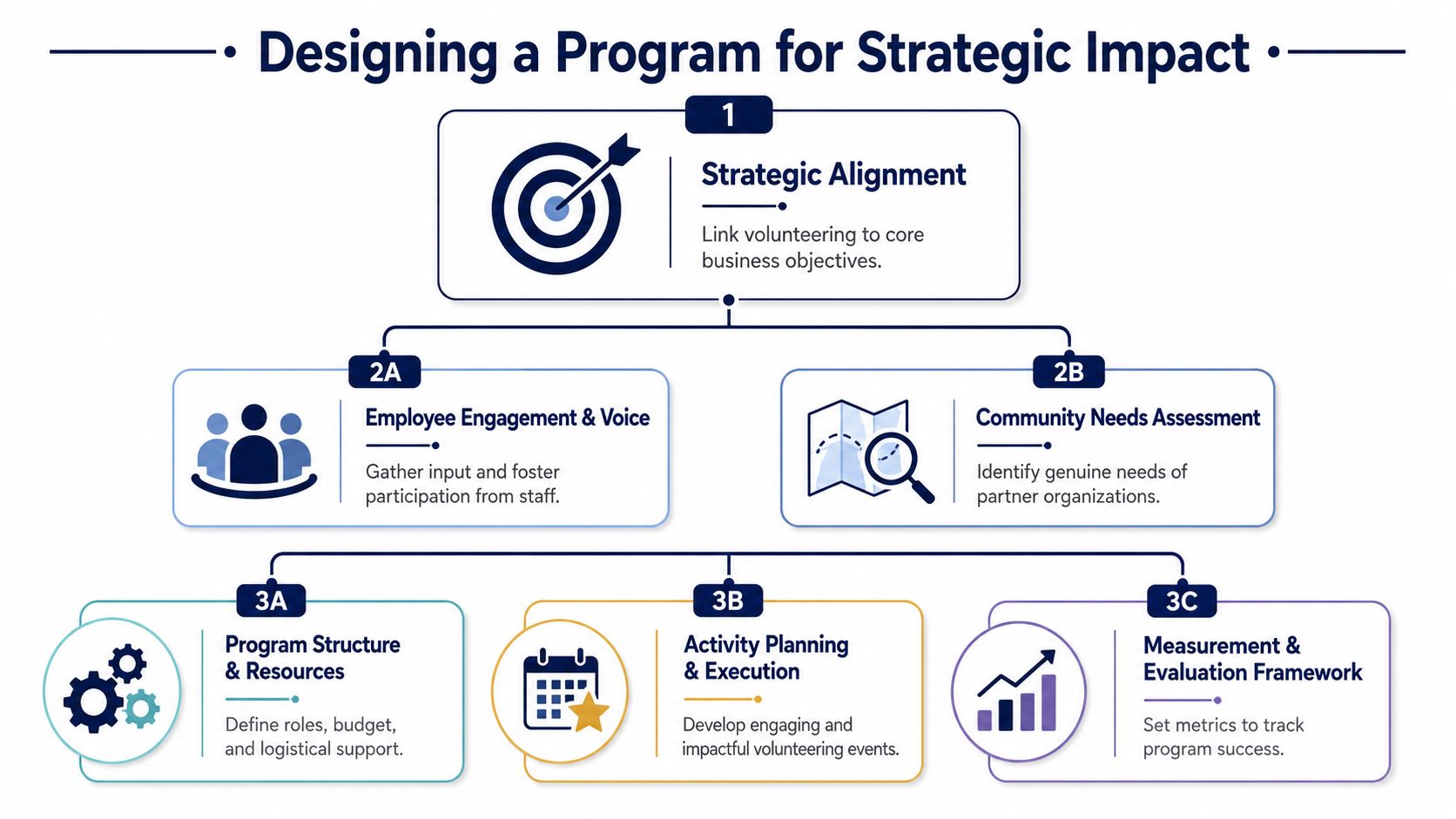
The organisation needs to understand what it wants the program to support internally, whether that is stronger culture, employee connection, leadership development, engagement or broader CSR objectives. At the same time, the community partner needs to identify where employee involvement can provide genuine and practical value.
According to Diversity Australia’s discussion of employee volunteering programs, organisations can consider several approaches, including team volunteering, individual volunteering and skills-based support. The right model depends on the needs of the community partner, the objectives of the business and the experience the organisation wants to create for employees.
This is where strategic design begins.
A Better Design Logic
A strategic program starts with two questions:
-
What does the organisation need this program to support internally?
-
What does the community partner need externally?
The overlap between those answers is where the best design sits.
If a company wants to strengthen collaboration across departments while supporting a practical community outcome, a team-based charity activity may be the right fit. If the business wants employees to apply their professional expertise, mentoring or project support may be more appropriate. If the organisation wants to create a broader culture of purpose, it may choose a mix of team, individual and skills-based opportunities.
The format should follow the objective, rather than the organisation selecting an activity first and trying to justify it afterwards.
A good design brief usually includes the following decision points:
-
Objective fit: Is the program intended to build culture, develop talent, strengthen CSR outcomes or achieve several of these together?
-
Partner fit: What does the non-profit genuinely need, and can it support the proposed level of employee involvement?
-
Format fit: Is the right approach team volunteering, skills-based support, individual participation, recurring service or a blended model?
-
Access fit: Can office-based, hybrid and remote employees participate in a meaningful way?
-
Experience fit: Will employees understand the cause, the contribution they are making and the outcome their involvement supports?
For organisations also considering the participant experience, details around merchandise and practical event support can influence engagement. If a team uses branded packs or event materials, resources on premium eco-friendly products for teams can help avoid waste-heavy choices that undermine the broader purpose of the program.
The Operating Choices That Shape Outcomes
Once the strategic direction is set, three operating choices help turn the program into a meaningful experience.
Build Strong Partner Alignment
The community partner should help define the need, the intended outcome and the most useful form of employee involvement. Clear expectations make planning easier and help ensure the program creates practical value rather than additional work for the non-profit.
Choose the Right Participation Model
Different volunteering formats serve different purposes. Team activities can create shared energy, connection and a visible community contribution. Skills-based support can apply professional expertise to a specific need, while individual opportunities can give employees greater choice.
The right model is the one that best matches the program’s objective, the needs of the partner and the employees taking part.
Define Success Before Launch
Most programs collect participation numbers, volunteer hours and photographs. Fewer decide in advance what success should look like for the business, employees and the partner organisation.
That might include a practical output delivered, funds or resources contributed, stronger employee connection, increased understanding of a cause or positive feedback from the community partner.
The guide to creating a CSR framework your team is passionate about is useful here because it encourages design around commitment, not just scheduling.
Strategic employee volunteering does not need to be complicated. Strong programs ask clear questions, choose the right format and define the value they want to create before the activity begins.
Examples of High Impact Volunteering
Abstract strategy becomes much easier to understand when viewed through a well-designed event. High-impact volunteering often sits at the intersection of team development and community contribution. That’s why charity team building can be such a useful format when it’s built properly.
Charity team building with a practical output
Consider a format like Bikes for Tykes. Teams do more than just arrive, complete a physical task, and leave. They work through challenges, make decisions together, coordinate resources, and assemble something that will be donated. The giving outcome matters, but so does the way the team gets there.
The same applies to a program such as Give a Dog a Home. A strong design turns the activity into more than a donation mechanism. Teams must communicate, problem-solve, allocate roles and maintain momentum under time constraints. The charitable result is tangible, and the internal team experience is equally deliberate.
That combination is where many employee volunteering programs become more valuable. The event supports community organisations, but it also creates a live environment for collaboration and connection. For People and Culture teams, that means one program can serve several purposes without becoming diluted.
What a better event looks like in practice
High-impact formats tend to share a few traits:
-
They produce something concrete: assembled items, donated goods or useful outputs that a partner can apply immediately.
-
They require real teamwork: participants must coordinate rather than passively stand alongside each other.
-
They are designed for adult workplaces: the activity is engaging, but the outcomes connect back to communication, trust and performance.
A weaker model often looks busy without creating much depth. People attend, complete a task in parallel, take a group photo and return to work with very little changed. A better event is structured to create interaction, shared responsibility and a visible contribution.
Good charity team building doesn’t ask teams to choose between culture and contribution. It combines them.
That’s also why play-based formats can work so well in a corporate setting when they are designed with purpose. Play in this context isn’t about distraction. It creates a more open, collaborative state where teams practise communication and problem-solving while working on something meaningful.
Leaders looking at different formats can review top charity team building programs in Australia to compare how various models combine giving outcomes with team development. The practical lesson is simple. The best volunteering event isn’t the one with the lowest coordination load. It’s the one that leaves both the charity partner and the internal team in a better position than before.
Launching and Managing Your Program
A strong concept can still fail in rollout. Most employee volunteering programs succeed or stall on execution discipline. That includes internal communication, manager support, registration flow, event operations and follow-up after the day itself.
Secure support before opening registrations
Leadership backing needs to be visible before invitations go out. Staff read organisational cues quickly. If executives talk about volunteering but don’t free up time, approve attendance, or participate themselves, uptake becomes uneven and the program starts to look optional.
The easiest format to launch is often team volunteering because it gives employees a familiar, shared experience with clear logistics and a visible outcome. More broadly, the Snapshot of Volunteering in Australia 2023 found that 57.1% of volunteers believe volunteering makes them more productive at work, reinforcing the potential workplace value of meaningful participation.
A solid pre-launch checklist usually covers:
-
Manager alignment: Ensure people leaders know why the program exists and how participation should be supported.
-
Clear employee messaging: Explain the community purpose, time commitment, logistics and expected outcomes.
-
Capacity planning: Match volunteer numbers to what the partner organisation can use.
Run the day like an operational program
Event-day quality shapes whether employees will participate again. That means the program needs an owner, a run sheet, decision points, safety checks, briefing notes and contingency planning. Volunteer days should feel purposeful, not improvised.
A practical operating model includes:
-
Arrival and orientation so people understand the partner, the need and the task.
-
Team structure with clear roles and enough facilitation to keep energy and focus high.
-
Visible milestones so participants can see progress and understand the value of the work.
-
Closing reflection that connects the activity back to workplace culture, not just the event itself.
For organisers who want the team impact to continue after the day, the article on ensuring benefits of team building last is a helpful companion piece.
Keep momentum after the event
The follow-up is where many programs lose value. A volunteering event should trigger a short internal cycle of reinforcement. Share outcomes with participants, thank the non-profit partner properly, capture feedback while it’s fresh, and give leaders a simple summary they can use with their teams.
Post-event communication works best when it highlights three things:
-
What the team contributed
-
What employees experienced
-
What happens next
That final point matters most. If the program ends with a thank-you email and a photo gallery, it remains a one-off. If it feeds into future opportunities, manager conversations and broader culture activity, it becomes part of how the organisation operates.
Measuring Success and Scaling for the Future
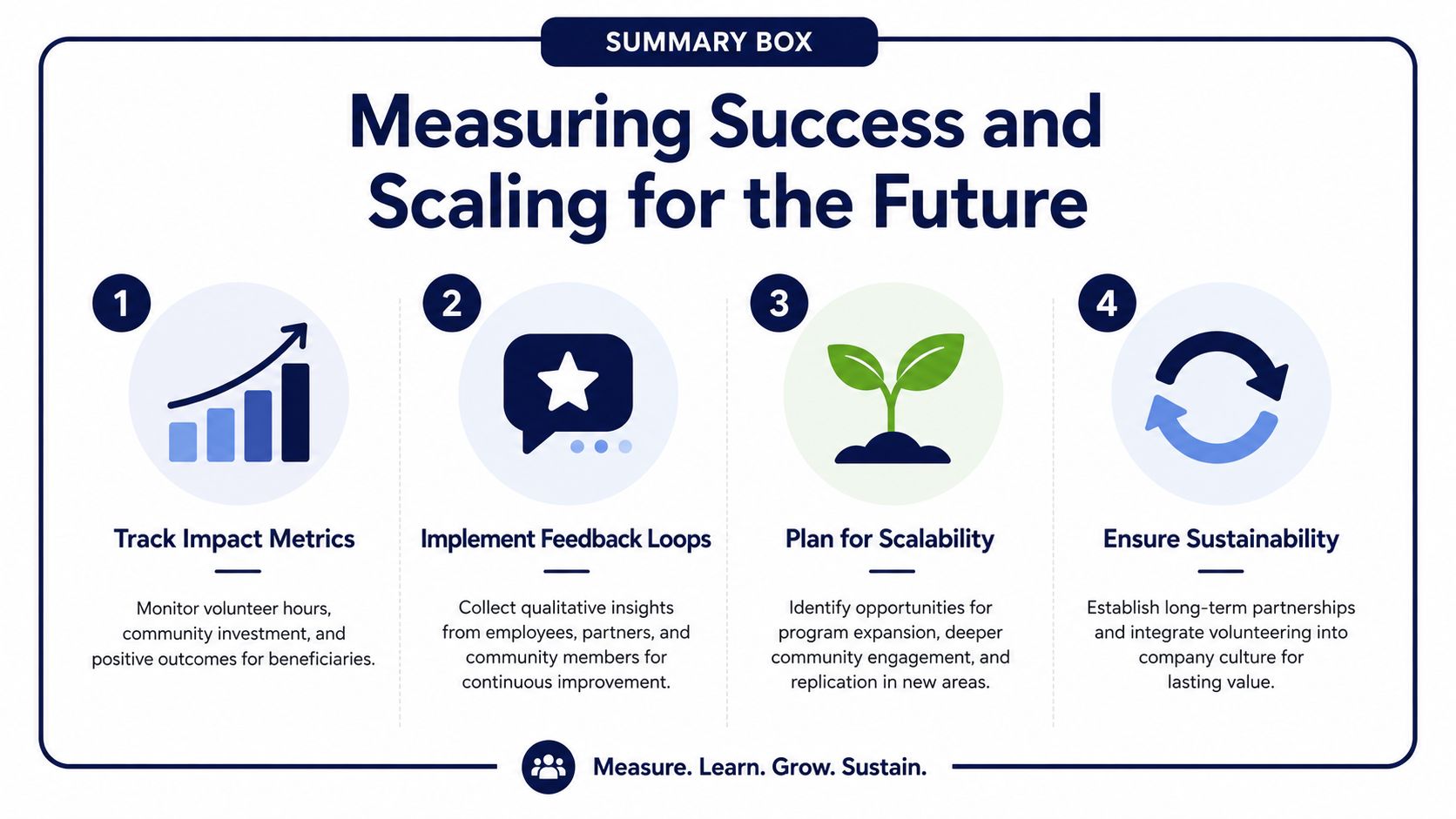
Programs that survive budget reviews can show more than turnout. Attendance matters, but it does not tell a CHRO, CSR lead, or finance partner whether volunteering improved retention, built useful skills, or created real value for a community partner. The strongest programs measure all three.
Measure more than attendance
A practical scorecard should cover inputs, outcomes, and fit.
Useful categories include:
-
Participation data: who joined, from which teams, at what level of seniority, and in what format
-
Partner value: what the non-profit received, whether the work matched a real need, and what changed because of it
-
Employee response: feedback on morale, connection, capability building, and willingness to participate again
-
Business impact: links to engagement, manager feedback, leadership development, cross-functional collaboration, or employer brand goals
-
Program quality: repeat participation, no-show rates, partner retention, and delivery issues that affect scale
Many teams miss the mark by counting volunteer hours but failing to test whether those hours solved a meaningful problem. The value of any format depends on whether it addresses a genuine need and delivers the outcome it was designed to create.
A useful reference point comes from adjacent community measurement disciplines. ComBase’s guide on how to calculate the ROI of your customer community is relevant because it shows how leaders can combine direct metrics with contribution-based evidence instead of relying on a single headline number.
The most credible volunteering report connects community outcomes and business outcomes in the same document.
Build a reporting rhythm leaders will use
Annual reporting is too slow on its own. Quarterly reviews work better because they show pattern changes early and give HR, CSR, and business leaders a chance to adjust partner mix, participation models, and internal positioning before the next cycle.
A concise internal report often works best in this format:
| Reporting area | What to include |
|---|---|
| Program activity | Events delivered, participation patterns, volunteering modes used |
| Community contribution | Outputs delivered, partner feedback, examples of practical value |
| Workforce impact | Employee feedback themes, manager observations, culture signals |
| Next actions | Adjustments, new partnerships, capability gaps, scaling opportunities |
Keep the report short enough to read and specific enough to act on. If a partner consistently reports weak fit, change the model. If employees rate skills-based projects higher than event volunteering, shift the mix. If one business unit has strong participation because managers actively support it, that becomes a management practice worth replicating.
Scale by deepening, not just expanding
Scale does not have to mean more events. In many organisations, the better move is to increase relevance and quality. That can mean strengthening an annual volunteering event, improving partner alignment, refining the participant experience or adding other opportunities where they support an identified need.
That shift is where employee volunteering starts producing measurable business value. Employees build capability in real conditions. Non-profits get support they would struggle to buy. Leaders get a program that supports culture, talent, and reputation without looking like a side activity.
Organisations that scale well treat volunteering as a core capability, not a calendar item. They measure carefully, learn quickly, and build programs where purpose supports performance.
Corporate Challenge Events helps organisations turn employee volunteering and charity team building into structured, high-impact experiences that strengthen culture while delivering genuine community value. For teams looking to combine purpose, play-based collaboration and smooth event delivery, Corporate Challenge Events is a strong place to start.