
Over 40% of Gen Z and millennial respondents in Australia have rejected a potential employer because the organisation’s values didn’t align with their own, and Deloitte Australia reports that almost all surveyed Gen Zs and millennials say purpose is important to job satisfaction (Deloitte Australia). That should end the idea that CSR belongs only in brand, sustainability, or external affairs.
For workplace leaders, CSR and employee experience are tightly connected. Employees don’t experience corporate social responsibility as a line in an annual report. They experience it through trust in leadership, pride in the organisation, a sense of belonging, and whether daily work feels connected to something beyond output and margin.
Table of Contents
CSR Is More Than an External Reputation Tool
Many leadership teams still treat CSR as an outward-facing function. That view is dated. Employees are paying attention to what the organisation supports, how consistently it acts, and whether its stated values hold up under pressure.
CSR becomes part of the employee experience the moment people ask a simple internal question: does this company behave the way it says it does? That question sits underneath trust, culture, and retention. It also affects whether employees feel they’re contributing to an organisation worth committing to.
A useful way to frame the shift is through the longer evolution of corporate social responsibility and workplace culture. Modern workplace CSR isn’t separate from culture. It helps define culture.
What employees read into CSR
Employees don’t just see community partnerships or sustainability announcements. They interpret signals such as:
-
Consistency: Are values visible in decisions, not just messaging?
-
Fairness: Does the organisation care about impact outside the office as much as it claims?
-
Credibility: Are leaders willing to commit resources, time, and attention?
-
Identity: Is this a company people feel comfortable representing?
CSR changes the internal story employees tell themselves about where they work.
That’s why the CSR employee experience work belongs in people strategy. It influences how employees feel before a single engagement survey question is answered.
How CSR Shapes Employee Trust and Pride
Trust starts with evidence. Employees trust organisations when actions line up with stated values, especially when those actions involve real trade-offs like budget, leadership time, or operational commitment. A company that invests in social responsibility shows employees what it’s willing to stand for when nobody is asking for a press release.
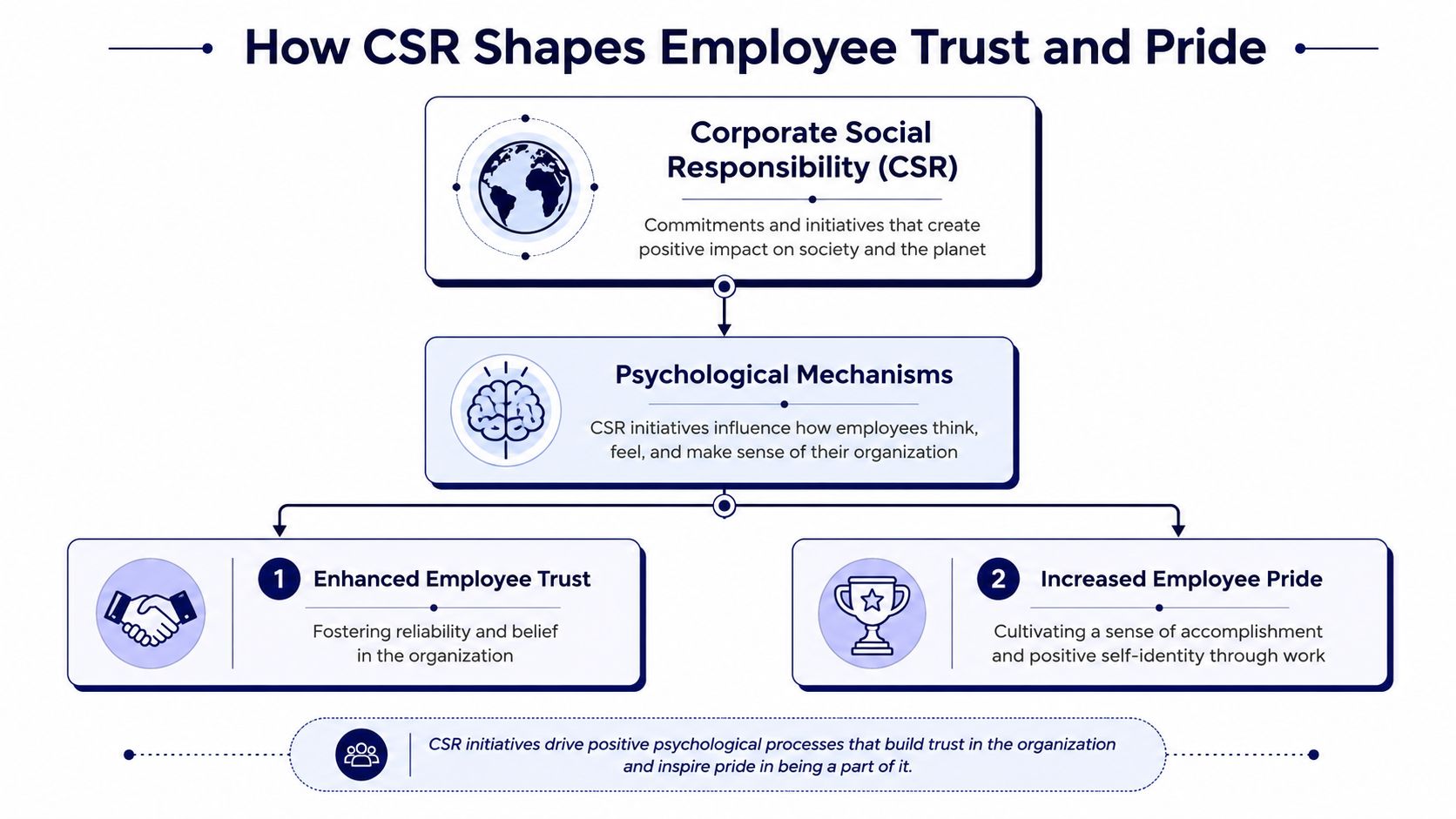
That trust often turns into pride. Qualtrics says employee pride in CSR plays a major role in fostering belonging and is a top driver of employee engagement just behind belonging (Qualtrics on belonging at work). Pride matters because employees don’t separate their work identity from the organisation’s public behaviour. If the company contributes positively, employees are more likely to feel good about being associated with it.
The strongest cultures usually understand this link. They don’t leave social impact sitting in a separate department. They connect it to the wider role of CSR in corporate culture.
Trust is built through visible choices
Leaders often overestimate what internal messaging can do and underestimate what employees infer from behaviour. Trust grows when CSR is:
-
Specific: Support is tied to clear causes or communities.
-
Repeated: Activity happens consistently, not only at symbolic moments.
-
Relevant: The cause aligns with company values and operating reality.
-
Shared: Employees can see how the organisation follows through.
Pride needs substance
Pride doesn’t come from polished language. It comes from legitimacy. Employees feel proud when CSR is connected to genuine effort, not a campaign built to look good for a quarter.
Practical rule: If employees can explain why the company supports a cause and what action followed, trust and pride usually strengthen together.
Forging Deeper Connections Through Belonging and Meaning
Belonging grows when people feel they’re part of an organisation with a purpose larger than revenue. That doesn’t mean profit stops mattering. It means employees can place their work inside a broader story about contribution, responsibility, and social value.

CSR and workplace culture find their practical relevance. A well-designed workplace CSR approach helps employees feel that the organisation stands for something coherent. That coherence matters in dispersed teams, hybrid environments, and large organisations where people can otherwise feel disconnected from leadership intent.
Belonging is social
CSR can create a shared reference point across functions, seniority levels, and locations. Teams may have different day-to-day work, but they can still connect around contribution. That shared identity often carries more weight than a slogan because it’s grounded in action.
For leaders shaping an employee experience strategy, it helps to think in two layers:
| Layer | What employees feel |
|---|---|
| Organisational layer | “This company has a role beyond profit.” |
| Personal layer | “My work connects to something worthwhile.” |
Meaning is individual
Meaning lands when employees can connect daily effort to human outcomes. Research on contribution-driven systems often points back to the importance of seeing impact as part of the experience, not just the company narrative. A useful example appears in this piece from the Kindness Community Foundation on the growth of contribution-driven systems, which explores how contribution becomes more powerful when it’s built into the operating culture.
Australian engagement data reinforces the value of getting experience right. In 2026, employee engagement in Australia climbed to 68% based on responses from more than 2,000 Australian workers, while still leaving a 32% gap of employees who remain unengaged (Australian engagement findings shared via LinkedIn). Purpose and belonging help close that gap because they change how work is interpreted, not just how work is assigned.
The Direct Impact of CSR on Engagement and Retention
Corporate leaders eventually ask the commercial question. Does CSR affect workforce outcomes that matter to the business? The evidence says yes, especially when employees perceive CSR positively rather than seeing it as distant corporate messaging.
A Frontiers in Psychology meta-analysis found employee perceptions of CSR are related to outcomes including identification, engagement, organisational attractiveness, turnover intentions, commitment, and job satisfaction. That’s a broad set of internal outcomes, and it places corporate social responsibility and employee engagement in the same strategic conversation.
Why the business case is stronger than it looks
CSR often gets underestimated because leaders assess it as a stand-alone initiative instead of a culture mechanism. In practice, it affects multiple people metrics at once.
-
Engagement: Employees are more likely to invest emotionally when values feel credible.
-
Commitment: People stay more connected to organisations they respect.
-
Attraction: Candidates interpret CSR as evidence of organisational character.
-
Retention: Lower turnover intentions matter long before resignation shows up.
The wider executive context supports that shift. Deloitte’s 2025 C-suite Sustainability Report found sustainability remains a top-three C-suite priority, with 83% of leaders increasing sustainability investments in the last year, as cited alongside the Frontiers evidence above.
A practical reading for HR teams is simple. CSR shouldn’t sit outside the engagement agenda. It belongs alongside recognition, leadership capability, manager behaviour, and the broader understanding of employee engagement.
When employees see social responsibility as real, engagement improves because the company feels more believable.
The Critical Risk of Performative CSR
Not all CSR improves the employee experience. Some of it damages it.
The risk appears when leaders treat CSR as image management, a one-off event, or a mandatory participation exercise with weak connection to employee values. Employees usually spot the gap quickly. When that happens, CSR stops building trust and starts producing cynicism.
Research highlighted in a QUT source on authenticity and CSR points to an important distinction. CSR has its strongest effect when it allows employees to express their whole selves and feels authentic, while CSR tied to perceived organisational support can have a negative impact on engagement if it feels forced (QUT research on authenticity and CSR).
What performative CSR looks like inside organisations
A program is at risk when it has these characteristics:
-
Detached leadership: Senior leaders endorse the message but don’t show involvement.
-
Low relevance: The cause has little connection to company values or employee concerns.
-
Compulsory energy: Teams feel pushed into visible participation rather than invited into meaningful contribution.
-
No follow-through: Activity happens once and then disappears.
Australian data also sharpens the warning. 56% of Australians have considered leaving their job due to a lack of meaningful, personalized experiences, according to Edenred’s Australian employee experience findings. Generic programs don’t just underperform. They can deepen disconnection.
Making CSR Tangible with Charity Team Building
One of the most practical ways to bring CSR into the lived employee experience is through corporate charity team building activities. Done well, they turn purpose from policy into participation. Employees don’t just hear about values. They work together to produce an outcome that has visible community benefit.
That matters because shared activity changes how CSR is experienced. Instead of sitting in a report or leadership presentation, it becomes social, memorable, and concrete. It can also support communication, collaboration, and connection through structured adult play, which is one reason charity formats work well at conferences, offsites, and culture days.
What works in practice
The strongest CSR employee experience programs usually include three ingredients:
-
A tangible output
Teams can see what they created or contributed. That gives the activity weight. -
A credible community link
The beneficiary relationship is clear, and employees understand where the impact goes. -
Good facilitation
The event doesn’t rely on goodwill alone. It’s organised so the team experience is as strong as the social outcome.
A simple donation can still be valuable, but it rarely shapes culture in the same way. Participatory formats create shared stories inside the business. They give employees something to talk about, remember, and connect back to the company’s values.
Design choices that protect authenticity
Leaders planning charity team building programs should pay attention to the mechanics around the event, not just the activity itself.
-
Partner quality: Community partners should be credible and operationally prepared.
-
Safeguarding: If volunteering or giving involves vulnerable communities, due diligence matters. Resources such as this guide to choosing a nonprofit background check company can help teams assess governance and volunteer risk.
-
Choice and context: Employees engage more positively when they understand why the cause fits and how the activity connects to the wider workplace CSR approach.
A charity team day works best when employees can feel both sides of the outcome. Better team connection inside the business, and real impact outside it.
A Strategic Investment in Your People and Purpose
CSR shapes how employees interpret the organisation they work for. It influences trust in leadership, pride in association, belonging in the culture, and whether work feels meaningful. That places CSR and employee experience firmly inside people strategy, not on the edge of it.
For organisations building a stronger culture, the goal isn’t to make CSR louder. It’s to make it more real, more consistent, and more lived. That’s the kind of approach that strengthens purpose and supports a stronger people and culture strategy.
For organisations that want to make purpose tangible through shared action, Corporate Challenge Events offers corporate charity team building activities that combine play-based team connection with visible community impact. It’s a practical way to bring CSR into the employee experience so teams don’t just hear about values. They experience them together.