
Easy indoor, outdoor and five-minute team building games to get your colleagues playing, connecting and working together.
You’ve been asked to organise a team activity. You want everyone involved, something that doesn’t require weeks of planning and, ideally, an experience people will actually enjoy.
Sounds simple enough.
Until you remember that your team includes the person who loves a competition, the colleague who would rather solve a puzzle, the one who enjoys anything creative and someone who quietly hopes nobody asks them to stand up and perform.
The good news? The best team building games for work don’t need complicated equipment, expensive venues or elaborate instructions.
Sometimes, all it takes is a clever challenge, a few minutes away from the usual routine and the opportunity to see your teammates in a different light.
At Corporate Challenge Events, we’ve spent more than 30 years bringing teams together through play. We’ve seen how a simple game can reveal unexpected talents, spark laughter and get people communicating in ways they wouldn’t normally.
So we’ve brought together 15 of our favourite team building games for adults, including activities from our own free Play Pack.
Whether you’re planning a Monday meeting, an indoor team session or a full outdoor team day, there’s something here to get your people playing.
How to Choose the Right Team Building Game
Before diving into the activities, ask yourself one question:
What does my team need right now?
Sometimes the answer is simply a good laugh. After a demanding few months, your people might appreciate an opportunity to relax, enjoy themselves and reconnect.
Other times, you might want to practise communication, encourage creative thinking or help colleagues understand one another better.
There’s room for both.
The mistake is assuming the biggest, loudest or most competitive activity will automatically be the most effective. Different people enjoy different forms of play, so offering variety and choice is important.
It’s also worth understanding why team building sometimes falls short, especially when an activity doesn’t suit the people participating.
For this guide, we’ve divided the games into three categories: quick meeting games, indoor challenges and outdoor activities.
15 Team Building Games at a Glance
| Game | Best for | Players | Time |
|---|---|---|---|
| Have You Ever | Getting to know colleagues | 6–30 | 10 min |
| Connection Deck Challenge | Conversation | 4–20 | 5 min |
| Silent Sort | Collaboration | 6–20 | 10 min |
| Problem Swap | Creative thinking | 6–15 | 15 min |
| Expert Round | Discovering strengths | 4–15 | 5 min |
| Fifteen Puzzle | Problem-solving | Teams of 2–5 | 10 min |
| Mr Squiggle | Communication | Teams of 4–8 | 20 min |
| Tower Build | Planning and creativity | Teams of 3–6 | 20 min |
| Working Style Mapping | Understanding differences | 6–20 | 20 min |
| The Worst Idea Wins | Creative thinking | Teams of 3–6 | 15 min |
| Street Scrabble | Exploration and strategy | Teams of 3–6 | 30 min |
| Park Scavenger Hunt | Connection and discovery | Teams of 4–6 | 30–45 min |
| Traffic Jam | Collaboration and planning | Teams of 6–10 | 20 min |
| Human Map | Communication | 10–25 | 10 min |
| Seated Water Relay | Friendly competition | Teams of 6–10 | 15 min |
Times are approximate and can be adjusted to your group.
Five Quick Team Building Games for Meetings
These are perfect for teams that want to bring a little more connection and energy into the working week without organising a full event.
1. Have You Ever
Best for: Discovering unexpected things about your teammates
Players: 6–30 | Time: 10 minutes | Equipment: None
You might have worked alongside someone for five years without knowing they’ve climbed a mountain, performed on stage or appeared on television.
That’s what makes this game so much fun.
How to play:
-
Ask everyone to think of an interesting experience or achievement they believe nobody else in the room has had.
-
Invite people to share their experience, keeping it broad enough for someone else to have done something similar.
-
Ask whether anybody else has done it.
-
Award five points if the experience is unique to the group.
-
Play three to five rounds, with the highest-scoring person or team winning.
Keep the examples lighthearted and let people choose what they’re comfortable sharing.
Why we love it: It often reveals surprising similarities and differences between people who think they already know one another.
From CCE’s free Play Pack.
2. The Connection Deck Challenge
Best for: Starting meaningful conversations
Players: 4–20 | Time: 5 minutes | Equipment: Conversation cards or prompts
Not every game needs a scoreboard.
Sometimes, a good question is enough to get people laughing, sharing stories or discovering something new about the person sitting beside them.
How to play:
-
Prepare a small collection of conversation prompts.
-
Divide into pairs or groups of three.
-
Give each group one question and two minutes to discuss it.
-
Invite anyone who wants to share an interesting answer or discovery.
Try questions such as:
-
What is a skill you’ve always wanted to learn?
-
What could you give a five-minute presentation on without preparing?
-
If our team could learn one new skill together, what would you choose?
The aim isn’t to find a correct answer. It’s to enjoy the conversation.
Why we love it: It creates opportunities for connection without putting everyone on the spot.
Want more prompts? Explore CCE’s free Connection Deck and Play Pack resources.
3. Silent Sort
Best for: Collaboration and non-verbal communication
Players: 6–20 | Time: 10 minutes | Equipment: Sticky notes and pens
Can your team organise information without saying a word?
How to play:
-
Give everyone three sticky notes.
-
Ask them to write down a favourite hobby, workplace strength or fun fact, one per note.
-
Collect and mix the notes.
-
Challenge the team to arrange them into groups based on common themes without speaking.
-
Once finished, discuss how the group made decisions and what surprised them.
You can introduce a second round with speaking allowed to see what changes.
Why we love it: It encourages people to notice how they communicate beyond words, while giving quieter contributors a different way to participate.
4. Problem Swap
Best for: Creative thinking and collaboration
Players: 6–15 | Time: 15 minutes | Equipment: Paper and pens
Sometimes the best ideas come from someone who hasn’t been staring at the same problem for weeks.
How to play:
-
Ask each person to write down a lighthearted workplace challenge or fictional problem.
-
Pass the paper to the person beside them.
-
Give everyone one minute to suggest a solution.
-
Keep passing the papers until each problem has several ideas.
-
Return them to their owners and invite people to share their favourite suggestions.
You could challenge the team to solve something practical, like improving the office lunch routine, or something ridiculous, like keeping a dragon happy in a shared workspace.
Why we love it: It encourages people to build on one another’s thinking rather than defend their first idea.
5. Expert Round
Best for: Recognising hidden strengths
Players: 4–15 | Time: 5 minutes | Equipment: None
Everyone has something they’re unexpectedly good at. The challenge is discovering it.
How to play:
-
Ask everyone to think of one skill they could teach another person.
-
Go around the group, with each person sharing their skill in one sentence.
-
Challenge the team to identify three unexpected skills they could combine to accomplish something together.
You might discover that your finance manager is an excellent photographer or that someone in sales knows how to build furniture from scratch.
Why we love it: It changes how people see one another and reminds teams that their colleagues have strengths well beyond their job descriptions.
Five Indoor Team Building Games for Offices and Conferences
Have a meeting room, a few basic supplies and a group of people ready to play?
These indoor team building games are designed to encourage collaboration, creativity and a little friendly competition.
6. Fifteen Puzzle
Best for: Problem-solving and logical thinking
Players: Teams of 2–5 | Time: 10 minutes | Equipment: Nine numbered cards per team
This deceptively simple challenge can get even the most confident problem-solvers scratching their heads.
The challenge: Arrange the numbers one to nine in a three-by-three grid so that every row, column and diagonal adds up to 15.
How to play:
-
Divide participants into small teams.
-
Give each team nine cards numbered one to nine.
-
Explain that every number must be used once.
-
Set a time limit of five to ten minutes.
-
The first team to complete a correct grid wins.
For the facilitator, one possible solution is:
| 4 | 9 | 2 |
|---|---|---|
| 3 | 5 | 7 |
| 8 | 1 | 6 |
Why we love it: It creates a shared problem that encourages discussion, experimentation and different approaches to finding a solution.
Another activity from CCE’s free Play Pack.
7. Mr Squiggle
Best for: Communication, listening and creative thinking
Players: Teams of 4–8 | Time: 20 minutes | Equipment: A picture divided into sections, paper or whiteboard, markers
Ever tried describing something perfectly clearly, only to discover the other person pictured something completely different?
Welcome to Mr Squiggle.
How to play:
-
Choose a simple illustration, such as an ice cream cone, house or cartoon animal, and divide it into four to six sections.
-
Nominate one drawer per team.
-
Give the remaining team members different pieces of the illustration.
-
One at a time, each person describes their section without showing it.
-
The drawer combines the descriptions into one picture.
-
Reveal the original illustration and compare the results.
The only rule is that nobody can show the drawer their piece.
Why we love it: The final reveal is often hilarious. It’s also a great reminder that what we communicate isn’t always what someone else understands.
Find the original activity and example artwork in The Play Pack.
8. Tower Build
Best for: Planning, creativity and teamwork
Players: Teams of 3–6 | Time: 20 minutes | Equipment: Paper, tape and string
How tall can you build a tower using only a few simple materials?
There’s one way to find out.
How to play:
-
Give each team 20 sheets of paper, a metre of tape and a metre of string.
-
Challenge them to build the tallest freestanding tower possible.
-
Allow five minutes for planning and ten minutes for construction.
-
Measure each tower after it has stood unsupported for ten seconds.
-
Celebrate the tallest successful structure.
For another round, swap team leaders or introduce a new constraint.
Why we love it: Some teams dive straight into building. Others spend most of their time planning. It’s interesting to see which approaches emerge and how teams respond when a design doesn’t work.
9. Working Style Mapping
Best for: Understanding differences
Players: 6–20 | Time: 20 minutes | Equipment: Whiteboard, markers and sticky dots
Not everyone approaches work in the same way, and that’s a good thing.
This activity helps teams explore different preferences without attaching labels or deciding there’s one correct way to work.
How to play:
-
Draw two scales on a whiteboard: think first / talk it through and prefer structure / prefer flexibility.
-
Ask everyone to place a dot where they feel most comfortable.
-
Invite the group to look at the spread.
-
Discuss where different preferences might complement one another.
-
Choose one practical adjustment that could make teamwork easier.
Why we love it: It’s a simple introduction to understanding the different ways people approach communication and collaboration.
For teams wanting to explore this more deeply, our team development workshops can introduce tools such as DOPE communication profiling and Play Styles.
10. The Worst Idea Wins
Best for: Creativity, imagination and breaking routine
Players: Teams of 3–6 | Time: 15 minutes | Equipment: Paper and pens
Sometimes the fastest way to find an interesting idea is to deliberately come up with a terrible one.
How to play:
-
Give teams a fictional challenge, such as designing the least practical office chair or inventing the world’s most inconvenient coffee machine.
-
Allow five minutes to brainstorm the most ridiculous solutions possible.
-
Give each team one minute to pitch its worst idea.
-
Vote for the funniest or most imaginative proposal.
-
For an extra challenge, ask teams to find one surprisingly useful feature in another team’s terrible idea.
Why we love it: It removes some of the pressure to be correct, giving people permission to experiment with ideas they might otherwise dismiss.
Five Outdoor Team Building Games for Work
Getting outside changes the setting and gives teams room to move, explore and enjoy something different together.
Just remember that outdoor activities need suitable spaces, accessible participation options and a wet-weather alternative.
11. Street Scrabble
Best for: Exploration, strategy and creative thinking
Players: Teams of 3–6 | Time: 30 minutes | Equipment: Smartphones and a designated playing area
Street Scrabble turns your local surroundings into a giant word game.
How to play:
-
Divide into teams and choose a theme, such as teamwork, creativity or your industry.
-
Set a safe, accessible area around your venue.
-
Teams photograph signs and use the first letter of each sign to construct a word related to the theme.
-
Each photographed letter may only be used once, unless the team finds another sign beginning with the same letter.
-
Score each letter: vowels and S earn one point, Q, Z and X earn five, and all other letters earn two.
-
The team with the highest-scoring valid word wins.
Use public signage rather than private property, and keep the emphasis on observation rather than speed.
Why we love it: It combines exploration, teamwork and strategic thinking, with plenty of opportunities for different people to contribute.
Street Scrabble is featured in CCE’s free Play Pack.
12. Park Scavenger Hunt
Best for: Discovery, communication and shared problem-solving
Players: Teams of 4–6 | Time: 30–45 minutes | Equipment: Clue sheets or smartphones
A scavenger hunt is a classic for good reason. It’s easy to customise, encourages people to explore together and can be as relaxed or competitive as you like.
How to play:
-
Choose a suitable park or outdoor venue.
-
Create a list of ten things teams must find, photograph or complete.
-
Divide into small teams and set a time limit.
-
Award one point for each completed challenge, with optional bonus points for creativity.
-
Bring everyone together to share their favourite discoveries.
Sample challenges could include finding three different leaf shapes, taking a team photo that represents collaboration, spotting something beginning with the letter C or creating a team slogan inspired by the surroundings.
Why we love it: Everyone can take on different roles, from spotting details and solving clues to organising the route or capturing photographs.
13. Traffic Jam
Best for: Planning, communication and collaboration
Players: Teams of 6–10 | Time: 20 minutes | Equipment: Floor markers, mats or large numbered cards
Traffic Jam is a problem-solving challenge that looks easier than it is.
The goal is for two groups facing one another to swap positions using an empty space between them.
How to play:
-
Set out seven spaces in a straight line.
-
Position three people on each side, facing towards the vacant middle space.
-
Players may move one space forward into an empty space or jump over one person facing the opposite direction into an empty space.
-
Nobody can move backwards, and only one person moves at a time.
-
The challenge is complete when both groups have swapped sides.
If the group gets stuck, reset and try another approach.
For an accessible table-based version, replace people with counters or toy cars.
Why we love it: Teams quickly discover the importance of planning, listening and recognising when their original strategy needs to change.
Traffic Jam is another activity from CCE’s Play Pack.
14. Human Map
Best for: Connection and non-verbal communication
Players: 10–25 | Time: 10 minutes | Equipment: Open space
Can your team organise itself without speaking?
How to play:
-
Challenge everyone to form a line according to a chosen category.
-
Nobody is allowed to speak during the challenge.
-
Start with something simple, such as birth month or alphabetical first name.
-
Once the line is complete, check whether everyone is in the correct position.
-
Try another round with a more difficult category.
You can also use cards on a table or a shared digital board if movement isn’t suitable.
Why we love it: It encourages people to find creative ways to communicate and gives the group a shared challenge that doesn’t depend on physical speed.
15. Seated Water Relay
Best for: Energy, coordination and friendly competition
Players: Teams of 6–10 | Time: 15 minutes | Equipment: Cups, buckets and water containers
A water relay with a twist: the goal isn’t to run faster than everyone else.
It’s to work together to transfer as much water as possible without spilling it.
How to play:
-
Arrange participants in teams, seated or standing in a line.
-
Place a bucket of water at one end and an empty container at the other.
-
Give each team a small cup.
-
Players pass water along the line from person to person.
-
After five minutes, measure how much water each team collected.
For indoor or dry-weather alternatives, replace water with soft balls or other small objects.
Why we love it: It’s a simple, lighthearted challenge that can get teams laughing while practising coordination and shared responsibility.
Why Play Matters for Adults at Work
There’s more to play than filling time or giving people a break from their desks.
The National Institute for Play (NIFPlay) recognises play as a fundamental human behaviour associated with learning, exploration, creativity and social connection.
And that doesn’t stop being relevant when we become adults.
A playful challenge can give people opportunities to try unfamiliar approaches, engage with colleagues outside their usual roles and experiment without the same expectations they might experience in day-to-day work.
But there is an important distinction.
We can create opportunities for play. We can’t force someone to experience it.
What feels playful to one person may not feel that way to another.
That’s why we encourage leaders to choose activities with different ways to participate, recognising that some people enjoy movement, others prefer solving problems, while others are drawn to creating or exploring.
You can read more about how inclusive play can bring different team members into an experience.
When people have choice and feel comfortable participating, they’re more likely to find something they genuinely enjoy.
How to Make Team Building Games More Inclusive
One of the most common mistakes when organising team activities is assuming everyone will enjoy the same experience. A little friendly competition might energise one person and make another uncomfortable. Someone who prefers time to think may contribute differently from someone who likes discussing ideas out loud.
Neither approach is better.
When planning your game, consider the different ways people might participate. Can someone contribute by organising, creating, observing, solving a puzzle or sharing ideas rather than performing physically?
For hybrid teams, make sure remote colleagues have a meaningful role rather than simply watching others play.
And remember that participation should feel inviting, not compulsory.
That’s particularly important for outdoor challenges, where mobility, access requirements and physical comfort can influence the experience.
Our guide to outdoor team building explores how to choose suitable activities and environments for different groups.
When Is Professional Team Building Worth Considering?
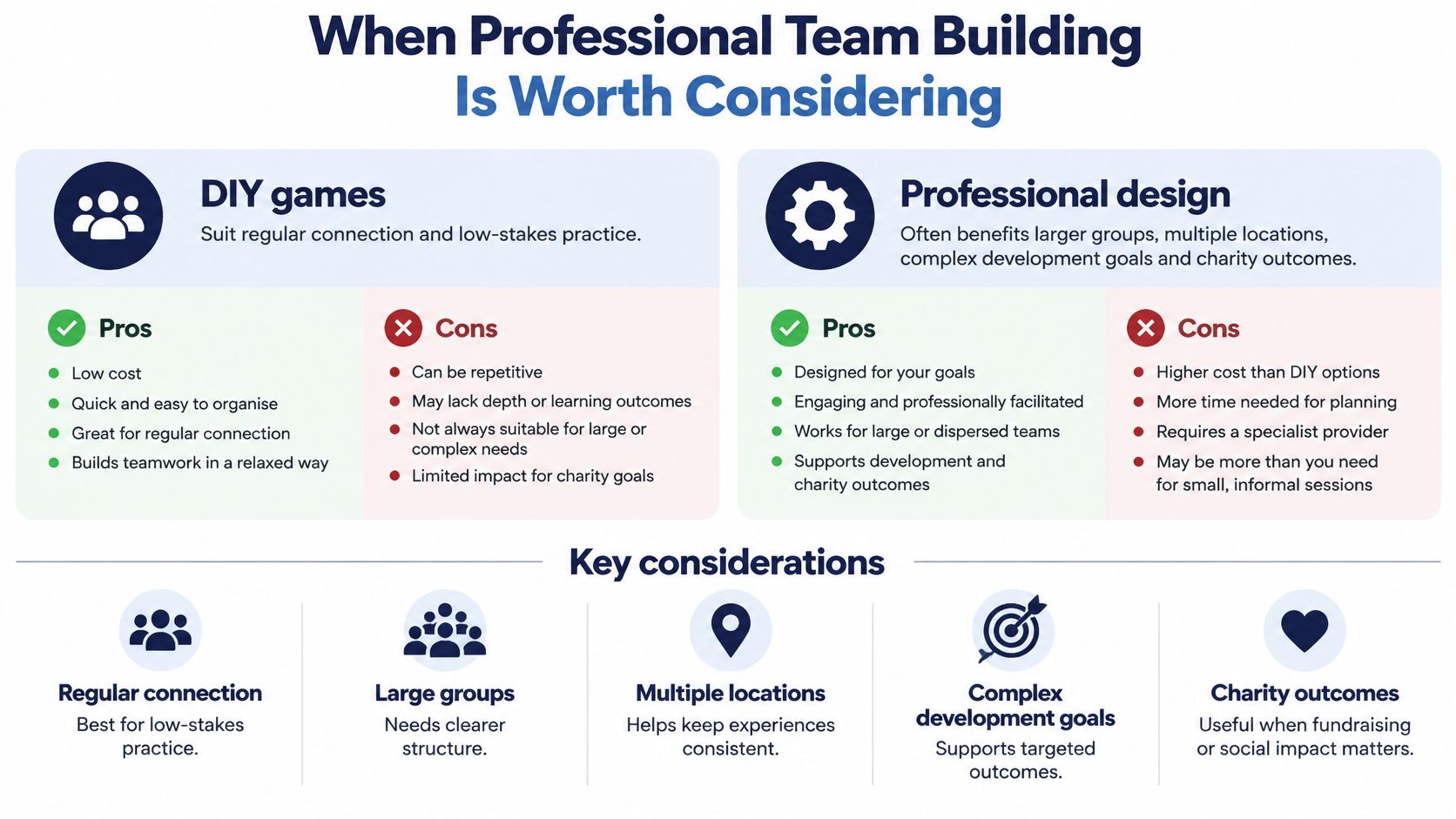
The beauty of DIY team building games is that anyone can organise them.
A five-minute challenge in a weekly meeting, a quick activity after lunch or a simple game at a team gathering can create moments of connection without a significant budget.
But sometimes your team needs more than a quick game.
Perhaps you’re bringing together 150 people at a conference, planning an event across multiple departments or looking for a meaningful way to celebrate an important milestone.
That’s where professional team building can make a difference.
At Corporate Challenge Events, we design facilitated experiences around the people participating and what you want them to experience together.
For teams looking for energy and laughter, programs such as Minute to Win It and Survivor introduce a mix of playful challenges and friendly competition.
For teams that enjoy exploration, City Scramble brings discovery, strategy and teamwork into a shared experience.
Our charity team building programs offer another approach, with teams collaborating to create something meaningful for people in their community.
And where the objective is to explore communication, different working styles or team development, we can recommend a facilitated workshop.
The distinction isn’t simply DIY versus paid. It’s about choosing the right level of experience, planning and facilitation for your team.
If you’re uncertain, our guide to choosing between a team building activity or workshop explores the differences.
Planning a larger offsite?
Venue choice matters too. Space, accessibility, weather conditions, equipment and the surrounding environment all affect what you can deliver.
A practical corporate retreat planning checklist can help organisers prepare for a larger event.
Even when comparing venues further afield, such as retreat facilities in New Mexico, the same principles apply: choose a setting that supports the experience rather than trying to force an activity into an unsuitable space.
How to Keep the Benefits Going After the Game
A great team building game can create laughter, a shared memory or an unexpected moment of connection.
That’s valuable in itself. But sometimes there’s an opportunity to build on what happened.
Maybe your team discovered that a simple planning conversation would have saved ten minutes of confusion. Perhaps someone demonstrated a strength that colleagues hadn’t recognised. Or maybe people simply enjoyed spending time together without talking about deadlines.
If something useful emerged, take a few minutes to discuss it.
You could ask:
-
What did we enjoy most?
-
Did anything surprise us?
-
What helped us work together?
-
Is there something we’d like to try again at work?
You don’t need to turn every game into a serious workshop. Sometimes the goal really is just to have fun together.
But if you want to continue the connection, try adding short moments of play to regular team meetings or creating an ongoing team challenge.
Our guide to making team-building benefits last explores how teams can carry useful learning into everyday work.
And if you’d like more ideas, CCE’s free Periodic Play Gift Pack includes six ready-to-use activities, the Connection Deck and other resources to help you bring play into the working week.
Frequently Asked Questions About Team Building Games
What are the best team building games for work?
The best games depend on your team’s size, interests and purpose. For quick connection, try Have You Ever or the Connection Deck Challenge. For problem-solving, Fifteen Puzzle and Traffic Jam are good options. For communication and creativity, Mr Squiggle is a favourite.
What are some five-minute team building games?
Expert Round and a short Connection Deck Challenge can both be completed in around five minutes. They’re simple options for starting a meeting or bringing colleagues together without extensive preparation.
What are some fun indoor team building games?
Indoor favourites include Tower Build, Mr Squiggle, Fifteen Puzzle, Working Style Mapping and The Worst Idea Wins. Most require only basic equipment and can be organised in a meeting room or conference space.
How do you make team building games inclusive?
Offer different ways to participate, consider mobility and communication preferences, and avoid activities that require everyone to perform or compete in the same way. Choice and a supportive environment help people engage comfortably.
What team building games work for large groups?
Games such as Human Map, Have You Ever and Street Scrabble can be adapted for larger groups. For more complex events, professionally facilitated programs can help coordinate activities, equipment, timing and team rotations.
Ready to Get Your Team Playing?
You don’t need a complicated plan to bring a little more play into the workplace.
Start with something simple. Pick a game your team might enjoy, make room for different people to contribute and see what happens.
You might discover a new side to a colleague, find an unexpected solution to a challenge or simply enjoy doing something different together.
And if you’re ready to take things further, Corporate Challenge Events can help you create a bigger experience.
With more than 30 years of experience delivering play-based team building across Australia and New Zealand, we offer everything from conference energisers and creative challenges to charity experiences and team development workshops.
Explore our team building programs or speak with one of our Play Specialists about creating an experience your team will genuinely enjoy.