A Sydney team leader often starts in the same place. The budget is approved, the calendar is tight, and the brief sounds simple enough: bring people together, make it worthwhile, and avoid another event that feels disconnected from real work or real impact.
That's why corporate volunteering in Sydney keeps coming up in planning conversations. It promises more than a social outing. It offers a way to support the community while strengthening team connection, shared purpose, and pride in the organisation. The problem is that good intent doesn't remove operational pressure. A traditional volunteer day can be difficult to source, coordinate, scale, and adapt to a mixed group with different abilities, schedules, and expectations.
A stronger approach is to treat volunteering as a structured team experience, not just a generous idea. For teams comparing offsites, CSR activations, conference breakouts, and culture initiatives, the practical question isn't whether giving back is valuable. It's whether the format is realistic to run well.
Table of Contents
The Search for More Meaningful Team Events
Sydney workplaces aren't short on activity ideas. What many teams lack is a format that feels useful on the day and credible afterwards. People & Culture leaders, office managers, and EAs often need an event that supports connection, fits the schedule, and leaves the team feeling that the time and budget served a purpose beyond attendance.
That's where corporate volunteering Sydney searches tend to begin. The intent is clear. Teams want workplace-supported volunteering or community contribution that aligns with company values and creates a stronger internal experience at the same time.
Good intent often stalls at the planning stage
Traditional volunteering can look straightforward until the organiser starts checking practical details. Is the charity set up for corporate groups. Can it host the required headcount. Is the work suitable for a conference venue, a half-day offsite, or a mixed-mobility team. Will the activity feel meaningful rather than passive.
For leaders building or refining company volunteer programs, the challenge usually isn't commitment to the idea. It's converting that intent into a format that can be booked, explained internally, and delivered without creating a heavy coordination load.
Practical rule: If the organiser has to build the experience from scratch, the event usually becomes harder to approve, harder to scale, and harder to repeat.
A more workable model for busy planners
A structured charity team building format closes that gap. Instead of arranging a full volunteer placement, the organiser can choose a facilitated experience with clear timing, defined outputs, and a direct community benefit. That's often a better fit for conference agendas, leadership offsites, and company-wide culture days.
Teams exploring charity team building programs in Australia often find that this model solves two problems at once. It creates a shared team experience people actively participate in, and it reduces the operational friction that derails many traditional volunteering plans.
Why Sydney Teams Want More Than Just a Day Out
The shift towards more purposeful team events isn't just a response to CSR language. It reflects a broader workplace expectation that team time should build culture, strengthen connection, and contribute to something concrete. In Sydney, where teams are often spread across functions, working styles, and locations, that expectation is even sharper.
A social event can still have a place. But many organisations now want something with organisational weight behind it. They want people to leave with stronger relationships, a clearer sense of shared values, and visible evidence that the company's actions match its internal messaging.
Corporate volunteering is already a mainstream workforce practice
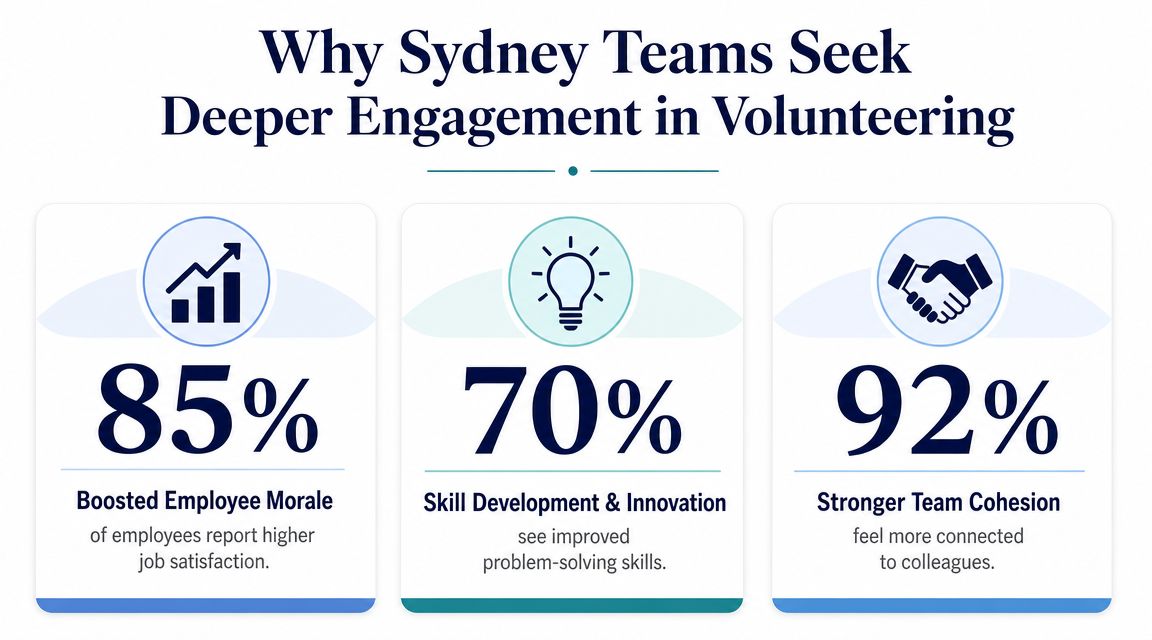
This isn't a fringe idea. A major Australia-wide snapshot found that, 78% of companies had a corporate volunteering program and 15% of employees participated, translating to about 1 million volunteering hours, according to Volunteering Research papers on corporate volunteering policy and practice.
For HR and People & Culture teams, that changes the frame. Corporate volunteering doesn't sit outside workforce strategy. It can function as part of engagement, employer brand, culture, and CSR in a disciplined way.
Why purposeful formats outperform generic outings
The strongest team experiences give people more than a break from the office. They create a task that requires contribution, a reason to collaborate, and an outcome that people can point to afterwards. That's different from entertainment for its own sake.
Well-designed volunteering formats can support:
Team pride: People often respond well when the company backs a cause in a visible, practical way.
Connection across roles: Shared tasks can cut through hierarchy and function more effectively than a standard meeting or meal.
A clearer culture signal: The event shows what the organisation values when it chooses to invest time together.
Australian guidance also points to a broader organisational payoff. Volunteering Australia's snapshot reports benefits that include improved staff morale, motivation, team spirit, initiative, better cross-functional relationships, stronger attendance, and improved recruitment and retention, while recommending deeper engagements aligned to professional development and community need.
Purpose matters, but design matters more. The activity has to support both the community outcome and the team outcome.
For Sydney organisers balancing culture and practicality, the most useful ideas are usually the ones that can sit comfortably inside a broader offsite or conference plan. That's why many planners also compare volunteering options with broader team building ideas in Sydney before deciding what format will carry the most value.
The Logistical Challenges of Traditional Volunteering
A lot of corporate volunteering plans don't fail because the cause is wrong. They fail because the operating model is awkward.
Traditional volunteering often assumes the host charity has the capacity, timing, supervision, safety processes, and physical space to absorb a corporate group. That can work well in some cases. It becomes much harder when the group is large, the event needs to fit a half day, or the team includes a wide mix of comfort levels, physical abilities, and work styles.
The hidden work behind a volunteer day
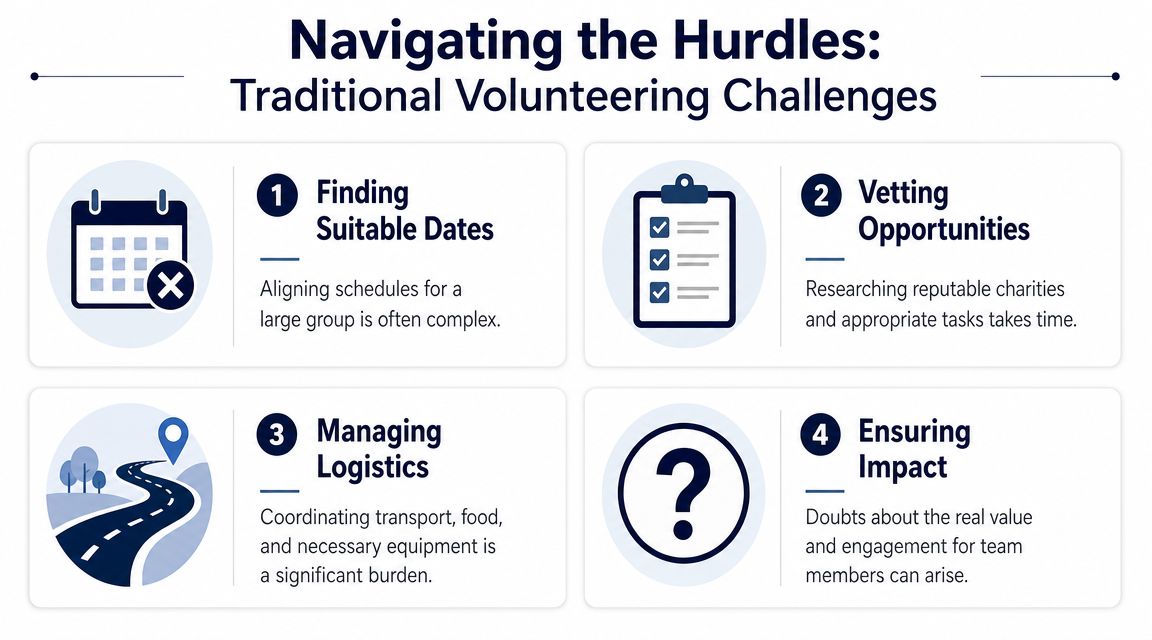
On paper, a volunteering day sounds simple. In practice, the organiser often needs to handle provider research, stakeholder approval, venue compatibility, transport, timing, participant communications, dietary and accessibility considerations, weather planning, and impact explanation.
That's before the team even arrives.
Public Sydney program listings show why this becomes difficult. Operational details vary widely. Some programs are capped at 30 participants, while others are limited to weekly schedules or fixed fees such as $3,700 + GST, according to Sydney corporate volunteering listings. For a busy planner, that inconsistency makes early comparison harder than it should be.
Where traditional formats often break down
A direct volunteer placement can be valuable, but there are predictable friction points:
Scale issues: A charity may welcome a small group but struggle with larger corporate headcounts.
Timing constraints: Some opportunities only run on fixed days, which clashes with conference or leadership calendars.
Travel load: Getting a team across Sydney can absorb time that would otherwise go into the experience itself.
Inclusion concerns: Outdoor, physical, or task-specific roles won't always suit every participant.
Risk and supervision: The organiser has to be confident the activity is safe, appropriate, and well-managed.
Operational insight: The event isn't only being judged on goodwill. It's being judged on punctuality, clarity, accessibility, and whether the organiser made good use of everyone's time.
The venue question is often underestimated
Many corporate teams want an experience that works at their office, hotel, or conference site. Traditional volunteering doesn't always flex that way. If the activity can only happen at a charity location or outdoor site, the event starts carrying more dependencies. Venue suitability, setup, equipment, and participant flow all become relevant.
That's why planners often assess volunteering options with the same lens they'd apply to any offsite format, including guidance on what to look for in a team building venue. Once volunteering is viewed as an event delivery challenge as well as a CSR activity, the barriers become easier to spot early.
Solving the Puzzle with Charity Team Building
A facilitated charity team building model works because it changes the organiser's job. Instead of sourcing a volunteer placement and stitching together the experience, the organiser books a structured program designed for corporate groups from the outset. The task, materials, timing, facilitation, and community pathway are already built in.
It turns a difficult coordination exercise into a manageable event format.

What this format looks like in practice
The best charity team building programs create a clear shared activity with a tangible output. That might mean building bikes for children, packing care kits, assembling practical resources for community groups, or completing hands-on challenges tied to a charity partner.
The team doesn't need to wonder what their effort produced. They can see it.
This model also works well for mixed groups because the experience is designed around participation, not just labour. People can contribute through planning, assembly, quality checks, communication, or problem-solving, which usually creates a more balanced team dynamic than a narrow volunteer task.
Why play improves participation
Play has an important role here, especially in workplace volunteering. It lowers the social barrier to joining in, reduces self-consciousness, and helps people interact as humans rather than job titles. In a charity context, that doesn't weaken the seriousness of the cause. It often improves the quality of participation.
A play-based structure can support:
Faster trust-building: People engage more easily when the activity has movement, creativity, or light competition.
Higher participation across personalities: Structured interaction makes it easier for quieter team members to find a role.
A less transactional feel: The event becomes a shared experience, not just a task to complete and photograph.
One practical option in this space is Corporate Challenge Events' charity program planning guide, which outlines how facilitated formats can fit conferences, offsites, and workplace events without requiring a full volunteer placement.
Why structured delivery is easier to repeat
Repeatability is where many CSR ideas either mature or disappear. A one-off event might feel successful, but if the process was painful to organise, it won't become part of the company's culture rhythm.
Structured charity team building is easier to rebook because the operating model is cleaner. Providers typically define the run sheet, materials, facilitation, and beneficiary pathway in advance. Supporting admin can also be simplified through practical tools such as VeeForm's donation form templates when a team needs a clearer way to manage contribution details or related internal workflows.
A volunteering format becomes strategically useful when it's simple enough to run again and strong enough to justify doing so.
How to Choose the Right Corporate Volunteering Program
The right program isn't the one with the nicest description. It's the one that fits the team, the event constraints, and the type of impact the organisation wants to make.
Sydney options can include direct-service charity work, environmental restoration, and cultural or parkland projects. The more useful question is which model aligns with the company's objective. The impact-quality question is essential because different formats support different CSR outcomes, as reflected in Sydney volunteering opportunities that span community, environmental, and cultural projects.
The criteria that actually shape the decision
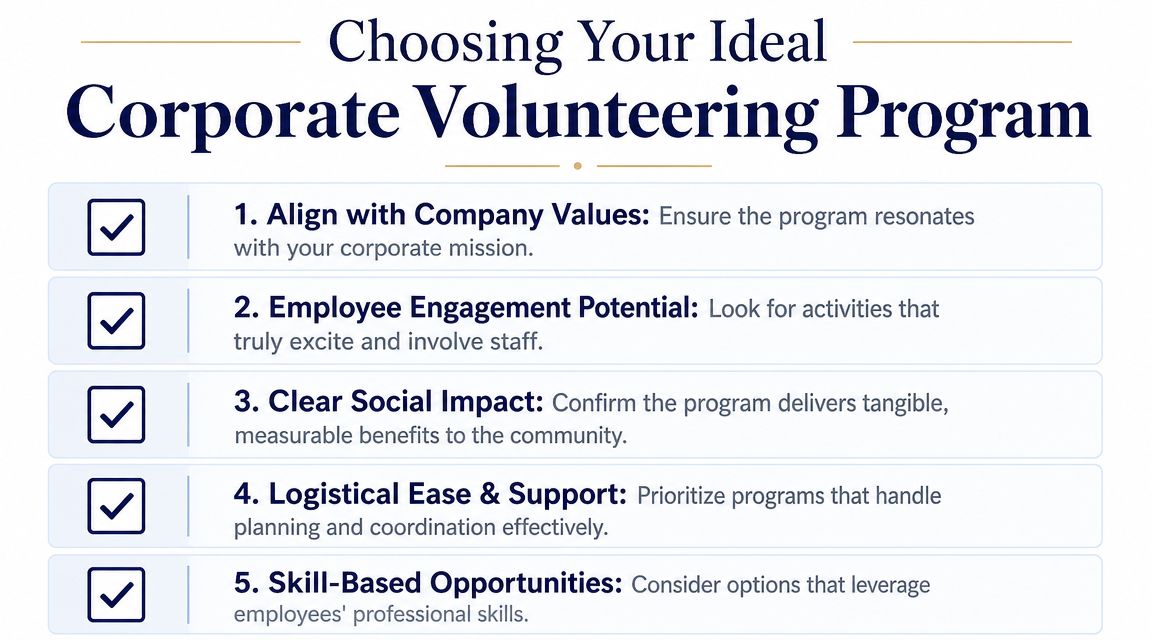
A practical decision starts with operational fit. These are the filters that usually matter most:
| Criteria | What to check |
|---|---|
| Group size | Can the program accommodate the full team without splitting the experience awkwardly. |
| Time available | Does it suit a half-day, conference breakout, or short activation window. |
| Location | Is it onsite, offsite, or mobile enough to work at the chosen venue. |
| Accessibility | Can people with different physical abilities and comfort levels participate fully. |
| Physical intensity | Does the activity suit the energy and capability of the group. |
Then test for strategic fit
Once the logistics work, the program still needs a reason to exist inside the organisation.
Charity alignment: The cause should make sense for the company's values, people strategy, or CSR priorities.
Facilitation needs: Some teams need a high-energy guided experience. Others need something calmer and more reflective.
Desired team outcome: Decide whether the event is meant to build trust, cross-functional connection, morale, or a stronger shared identity.
Tangible community impact: Participants should understand what they contributed and who benefits.
A useful internal discipline is to write the event brief in one sentence before speaking to providers. If the team can't state what success looks like, the provider can't design for it.
Selection test: If a program sounds meaningful but the organiser still can't explain who it suits, how it runs, and what the team will take back to work, it isn't ready to book.
For organisations trying to make those choices more consistent, it helps to use a CSR lens rather than just an event lens. A simple starting point is this guide on choosing a charity partner that aligns with your CSR framework.
Your Pre-Booking Checklist for Volunteering in Sydney
A good provider conversation starts with better internal questions. When planners ask precise questions early, they get cleaner proposals, fewer surprises, and a stronger event brief.
The checklist below helps teams pressure-test a corporate volunteering Sydney option before committing budget and calendar space.
Questions worth answering internally first
What cause does the team want to support
A broad desire to give back isn't specific enough. Choose whether the focus is community service, practical support, environmental outcomes, or another defined area.Does the event need to be onsite or offsite
Venue flexibility changes the shortlist quickly. If the activity must run at the office or conference venue, remove options that rely on travel-heavy placement models.How many people need to participate
Don't assume every provider can handle the same group size smoothly. Full participation should be designed, not improvised.What team outcome matters most
Clarify whether the organisation wants connection, morale, collaboration, cross-functional mixing, or a stronger values signal. Different formats support different outcomes.
Questions to ask the provider
A strong provider should be able to answer these without vagueness:
How will the impact be explained to participants
People engage more meaningfully when they understand the beneficiary, the purpose of the task, and the pathway from activity to outcome.How will the experience stay inclusive
Ask how the format supports different personalities, physical capacities, and comfort levels.What does the run sheet look like
The organiser needs clarity on timing, setup, facilitation, pack-down, and any venue requirements.What will the team take back to work
The answer shouldn't only be that they did something good. It should include what the experience reinforces inside the team.
Signs the program is likely to work
The strongest options usually have three characteristics. They are easy to understand, easy to participate in, and easy to justify internally after the event. If any one of those is missing, friction tends to show up somewhere else.
A well-chosen program gives the team a genuine shared memory, a visible contribution, and a format that doesn't punish the organiser for trying to do something meaningful.
Corporate Challenge Events delivers charity team building and corporate volunteering-style experiences in Sydney that help teams connect, contribute and create lasting impact through play based team building.