
Team building did not begin with icebreakers, away days, or a last-minute conference activity. It began with a harder question. Why do capable people, placed in the same room with the same goal, so often produce uneven results?
That question sits underneath modern workplace frustration. A team can have smart hires, clear targets, and decent systems, yet still stall because people hesitate to speak, protect territory, misread conflict, or pull in different directions. The problem is rarely effort alone. It is the pattern of relationships inside the group.
That is why the history matters. Long before team building became shorthand for games and social events, researchers were studying how groups form norms, respond to pressure, share influence, and learn together. In other words, team performance was first treated as a science of human behaviour. A useful primer on that tradition sits in this overview of the science behind consistent team building.
For People and Culture leaders, executive assistants, office managers, and team leaders, this is more than background knowledge. It helps explain why a single activity rarely repairs a strained team. A workshop can create energy for an afternoon. Lasting improvement comes from addressing the mechanics underneath performance: trust, role clarity, communication habits, conflict, belonging, and shared expectations.
Group dynamics works like the hidden wiring in a building. If the wiring is sound, the visible systems work. If it is faulty, new furniture does not solve much.
Table of Contents
Team Building Began as a Science Not an Activity
The common picture of team building is too narrow. It suggests that teams improve because people spent an afternoon together doing something light, energetic, or unusual. Sometimes that helps. Often it doesn't, especially when the activity has no link to how the team works.
Group dynamics is the more useful starting point. It describes the invisible forces inside a group that shape results: who speaks first, who stays quiet, who influences decisions, how conflict is handled, whether people feel safe to disagree, and how quickly a group settles into habits.
A leadership team can have strong technical capability and still underperform because its group dynamics are off. Meetings become repetitive. Decisions drift. A few voices dominate. Tension gets disguised as politeness. Nothing looks dramatic on paper, but the team stops learning.
Practical rule: If a team problem keeps showing up in communication, meetings, accountability, or conflict, it's usually a group dynamics problem before it becomes a performance problem.
The best modern approaches still come back to the same question researchers asked decades ago: how do people behave when they have to work together under pressure, uncertainty, and shared responsibility?
For leaders looking at team building through a more evidence-led lens, the science behind consistent team building offers a practical way to connect culture work with day-to-day team performance.
The First Workplace Questions About Productivity
The history of group dynamics didn't begin in an offsite venue. It began in factories, research centres, and training rooms where organisations were trying to understand productivity in human terms rather than mechanical ones.
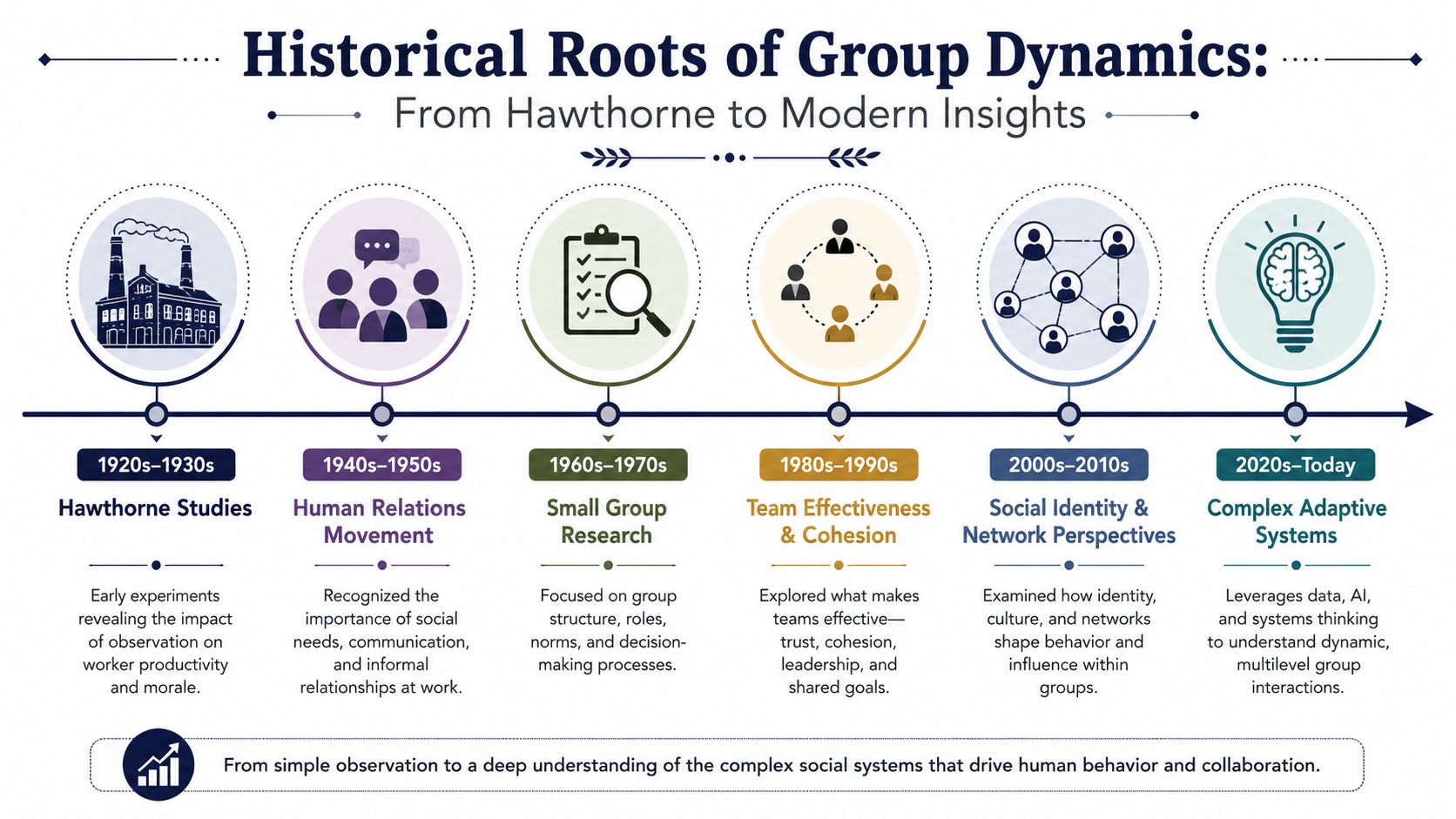
What the Hawthorne era changed
The Hawthorne Studies, conducted at Western Electric's Hawthorne Works between 1924 and 1932, asked a deceptively simple workplace question: what affects output?
Their methods and interpretations have been debated for years, but their legacy still matters. They helped shift management thinking away from a narrow focus on physical conditions alone and toward the social side of work. In plain English, leaders started paying more attention to the fact that people don't perform in isolation. They respond to attention, relationships, expectations, and the norms of the group around them.
That change in focus was significant. It moved workplace thinking from “how do we control the environment?” to “how do people behave together inside the environment?”
Lewin made groups observable
The next leap came from Kurt Lewin, who helped establish group dynamics as a serious field of study. Lewin founded the Research Center for Group Dynamics at MIT in 1945 and focused on questions that still shape organisational development now: group productivity, communication, leadership, group membership, and change.
What made Lewin so influential wasn't only the research itself. It was the idea that groups could be studied, understood, and improved. Managers no longer had to treat teamwork as a mystery or a personality issue. They could look at patterns.
A project team, for example, might struggle because responsibilities are vague. Another might struggle because one senior person shuts down challenge. Another might be full of capable people who never build enough trust to test ideas openly. Lewin's contribution gave organisations permission to treat those patterns as workable problems.
A useful modern extension of that thinking appears in this guide on what makes a good team, which connects structure, communication and trust in practical workplace terms.
T-groups
From Lewin's work came T-groups, or training groups, which influenced management development and experiential learning. Their method was simple in concept and confronting in practice. People learned about teamwork by interacting in real time, noticing what happened in the room, receiving feedback, and reflecting on their own behaviour.
That approach shaped much of what later became leadership workshops, facilitated team sessions, and modern team development programs. Instead of teaching teamwork as a theory only, T-groups treated the group itself as the classroom.
A team doesn't learn collaboration by hearing a lecture about collaboration. It learns by collaborating, noticing what helps, and adjusting together.
That principle still underpins the strongest team building design today. The form has changed. The venues are different. Hybrid work has added complexity. But the learning mechanism remains familiar: real interaction, useful feedback, shared reflection, and clearer patterns of behaviour.
Mapping the Team Journey with Tuckman's Stages
A team rarely starts as a team. It starts as a collection of individuals, each carrying private assumptions about authority, effort, risk, and what good work looks like. Bruce Tuckman gave managers a practical way to understand that progression in his 1965 paper, Developmental Sequence in Small Groups, by describing the now-familiar stages of forming, storming, norming, and performing. He later worked with Mary Ann Jensen to add adjourning, which recognised that many groups end, reset, or hand work on rather than continue indefinitely.
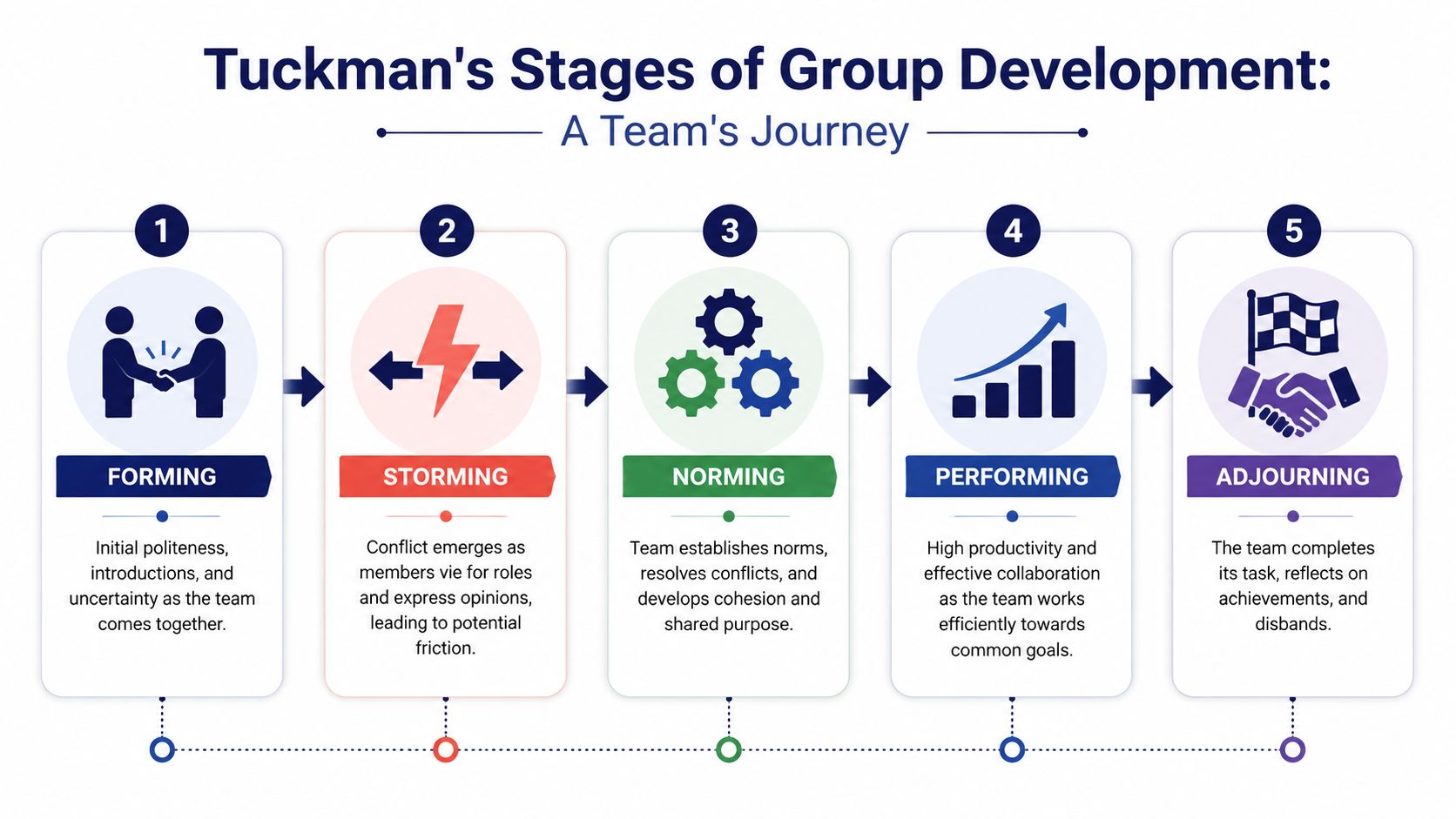
A map, not a script
What made Tuckman's model stick was its usefulness. Managers could finally describe what they were seeing without treating every awkward meeting as a sign of failure. A new project team that feels hesitant is not necessarily disengaged. A team that starts arguing after two calm weeks is not automatically off track.
The stages work like a map of a journey. A map helps you recognise where you are and what usually comes next. It does not promise a straight road, and it does not mean every team travels at the same speed.
A practical reading of the stages looks like this:
Forming is the arrival point. People are polite, careful, and often more observant than honest. They are testing the waters. Who decides? What matters here? What happens if I disagree?
Storming is where the core work of difference begins. Priorities clash, styles grate, and unclear roles become visible. This stage can feel messy because the team has stopped acting and started revealing itself.
Norming develops when the group turns repeated friction into shared habits. Members begin to understand how to communicate, how to make decisions, and what standard of behaviour the group will accept.
Performing happens when trust, clarity, and coordination are strong enough that attention shifts from managing relationships to delivering work well.
Adjourning matters because endings teach too. Project teams close, leaders change, restructures happen, and people carry lessons, good or bad, into the next group they join.
This remains one of the clearest ways to explain team dynamics at work because it helps leaders diagnose behaviour in context rather than judge it too quickly.
The stage leaders misread most often
Storming is the stage many workplaces mishandle.
Senior leaders often prefer early harmony because harmony looks efficient. Meetings run on time. Few people push back. Decisions appear easy. But surface calm can hide uncertainty, caution, or status anxiety. Then conflict appears, and someone concludes that the team has become dysfunctional, when the opposite may be true. The team may only now be honest enough to deal with real differences.
That matters in modern organisations where collaboration is expected but disagreement is often poorly handled. Product teams debate deadlines. Executive groups pull in different strategic directions. Hybrid teams misread tone and intent. In each case, the question is not whether friction exists. The question is whether the group can use it to improve thinking.
A short diagnostic helps:
| Stage signal | What leaders often assume | What may actually be happening |
|---|---|---|
| Polite meetings | The team is aligned | People may still be withholding views |
| Rising disagreement | The team is unstable | Members are testing boundaries and roles |
| Better rhythm | Problems are gone | Norms are becoming clearer |
| Smooth delivery | The team is “finished” developing | Ongoing support still matters |
The practical lesson is simple. Team development is not a soft-side extra to bolt on after core work. It is part of core work. Tuckman helped leaders see that performance grows through stages, and later research on psychological safety would help explain why some teams move through those stages with more candour, learning, and resilience than others.
How Psychological Safety Redefined Teamwork
Late twentieth-century research changed the conversation again. Earlier models explained how teams form and develop. Amy Edmondson's 1999 research on psychological safety clarified why some teams learn faster, recover better, and contribute more openly than others.
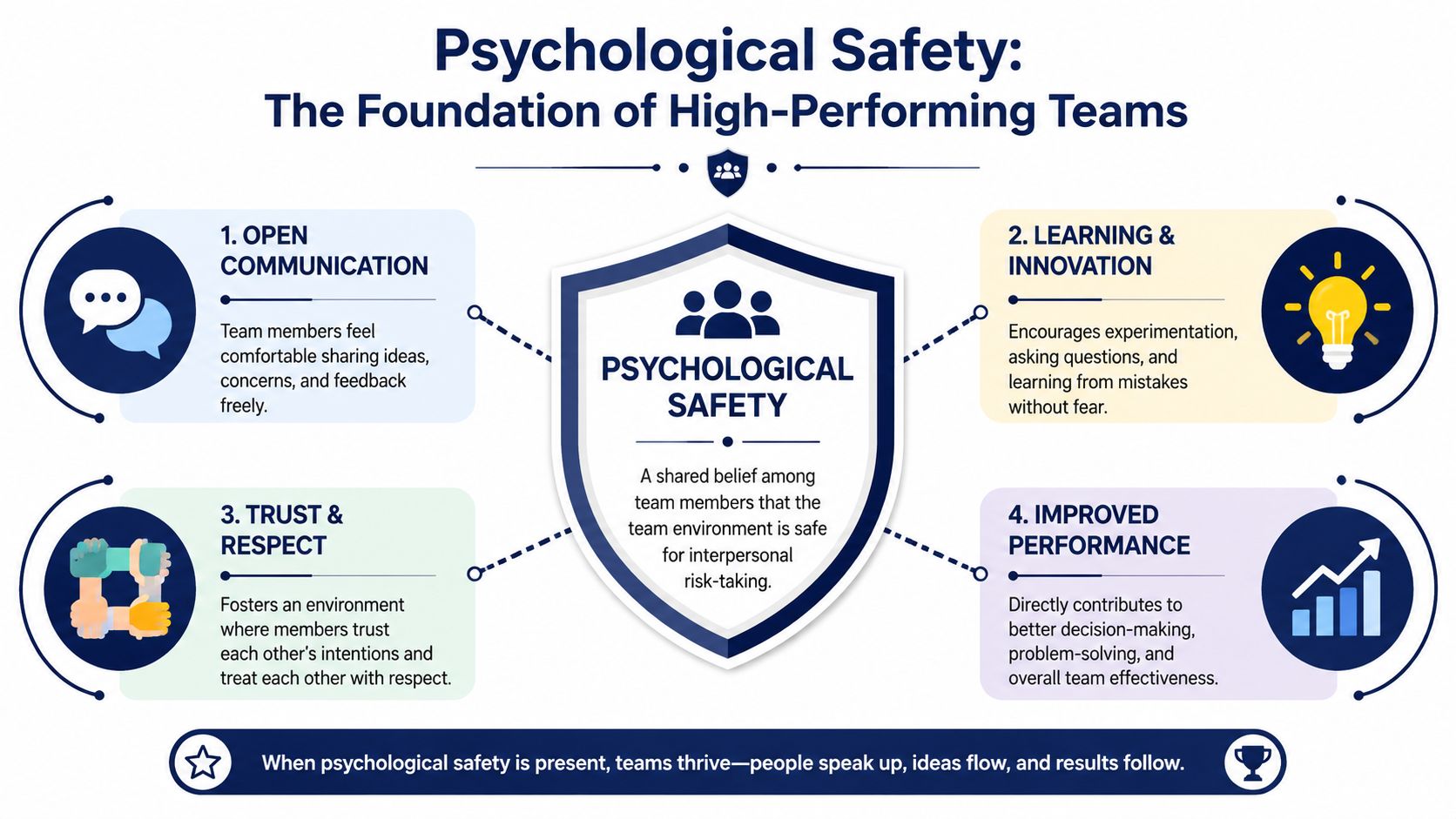
What psychological safety means at work
Psychological safety is commonly understood as a shared belief that the team is safe for interpersonal risk-taking. In workplace language, that means people believe they can ask a basic question, raise a concern, challenge an idea, admit a mistake, or offer a different view without being punished, embarrassed, or sidelined.
That definition sounds simple, but it changed how leaders think about performance. A quiet team may not be calm. It may be careful. A compliant team may not be aligned. It may be self-protective.
For readers who want a plain-English explanation of psychological safety, that resource gives a useful overview of the concept and why it affects contribution.
Why speaking up changes performance
Teams cannot learn from what people are afraid to say.
That's the practical heart of psychological safety. When people stay silent, leaders lose access to weak signals, early warnings, dissenting views, and new ideas. Errors travel further. Assumptions remain untested. Meetings become a performance instead of a working session.
A psychologically safer team usually shows a different pattern:
Questions surface earlier because people don't need to protect an image of competence.
Mistakes are easier to correct because the team can discuss them directly.
Ideas improve faster because challenge is treated as contribution, not disloyalty.
Inclusion becomes behavioural because more people participate.
Leadership cue: If only confident or senior voices speak freely, the team may have trust but still lack psychological safety.
This is why modern team building can't stop at rapport. Bonding helps, but it doesn't automatically create the conditions for honest contribution. The practical challenge is to build environments where participation feels safer and more useful. For leaders focused on that shift, building trust in teams is one part of the broader work.
The Evolution from Research into Activities
Once organisations began to understand communication, group development, feedback, and trust more clearly, those ideas started moving into practice. That's where the history of team building starts to resemble what many workplaces recognise today.
How theory moved into practice
Organisational development translated research into experiences. Leadership programs used simulations. Retreats used problem-solving tasks. Facilitators designed communication exercises that helped teams notice patterns under pressure. Outdoor challenges became popular because they disrupted routine and made group behaviour easier to see.
The underlying logic was sound. If teams learn through interaction, then a well-designed shared experience can reveal habits that ordinary meetings hide. A senior leader who dominates discussion in the boardroom may do the same in a planning challenge. A team that avoids conflict at work may also avoid hard decisions in a timed scenario. Activities became a mirror.
That's why team building, at its best, was never separate from team development. It was applied group dynamics.
Where team building lost credibility
The reputation problem arrived when some organisations copied the form and lost the purpose.
An activity-first approach tends to fail in a few familiar ways:
No clear team need means the event may be enjoyable but irrelevant.
Forced participation creates compliance rather than commitment.
Weak facilitation leaves no room for reflection or transfer back to work.
Poor fit with culture can make people feel managed rather than engaged.
A finance leadership team preparing for a merger integration doesn't need random entertainment labelled as development. A newly hybrid department dealing with fractured communication doesn't need a generic away day with no follow-through. Leaders became sceptical for good reasons. They had seen team building detached from real organisational outcomes.
The lesson isn't that activities don't work. It's that activities only work when they are built around the actual team challenge.
Modern Team Building as Purposeful Experience Design
A lot of leaders still talk about team building as if it sits outside the core work. The stronger approach treats it as part of the work itself. It is experience design with a behavioural purpose.
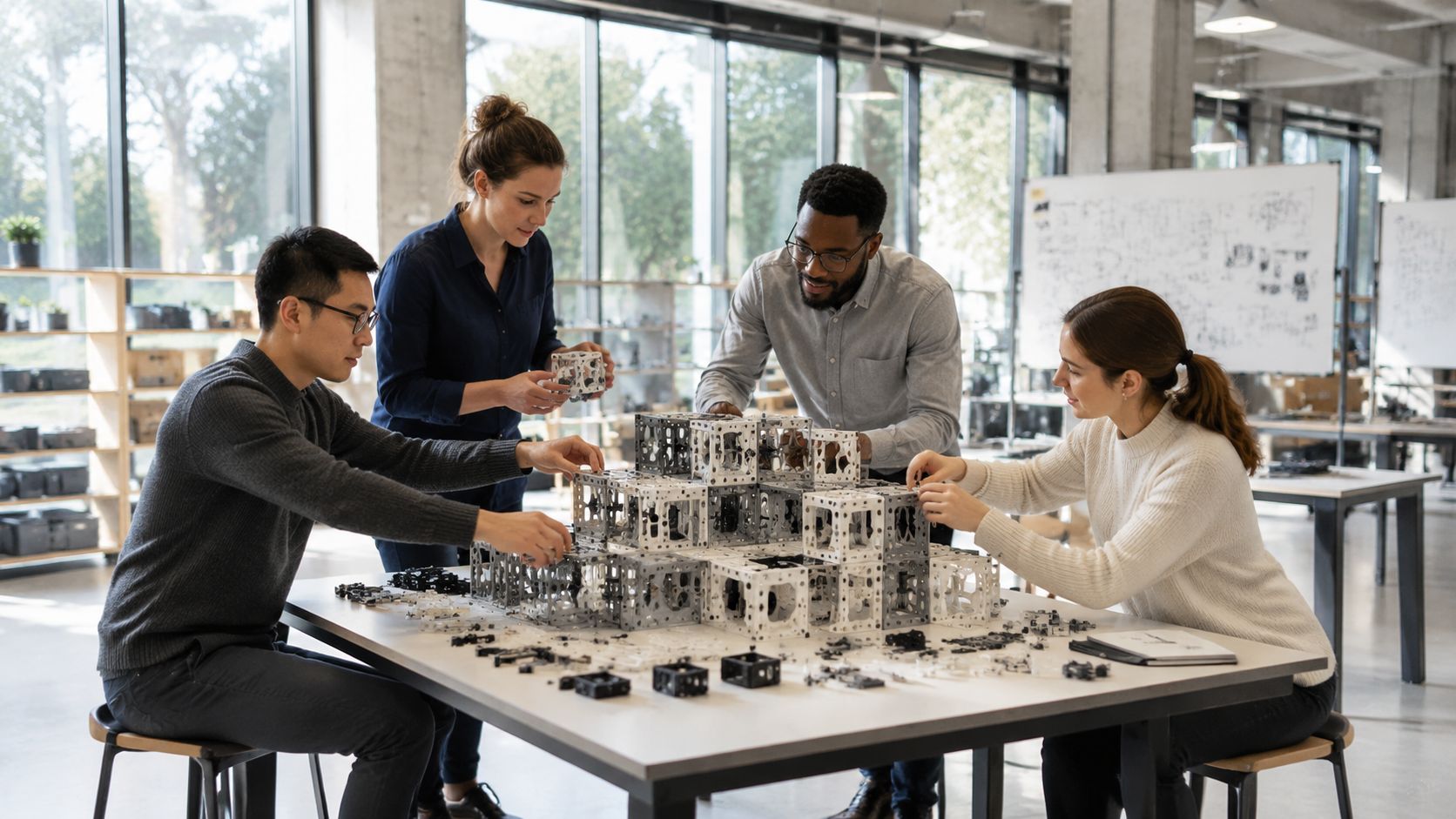
From events to designed learning moments
Modern teams rarely fail from a lack of information alone. They fail in the spaces between people. In a hybrid project team, for example, deadlines can look clear on paper while hesitation, status differences, and weak handovers insidiously slow everything down. A well-designed team experience brings those patterns into the open, then gives people a safer way to practise better ones.
That is a very different brief from “let's organise something fun for the quarter.” A useful design process starts with diagnosis. What is happening in the team right now? Are people guarded after a restructure? Are functions cooperating politely while avoiding hard trade-offs? Has pressure drained energy to the point where every meeting feels mechanical?
The design should match the problem.
A planning lens for EAs, People and Culture teams, and event organisers often includes:
Current team condition. Choose a format that fits the group's energy, trust level, and working relationships.
Target behaviour. Decide what people need to practise together, such as clearer communication, faster coordination, or more candid discussion.
Participation design. Build for different personalities, confidence levels, and cultural preferences so contribution is shared rather than dominated.
Reflection and transfer. Create time to name what happened and agree how it will show up in meetings, projects, and day-to-day decisions.
Some event teams also find external resources useful when they're comparing formats for boosting team morale with events, especially when morale sits inside a wider engagement plan rather than as a one-off concern.
Where play based team building fits
Play-based team building makes more sense when you place it in that history. Early group dynamics researchers were trying to understand how people behave under shared conditions. Modern facilitators use structured experiences to let teams see those behaviours in real time. Play works a bit like a flight simulator for collaboration. The setting is lighter than the stakes of daily work, but the habits on display are often the same.
That is why a good play-based session can be so revealing. One person rushes to control the task. Another waits for permission to speak. A third keeps the group calm but never challenges a weak idea. In a normal meeting, those patterns can hide behind job titles and agenda items. In a purposeful activity, they become visible, discussable, and easier to change.
Used well, play does not treat adults like children. It gives adults a temporary environment where experimentation feels acceptable and small failures carry less social cost. That simple truth is learning in teams is not only cognitive. It is relational. People test whether they can speak plainly, disagree usefully, recover quickly, and stay connected while solving something together.
For organisations that want those experiences tied closely to performance goals, team building that aligns with business objectives gives a clearer strategic frame. Corporate Challenge Events is one example in this space, designing play-based workplace experiences around connection, communication, and shared problem-solving instead of activity for its own sake.
What This History Teaches Today's Leaders
Leaders often treat team problems as if they begin with poor results. The history of group dynamics points to an earlier starting point. Trouble usually starts in the small exchanges people barely notice at first. Who speaks with confidence. Who stays quiet. Which disagreement gets explored, and which one gets smoothed over too quickly.
Teams do not fail only through bad strategy. They also fail through repeated patterns of interaction that slowly narrow what the group can see and say.
The leadership lessons worth keeping
Across decades of research, a few lessons keep returning.
Shared work does not automatically create a real team. Interdependence can exist without trust, role clarity, or useful challenge.
Relationships shape performance. People hear feedback, pressure, and disagreement through the quality of their connection with others.
Shared goals are only the starting point. Teams also need shared experiences that teach them how to solve problems together under pressure.
Reflection changes behaviour. A team that never pauses to examine its habits usually repeats them.
Psychological safety affects contribution. People speak up more readily when the social risk feels manageable.
Play-based team building only works when it is designed with intent. The activity matters less than the behaviour it reveals and the conversation it supports afterwards.
A team is a little like a rowing crew. Giving everyone the same finish line does not guarantee rhythm. People also need timing, trust, and a way to correct course while moving.
Teams rarely improve because they hear another slogan about collaboration. They improve when collaboration becomes visible enough to examine and practise.
Social cohesion is not the same as task cohesion
Many leaders learn this the hard way. A team can be warm, supportive, and pleasant to work with, yet still miss deadlines, avoid accountability, and soften necessary debate.
Social cohesion is about connection. Task cohesion is about shared commitment to the work itself. Those two forms of cohesion often travel together, but not always. Friendly teams can protect harmony at the expense of clarity. Highly driven teams can hit targets while exhausting the people doing the work.
The practical lesson is simple. Do not mistake a good atmosphere for effective coordination.
Ask harder questions. Can people challenge a weak idea without damaging the relationship? Do priorities stay clear when pressure rises? Does the group recover quickly after conflict, or does it carry resentment into the next decision?
Those are the questions that connect the history of group dynamics to modern team building. The point is not to run an activity and hope morale improves. The point is to design experiences that let a team practise the behaviours its real work requires, then reflect on what happened while the lesson is still fresh.
For leaders, that shift is strategic. It turns team building from a calendar event into a way of shaping how people work together every day.
Corporate Challenge Events has been helping teams connect, communicate and perform through play based team building for more than 30 years, creating serious fun with lasting impact across Australia and New Zealand.