
Why do so many well-funded team initiatives produce a pleasant afternoon and almost no lasting change at work?
For many organisations, the answer isn't poor intent. It's a flawed assumption. Leaders often treat team performance as a cultural issue alone, as if better rapport, more social time, or another catered session will automatically create trust, candour, and collaboration. That view misses a harder reality. Teams don't perform well when people remain in a low-safety, high-vigilance state, and no amount of surface-level bonding fixes that.
A more useful way to think about what makes a good team is biological as well as cultural. When teams lack the conditions that switch people out of threat mode and into connection, curiosity, and adaptive thinking, the usual interventions underperform. Traditional workshops can still add value, but they often land on top of an environment where people are guarded, overloaded, and socially disconnected. In that state, teams can hear the right messages and still fail to behave differently.
Australian workplace leaders are increasingly looking for methods that change team dynamics in a way people can experience in meetings, projects, and day-to-day collaboration. That's where structured, outcome-led play has become more relevant than many leaders expect. It creates the conditions for trust and responsiveness to emerge, rather than demanding those behaviours from people who don't yet feel safe enough to offer them. A useful starting point is to look at how team bonding at work changes behaviour under pressure, not just how it lifts mood in the moment.
Table of Contents
Beyond Pizza Parties What Really Makes a Good Team
Most leaders already know what doesn't work. A lunch, a trivia round, or a one-off social event may create goodwill, but it rarely repairs weak collaboration, guarded communication, or fractured cross-functional relationships. Teams can be friendly and still ineffective. They can enjoy each other's company and still avoid hard conversations, hoard information, or stall when pressure rises.
That gap matters because many common definitions of a good team are incomplete. They focus on visible outcomes such as communication, trust, and shared goals, but they don't ask what allows those behaviours to happen consistently in the first place. A team doesn't become honest, adaptable, and resilient solely due to a leader saying those values matter. People have to feel safe enough to contribute, alert enough to engage, and connected enough to respond well to each other.
The problem behind the problem
The more useful diagnosis is often a play deficit. This isn't about entertainment or childishness. It describes a team environment where social attunement, shared energy, and low-stakes interaction have become so scarce that people remain overly procedural and overly defended. In that state, teams can look busy while operating with very little relational flexibility.
A team with a play deficit usually shows a familiar pattern:
Meetings stay polite: People agree quickly, then challenge decisions later in smaller groups.
Feedback gets delayed: Managers soften, postpone, or avoid useful correction because the environment feels brittle.
Collaboration becomes transactional: Teams interact when they must, not because trust makes cooperation efficient.
Change feels heavier than it should: Even sensible adjustments trigger resistance because the group has little adaptive capacity.
Teams don't usually fail because people forgot the value of trust. They fail because the environment never gave trust a fair chance to form.
What good teams do differently
Strong teams still need clarity, capability, and accountability. No play-based approach replaces those basics. But the best teams add something many corporate systems neglect. They create repeated moments where people coordinate, read each other accurately, recover from small mistakes, and build confidence through shared challenge.
That's why the conversation about what makes a good team has to move beyond morale tactics. Social time alone isn't enough. Generic “fun” isn't enough either. Leaders need interventions that change the team's operating state, not just its calendar.
A good team is usually marked less by constant harmony and more by three practical signals. People speak up earlier. They recover faster when work gets tense. They solve problems with each other instead of around each other.
The Biological Blueprint of a High-Performing Team
What allows one team to stay sharp under pressure while another becomes cautious, fragmented, and slow?
The answer is biological before it is cultural. Teams perform well when the brain can spend energy on judgement, learning, and coordination instead of scanning for social threat. That point gets missed in a lot of workplace advice. Leaders are often told to improve culture, communicate more clearly, or run another team-building session. Those steps can help, but they often fail because they do not change the team's underlying state.
A persistent play deficit sits at the centre of that problem. Adults do not stop needing play because they work in a corporate setting. They still need the kind of low-stakes, socially interactive challenge that helps the nervous system relax, read cues accurately, and build trust through action. Without it, teams can look functional on the surface and still remain biologically guarded.
The business effect is well established. Research cited by the Australian HR Institute on psychological safety links stronger psychological safety with higher innovation and lower turnover. The mechanism is straightforward. When people expect embarrassment, exclusion, or blame, the amygdala stays alert and the prefrontal cortex has fewer resources for reasoning, perspective-taking, and creative problem-solving. Corporate Challenge Events explains that same link in its article on how BDNF and play support workplace learning.
Trust starts in the nervous system
Trust is not built by intention alone. A team cannot collaborate well if each person is preoccupied with self-protection.
When the nervous system settles, people interpret tone more accurately, recover faster from friction, and contribute with less defensive filtering. That is why psychological safety works as an operating condition, not a slogan. It gives the brain access to the functions good teamwork depends on.
Leaders who understand this stop treating connection as a soft extra. They treat it as performance infrastructure. Repeated experiences of shared challenge, movement, humour, experimentation, and small social risk help teams build regulation together. Play matters here because it creates those conditions faster than discussion alone.
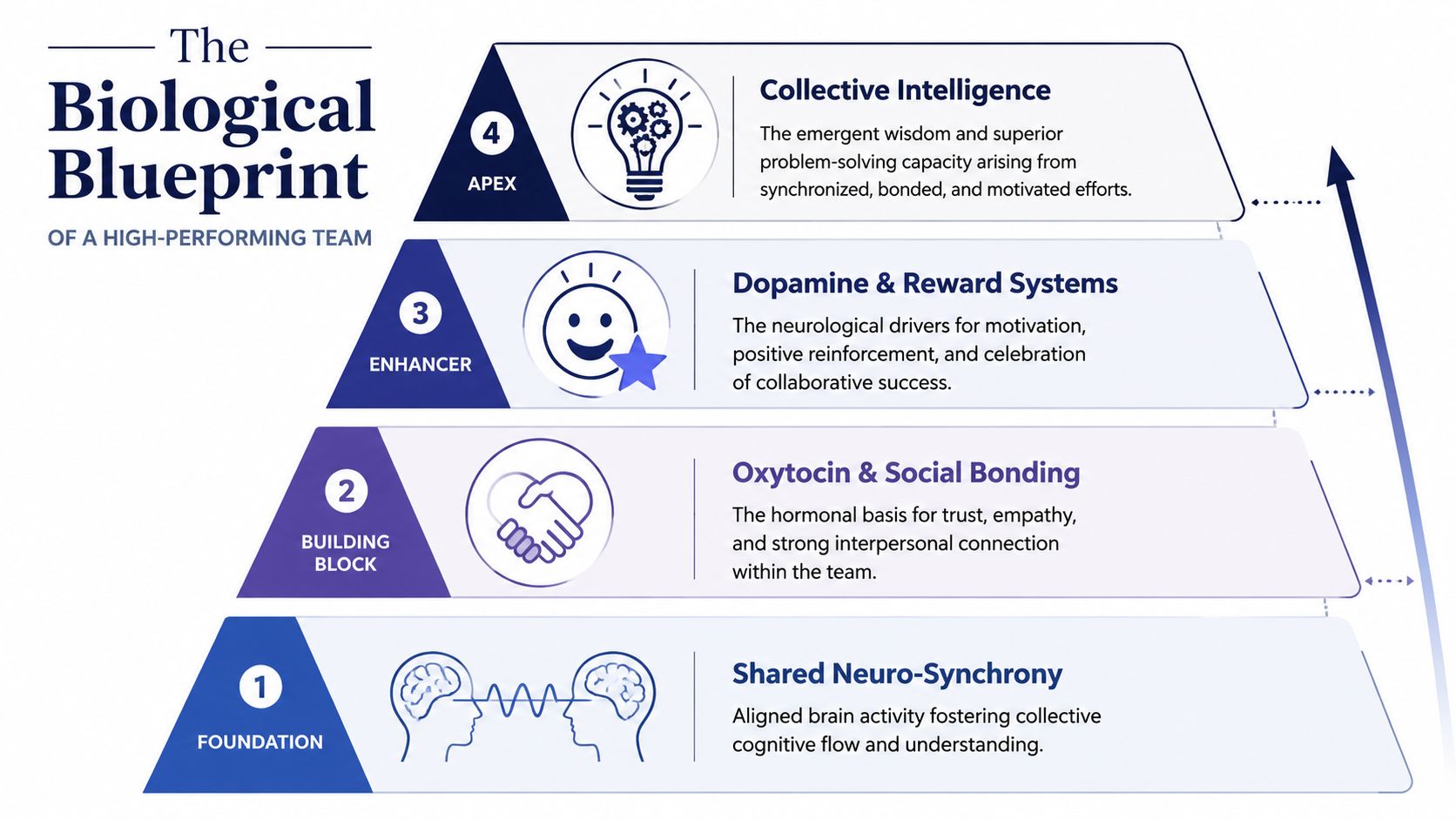
Four layers leaders need to build
The biological blueprint of a good team can be understood in four connected layers:
| Layer | What it looks like at work | Why it matters |
|---|---|---|
| Shared neuro-synchrony | People pick up each other's cues, pace, and intent with less friction | Coordination improves without constant clarification |
| Social bonding | Colleagues give each other the benefit of the doubt more often | Trust forms faster and conflict feels safer to address |
| Reward activation | Shared effort produces energy instead of depletion | Motivation becomes contagious across the group |
| Collective intelligence | The team solves problems better together than any one person can alone | Decisions improve under complexity and pressure |
These layers explain why some teams stay flexible during disagreement. Their members can stay socially connected while working through tension. Teams with a stronger play deficit often struggle here. They have not had enough repeated, low-risk opportunities to build synchrony, test trust, and experience challenge without penalty. Under pressure, that gap shows up as silence, defensiveness, over-explaining, or rigid positional debate.
Practical rule: If a team cannot stay regulated during disagreement, communication training on its own is unlikely to fix the problem.
That trade-off matters. Frameworks, role clarity, and manager training still have a place. I use them often. But teams get little value from those tools if the group remains biologically guarded. The better leadership question is more precise: what conditions help this team access the intelligence it already has?
How to Diagnose Team Dysfunction
Team dysfunction often gets misread as an attitude problem. Leaders see low energy, patchy accountability, or conflict avoidance and conclude that people aren't committed enough. Sometimes that's partly true. More often, the behaviour is a symptom of a team environment that has become overly guarded and under-connected.
That's why diagnosis should start with observation, not judgement. A good team audit looks for recurring patterns in real work. Meetings, handovers, project reviews, and cross-functional decisions reveal more than any values statement.
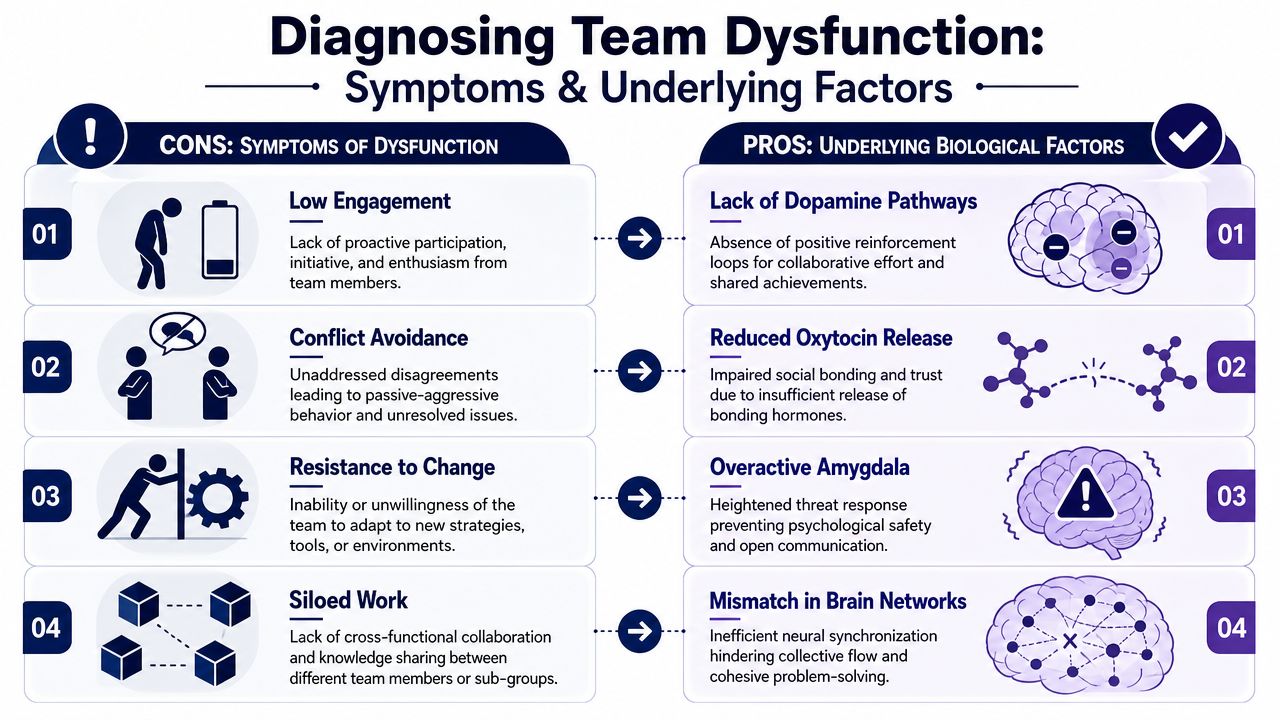
What dysfunction looks like in ordinary work
Australian workplace data gives useful context. A landmark AHRI study found that organisations with leaders who provide strong feedback achieve 8.9% higher profitability, while highly engaged teams see a 23% increase in profitability and a 43% reduction in turnover. Yet a Gallup Australia report found only 32% of Australian employees were actively engaged in their roles. Those figures appear in the earlier referenced Corporate Challenge Events research summary.
The numbers help, but the day-to-day signs are usually more revealing:
Low engagement in meetings: The same two or three people carry discussion while others contribute only when called on.
Conflict avoidance disguised as harmony: People say “all good” in the room, then raise objections privately after the meeting.
Siloed execution: Teams complete their piece of work but don't integrate well with adjacent functions.
Feedback bottlenecks: Managers either overcorrect publicly or avoid direct feedback until problems have compounded.
A leader looking at those symptoms shouldn't ask only whether people understand expectations. The better question is whether the team has enough trust, social ease, and shared energy to act on expectations in real time.
A practical audit for leaders
A simple diagnostic review can be run over two weeks without a formal consultant. It helps to examine behaviour across four moments:
Decision-making: Who speaks first, who speaks last, and whose view changes the outcome?
Pressure points: What happens when deadlines move or priorities clash?
Error handling: Does the team treat mistakes as useful information or social risk?
Recovery after tension: Can people reconnect quickly after disagreement?
A dysfunctional team often looks efficient on paper because people avoid visible friction. The cost appears later in slower decisions, rework, and quiet disengagement.
There's also value in checking for over-correction. Some teams react to stress by over-structuring everything. They add more meetings, more reporting, and more approval layers. That can create the appearance of control while draining the spontaneity and responsiveness that healthy collaboration needs.
The best diagnosis is specific. “Communication needs work” is too broad to be useful. “The team withholds dissent in senior-facing meetings and escalates concerns too late” gives leaders something they can design around.
Strategic Play A Practical Framework for Building Better Teams
Once leaders recognise a play deficit, the next step isn't to plan a more entertaining event. It's to use strategic play as a deliberate intervention. That means designing shared experiences that lower social threat, increase responsiveness, and create repeated moments of cooperative success.

What strategic play does differently
Strategic play works because it changes behaviour through experience, not instruction alone. In a well-designed challenge, people have to read cues, adapt quickly, test ideas, and recover from small failures together. That's very different from sitting through another session on collaboration while actual working habits remain untouched.
It also differs from generic social activities in one important way. The task has structure. There is a purpose, a shared objective, and enough challenge to reveal how the team operates under pressure without pushing people into shutdown.
What makes a good team takes concrete form. Good teams are not just teams that get along. They are teams that can coordinate under uncertainty, exchange feedback without threat, and build momentum from shared wins.
What works and what tends to fail
Leaders choosing play-based interventions should separate strategic design from casual entertainment.
What tends to work well
Purposeful challenge: Activities with a clear objective force teams to collaborate instead of merely co-attending.
Shared physical or cognitive effort: Teams bond faster when success depends on coordinated action.
Skilled facilitation: Debrief quality determines whether the experience transfers back to work.
Integration with leadership development: Organisations often pair team experiences with resources such as understanding performance coaching for teams so behavioural gains don't stay isolated to the event itself.
What often disappoints
Entertainment without reflection: People enjoy it, then return to the same habits on Monday.
Activities detached from business reality: If the challenge bears no relation to how the team works, transfer is weak.
One-size-fits-all design: A newly merged leadership group and an overstretched operations team usually need different interventions.
One practical option in this space is Corporate Challenge Events, which delivers play-based workplace programs such as charity builds, conference energisers, and problem-solving challenges. The relevance isn't the format alone. It's the use of structured play to improve connection, communication, and collaboration in corporate settings.
Play becomes strategic when leaders stop asking whether it's enjoyable and start asking what team behaviour it's designed to unlock.
Designing High-Impact Team Building Experiences
The most effective team-building experiences are chosen the same way good leaders choose any intervention. They start with the problem. A team that needs sharper collaboration under pressure won't necessarily benefit from the same format as a team that needs stronger trust across functions or a clearer sense of shared purpose.
That's why event selection shouldn't begin with popularity. It should begin with diagnosis. If the goal is to improve role clarity, one type of experience will fit. If the goal is to lift morale after change fatigue, another will be better. If the goal is to create a stronger social contract across departments, a purpose-driven format often outperforms a standard social event.
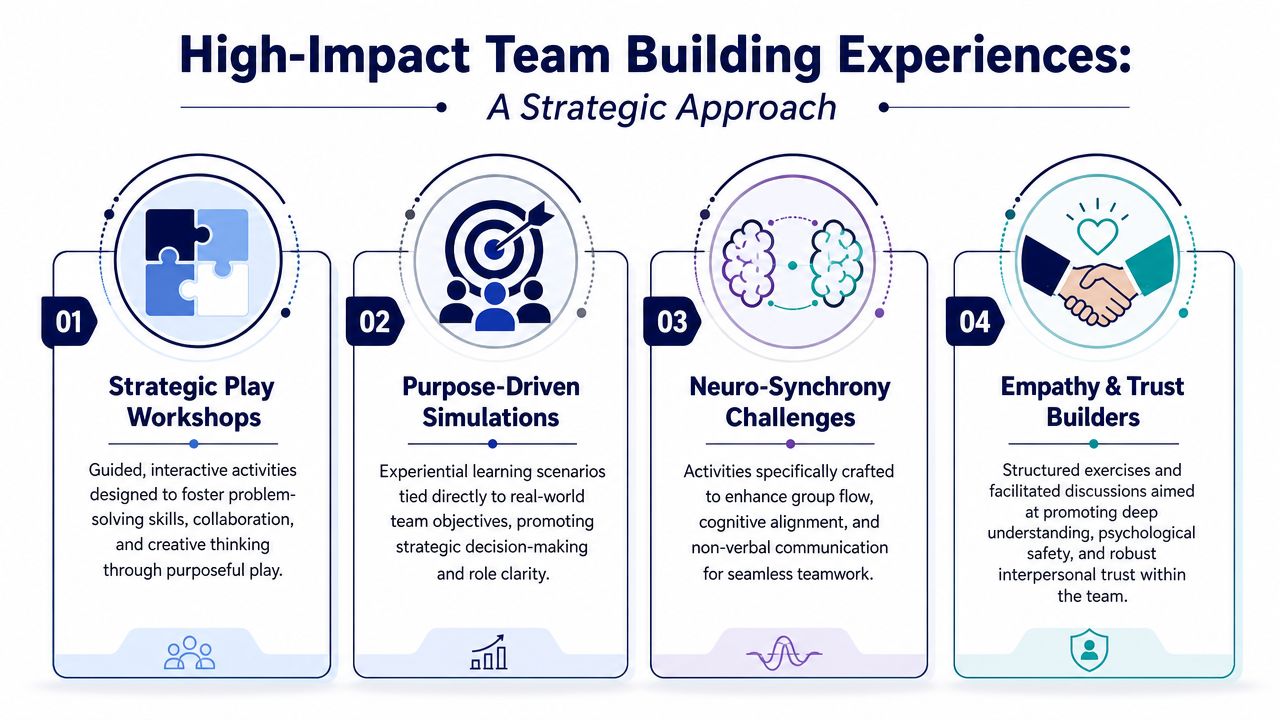
Match the activity to the problem
Different formats solve different issues. A simple planning lens helps:
| Team need | Better fit | Why it helps |
|---|---|---|
| Cross-functional friction | Problem-solving challenges such as Pipeline or Flat Pack Frenzy | Shared constraints expose communication habits and improve coordination |
| Low trust after change | Empathy and trust-building experiences with facilitated reflection | People need safer interaction before they can handle direct challenge well |
| Weak shared purpose | Charity team building such as Bikes for Tykes or Give a Dog a Home | A meaningful external outcome shifts attention from internal politics to collective contribution |
| Flat conference energy | Structured conference play and energisers | Attention and engagement improve when people reconnect physically and socially |
A costly mistake many corporate buyers make involves asking, “What activity will people enjoy?” That's a fair question, but it's not the most important one. A better question is, “What behaviour needs to change after this?”
Why purpose changes the quality of connection
The strongest evidence for purpose-driven design comes from the charity team-building category. A 2025 report from the Australian Business Council for Charity found that team building programs with a tangible charity outcome generate 3.5x higher levels of psychological safety and 2.8x greater retention of team norms six months post-event compared with non-impact activities. The same verified data notes that 74% of large employers in Australia treat CSR as a key priority.
That result helps explain what many organisers already sense. Shared altruistic purpose changes the tone of team interaction. People often become more generous, less performative, and more willing to support each other when the goal matters beyond the room itself.
Shared purpose often succeeds where pure “fun” falls short, because people aren't just solving a task. They're aligning around meaning.
A charity build won't solve every culture issue. If a leadership team lacks candour, a direct problem-solving simulation may be the better first move. But when a business wants team connection and community impact to reinforce each other, purpose-led design becomes a serious option rather than a nice extra.
Measuring the ROI of a Connected Team
If team building is positioned as culture spend alone, it's easy for senior leaders to treat it as discretionary. If it's measured as a performance intervention, the conversation changes. The key is to assess what shifts in behaviour, coordination, and decision quality after the experience, not just whether participants enjoyed the day.
Structured team experiences can help teams practise communication, role clarity and problem-solving in a lower-stakes environment. Their value is strongest when the activity is matched to a clear workplace objective and followed by reflection on how the team will apply it at work.
Measure behaviour not just enjoyment
Post-event surveys still have value, but they shouldn't be the primary measure. A stronger evaluation approach tracks what changes in the weeks that follow.
Useful indicators include:
Meeting quality: Are more people contributing, challenging constructively, and resolving decisions faster?
Cross-functional activity: Are teams escalating less and coordinating more directly?
Leadership alignment: Are senior stakeholders leaving planning sessions with fewer mixed messages?
Conflict recovery: Do interpersonal issues get addressed earlier and with less residue?
A finance-minded audience often responds well to pre-and-post comparison. For teams that need a basic framework, tools used in calculating ROI for event management can help structure the conversation, provided the measures include culture and performance signals rather than attendance alone.
A workable ROI scorecard
A practical scorecard usually combines three kinds of evidence:
Perception data: Short pulse checks on trust, safety, and communication.
Behavioural data: Observation from managers on feedback quality, participation, and collaboration.
Operational data: Internal conflict reports, retention patterns, and leadership alignment markers.
The strongest reviews are done at multiple points, not just the day after the event. Teams need enough time to show whether new interaction patterns are holding under ordinary work pressure. A helpful reference point for this broader business case is the discussion on the ROI of play in workplace performance.
A connected team is easier to spot than many dashboards suggest. People bring concerns forward sooner. Managers spend less time repairing avoidable friction. Decisions hold because they were tested thoroughly the first time. That is usually the clearest sign that the investment worked.
Teams don't become high-performing because they spent more time in the same room. They improve when the environment helps people feel safe enough to contribute, connected enough to collaborate, and energised enough to adapt. For organisations that want a practical, play-based way to build those conditions into conferences, offsites, Christmas events, and culture programs, Corporate Challenge Events offers workplace team-building formats designed around connection, communication, morale, and performance.