
A leadership team gathers on a video call to review a delayed project. Cameras are on, but the room feels guarded. One manager gives a careful update. Another avoids challenging a weak assumption. A third saves their real concern for the meeting after the meeting. Nothing dramatic happens, yet the team leaves with less clarity than it had going in.
That is what low trust looks like in corporate life. It rarely announces itself as a culture problem. It appears as slower decisions, cautious language, duplicated checking, defensive emails, and a visible reluctance to ask for help. For HR leaders, People & Culture teams, executive assistants planning offsites, and department heads running hybrid teams, building trust in teams is not an abstract culture aspiration. It sits underneath execution, change adoption, collaboration, and resilience.
Table of Contents
Why Trust Is a Performance Metric Not a Vibe
Senior leaders often talk about trust as if it belongs in the values statement. Teams experience it in operations. A low-trust team isn't only tense. It withholds information, escalates late, avoids productive conflict, and spends energy protecting position instead of solving problems.
In simple terms, trust affects how work is done. A trusted team can discuss ideas without personal conflicts, spot risks early, fix mistakes quickly, and work together smoothly. Without trust, teams rely more on control, needing more approvals, checks, and side talks, which reduces ownership.
What low trust looks like in real meetings
A project review with weak trust has a familiar pattern:
Updates replace dialogue: people report progress but don't test assumptions.
Silence hides disagreement: the team looks aligned until deadlines slip.
Risk is edited out: concerns are softened to avoid friction.
Leaders over-function: managers step in because they don't trust the team to handle tension well.
Low trust rarely creates one obvious failure. It creates a string of small avoidable frictions that slow the whole system.
That is why building trust in teams deserves the same attention as planning, role clarity, and delivery discipline. It shapes performance every day, especially when teams are under pressure, spread across locations, or working through change.
The Two Pillars of Workplace Trust
Trust at work rests on two pillars. The first is relational trust. The second is technical trust. Teams need both.
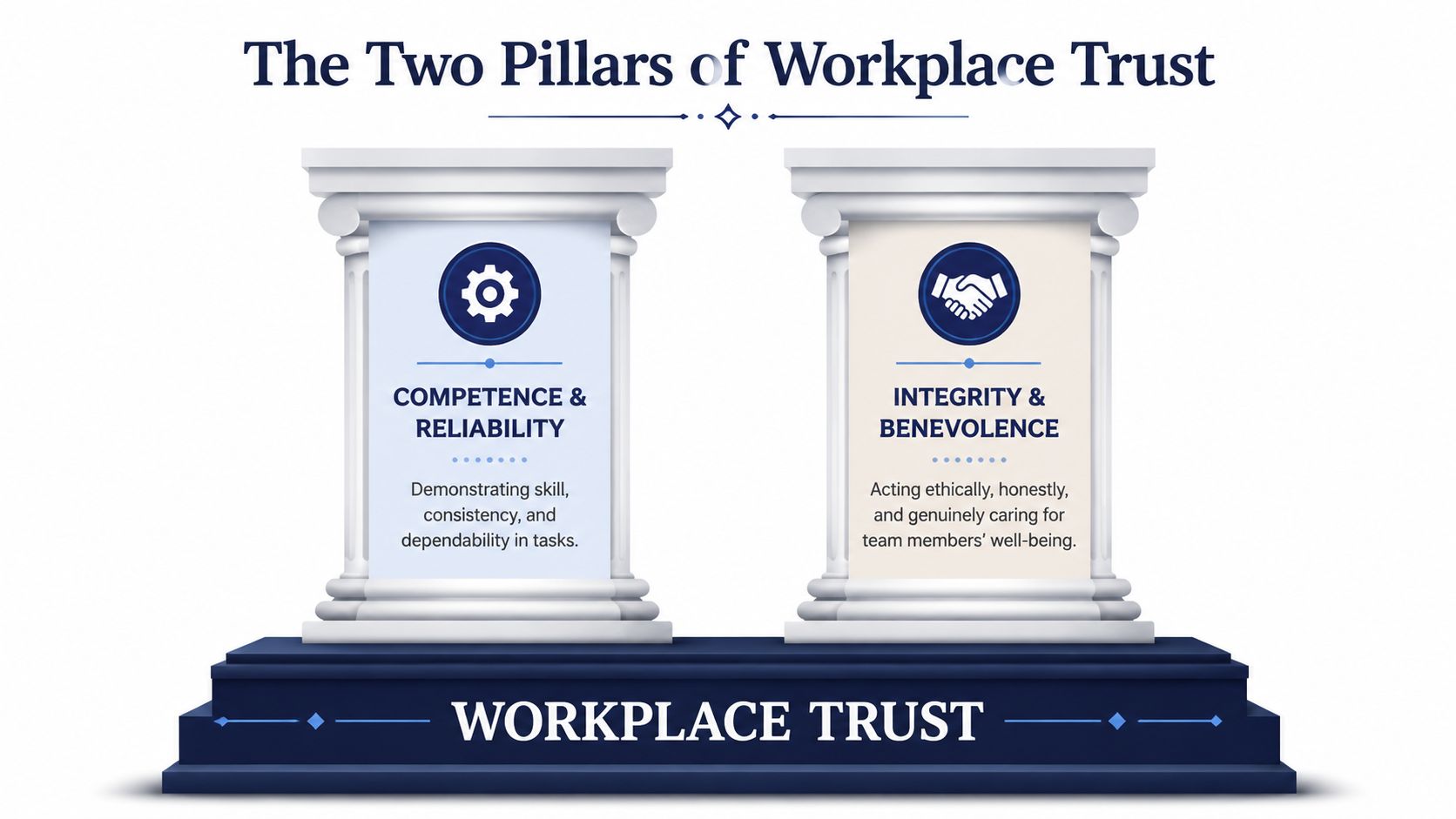
Evidence-based team settings describe trust as a combined relational-and-technical operating model, where empathy-driven, bi-directional communication and shared goals support psychological safety, while frequent interactions, rapid responsiveness, demonstrable expertise, and early quick wins increase perceived reliability and predictability among team members, as outlined in this evidence-based trust-building model.
Relational trust
Relational trust answers a human question. Is it safe to work openly with this person or team? It grows when leaders listen properly, ask for input before decisions are locked in, and show that disagreement won't be punished.
This pillar is often mishandled because organisations reduce it to “being nice”. In practice, it is more demanding than that. It requires clear intent, genuine curiosity, and consistent behaviour under pressure.
Technical trust
Technical trust answers a practical question. Can this person or team be relied on? It is built through follow-through, responsiveness, visible expertise, and predictable execution. Teams trust colleagues who close loops, meet commitments, and make progress legible.
A common failure point sits here. Leaders try to repair trust with better messaging while leaving unreliable workflows untouched. If handovers are messy, ownership is vague, and decisions drift, trust won't improve for long because the operating system keeps teaching people to be cautious.
| Pillar | Built through | Damaged by |
|---|---|---|
| Relational trust | Empathy, shared goals, two-way communication | Dismissiveness, secrecy, one-way directives |
| Technical trust | Fast follow-up, expertise, consistency, early wins | Missed commitments, ambiguity, slow response |
How to Diagnose Trust Gaps in Your Team
Teams don't typically need a philosophical debate about trust. They need a diagnosis. Trust problems become visible in behaviour long before they are named in a survey or escalated to HR.
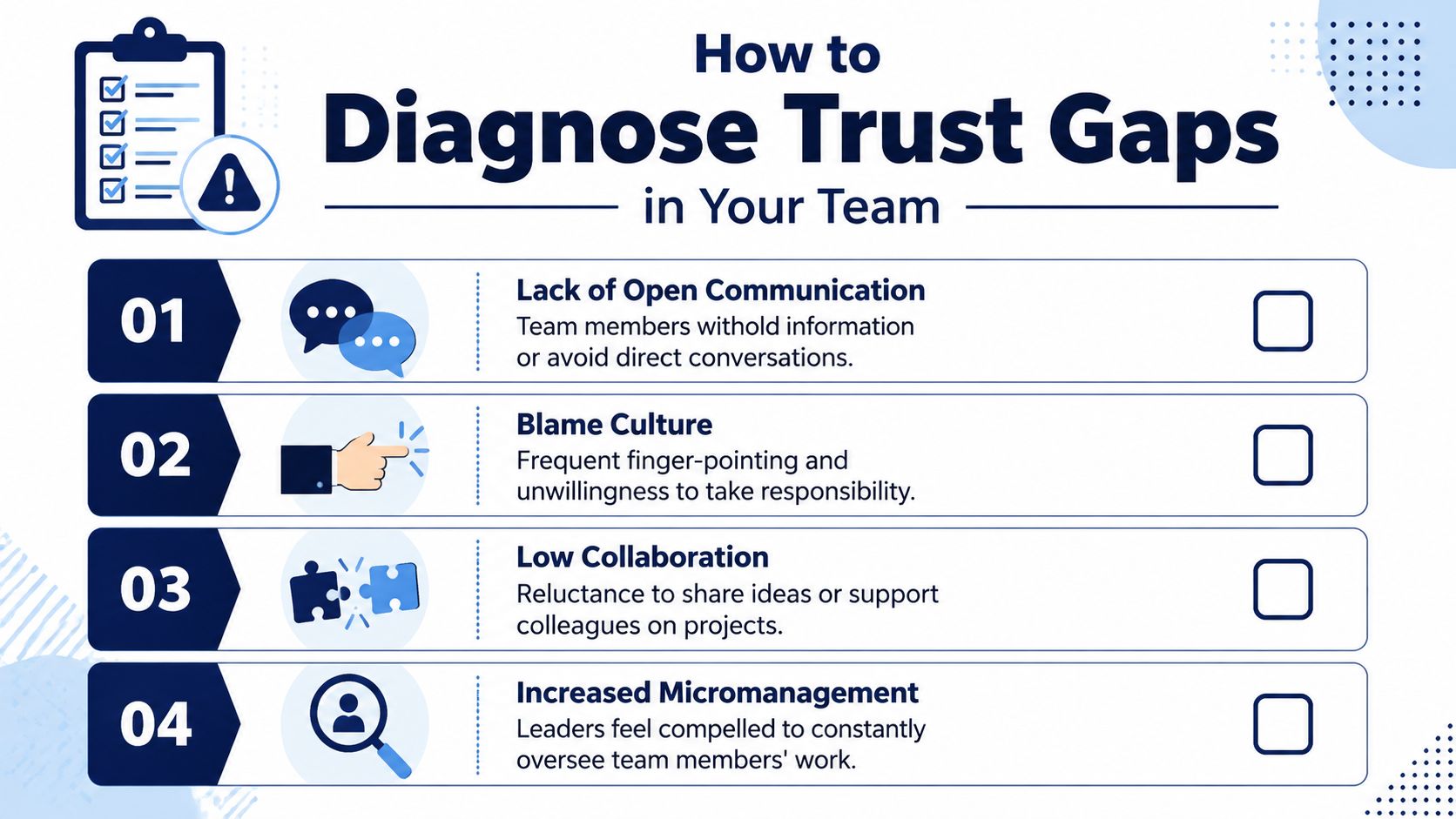
For Australian hybrid and distributed teams, the diagnostic lens needs to include virtuality. Research summarised in this analysis of trust in modern teams notes that higher virtuality generally lowers trust and increases both relationship and task conflict, while the effect is materially reduced when teams have higher specialisation and more flexible task structures. In practice, that means teams need more structured face-to-face interaction, clearer role expertise, and fewer rigid interdependencies when work is spread across locations.
Red flags leaders should watch closely
Some signs are obvious. Others are easy to mistake for personality or workload. The most useful diagnostic questions are behavioural.
Information is rationed: team members share only what is necessary, often late.
Debate happens offline: meetings look smooth, but disagreement resurfaces in side channels.
Support is selective: people help trusted colleagues but avoid broader collaboration.
Managers increase oversight: extra checking appears because leaders sense hidden risk.
People stop asking for help: the team treats vulnerability as exposure rather than normal coordination.
A more detailed set of behaviours appears in these hidden signals of team disconnection, which can help leaders separate general disengagement from specific trust breakdowns.
A quick diagnostic table
| Observable behaviour | Likely trust gap |
|---|---|
| Quiet meetings with little challenge | Low psychological safety |
| Repeated checking and chasing | Low confidence in reliability |
| Tension between functions | Weak shared goals or role clarity |
| Polite but distant video calls | Low connection across locations |
If a team says communication is the problem, the deeper issue is often that people don't yet believe candour is safe or useful.
Diagnosis matters because trust work fails when leaders prescribe the wrong intervention. Some teams need clearer accountability. Others need better connection. Hybrid teams often need both at once.
The Trust Framework A Simple Model for Action
A useful model for building trust in teams has three parts. Reliability, respect, and repair.
Reliability is the operational layer. People trust teams that do what they said they would do, respond promptly, and make ownership clear. Without reliability, trust remains sentimental.
Respect is the relational layer. It shows up in how leaders listen, how conflict is handled, whose voice gets airtime, and whether people are treated as contributors rather than interruptions.
Repair is the recovery layer. Every team experiences missteps, missed expectations, and occasional breaches. High-trust teams aren't perfect. They notice strain early and address it directly.
Why this model works
Many trust models are too broad to use in a live workplace. These three elements are easier to apply in meetings, project reviews, offsites, and change programs. Leaders can ask simple questions:
Are commitments dependable?
Do people feel heard and handled fairly?
When trust dips, is there a way back?
That turns trust from a vague aspiration into a practical management discipline.
Practical Daily Behaviours for Building Trust
Trust grows through repeated signals. Most of them are small, visible, and easy to miss when leaders focus only on strategy or delivery.
Reliability in the day-to-day
A leader builds reliability by making expectations precise and closing loops quickly. If a decision is pending, name who owns it and when the team will hear back. If a commitment changes, explain it before others have to chase.
A simple habit works well in hybrid settings. End important meetings with written next steps, owners, and timing. That reduces interpretation gaps and shows that accountability is shared, not assumed.
Respect in daily leadership practice
Respect is demonstrated through attention. Leaders who multitask through check-ins, interrupt quieter contributors, or only engage with the most confident voices train the team to self-censor.
Useful behaviours include:
Ask before deciding: invite input while there is still room to shape the outcome.
Protect speaking space: make room for people who don't naturally compete for airtime.
Handle mistakes cleanly: focus on learning and recovery before assigning blame.
Give context, not just instruction: adults collaborate better when they understand the wider objective.
Practical rule: if a leader asks for candour, then reacts defensively when it arrives, the team will remember the reaction, not the invitation.
These behaviours aren't dramatic. They are effective because they are repeatable. Teams watch patterns more than intentions.
Using Facilitated Exercises to Accelerate Connection
Daily leadership habits create the base layer of trust, but some teams need a faster reset. That is especially true after restructures, leadership changes, conflict between functions, or a long period of low-contact hybrid work. In those conditions, waiting for trust to gradually reappear is usually too passive.
Facilitated exercises help because they create a temporary structure where candour is safer and more evenly distributed. A good exercise doesn't force oversharing. It gives people a practical way to reveal working styles, assumptions, concerns, and strengths without turning the session into group therapy.
Exercises that work in corporate settings
A few formats are consistently useful:
Storytelling pairs: colleagues share a formative work experience, then introduce each other back to the group. This builds empathy and listening.
Working-style exchanges: teams name what helps them do their best work and what creates friction. This improves coordination quickly.
Rose, bud, thorn check-ins: teams surface what is working, what is emerging, and what feels difficult. This creates a balanced language for challenge.
Expectation mapping: the group clarifies what support, responsiveness, and ownership should look like in practice.
Leaders considering a more structured intervention can look at how team building workshops create high-performing teams when facilitation is tied to clear business objectives rather than generic morale boosting.
What does not work
One-off icebreakers with no relevance to real work don't shift trust. Neither do sessions that invite honesty but produce no follow-up. The exercise should connect to how the team works after the workshop ends. Otherwise, the event becomes a short-lived mood lift rather than a genuine change in team behaviour.
Designing High-Impact Trust-Building Events
An offsite or conference session can strengthen trust, but only if the event is designed for that purpose. Many team days fail because they optimise for entertainment, not transfer back into work.
A well-designed trust-building event starts with one question. What trust problem is this event supposed to address? If the issue is cross-functional friction, the activities need interdependence and role clarity. If the issue is post-change disconnection, the design needs shared purpose, informal interaction, and enough facilitated reflection to turn experience into insight.
Match the activity to the trust outcome
Different formats build different aspects of trust.
| Event format | Trust outcome it supports |
|---|---|
| Charity team building | Shared purpose, contribution, collaboration under a positive mission |
| Problem-solving challenges | Visible competence, role clarity, fast feedback |
| Play-based team activities | Lowered guard, social connection, psychological safety |
| Conference energisers | Reconnection, energy shift, informal interaction |
One practical example is a provider such as Corporate Challenge Events, which designs corporate team building around business objectives including collaboration, connection, and culture outcomes. The critical point is not the brand. It is the design logic. The activity should make trust-relevant behaviours visible, necessary, and discussable.
Event design principles leaders should insist on
Start with a behavioural objective: decide whether the event is targeting openness, reliability, cross-team understanding, or trust repair.
Build interdependence into the activity: people need to rely on each other to complete the task.
Use facilitation, not just activity delivery: reflection is what converts a good experience into workplace insight.
Create a re-entry plan: define how the team will carry one or two new behaviours back into meetings and projects.
A trust-building event is most useful when it acts as an accelerator, not a substitute, for leadership discipline.
The Science of Play and Its Role in Forging Trust
Play works in adult workplaces because it changes the social conditions under which people interact. It lowers status rigidity, increases shared attention, and gives teams a faster route into cooperation than a standard meeting format can provide.

In a conventional workplace setting, people often protect expertise, manage impressions, and stay inside role boundaries. In a well-facilitated play-based challenge, those habits soften. A finance leader, project coordinator, and operations manager can all become equal contributors to a task that requires experimentation, communication, and adaptation in real time.
Why play speeds up connection
Play is useful for trust because it makes three things easier:
Shared risk feels safer: the activity creates enough structure that people can contribute without overexposure.
Strengths become visible quickly: teams see who organises, who notices detail, who steadies pressure, and who invites others in.
The emotional tone changes: energy lifts, and guarded interaction often gives way to more natural cooperation.
Leaders interested in the broader biological rationale can explore how BDNF and play support learning and adaptability. In practice, the value is straightforward. Play gives adults a credible, work-relevant route into trust-building behaviours that many formal sessions struggle to foster.
Play is not a detour from performance. In the right format, it becomes a faster route to the social conditions that performance depends on.
A Leader's Guide to Repairing Broken Trust
Trust repair is harder than trust building because the team now has evidence for its caution. That is why generic advice such as “be transparent” or “communicate more” often lands badly after a breakdown. The team does not need more messaging first. It needs a credible repair process.
Guidance from Comcare on building trust in teams points to both in-person and high-quality screen-based connection, including full attention, asking for input before decisions, and starting trust-building with new team members in person where possible. For teams recovering after prolonged hybrid work or restructures, research also suggests that informal, unplanned interactions and reducing rigid task structures can help mitigate conflict and rebuild trust.
What repair requires
A workable repair sequence looks like this:
Name the breach clearly: identify what happened without minimising it.
Acknowledge impact: people need to hear that the practical and emotional effects are understood.
Change a visible condition: adjust meeting rules, decision rights, escalation paths, or task structure so behaviour can improve.
Create repeat contact: trust rarely returns through a single apology. It returns through repeated credible interactions.
A team dealing with entrenched conflict may also need conflict resolution training for workplace teams so that difficult conversations stop collapsing into avoidance or blame.
What leaders often get wrong
Repair fails when leaders rush to reassurance. It also fails when they focus only on intent. Teams judge trustworthiness through lived experience. If the work still feels unsafe, opaque, or over-controlled, the repair has not started, regardless of the language used about culture.
How to Measure Trust and Track Progress
Trust should be measured the same way any meaningful team condition is measured. Look for behavioural evidence, gather direct feedback, and track whether patterns are improving over time.
What to observe
A leader does not need a complex dashboard to begin. Trust shows up in whether people speak candidly, raise risks early, and collaborate without excessive protectionism.
Useful indicators include:
Meeting contribution: who speaks, who stays silent, and who gets interrupted
Escalation timing: whether problems surface early or arrive late
Cross-team cooperation: whether functions solve issues together or retreat into blame
Commitment follow-through: whether agreed actions happen without repeated chasing
What to ask directly
Pulse questions can stay simple if they are specific. Ask whether people feel safe raising concerns, whether decision-making is clear, and whether colleagues follow through on commitments. Then compare responses over time rather than overreacting to a single snapshot.
A short review rhythm helps:
| Review point | Question |
|---|---|
| After major meetings | Did the team challenge ideas openly? |
| After projects | Were issues surfaced early enough to solve? |
| Monthly pulse | Do people feel heard, supported, and able to speak plainly? |
| Post-event follow-up | Which trust-building behaviours have carried back into work? |
The final step is the one most organisations skip. Share what has been heard, what will change, and what will not. Measurement becomes trust-building only when leaders close the loop visibly.
For organisations that want a more deliberate approach to building trust in teams, Corporate Challenge Events offers play-based corporate team building, facilitated workshops, conference sessions, and charity programs that can be aligned to connection, collaboration, and culture objectives across Australian workplaces.