
Why do adults stop playing at work? Usually, it is not because they have lost their imagination. It is because the workplace has taught them to hide it. Picture a junior marketer sketching an untested campaign route in a meeting. Halfway through, they pull back and say, “Sorry, that is probably too rough.” The room goes quiet. Not because the idea is weak, but because everyone recognises the rule: polished ideas look professional; unfinished ones feel risky.
That rule is rarely written down. It is learned through interruptions, rushed decisions and the way leaders respond to uncertainty. Over time, people stop sharing the messy middle of their thinking. The cost is bigger than a dull meeting. Teams lose curiosity, experimentation and the chance to discover a better answer before settling for the safest one.
The Unwritten Rule Adults Learn at Work
Adults learn quickly what a workplace rewards. If tidy answers receive praise while questions are treated as delays, people adapt. They wait until an idea is defensible before sharing it. They avoid proposing something that may fail in public. Managers may call this efficiency, but it often removes the exploration that good decisions need.
The pattern appears in team experiences too. Many of the reasons team-building efforts fail are the same reasons brainstorming stalls: participants feel watched, judged or pushed to perform before they feel safe enough to contribute. A room can look busy and still contain very little genuine experimentation.
The practical test is simple. When someone offers an unfinished thought, does the leader help the group explore it, or immediately ask whether it will work? Evaluation matters, but timing matters too. If every idea must arrive fully formed, play has already been designed out of the conversation.
What Play at Work Actually Means
Play at work is not an instruction to be silly, nor is it a permanent personality trait. It is a state of voluntary, absorbed engagement in which people have enough freedom to explore, respond and adjust. It may appear during a strategy session, a design sprint, a team challenge or an informal conversation. The setting changes; the underlying conditions are similar.
NIFPlay’s foundations of play describe play as a biological state shaped by curiosity, absorption and context. The distinction matters because a person who does not think of themselves as playful can still enter a play state when the environment gives them a suitable way in. Corporate Challenge Events explores the same idea in its workplace guide to understanding play and through its partnership with the National Institute for Play.
Useful play has structure, but it is not completely scripted. People can influence what happens, receive feedback and change course. The experience has an immediate value beyond a prize or performance rating. Most importantly, there is some choice in how people participate. Different play styles can provide different entry points, but they should never become labels that box people into one way of contributing.
This is why an ordinary planning conversation can become playful while a brightly branded game can feel rigid. The activity is not the deciding factor. Choice, curiosity, low-stakes experimentation and room to adapt are.
Four Conditions That Shut Play Down
Play usually disappears through ordinary workplace habits rather than an explicit ban. Four conditions do most of the damage.
| Condition | What the team learns | A better response |
| Performed professionalism | Rough thinking looks careless, so people self-edit before speaking. | Leaders share work in progress and reward useful questions. |
| Immediate judgement | Unusual ideas carry social risk, so the safest option wins early. | Separate idea generation from evaluation. |
| Output-only routines | Every minute must produce a decision, update or deliverable. | Protect brief periods for testing and reflection. |
| Low time and energy | Participation becomes another demand when people are depleted. | Reduce friction and give realistic choices about how to join. |
Judgement is especially powerful because it changes what people offer before they speak. When every contribution is scored on arrival, a brainstorm becomes an exercise in social risk management. David Rock’s SCARF model of social threat and reward helps explain why. Status, certainty, autonomy, relatedness and fairness all influence whether people feel able to take a risk in front of others. A dismissive interruption may look small, yet it can change the rest of the room’s behaviour.
Output-only routines create a second problem. If every meeting is packed with updates, approvals and deadlines, there is nowhere for a tentative idea to live. Leaders cannot ask for curiosity while designing every hour as a production line. They need to create a short, protected space in which a team can ask, “What else could we try?” before moving to a decision.
Energy is part of the design as well. Heavy workloads, back-to-back calls and uncomfortable environments make exploration harder. Practical details such as breaks, water, food and informal shared space are not a substitute for good leadership, but they affect people’s capacity to engage. This workplace refreshment and environment guide offers one facilities-level example of thinking beyond the agenda itself.
Why Forced Fun Fails
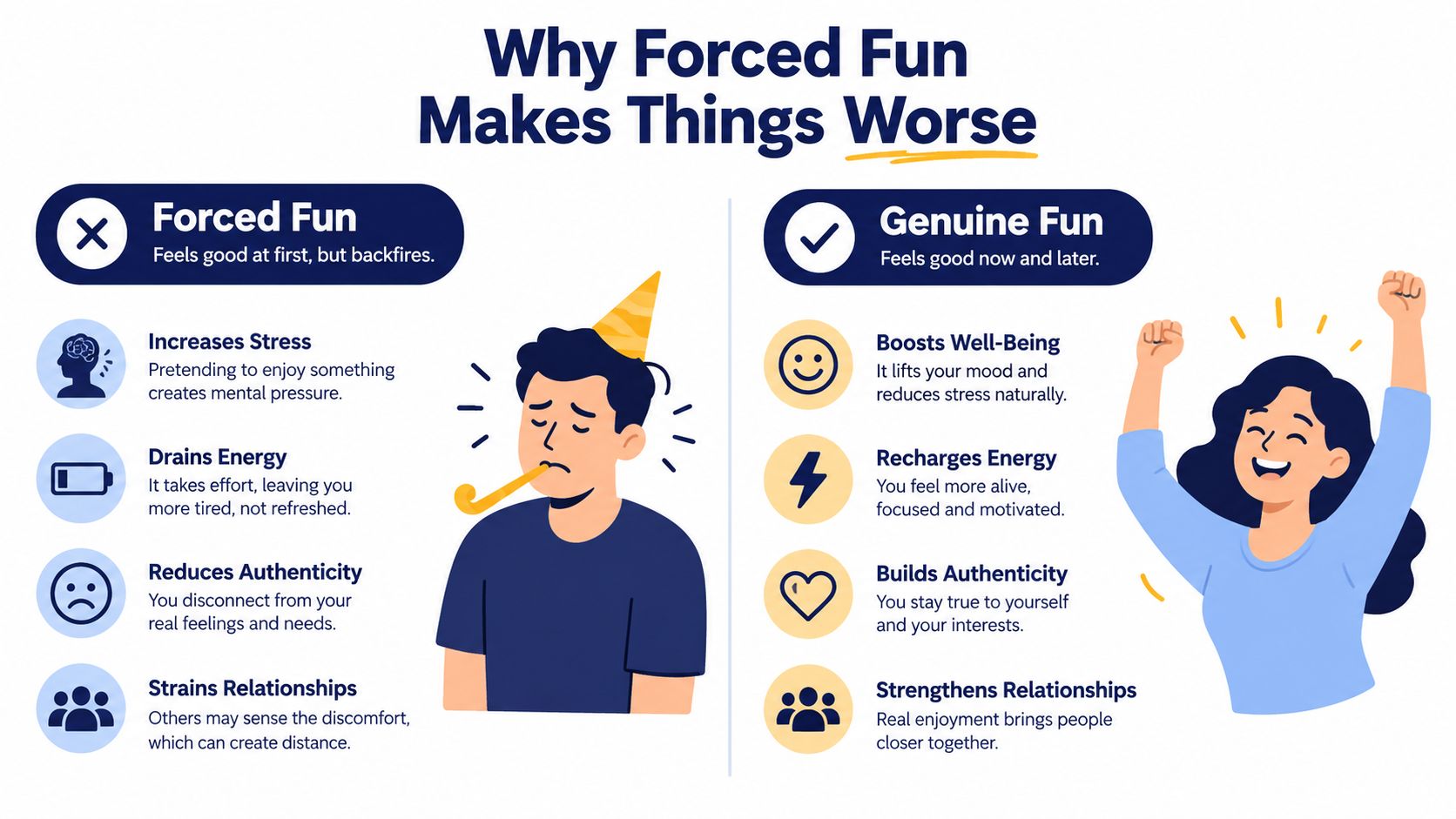
Forced fun removes the ingredient that makes play possible: meaningful choice. When everyone is expected to enjoy the same activity in the same way, participation becomes a performance. People smile, comply and wait for the exercise to finish. The room may look engaged while the participants remain guarded.
That does not mean every team experience must be optional from start to finish. A company may reasonably expect people to attend. Within the experience, however, participants should have choices about role, visibility, intensity and how they contribute. A builder, observer, speaker, organiser and problem-solver can all support the same outcome without being asked to perform identically.
The safest design is not always the quietest one. High-energy activities can work brilliantly when they suit the group, and reflective formats can fail when they feel vague or exposed. The better question is whether the format respects the people in the room. These team-building activities designed to avoid awkwardness show how purpose and participation design can replace icebreaker theatre.
Good facilitation begins before the event. It considers what the team is carrying, explains why the activity matters and provides several practical ways to take part. During the session, the facilitator reads the room and adjusts. Afterwards, the group names what happened and connects it back to work. Without that debrief, even an enjoyable experience may remain an isolated memory.
What Teams Gain When Play Returns
More original thinking
Play lowers the cost of trying an idea that may not survive. That does not make every idea valuable. It allows more possibilities to surface before the team narrows them down. People can combine, test and reshape suggestions instead of defending the first safe answer.
A University of Western Australia review of 122 play-at-work studies found a broad range of positive individual and organisational outcomes associated with activity-based play at work. Its most useful message for organisers is not that any game will work. Different forms of play serve different objectives, so the design must start with the outcome the team needs.
Stronger adaptability
A playful challenge gives people permission to try, receive feedback and try again. That cycle resembles real work more closely than a single polished answer. When the conditions change, teams practise noticing what is no longer working, adjusting roles and continuing without treating the first setback as failure.
UWA research on play at work and energy management also frames play as a meaningful workplace practice rather than a novelty. The value lies in how people use the experience to regulate energy, approach demands and engage with one another.
Better connection across roles
Shared play can give colleagues a new view of how others think and contribute. That is particularly useful across departments, seniority levels and hybrid teams, where friction often grows from unfamiliarity. People do not need to become close friends. They need enough trust and shared experience to communicate more openly when the work becomes difficult.
A 2026 Journal of Organizational Behavior special issue on workplace play connects play with authentic connection, psychological safety, inclusion, proactive redesign, motivation and wellbeing. It also recognises that power, diversity and depleted resources shape who feels able to participate. That balance is important. Play can strengthen healthy conditions, but it cannot compensate for poor management or an unsafe culture.
Five Ways Leaders Can Restore Play This Week
1. Separate generation from evaluation. Give the team a defined period to produce options before discussing feasibility. Even five unjudged minutes can stop the first safe answer from becoming the only answer.
2. Use a useful constraint. Ask, “How might this work if our obvious option disappeared?” A clear constraint gives people permission to move away from habit without turning the conversation into an unstructured free-for-all.
3. Ask what surprised people. Replace one routine status round with an observation round. Surprise invites information that a standard update often misses and gives quieter participants a clearer way into the discussion.
4. Offer more than one role. Let people contribute as builders, speakers, observers, organisers or problem-solvers. Choice does not reduce accountability. It helps people engage through a role in which they can add real value.
5. Protect a little breathing room. Leave five minutes after a workshop or meeting for reflection and informal conversation. Do not fill every pause. Teams often make useful connections once the pressure to produce an immediate answer has lifted.
When a Facilitated Team Experience Helps
Small changes inside everyday meetings are a strong starting point. Some situations need more structure. New teams, post-change resets, cross-functional groups and leadership cohorts can benefit from an external facilitator who holds the framing, participation design and debrief while the whole team joins the experience.
The format should follow the purpose. An activity may be the right choice when a team needs to practise communication, collaboration or adaptability through experience. A workshop may fit better when the group needs shared language, deeper reflection or a plan for changing behaviour. This guide to choosing between a team-building activity and workshop provides a practical starting point.
Distributed teams need the same clarity. Shorter sessions, simple technology, varied modes of contribution and deliberate breaks usually matter more than copying an in-person agenda onto a video call. Vimeo’s guide to virtual retreat formats offers useful prompts for organisers thinking through remote-friendly structure and variety.
A facilitated experience should not be expected to repair culture in a day. Its job is to make behaviour visible, give people a better way to practise together and create language the team can use afterwards. The learning lasts when leaders reinforce it in ordinary meetings, decisions and handovers.
Make Room for the Rough Idea
Adults do not stop playing because they outgrow curiosity. They stop when the cost of being unfinished becomes too high. Leaders can lower that cost by delaying judgement, widening the ways people can contribute and protecting small spaces for exploration inside real work.
Return to the junior marketer with the rough campaign sketch. The most useful response is not instant praise or instant criticism. It is, “Keep going. What are you noticing?” That sentence tells the whole room that an idea is allowed to develop before it has to defend itself.
For organisations that want to build those conditions through a purposeful shared experience, Corporate Challenge Events designs play-based team activities and workshops around the people, context and outcome, not around a generic idea of fun.