Someone has dropped a calendar invite on a manager's desk with one line in the title, team-building, and nothing else. No objective. No audience brief. No clue whether the group needs a lift, a reset, or a proper conversation about how work is getting done.
That's the job, and many skip it. They start with venue quotes, entertainment ideas and a vague sense that “something fun” should happen, then wonder why the room feels polite instead of changed. In Australian workplaces, that's a costly mistake, because the gap between being on a team and being part of a high-performing one is significant. ADP's Australian research found only 16% of employees were fully engaged in 2025, while 52% of those who felt part of a high-performing team were fully engaged, compared with just 10% of those who did not ADP research.
The first strategic decision isn't the activity provider. It's whether the team needs an energising Team-Building Activity or Workshop, or a combination of both. Get that wrong and the budget gets burnt on a nice day that fixes nothing. Get it right and the event can shape how people show up on Monday.
Table of Contents
- The Brief You Were Given and What Was Missing
- Activities and Workshops Are Built for Different Jobs
- Choosing Between Energy, Awareness and Behaviour Change
- Matching the Format to What Your Team Actually Needs
- When the Strongest Move Is to Combine Both
- CCE Workshops Matched to the Challenge They Solve
- How the Trusted Play Process Brings It Together
The Brief You Were Given and What Was Missing
The standard brief arrives half-finished. A leader is told to “organise team building”, often with a tight deadline, a loose budget and a room full of people who've seen this movie before. That's how organisations end up paying for noise when what they needed was clarity.
The missing part is always the same. Nobody has asked what the team is struggling with right now, what success should look like in 90 days, or whether the goal is to lift energy or change how people work together. Those three questions are more useful than any venue shortlist, because they separate a morale event from a real intervention.
Practical rule: if the team's problem is fuzzy, the event will be fuzzy too.
That's where a quick internal approval step helps. A simple team-building approval process forces the sponsor to name the outcome before the booking starts. That doesn't make the event less fun, it makes it defensible. It also protects the organiser from the awkward post-event question every HR lead dreads, which is, “So what changed?”
The cost of skipping this step is easy to predict. The budget gets spent, the staff get a pleasant day out, and the underlying tension stays in the room. Worse, people who've already sat through three generic team days start treating the next one as theatre. If the underlying issue is feedback, trust or workload, a loud activity can feel like a dodge rather than support.
A stronger brief asks for purpose, not packaging. If the team needs celebration, reconnecting or a reset, that should be named up front. If the team needs a hard look at how it communicates or collaborates, then the event needs enough structure to handle that.
Activities and Workshops Are Built for Different Jobs
The cleanest way to think about it is simple, activities create an experience, while workshops create a shift. A good activity raises energy, breaks routine and gives people a shared memory. A good workshop surfaces patterns, builds language and changes the way people operate.
| Dimension | Activity | Workshop |
|---|---|---|
| Purpose | Energy, play, shared memory, connection | Self-awareness, communication, role clarity, cultural change |
| Format | Loose, time-boxed, lightly facilitated | Structured, agenda-driven, guided by a facilitator |
| Duration | Usually 60 to 180 minutes | Usually 120 minutes to a full day, often with follow-up |
| Outcomes | Morale lift, laughter, short-term connection | Agreements, new language, practical commitments |
| Follow-through | Ends when the event ends | Includes actions, check-ins and accountability |
The format should match the job to be done. A team that's flat after a demanding quarter probably needs movement, novelty and a safe way to re-enter the room with some energy. A team that keeps circling the same conflict does not need more jokes, it needs a structured container that makes the issue discussable.
There's also a useful distinction in how people leave the room. After an activity, they should leave with a shared story. After a workshop, they should leave with a shared method. One is about emotional momentum, the other is about operational change.
A good way to source ideas for the activity side is to scan engaging team building ideas and then filter ruthlessly through the team's actual purpose. That's the part many organisers skip. They collect ideas first, then try to invent the problem later.
If the goal is to feel something today, run an activity. If the goal is to do something differently tomorrow, run a workshop.
For teams still deciding between lighter and more structured options, the team bonding guide is a useful starting point because it helps organisers think about outcome before format. That's the right order.
Choosing Between Energy, Awareness and Behaviour Change
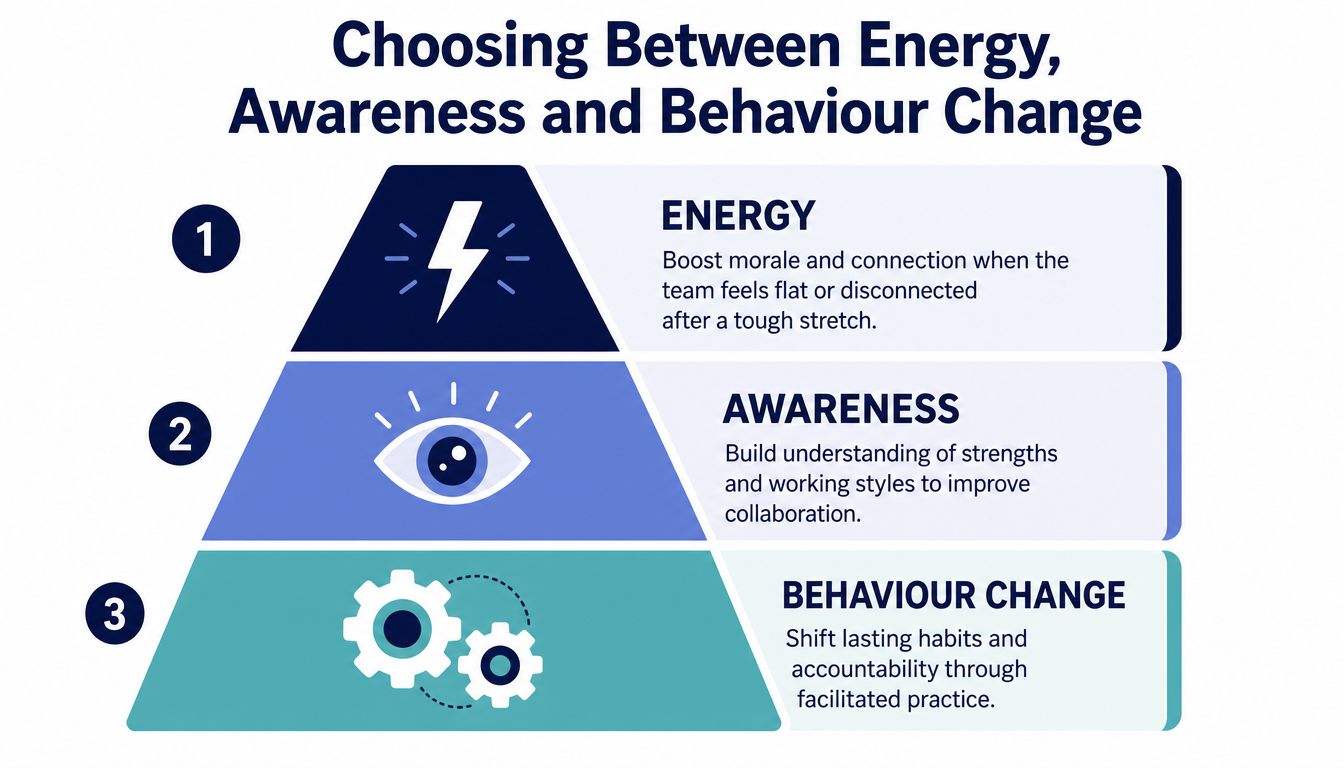
Teams rarely need generic team building. They need a clear call on whether the problem is energy, awareness, or behaviour change.
Energy is the right call when the team looks flat, disconnected or burnt out. That usually shows up after a hard quarter, a restructure, or too many weeks of deadline pressure. A shared experience can shift the mood and give people a cleaner way back into the room.
Awareness sits at a different level. The team may have blind spots in how it communicates, gives feedback, or handles tension. People are not necessarily difficult, they just cannot see their own patterns clearly enough to change them. Insight helps, but insight without practice disappears fast.
Behaviour change is the highest bar. The team already knows something is off, and now it needs new habits, agreements, or skills. That is the point where a workshop earns its keep, because it can shape engagement, collaboration and delivery only if people practise what they are learning.
The research on employee engagement backs that logic. Analysts in ANU research found engagement was low across the workforce, and lowest for remote workers in the same dataset. That does not mean every team should book a workshop. It means the format should match the problem, not the organiser's default preference for fun.
Use these questions to make the call:
Does the team need a lift, or a reset?
Does the team need a better experience, or better behaviour?
Will people work differently on Monday, or just remember a good day?
Those questions cut through the noise quickly. If the answers point to language, trust, or role confusion, a workshop belongs in the plan. If the answers point to fatigue or low connection, an activity is the stronger move.
For organisers matching event design to engagement realities, the employee engagement research is a useful reference point. It keeps the focus on what the team needs, not on forcing one event to do every job at once.
Matching the Format to What Your Team Actually Needs
New teams usually need shared reference points before they need deep reflection. If people don't yet know each other's working styles, a short, high-energy activity gives them common ground without forcing premature honesty. A half-day session that starts with movement or a light challenge gives the room enough trust to handle the rest of the day.
A team stuck in small frictions needs the opposite. A structured workshop with skilled facilitation is the only sensible option when people already know each other too well and still avoid the hard topics. The safe container matters, because those patterns won't surface if the prompts are vague or the room is left to manage itself.
A third situation shows up constantly in corporate life. The team is performing well enough operationally, but everyone feels a bit flat and the leader wants to recognise the effort. That's an activity job, not a workshop job. If a leader tries to turn that moment into a heavy discussion, the room will read it as tone-deaf.
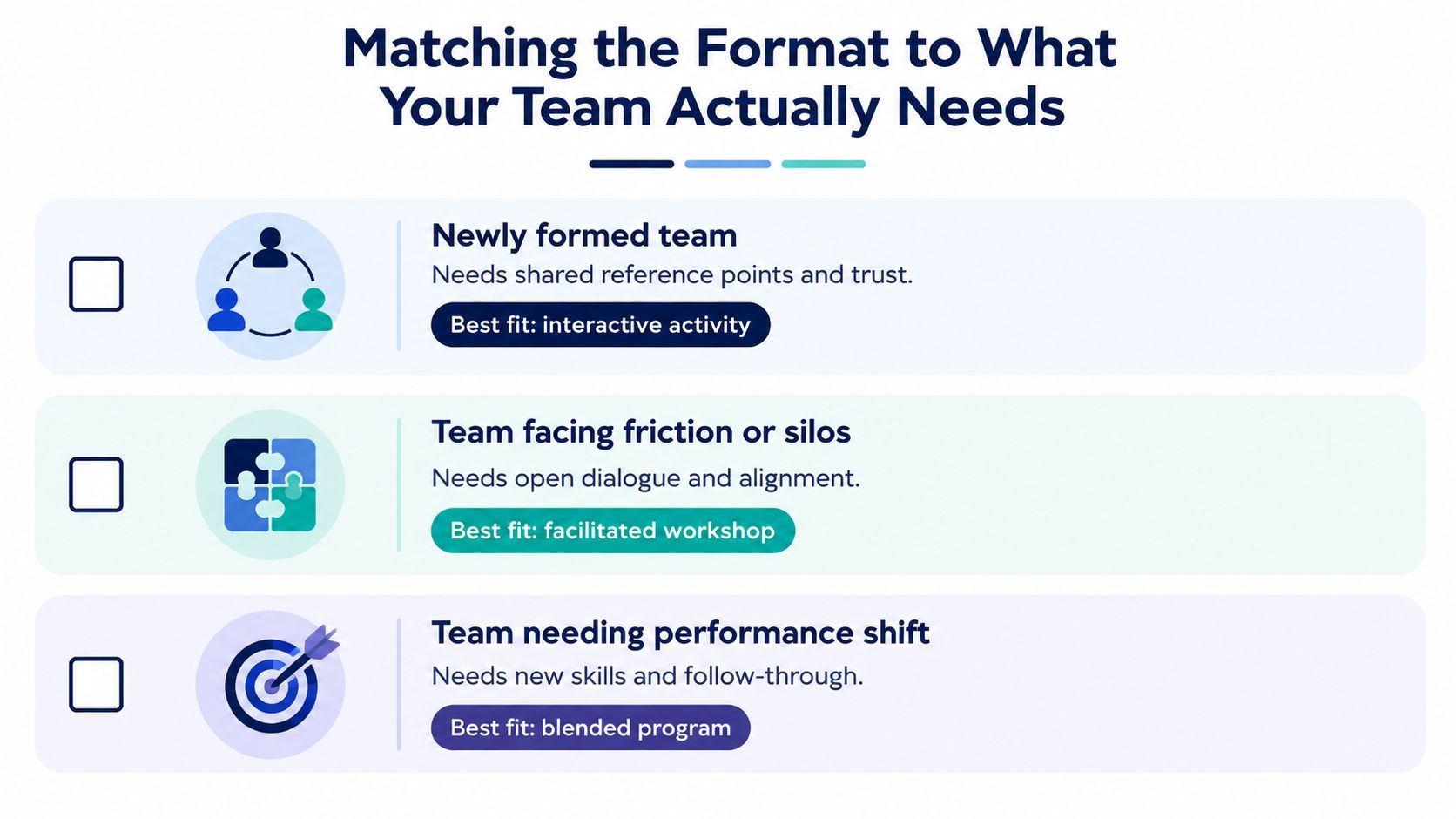
Here's the quickest way to decide:
Newly formed team: choose an interactive activity that creates trust and shared reference points.
Team facing friction or silos: choose a facilitated workshop that lets people speak openly and align.
Team needing a performance shift: choose a blended program that pairs experience with follow-through.
For organisers comparing options, the right team-building activity guidance is useful because it keeps the focus on fit, not just format. That's the part that usually saves the event.
When the Strongest Move Is to Combine Both
The best team days do not force a false choice between fun and substance. They sequence both. The activity lowers defences, creates a shared story and gets people talking in a way that feels natural. The workshop then captures that goodwill and turns it into actual commitments, because people are more open once they've shared a real experience together.
A strong combination usually starts with a 90 to 120 minute interactive game or challenge early in the day. Once energy is up and the room feels human again, a facilitator can guide a debrief that names one or two behaviours the team will change over the next quarter. That is where the event stops being entertaining and starts becoming useful.
The failures are easy to spot. One is stapling a generic workshop onto the back of a fun activity, then leaving the team with a vibe and no traction. The other is opening with heavy content, which makes people suspicious of the play element that follows. Both mistakes come from the same problem, poor sequencing.
A combined format works because energy and honesty are easier to sequence than to force at the same time. The activity creates permission. The workshop creates direction. Put them together properly and the event doesn't just feel good, it gives the team language for how it wants to operate after the day is over.
CCE Workshops Matched to the Challenge They Solve
| Workshop | Team Challenge It Solves |
|---|---|
| Science of Play | Teams that need a credible way to understand why play, attention and collaboration belong in adult work settings |
| The PLAY Principles | Teams that need a common language for how to bring play into work without making it feel random |
| DOPE Behaviour Profiling | Teams with friction around working styles, preferences and interpersonal misunderstandings |
| Belbin Team Roles | Teams that need clearer role contribution, especially when people are duplicating effort or leaving gaps |
| FISH! Philosophy | Teams that need to reset energy, attitude and day-to-day workplace behaviours |
| Find Your Why | Teams that need stronger purpose and a clearer reason to care about the work |
| FUMISH | Teams that need a lighter, high-connection format without pretending the event is a deep strategy session |
| Positive Teams Masterclass | Teams that want a structured conversation about building a healthier and more constructive team climate |
These are not interchangeable, and they shouldn't be sold that way. Science of Play is for teams that need the theory behind the method, while The PLAY Principles suit leaders who want a practical frame for using play well. DOPE Behaviour Profiling and Belbin Team Roles are the sharper choices when the issue is working style or role clarity, because those problems usually sit under the surface until someone names them properly.
For culture and energy, the fit changes. FISH! Philosophy works when the team needs a reset in everyday behaviour, and Find Your Why makes more sense when people need a stronger connection to purpose. FUMISH is a better match when the brief is connection and momentum rather than a heavy diagnostic, and Positive Teams Masterclass is the obvious option when the leader wants to talk openly about team climate without drifting into vague morale talk.
Choose this when the challenge is clear, because that's where the budget earns its place. If the team problem is role confusion, don't book an energiser and hope the confusion clears itself. If the issue is low trust or poor communication, pick a format that puts that topic in the room.
For leaders comparing corporate team-building activities and structured team-building workshops, the decision should always sit on the problem first and the format second. That's how the right intervention gets chosen.
How the Trusted Play Process Brings It Together
The Trusted Play Process gives leaders a simple way to choose the right format without overcomplicating it. Start with the team's current state. Then name the desired outcome in plain language. Only after that should the organiser decide whether the brief needs an activity, a workshop or a blended journey.
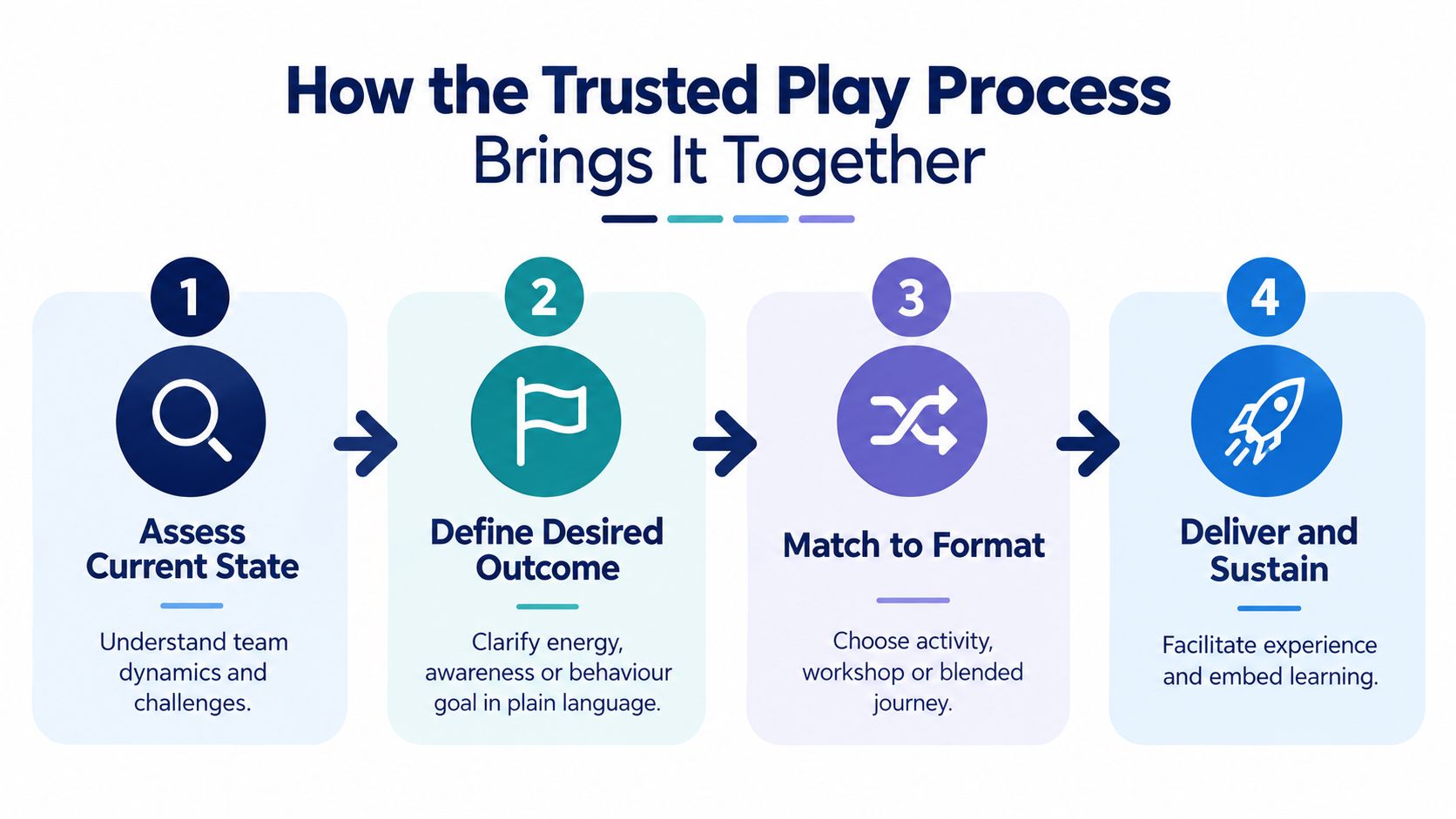
The process is practical enough to run internally before a facilitator is briefed. Gather team size, recent survey themes and the biggest blockers people keep mentioning. That gives enough context to recommend session length, pre-work and whether the room needs energy first or reflection first.
A useful internal check comes from The Play Philosophy, because it frames play as something deliberate rather than decorative. That lens helps leaders avoid treating the event as a box-tick and start treating it as a workplace tool.
A real-world pattern often looks like this. A team arrives with low energy, poor cross-functional handoffs and enough tension that a simple activity would feel underdone. The Trusted Play Process points to a blended format, not because compromise sounds nice, but because the team needs both a reset and a structured way to talk about how work moves.
That's the value of the process. It gives the organiser a clear recommendation, a session length and a pre-work checklist before anyone locks in the event. It also stops the common mistake of trying to solve a culture problem with a party or trying to fix low morale with a lecture.
Corporate Challenge Events helps organisations choose between an activity, a workshop or a blended experience based on the team's current state and the outcome they need. If the brief is sitting on your desk right now and the goal isn't clear, visit Corporate Challenge Events and start with the team problem, not the venue.