Often, teams that book an offsite don't have a people problem. They have an environment problem. The team is working in a rhythm of screens, notifications, meetings, deadlines, and indoor spaces that keep attention fragmented and energy flat. Even capable teams can start to sound more transactional than collaborative when that pattern goes on for too long.
That's why outdoor team building works so well for all organisations, regardless of industry or size. It doesn't just change the choice of activity. It changes the conditions around how people think and feel, it directly influences how they show up and interact with one another. In Australia, organisations are already accustomed to bringing people together physically, with the Australian Bureau of Statistics recording 1,228,620 domestic business trips in the year to June 2024, which reflects how common offsites, meetings and in-person gatherings remain within working life (Gusto overview citing ABS travel context).
For HR leaders, executive assistants, People and Culture teams and business leaders, the question isn't whether fresh air feels nice. It's how can movement and play in nature benefit them and their people
Table of Contents
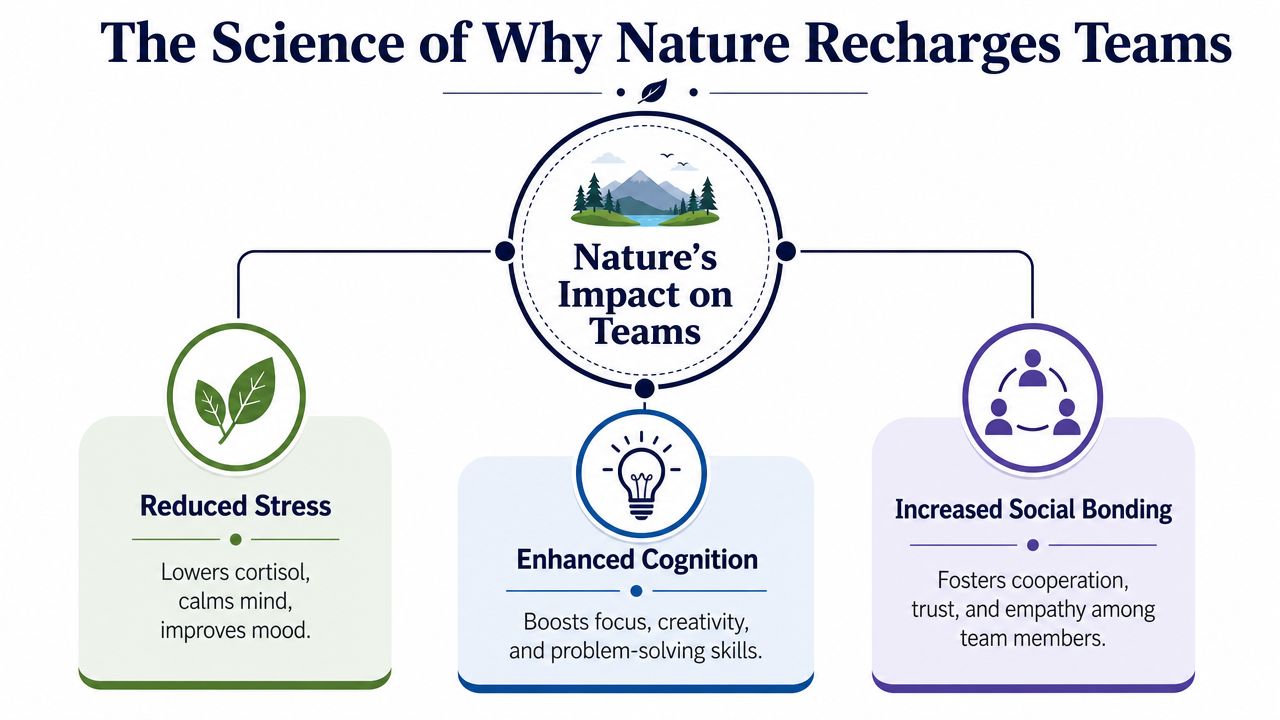
The Science of Why Nature Recharges Teams
Biophilia and the modern workplace
A useful starting point is biophilia. In simple terms, biophilia refers to the idea that humans have an innate tendency to connect with nature and living systems, a concept discussed in research on human relationships with the natural world (biophilia overview in environmental health literature). That doesn't mean every employee responds to the outdoors in exactly the same way, or that nature automatically solves workplace issues.
It does help explain why many people feel different when they step out of a meeting room and into an open, natural setting. Modern teams spend much of their week indoors, seated, screen-based and cognitively overloaded. An outdoor environment changes what people look at, how they move, and often how formally they interact.
Practical rule: Outdoor team building works partly because the setting itself interrupts routine behaviour. People often speak more naturally when they're no longer locked into the usual room layout, agenda pressure and screen habits.
That physical shift can be useful before any formal activity even begins. It creates a setting that feels less rigid and more human, which is often the first step toward better connection.
Attention Restoration Theory in plain English
Stephen Kaplan's Attention Restoration Theory offers a practical explanation for why mentally tired teams can benefit from being outside. The theory proposes that directed attention is the kind of focus people use for emails, decisions, deadlines, meetings and problem-solving, and that this form of attention gets fatigued over time (Kaplan's Attention Restoration Theory).
Nature supports recovery because it can hold attention gently rather than demand effort. Kaplan described this as soft fascination. A tree line, water, breeze, open sky or natural textures can engage the mind without asking it to process another task list. Natural settings can also create a feeling of being away, which helps people step outside routine work pressures, even for a short period.
For a corporate team, that's highly relevant. A group that arrives mentally overloaded may struggle to brainstorm well, listen carefully or stay patient with one another. A well-designed outdoor session gives tired minds some room to reset. That often improves the quality of participation, not just the mood.
A useful companion piece for this idea is Corporate Challenge Events' perspective on why teams need a dose of play, which connects mental overload with the need for more restorative, human-centred interaction at work.
Stress Recovery Theory and team behaviour
Roger Ulrich's Stress Recovery Theory focuses on a related but different process. It suggests that exposure to unthreatening natural environments can help people recover from stress more effectively than many urban environments, across emotional, attentional and physiological dimensions (Ulrich and colleagues on stress recovery).
That matters because stress doesn't stay private. It shows up in how people interrupt, withdraw, react defensively, rush decisions or miss cues from colleagues. Teams under pressure often don't need a lecture on communication. They need conditions that make good communication easier.
Gallup's global research found that only 20% of employees worldwide were engaged in their jobs in 2025, while engaged teams delivered 10% higher customer loyalty and 23% higher profitability in the business units studied (Gallup figures cited here). Outdoor team building isn't a magic switch for engagement, but it can support the human conditions that engagement depends on, including energy, attention and social connection.
When people feel less physiologically tense, they often listen better, contribute sooner and respond with more patience.
That's one reason the environment deserves more attention in team development design. The setting can either amplify fatigue or help the group come back to itself.
From Wellbeing to Performance The Business Case for Going Outdoors

Why outdoor time belongs in performance conversations
Nature belongs in business conversations because performance isn't produced by strategy alone. It also depends on whether people can focus, recover, generate ideas and work well together. McKinsey's discussion of nature and teams points to the link between time in nature, creativity, wellbeing and team performance, which helps reframe outdoor experiences as a useful work design choice rather than a break from real work (McKinsey on nature and team creativity and performance).
That distinction is important for leaders planning offsites. A strong outdoor session can help teams shift from reactive mode into a better state for problem-solving and perspective. For some groups, that's the difference between repeating familiar conversations and generating better ones.
A practical business lens on this appears in the ROI of play, which treats team connection as part of performance infrastructure rather than an optional extra.
The screen heavy work pattern many teams now live in
The phrase nature deficit disorder can help describe a broader cultural pattern, but it needs care. It is not a formal medical diagnosis. It was popularised by Richard Louv as a way to describe concern about reduced regular contact with nature in modern life (discussion of the term in published literature).
In a workplace context, many teams now operate in an indoor, screen-heavy rhythm. People move less, look at fewer varied environments, and spend more of the day in a narrowed field of attention. Over time, that can make work feel mentally cramped and socially thinner than it needs to be.
Outdoor team building helps counter that pattern by giving people a fuller sensory environment and a more active mode of interaction. It supports a shift that many teams need but rarely design for on purpose.
A simple way to think about the business case is this:
| Workplace challenge | What an outdoor format can support |
|---|---|
| Mental overload | More space for attention recovery |
| Social friction | Lower-pressure interaction |
| Flat conference energy | Physical movement and renewed participation |
| Stale thinking | Fresh context for ideas and problem-solving |
Activating the Outdoors Why Play Unlocks Potential
Nature creates the setting and play changes the interaction
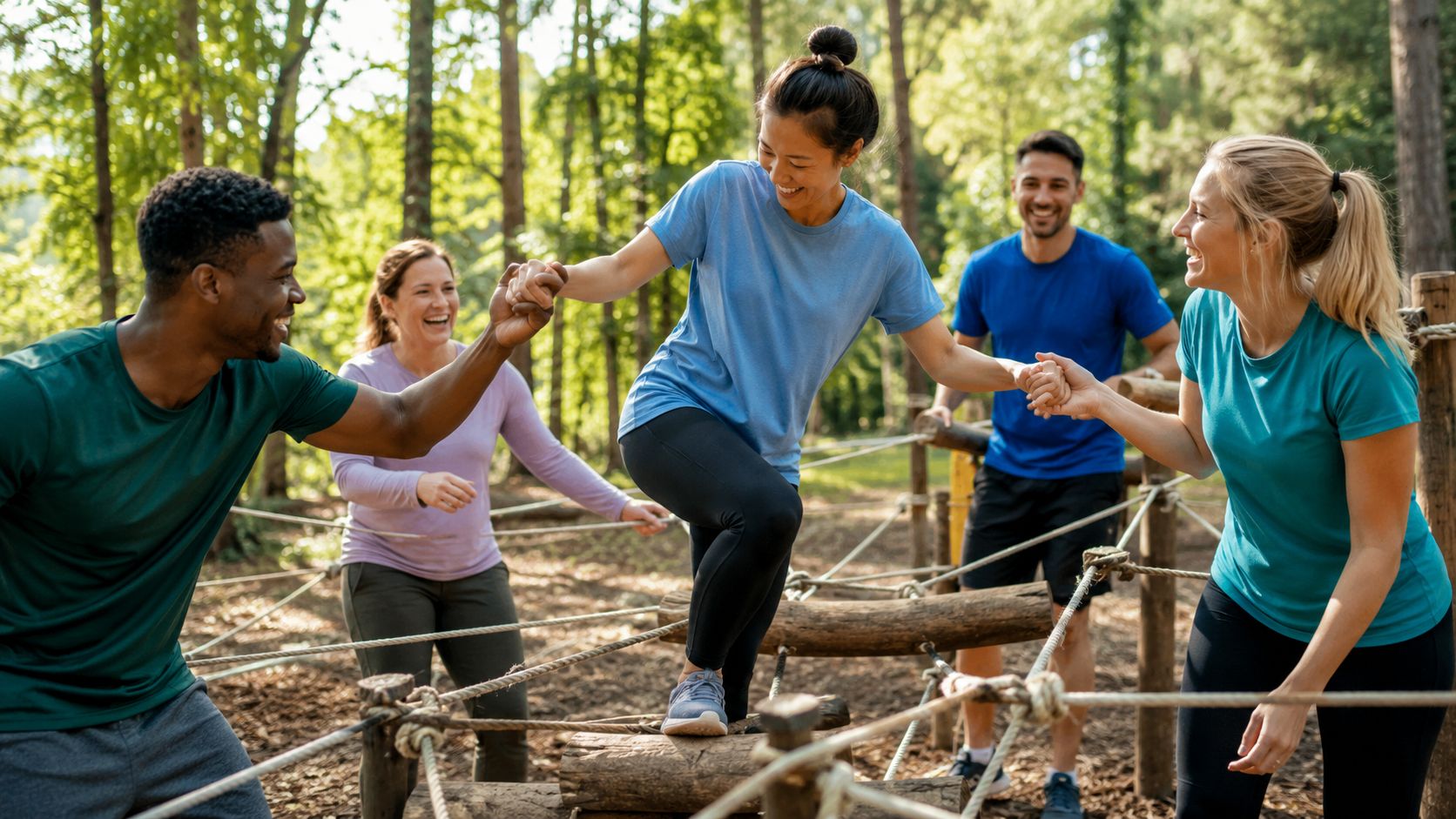
Nature can calm and restore. Play-based team building adds the active ingredient that turns that environment into team development. It gives people something to do together that requires movement, response, experimentation and shared attention.
That's why play often works especially well outdoors. A good activity doesn't rely on forced networking or scripted vulnerability. It gives people a practical challenge, and conversation forms around the task. A team starts coordinating, laughing, adjusting, helping and noticing one another in real time.
Play also softens status barriers that can dominate indoor workplace settings. The usual hierarchy doesn't disappear, but it often becomes less restrictive when people are solving an outdoor challenge together. That can help quieter voices participate more naturally.
Leader takeaway: The goal isn't to make work feel childish. The goal is to create a setting where adults can think, move and relate with more flexibility.
Teams looking for broader inspiration can review examples of top outdoor team building activities to see how different formats support different outcomes.
Why outdoor play creates stronger shared experiences
Well-facilitated outdoor play helps teams practise useful workplace behaviours without making the learning feel heavy-handed. That includes:
Communication under movement: People have to give clear instructions while the group is active and distracted.
Creative problem-solving: Teams test ideas quickly instead of over-discussing them.
Trust and support: Colleagues notice who steps up, who includes others, and who helps the group recover when something doesn't work.
Shared memory: A team remembers the experience later, which gives leaders a reference point for future conversations about behaviour and culture.
Corporate Challenge Events offers outdoor and play-based team experiences that use this structure in a corporate context, including formats for conferences, offsites and culture programs.
For teams exploring the broader philosophy behind this approach, play and team performance is a useful place to start.
Designing Your Outdoor Team Building Experience
Match the format to the team outcome
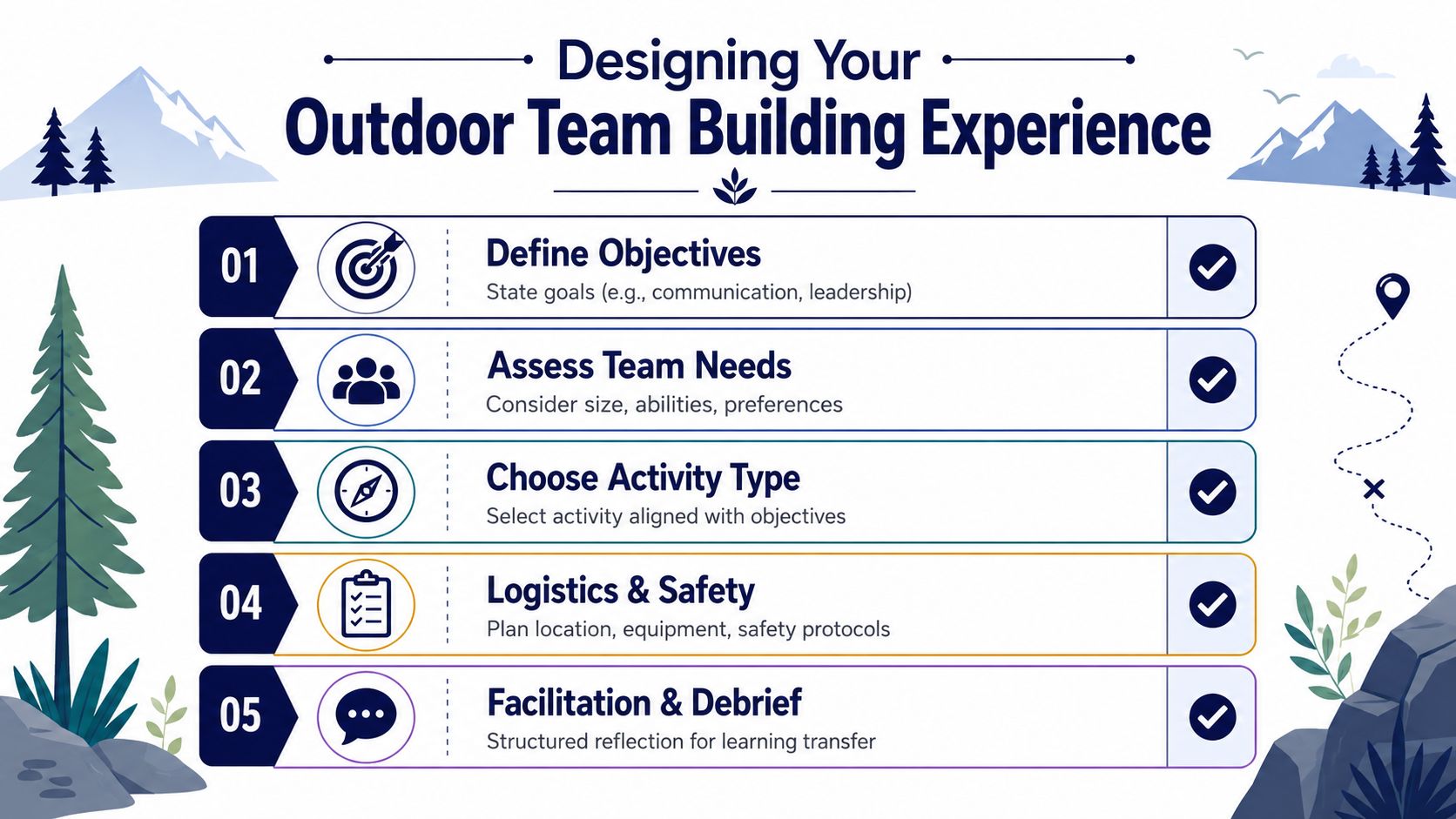
The right outdoor team building activities depend on what the team needs to practise. A planning process works better when it starts with the desired outcome rather than the most exciting-looking activity.
For example:
Connection and morale: Social formats and light competition often work well as outdoor team building activities, especially for mixed groups or teams that need to reconnect.
Communication and coordination: Collaborative problem-solving tasks usually create better learning than purely competitive formats.
Leadership development: Outdoor team development works best when the activity is followed by structured reflection about roles, decision-making and follow-through.
Purpose and CSR: Charity team building can help teams connect around contribution as well as collaboration.
Conference energy: Short, active formats can reset attention and lift participation in conference team building.
Build for inclusion safety and transfer back to work
Effective outdoor team building should be designed as a psychosocially safe intervention. That means the event should be more than socially enjoyable. It should be safe, inclusive and purposeful.
A practical design checklist includes:
Low skill barriers: Choose activities where success depends on coordination, not athletic ability.
Physical accessibility: Make sure all participants can contribute meaningfully, even if roles differ.
Environmental planning: Consider heat, UV, shade, hydration and timing, especially in Australian conditions.
Facilitated reflection: Add a debrief so teams can connect the experience to workplace habits and behaviours.
Venue fit: Assess layout, movement space and accessibility using criteria like those in what to look for in a team building venue.
Good outdoor design creates enough challenge to lift energy and cooperation, but not so much pressure that people feel excluded or overloaded.
Effective Outdoor Team Building Is More Than Just Fresh Air
Fresh air helps, but it isn't the reason a team event creates lasting value. The stronger outcome comes from combining the right environment, the right activity and the right facilitation. Nature can support attention recovery and stress reduction. Play can open up interaction, experimentation and shared problem-solving. Facilitation connects those moments back to workplace behaviour.
That's the difference between a simple social outing and a deliberate team development experience. Leaders planning an offsite should look for formats that align with actual business outcomes, including communication, trust, conference engagement, leadership or cross-functional connection. A useful planning filter is team building that aligns with business objectives.
Frequently Asked Questions About Outdoor Team Building
Some planning questions come up every time, especially when HR teams need to balance engagement goals with risk, inclusion and event logistics.
| Question | Answer |
|---|---|
| What is outdoor team building? | Outdoor team building is a structured team experience held outside a traditional meeting room. It usually combines movement, shared tasks and facilitated interaction to support outcomes such as communication, connection and problem-solving. |
| Why is outdoor team building good for workplace teams? | It changes the conditions around how teams interact. Outdoor settings can help reduce mental fatigue, create a sense of separation from daily pressure and make collaboration feel more natural. |
| What are examples of outdoor team building activities? | Examples include collaborative problem-solving challenges, charity builds, city-based team adventures, light competition formats, scavenger-style activities and conference energisers. The best choice depends on the team outcome. |
| How does nature support team performance? | Natural environments can support attention recovery, stress reduction and a more open state for conversation and idea generation. Those conditions can improve how teams listen, contribute and solve problems together. |
| Can outdoor team building be used for conferences and offsites? | Yes. It's often well suited to conferences and offsites because it helps reset energy, improve participation and make in-person time more valuable. |
| How can organisers make outdoor events more inclusive? | Choose low-barrier activities, build in varied roles, account for access needs and environmental conditions, and design for psychosocial safety. Planners working through inclusion questions may find team building for neurodiverse teams helpful. |
If a team needs more than another meeting room reset, it may be time to take the work of culture outdoors. Corporate Challenge Events helps organisations plan outdoor play-based team building aligned to goals such as stronger connection, better communication, conference energy, leadership development and purposeful team experiences.
Meta title: Outdoor Team Building for Better Team Performance
Meta description: Discover why outdoor team building helps teams think, connect and perform better through nature, play and purposeful facilitation.