
A lot of leadership teams are dealing with the same pattern right now. The team is full of capable people, yet projects still stall, meetings drift, handovers get messy, and avoidable friction keeps showing up between functions. The problem often isn't effort or intent. It's that nobody has made the team's contribution pattern visible.
That's where Belbin team roles becomes useful. In a hybrid Australian workplace, role balance is less obvious than it used to be because people contribute across projects, locations, and reporting lines. A framework that helps leaders spot missing behaviours, duplicated tendencies, and practical ways to rebalance the team can save a lot of wasted motion.
Table of Contents
What Is the Belbin Team Role Model
Belbin team roles is a behavioural framework for understanding how people contribute inside a team. It is not a personality test in the usual sense, and that distinction matters in corporate settings. Leaders don't need another label. They need a clearer view of who generates ideas, who challenges assumptions, who coordinates input, and who makes sure work lands.
Belbin emerged from a 9-year study at Henley Management College, where Meredith Belbin and his team observed teams in management games and identified nine behavioural clusters. The same research history also established a central principle: no role is superior to another. Team effectiveness depends on having the right mix of contributions rather than filling a room with the same kind of high performer.

For People & Culture teams, that makes Belbin more practical than many broad profiling tools. It links directly to observable behaviour in meetings, projects, and decision-making. A useful companion read is this guide on how behavioural profiling can transform your team, especially for organisations trying to turn profiles into better team habits.
A model built around contribution
The easiest way to understand Belbin is to see it as a team design tool.
Thinking roles bring ideas, analysis, and expertise.
Action roles convert plans into movement and delivery.
Social roles align people, relationships, and external connections.
A team with strong thinking and weak action often produces smart discussion with poor follow-through. A team with strong action and weak social coverage can move quickly while leaving confusion or resentment behind.
Practical rule: Belbin is most useful when the conversation shifts from “What type of person is this?” to “What contribution does the team need more of right now?”
That framing helps leaders use the model in a mature way. It supports role clarity, better delegation, and more honest conversations about where the team gets stuck.
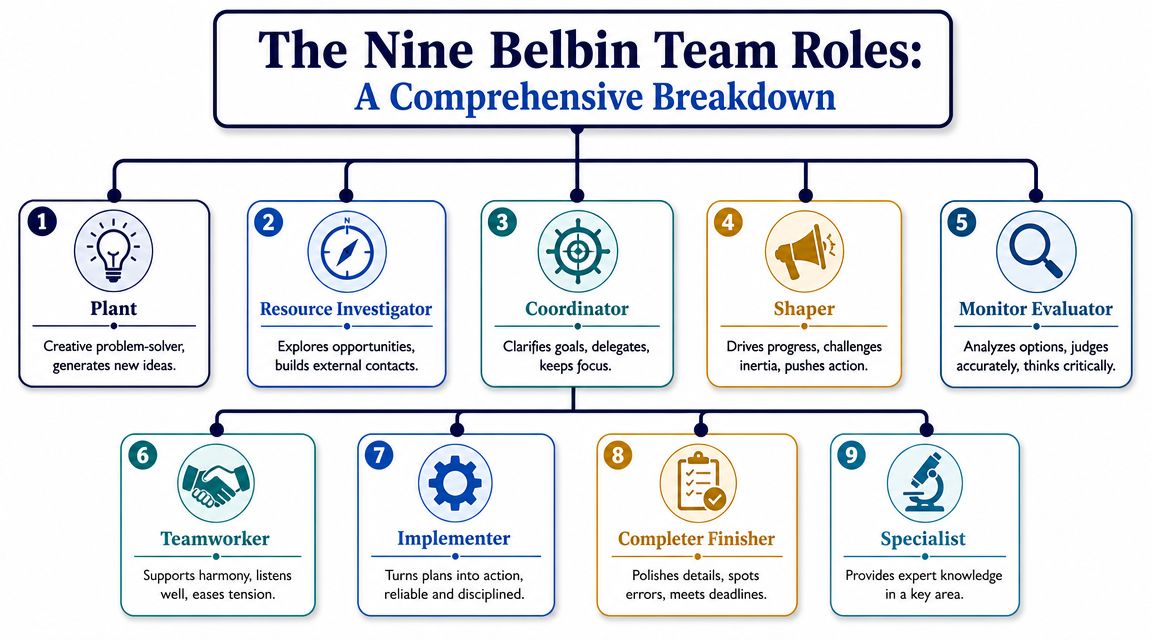
A Deep Dive into the Nine Belbin Roles
Belbin's framework groups the roles into Thinking, Action, and Social categories, which helps leaders diagnose where work breaks down in practice. The underlying architecture is set out in the Belbin technical manual. For teams comparing profiling approaches, this article on psychometric testing vs behavioural profiling can help clarify where Belbin sits.
Thinking roles
These roles shape the team's intellectual quality. They generate options, test judgement, and provide depth.
| Role | Primary contribution | Typical risk |
|---|---|---|
| Plant | Brings original ideas and unconventional solutions | Can become absorbed in ideas that others struggle to follow |
| Monitor Evaluator | Assesses options carefully and brings sober judgement | Can sound detached or overly critical when momentum is high |
| Specialist | Contributes deep expertise in a defined area | Can focus narrowly on their own field |
A team with a strong Plant often has no shortage of possibilities. The challenge is that creativity without containment can swamp a project. Leaders usually get more value from a Plant when the team gives them a defined problem to solve rather than asking for ideas on everything.
The Monitor Evaluator is often underappreciated until a team has made a poor decision too quickly. This role slows the rush to agreement and tests whether enthusiasm is supported by logic.
The Specialist matters most when technical credibility or subject matter depth is essential. In cross-functional projects, this role often protects the team from superficial decisions.
Action roles
These are the roles that move work from intention to output.
Shaper pushes for progress, challenges inertia, and keeps pressure on outcomes.
Implementer translates ideas into workable systems, plans, and routines.
Completer Finisher checks details, protects quality, and closes loose ends.
Each of these roles contributes differently. A Shaper is useful when a project is circling or slowing down. The trade-off is that the same drive can create friction if the person pushes harder than the team can absorb.
An Implementer brings discipline. This is the person who turns a whiteboard session into a schedule, a workflow, or a practical sequence of tasks. When teams say, “We keep talking about the same issue but nothing changes,” an Implementer gap is often sitting underneath that complaint.
The Completer Finisher is the role leaders usually miss until late-stage risk appears. Client-ready documents, final approvals, event logistics, safety checks, and executive packs all benefit from someone who notices what others skim past.
Teams rarely fail because they lacked good intentions. They fail because the last ten per cent of coordination, delivery, or quality control never became anyone's job.
Social roles
Social roles stabilise the human side of performance. They don't just keep things pleasant. They help the team function under pressure.
Coordinator
The Coordinator clarifies goals, draws contributions from others, and keeps the group aligned on priorities. In senior teams, this role often improves meeting quality because it ensures airtime goes to the right people at the right time.
Teamworker
The Teamworker supports collaboration, reduces unnecessary tension, and notices when relationships are affecting delivery. This role is especially valuable in matrix environments where influence matters as much as authority.
Resource Investigator
The Resource Investigator scans outward. They build contacts, surface opportunities, and bring in useful information or relationships from beyond the immediate team. They are often strongest at the front end of work, where curiosity and networking create momentum.
A common mistake is to treat social roles as “soft” contributions. In practice, they often determine whether a capable group can coordinate across stakeholders, recover from disagreement, or stay connected during change.
How to Interpret Your Team's Belbin Profile
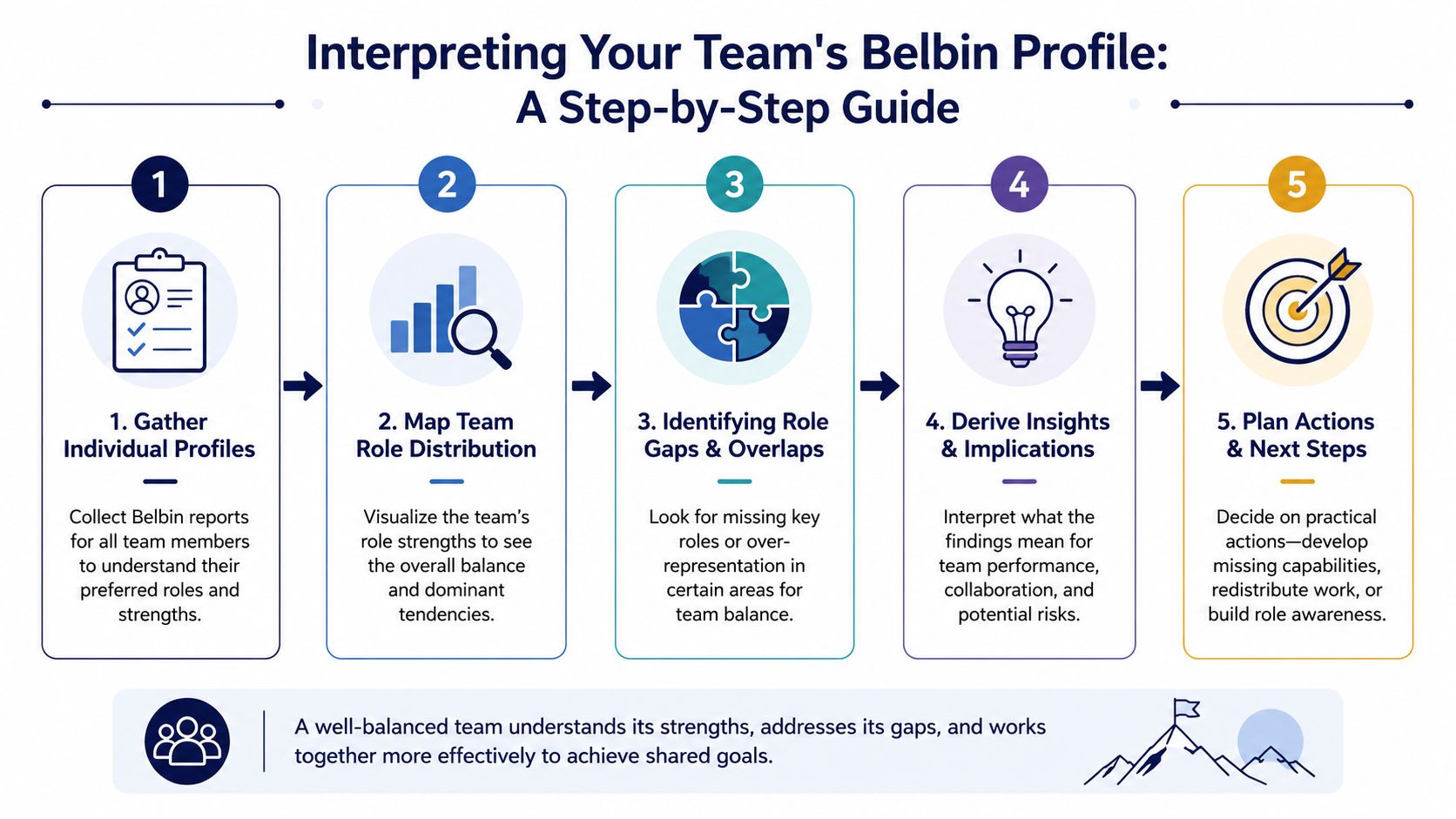
A team profile is only useful if leaders read it as a pattern, not a set of labels. The main question isn't whether every role appears neatly on a chart. It's whether the team has enough behavioural coverage to handle the work in front of it.
Belbin teaching commonly cites the claim that team success could be predicted with over 80% accuracy based on role composition. Whether a leader takes that figure as persuasive or directional, the practical implication is the same. Role balance deserves attention. A team profile is a legitimate management conversation, not just an HR exercise.
A useful next step for managers is learning how to take your team to the next level with profiling so the discussion moves beyond individual reports.
What to look for first
Start with three lenses.
Gaps
If nobody naturally plays a quality-control role, errors and unfinished work often show up late. If nobody coordinates well, meetings can produce activity without ownership.Overlaps
Too many people leaning into the same role can create drag. Several Shapers may generate conflict. Several Plants may create idea overload without agreement on priorities.Category imbalance
A team heavy on thinking roles may analyse well but execute poorly. A team dominated by action roles may move fast while underinvesting in reflection or stakeholder alignment.
Turning a profile into action
Leaders get the most value when they connect profile patterns to recurring business problems.
Missed deadlines may point to weak implementation or weak finishing discipline.
Circular meetings often indicate too much shaping and not enough coordination or evaluation.
Conflict between strong performers can reflect role collision rather than attitude.
A Belbin profile should start a conversation about work design, not end it with a label.
That conversation usually improves when managers ask practical questions. Who should chair the meeting? Who should test assumptions before a decision? Who owns final review? Which role does the team need to flex into on this project even if it isn't a natural preference?
Using Belbin for Practical Team Development
Belbin is most effective when it changes how work is organised. In modern Australian workplaces, that often means using the profile to rebalance contributions across projects rather than treating roles as fixed. The ABS working arrangements data is a useful reminder that high levels of remote work are still part of the operating environment, so missing team behaviours can stay hidden longer when people aren't together physically.

For leaders building capability rather than just diagnosing issues, this guide on training to build your high performance team is relevant because it treats team development as an ongoing operating discipline.
Where leaders usually get value quickly
A newly formed project team often benefits from a simple role check before kickoff. Not a long workshop. Just a quick review of likely strengths, likely blind spots, and who will compensate for what.
Recurring meetings are another high-value use case. If a leadership meeting produces strong debate but weak closure, assign clearer coordination and finishing responsibilities. If a cross-functional group gets stuck in caution, bring more shaping energy into the room and make decision rights explicit.
Conflict resolution also improves when leaders reframe some issues as contribution clashes rather than personal faults. A Shaper and a Teamworker may both be trying to help the team. They're just trying to help in different ways. That reframing doesn't solve the issue on its own, but it makes the conversation less defensive.
Why hybrid teams need process, not just profiles
In dispersed teams, role awareness has to be built into workflow. Remote and project-based structures reward explicit operating habits.
Assign meeting roles deliberately so coordination, challenge, and closure don't happen by accident.
Pair complementary contributors such as idea generators with strong implementers.
Use short team retrospectives to ask which role the team underused during the last cycle.
For teams trying to improve how they work through complex tasks together, Soul Shoppe's guide to problem solving offers a helpful lens on collaborative process. It's useful because Belbin identifies contribution patterns, but the team still needs routines for making decisions, resolving tension, and moving work across handoffs.
Integrating Belbin with Play-Based Team Building
A Belbin profile can diagnose a pattern, but diagnosis alone rarely changes behaviour. Teams don't become better collaborators because they can name the missing role. They improve when they practise different ways of contributing under conditions that are visible, structured, and safe enough for people to experiment.
From insight to rehearsal
That's where play-based team building earns its place. In a workplace setting, structured challenges create a live rehearsal space for the very behaviours Belbin makes visible. A team that lacks creative stretch can work through an open-ended problem-solving activity. A team that struggles with execution can benefit from a timed build or delivery challenge where planning, coordination, and finishing discipline are impossible to ignore.
The value isn't the activity by itself. The value comes from tying the activity to a role-based development goal, then debriefing what happened. Who took over too quickly. Who held back. Who coordinated well. Who noticed quality risk too late.
For organisations wanting that kind of link between profiling and practical development, play-based learning provides a useful model. It treats play as a method for building workplace capability, not as a distraction from serious work. In that context, programs such as problem-solving or build-based team challenges can give leaders a clearer way to convert Belbin insight into new team habits.
The strongest use of Belbin isn't naming people correctly. It's creating conditions where the team can practise missing behaviours before the next high-stakes project exposes the gap.
Common Misconceptions and Pitfalls to Avoid
One of the most common mistakes is treating Belbin as a selection tool. That stretches the model beyond what it does well. Independent analysis from the University of Cambridge's Institute for Manufacturing notes that Belbin roles are behavioural tendencies, not fixed job titles, and that the model is strongest as a development and communication tool, while being weaker as a standalone hiring tool in flexible work environments. That distinction is outlined in this Cambridge overview of Belbin's team roles.
What Belbin should not be used for
Belbin shouldn't be used to box people in. A profile is a snapshot of likely contribution patterns, not a permanent limit on what someone can do. Skilled managers still need to look at capability, performance, context, and the actual demands of the role.
It also shouldn't become an excuse for poor team discipline. Saying “we don't have a Coordinator” is not a substitute for setting an agenda, clarifying ownership, or documenting decisions. Teams can compensate for missing roles when they design stronger processes.
Another trap is using the language carelessly. Once labels get thrown around in a dismissive way, trust drops fast. Leaders are better off using Belbin vocabulary to improve mutual understanding, not to explain away frustration. For teams where crossed wires are already part of the problem, these strategies to reduce workplace miscommunication are a useful complement because they focus on communication habits rather than profile labels alone.
Belbin works best when it stays in its lane. It's a framework for noticing contribution patterns and improving team balance. It isn't a shortcut around management judgement.
When a team gains a clear understanding of its behavioral patterns, it can reorganize its work processes. Corporate Challenge Events assists organizations with Belbin profiling, team development workshops, and play-based team building, enabling teams to practice necessary behaviors for the workplace. As an accredited training provider of Belbin, we offer both standalone workshops and those combined with play-based learning.