
Emotional intelligence is the ability to recognise, understand and manage emotions in a way that improves judgment, relationships and results at work. Studies show that emotional intelligence accounts for 58% of job performance across all industry types, which is why senior leaders can't afford to treat it as a vague personal quality.
For many executive teams, the question isn't only what emotional intelligence is. The more useful question is what role it plays in leadership, culture and team performance when pressure rises, priorities clash and collaboration starts to fray. Emotional intelligence sits underneath those moments. It shapes how leaders read a room, how managers handle tension, how teams recover from setbacks and how organisations build trust without slowing execution.
The term itself has been around since 1990, when psychologists Peter Salovey and John D. Mayer formally defined it as “the subset of social intelligence that involves the ability to monitor one's own and others' feelings and emotions, to discriminate among them, and to use this information to guide one's thinking and actions.” Daniel Goleman later pushed the concept into mainstream business thinking through his 1995 book Emotional Intelligence: Why It Can Matter More Than IQ.
For corporate leaders, that history is useful, but the practical value is clearer still. Emotional intelligence is measurable. It has a biological basis linked to how people regulate stress and process social cues. It also shows up in operational outcomes such as collaboration, retention, conflict and leadership effectiveness.
Table of Contents
The Undeniable Link Between Emotional Intelligence and Performance
Building the Emotionally Intelligent Organisation of Tomorrow
The Undeniable Link Between Emotional Intelligence and Performance
Nearly three-quarters (71%) of hiring managers surveyed by Career Builder in 2011 said they valued an employee’s EQ over their IQ. A further three-quarters (75%) said they would be more likely to promote an employee with high emotional intelligence. More than half (59%) said they wouldn’t hire a candidate with a high IQ and low EQ. That reflects a hard operational reality. Performance at work is shaped by how people read pressure, regulate reactions, and respond to other people in real time.
For leaders, emotional intelligence is not a soft add-on to technical capability. It is a set of measurable human skills with biological roots in attention, threat response, and social connection. Those skills affect whether feedback is heard, whether conflict gets resolved, and whether a team can stay coordinated when stakes rise.
I see the trade-off clearly in senior teams. A group can be full of smart, experienced people and still slow itself down through defensiveness, poor listening, or status-driven behaviour. Technical skill helps people solve defined problems. Emotional intelligence helps them solve problems together.
Why leaders get better results with EI
Teams perform better when leaders can spot emotional shifts early and respond with intention. A tense room changes decision quality. Anxious people protect territory. Frustrated people shorten their thinking. People who feel respected contribute more useful information, especially when the issue is ambiguous or politically sensitive.
That is why emotionally intelligent leadership shows up inside the behaviours associated with high-performing team characteristics. Clarity, trust, accountability, and adaptation all depend on people being able to manage themselves while staying aware of others.
Practical rule: If a leader cannot read the emotional climate of a team, that leader is making decisions with incomplete data.
What EI is and what it is not
Emotional intelligence does not mean avoiding tension or lowering standards. In low-EI cultures, leaders often mistake politeness for health. Difficult messages get diluted, accountability becomes uneven, and resentment moves underground until it shows up as disengagement, delay, or politics.
A more useful definition in business looks like this:
Self-regulation over impulse: People notice a reaction, pause, and choose the response that serves the work.
Empathy over agreement: Leaders understand another person's position without abandoning expectations.
Relationship skill over popularity: Trust grows through consistency, clarity, and follow-through.
There is also a practical development point that many organisations miss. Emotional intelligence improves fastest through repeated social practice, not just awareness sessions or personality labels. Structured play can help here because it creates low-risk, high-feedback situations where people have to read cues, recover from mistakes, share attention, and regulate themselves under mild pressure. Used well, those activities are not a break from performance. They are a direct way to strengthen the human systems that performance depends on.
Senior leaders invest heavily in strategy, process, and capability frameworks. Emotional intelligence determines whether those investments translate into coordinated action.
The Four Pillars of Emotional Intelligence in the Workplace
Daniel Goleman's workplace model remains useful because it translates emotional intelligence into four clear domains that leaders can observe, coach and develop. These pillars are self-awareness, self-management, social awareness and relationship management.
Used well, the model helps teams move from abstract language about “better communication” into specific behaviours.
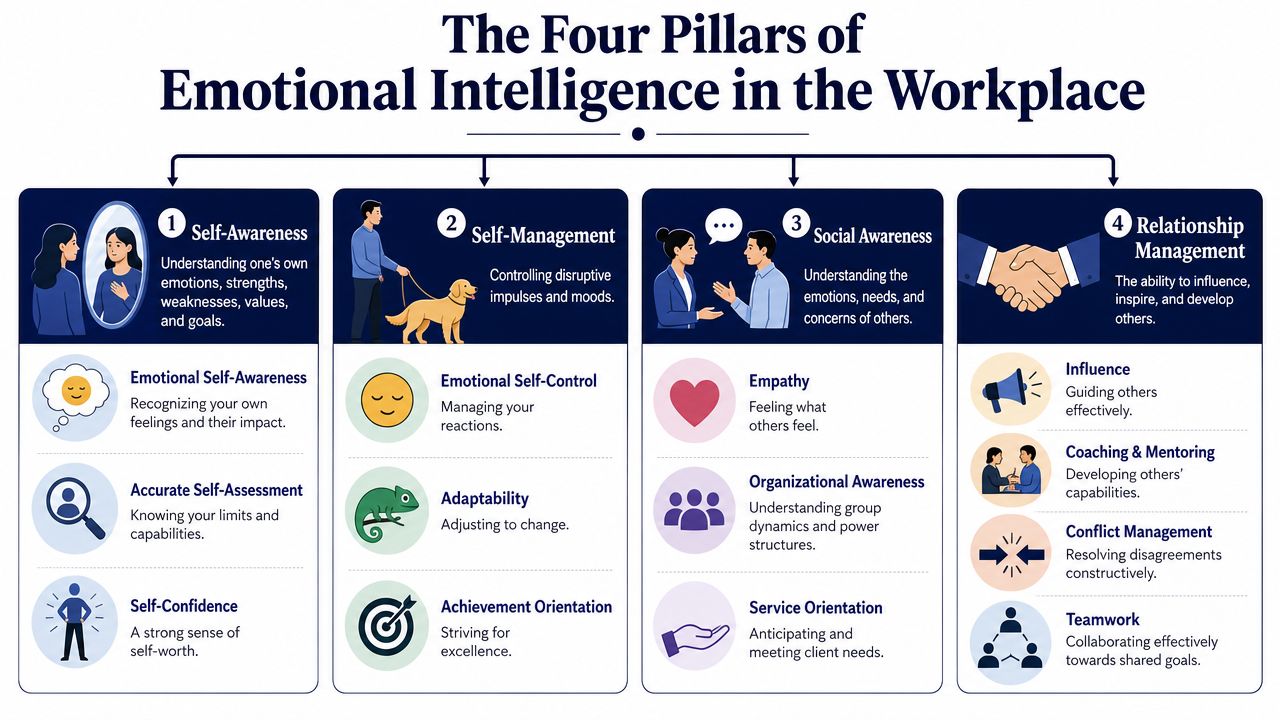
Self-awareness
Self-awareness is the foundation. A leader who can't identify their own triggers, habits and blind spots will struggle to lead consistently, especially under pressure.
At work, this shows up in three useful ways:
Recognising emotional patterns: noticing when stress turns into impatience, avoidance or overcontrol.
Assessing impact accurately: understanding how tone, timing and behaviour affect others.
Holding confidence without overreach: staying grounded in strengths while acknowledging limits.
A self-aware executive can enter a difficult meeting knowing whether they're centred enough to lead it well. That's a major advantage in high-stakes environments.
Self-management
Once people can recognise their internal state, the next task is managing it. Self-management is what stops anxiety from becoming reactivity and stops frustration from spilling into poor decisions.
This doesn't mean becoming emotionally flat. It means using emotion well.
A manager with strong self-management can reset after a setback, adapt when a plan changes and hold a performance conversation without becoming defensive. Those behaviours have a direct effect on credibility.
Teams don't need emotion removed from work. They need emotion handled skilfully.
Social awareness
Social awareness is the outward-facing side of emotional intelligence. It includes empathy, organisational awareness and the ability to read group dynamics.
Leaders with strong social awareness pick up what others miss. They notice when silence means confusion rather than consent. They recognise when a stakeholder's resistance is really fear about loss of control. They understand that team morale rarely declines all at once. It weakens through small relational failures.
This is also where communication capability deepens. Teams trying to improve collaboration often benefit from sharpening communication skills in team settings because those skills rest on social awareness, not just message clarity.
Relationship management
Relationship management is where emotional intelligence becomes visible in leadership practice. It includes influence, conflict handling, coaching, teamwork and the ability to create commitment.
A leader may understand their own emotions and read others well, but if they can't convert that understanding into action, performance still stalls. Relationship management closes that gap.
Some examples include:
Coaching effectively: asking questions that build reflection rather than dependence.
Navigating conflict constructively: surfacing disagreement early and keeping it productive.
Building alignment: helping people move toward shared goals even when interests differ.
This pillar often separates managers who supervise work from leaders who shape culture. It's also the area where emotionally intelligent behaviour becomes contagious. Teams tend to mirror the emotional norms their leaders model.
Why Emotional Intelligence Is a Business Imperative
The business case for emotional intelligence becomes clearer when it is connected to operational outcomes rather than treated as a vague leadership ideal.
In a multi-year Six Seconds case study with Amadori, a major Italian food company, managers’ emotional intelligence predicted 47% of the variation in performance-management scores and 76% of the variation in employee engagement. Across the same period, turnover in the company’s sales force fell by 63%.
Those findings show why emotional intelligence deserves serious attention from HR, People and Culture teams and executive leaders. When managers can regulate pressure, build trust, handle conflict and respond to people with greater awareness, the impact reaches beyond individual leadership style into engagement, retention and team performance.
EI affects more than individual behaviour
Many organisations still frame emotional intelligence as a personal development topic. That's too narrow. Collective emotional capability shapes how a team makes decisions, handles setbacks and maintains momentum when complexity rises.
When a business invests in systems but ignores emotional capability, familiar problems appear. Change programs stall because managers don't address resistance well. Strong specialists get promoted into leadership roles without the relational skill to carry teams with them. Performance issues linger because feedback feels risky.
For HR and transformation leaders building a stronger People and Culture strategy, emotional intelligence belongs alongside leadership, capability and culture rather than sitting in a separate “soft skills” bucket.
The commercial trade-off is real
Every organisation makes trade-offs. Some prioritise technical expertise and assume interpersonal capability will sort itself out. Others invest in broad culture messaging without building the underlying behaviours that make culture real. Neither approach works particularly well.
A more disciplined approach treats emotional intelligence as operating infrastructure:
In leadership: it improves judgment under pressure.
In teams: it reduces friction that slows delivery.
In talent decisions: it helps identify who can lead beyond their technical remit.
In retention: it supports environments where people can perform without chronic relational strain.
Emotional intelligence doesn't replace technical skill. It determines how reliably technical skill gets translated into results through other people.
Why the issue keeps rising
Senior leaders are dealing with flatter structures, faster change and more visible tension across teams and functions. That raises the premium on people who can stay composed, communicate clearly and build cooperation across difference.
In that setting, emotional intelligence isn't a nice addition to leadership capability. It's one of the few competencies that improves performance and culture at the same time.
Emotional Intelligence in Action Workplace Scenarios
Emotional intelligence shows up fastest under pressure. In a routine meeting, almost any manager can appear composed. In a delayed project, a tense feedback conversation or a cross-functional dispute, the underlying capability becomes visible in minutes.
That matters because team performance is biological as well as behavioural. When pressure rises, people read threat, tone and intent before they process the spreadsheet or project plan. Leaders who can regulate themselves and read the room reduce unnecessary threat responses, protect thinking quality and keep coordination intact. That is one reason emotionally intelligent teams lose less time to friction and spend more time solving the actual problem.
High vs Low Emotional Intelligence Behaviours
| Scenario | Low EI Behaviour | High EI Behaviour |
|---|---|---|
| Receiving constructive feedback | Becomes defensive, explains away the issue, focuses on fairness | Listens fully, asks clarifying questions, separates intent from impact |
| Leading a pressured meeting | Speaks over others, rushes decisions, transmits stress into the room | Names pressure without dramatising it, sets priorities, keeps discussion focused |
| Handling conflict between colleagues | Avoids the issue or takes sides too early | Surfaces the problem, listens to both views, moves the conversation toward resolution |
| Responding to project change | Blames the process, fixates on disruption, spreads frustration | Reorients the team, clarifies what's changing, steadies energy and expectations |
| Managing a disengaged employee | Assumes poor attitude, delays the conversation | Explores underlying causes, sets expectations clearly, supports improvement |
What these scenarios reveal under pressure
Low emotional intelligence often appears as threat management. People protect status, defend their intent, withdraw from tension or push stress into the team. High emotional intelligence appears as regulation plus judgement. People stay aware of their own reaction, read what others need in the moment and choose a response that keeps both trust and task progress intact.
Senior leaders should watch for the less obvious signs. Polished agreement can hide resentment. Silence can mean caution, confusion or disengagement. Fast decisions can reflect clarity, but they can also reflect discomfort with conflict. The assessment question is simple: when stakes rise, does this person make the system steadier or more reactive?
Conflict is usually the clearest test. Healthy teams do not avoid disagreement. They handle it without turning every difference into a personal contest. Managers who need practical help building that capability often benefit from conflict resolution training for leaders and teams, especially where recurring tension is affecting delivery.
Structured play can also help here, particularly with teams that struggle to practise these skills in live operational settings. Well-designed experiential activities create low-risk pressure, visible interdependence and immediate feedback. That makes emotional regulation, perspective-taking and communication patterns easier to observe and improve than in a slide-based workshop.
There is a direct link to wellbeing too. Teams that stay in a constant state of interpersonal threat make good thinking harder and burnout more likely. Developing emotional intelligence supports decision quality and collaboration while also contributing to reducing workplace stress.
A team's emotional intelligence is easiest to spot when expectations collide, timelines slip and nobody can rely on a perfect answer.
The practical test is straightforward. Watch what happens when pressure, ambiguity and difference show up at the same time. That is where emotional intelligence stops being a definition and becomes a performance variable.
How to Assess and Develop Team Emotional Intelligence
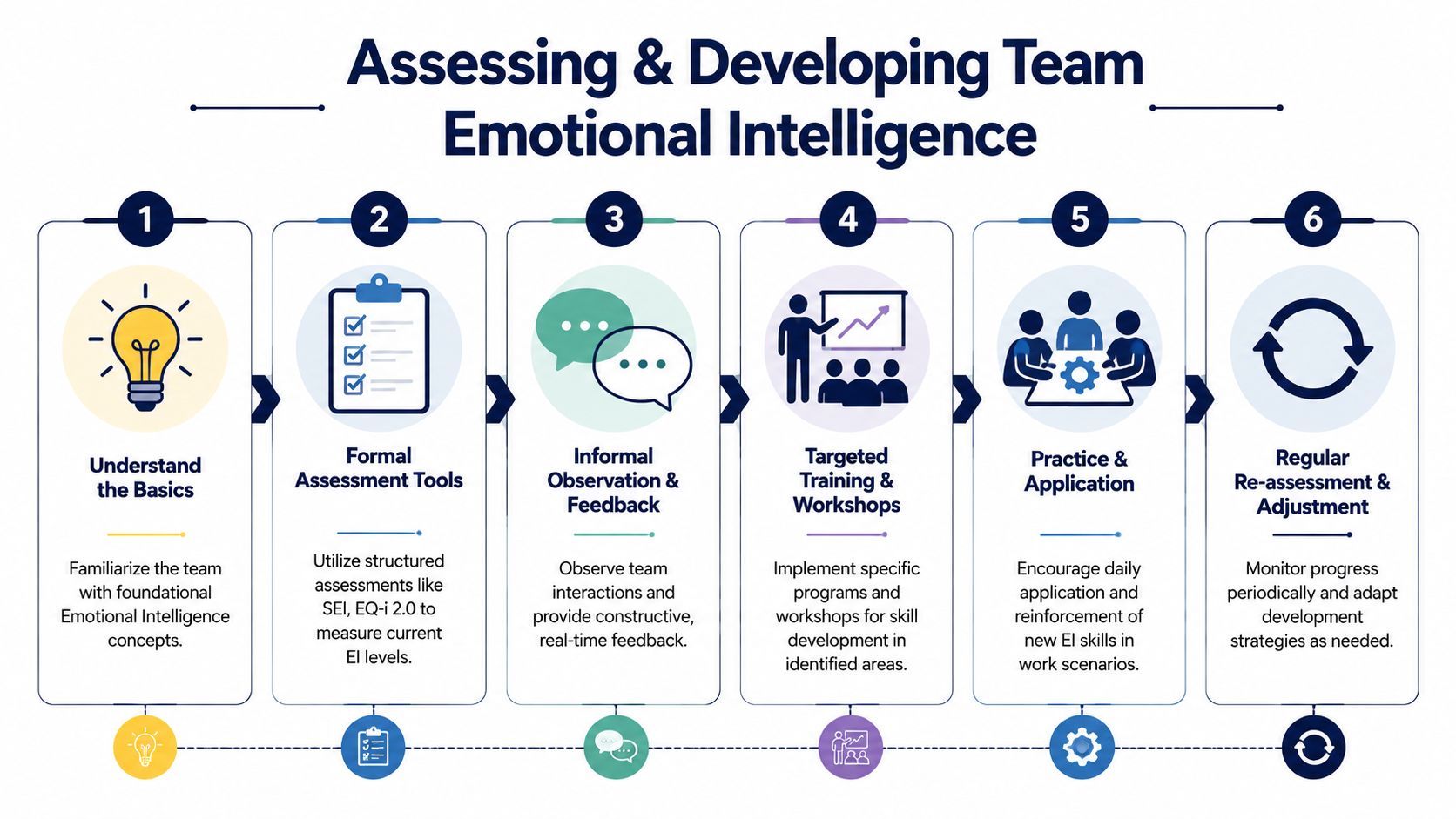
Emotional intelligence development starts with honest diagnosis. Many teams assume they're stronger in this area than they really are because they confuse low conflict with healthy dynamics, or friendliness with trust. A better approach combines formal assessment, behavioural observation and deliberate practice.
The science behind that work is increasingly practical. Emotional intelligence is neurobiologically defined as the capacity to reason about emotions and of emotions to enhance thinking, grounded in the integration of the prefrontal cortex with limbic structures that regulate the stress response.
Start with assessment that leaders can use
Formal tools can help, but only if leaders know what to do with the output. Instruments such as SEI and EQ-i 2.0 can provide structured insight into patterns like self-regulation, empathy and decision-making under pressure. That data is useful when it's connected to real work, not left sitting inside a report.
Teams also need informal signals. Behavioural observation during meetings, retrospectives, project debriefs and stakeholder conversations often reveals more than self-ratings alone. That's one reason many organisations compare psychometric testing vs behavioural profiling for teams before choosing an approach.
A practical diagnostic lens includes:
Pressure moments: How do people behave when deadlines tighten or priorities shift?
Feedback patterns: Do managers invite challenge, or defend quickly?
Cross-team interaction: Is tension handled directly, or displaced into email loops and delays?
Recovery ability: How fast does the team reset after setbacks or mistakes?
Development works best in live conditions
Emotional intelligence rarely improves through theory alone. People need situations that surface real reactions, require coordination and create enough challenge for habits to become visible. That's why experiential learning is effective when it's properly designed.
Structured, play-based interventions can do that well in corporate settings because they create low-risk environments with real stakes. Teams must communicate under time pressure, distribute leadership, manage frustration, read one another's cues and solve problems together. Those are not side effects. They are the point.
Charity team building adds another layer by strengthening social awareness. It shifts people out of narrow departmental thinking and into a shared task with visible meaning. Problem-solving challenges, meanwhile, sharpen relationship management because teams have to influence, negotiate and adapt in real time.
Leader lens: If a development activity doesn't generate observable behaviour, it's hard to coach and even harder to sustain.
Reinforcement matters more than the event itself
No single workshop or offsite will build an emotionally intelligent culture on its own. The event creates insight and shared language. The workplace either reinforces that learning or erodes it.
Leaders can improve the odds by embedding a few simple practices:
Debrief behaviour, not just outcomes: Ask how the team handled pressure, disagreement and communication.
Coach in the moment: Give specific feedback close to the behaviour rather than saving it for formal reviews.
Build reflection into routines: Use team check-ins, retrospectives and project reviews to discuss emotional as well as operational patterns.
Support stress regulation: Teams dealing with sustained load often need practical tools for reducing workplace stress alongside capability development.
Emotional intelligence grows when people repeatedly practise better responses in conditions that resemble an actual workplace.
Building the Emotionally Intelligent Organisation of Tomorrow
The strongest organisations don't leave emotional intelligence to chance. They treat it as a developable capability that supports leadership quality, team cohesion and execution under pressure.
That's the most useful answer to what is emotional intelligence in a corporate setting. It's not a personality label and it isn't a vague call for people to be nicer to one another. It's a measurable set of abilities that shapes how people interpret situations, regulate themselves, work with others and maintain performance when conditions become demanding.
What mature organisations do differently
Emotionally intelligent organisations tend to make a few deliberate choices.
They promote with care: technical excellence matters, but leadership readiness includes emotional capability.
They build shared language: teams can name behaviours such as defensiveness, empathy, reactivity and trust without turning every issue into therapy.
They design development around behaviour: learning is tied to meetings, projects, conflict, feedback and collaboration.
They reinforce from the top: senior leaders model the standard rather than outsourcing it to HR.
The shift is strategic. When leaders understand emotional intelligence as part of performance infrastructure, they make better choices about hiring, promotion, team building and culture investment.
Organisations don't become more resilient because pressure disappears. They become more resilient because their people learn how to handle pressure together.
Emotional intelligence won't solve every business problem. It will, however, improve the quality of leadership and teamwork brought to those problems. For decision-makers responsible for culture, capability and results, that makes EI one of the most practical long-term investments available.
Corporate Challenge Events helps Australian organisations turn team building into a serious performance tool through play-based programs designed for conferences, offsites, culture initiatives, charity events and workplace connection. Leaders looking to strengthen trust, communication, collaboration and energy across teams can explore the full range of experiences at Corporate Challenge Events.