
Conflict rarely appears on a budget line until it has already absorbed time, leadership attention, and formal grievance costs. Australian business guidance frequently cites research showing employees spend about 2.8 hours per week dealing with workplace conflict, while managers may spend 24% to 60% of their time managing it, with 85% of employees experiencing conflict at work according to the cited workplace conflict data referenced in business guidance. That shifts the conversation. Conflict resolution training isn't an interpersonal nicety. It's an operational decision.
For leaders responsible for performance, culture, and retention, the more useful question isn't whether conflict exists. It's whether the organisation has a repeatable way to handle it before it turns into avoidance, rework, disengagement, or escalation. Teams don't need a promise of zero conflict. They need a practical method for addressing friction early, well, and consistently.
That's also why conflict capability belongs in the same conversation as collaboration and team effectiveness. Organisations already invest in communication, leadership, and offsite design because stronger team behaviour supports business outcomes. The same logic sits behind team building for meeting business objectives. Conflict resolution training belongs in that category.
Table of Contents
- Introduction Why Conflict Resolution Training Is a Business Imperative
- Defining Modern Conflict Resolution Training
- The Tangible ROI of Resolving Workplace Conflict
- A Practical Six-Step Conflict Resolution Framework
- Beyond the Classroom Experiential and Play-Based Learning
- How to Choose the Right Conflict Resolution Training Partner
- Conclusion Building a More Resilient and Collaborative Team
Introduction Why Conflict Resolution Training Is a Business Imperative

Workplace conflict consumes hours that should be spent on customers, delivery, and decisions. The cost shows up in rework, stalled approvals, avoidable manager involvement, and talented people choosing to stay quiet instead of raising risks early.
I see the same pattern across leadership teams. Conflict is often treated as an HR matter until it starts affecting project timelines, sales handovers, safety conversations, or execution across functions. By that point, the issue is no longer interpersonal friction alone. It is a drag on performance.
The practical business case is straightforward. Teams that handle disagreement well make faster decisions, escalate fewer issues, and recover more quickly after difficult conversations. Teams that handle it poorly create hidden costs. Meetings become guarded, email traffic replaces direct discussion, and managers spend their time refereeing tension instead of leading work.
What leaders usually miss
Conflict rarely begins with a formal complaint. It starts in ordinary moments. A project lead withholds feedback to avoid a defensive reaction. Operations and sales interpret the same priority differently. A manager steps into every disagreement because nobody else has a reliable process for resolving one.
That is a capability problem.
Good conflict resolution training helps people address those moments earlier, while the stakes are still manageable. It also gives leaders a consistent way to coach behaviour across the business, which is one reason team building linked to business objectives matters more than many companies assume.
Classroom learning has a role, especially for frameworks, language, and policy boundaries. Retention improves when teams also practise under light pressure in realistic group activities. Well-designed experiential and play-based sessions give people a low-stakes setting to test listening, negotiation, and de-escalation habits before those habits are needed in a difficult client meeting or a tense internal review.
That trade-off matters. Formal instruction explains what good conflict handling looks like. Experiential practice shows whether people can do it when timing, ambiguity, and group dynamics are in play.
There is also a governance angle. Some disputes are rooted in unclear incentives, decision rights, or perceived bias, not personality alone. Work on ethics and role clarity, including the Logical Commander Software Ltd. guide on ethics, reinforces the point that conflict capability sits alongside sound management practice, not outside it.
For HR, People and Culture, and operational leaders, the implication is clear. Conflict resolution training is not a soft add-on. It is part of how organisations protect manager capacity, improve collaboration, and keep execution on track.
Defining Modern Conflict Resolution Training
Modern conflict resolution training isn't a lecture on being nicer to colleagues. It's a structured capability-building system that helps people diagnose tension, hold difficult conversations, and move disagreement towards a workable outcome. The strongest programs don't try to eliminate conflict. They teach teams how to use it productively.
In a corporate setting, that usually means developing skills in active listening, negotiation, de-escalation, perspective-taking, and emotional regulation. It also means giving people a common language. Without that shared language, one employee calls something direct feedback, another experiences it as disrespect, and the manager is left trying to decode both sides.
More than policy and mediation
Policy has a role, especially where conduct, safety, harassment, or power imbalance are involved. But policy alone can't teach people how to manage the ordinary friction of deadlines, role ambiguity, competing priorities, and cross-functional pressure. Mediation can help once a dispute has matured. Training works earlier, when a team still has room to correct course.
That's where leaders often make a category error. They buy a one-off session on communication and expect behaviour to change under pressure. It rarely does. Teams need repeated practice, clear language, and reinforcement that matches the realities of their workplace.
A useful parallel sits in governance. Conflict of interest management also depends on clear definitions, practical judgement, and consistent handling rather than vague good intentions. The Logical Commander Software Ltd. guide on ethics is a helpful reference because it shows how organisations turn a sensitive issue into a manageable decision process.
What effective training usually includes
A modern program should help participants do three things well:
- Recognise the issue early: identify what kind of conflict is present and what's driving it beneath the surface
- Respond with structure: use a process instead of reacting from frustration, defensiveness, or avoidance
- Transfer the skill back to work: apply the same approach in meetings, project reviews, and one-to-ones
For HR teams deciding where to invest, conflict capability should sit alongside broader interpersonal development. That's why many organisations review it together with soft skill training needs across the business.
The Tangible ROI of Resolving Workplace Conflict

The return on conflict resolution training becomes clearer when leaders stop measuring it as a sentiment initiative and start assessing it as operational waste reduction. Unresolved conflict consumes labour hours, management time, and formal process costs. It also pushes routine issues into expensive channels that should be reserved for serious matters.
Australian public sector data sharpens that point. The Australian Public Service Commission reported spending approximately $19.8 million on conflict and grievance management in 2023–24, as noted in this discussion of conflict and grievance costs. That figure won't map neatly onto every private sector organisation, but it does show that conflict carries direct and significant system costs when it isn't handled early.
Where the return usually appears
The strongest returns tend to show up in a few predictable places.
| Area | What improves when conflict is handled earlier |
|---|---|
| Manager capacity | Leaders spend less time refereeing recurring interpersonal issues |
| Team delivery | Work moves with fewer delays caused by avoidance and misunderstanding |
| Employee experience | Staff are more likely to raise issues before they become formal disputes |
| Organisational risk | Fewer matters escalate into grievance, investigation, or external process |
These gains are easier to defend internally when training is tied to business metrics rather than generic morale language. The conversation becomes more credible when People & Culture teams discuss resolution speed, participant satisfaction, team morale, relationship quality, and the reduction of repeat conflicts.
Training only pays off when behaviour changes
The budget question is fair. Leaders should ask how training converts into measurable value. A practical lens comes from broader L&D thinking. The LearnStream article on how to turn employee development into profit is useful because it frames training ROI around improved capability, better execution, and stronger transfer into day-to-day work rather than attendance alone.
Strong training doesn't create value at the moment of delivery. It creates value when people handle the next difficult conversation better than they would have before.
That's why experiential reinforcement matters. Organisations already exploring the ROI of play in workplace development will recognise the same principle. Learning sticks when participants practise under realistic conditions, reflect on what happened, and carry that behaviour back into work.
A Practical Six-Step Conflict Resolution Framework
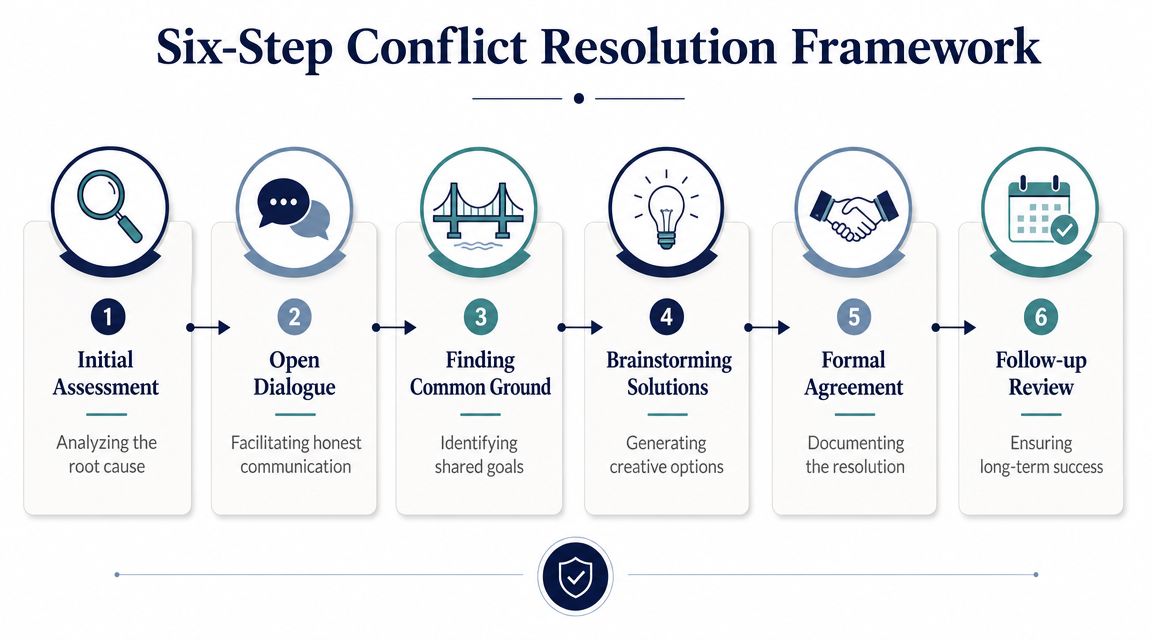
The most effective training programs teach a workflow people can remember under pressure. A proven model includes six steps: clarify the disagreement, establish a shared goal, surface barriers, generate options, agree on the best resolution, and assign responsibilities, according to this six-step conflict resolution guide. The strength of the model is its simplicity. It turns a heated interpersonal issue into a problem-solving task.
Step one to step three
Clarify the disagreement People often enter a conflict conversation arguing about symptoms rather than the core issue. One person thinks the problem is missed deadlines. Another thinks it is unclear authority. Until the disagreement is named properly, the conversation stays muddy.
Establish a shared goal Establishing a shared goal is often the point at which many conversations improve. Even when people disagree on cause or responsibility, they can often agree on the outcome they both want, such as a smoother handover, a cleaner client experience, or less confusion in weekly meetings.
Surface barriers
Barriers usually sit below the first layer of complaint. They might include unclear decision rights, communication style clashes, workload pressure, or assumptions that were never tested.
A conflict conversation becomes more productive the moment participants stop defending positions and start describing obstacles.
Step four to step six
Generate options
Teams need more than one path forward. If the only option on the table is “do it my way,” the process has already stalled. Good facilitation encourages alternatives, trade-offs, and practical compromises.Agree on the best resolution
This step calls for specificity. “We'll communicate better” isn't an agreement. “The project lead confirms priorities in writing after the Monday stand-up” is.Assign responsibilities
Conflict often returns when no one owns the next action. Responsibility creates follow-through and reduces ambiguity.
What this looks like in a real team
Consider a project team where operations believes sales is overpromising delivery timeframes, and sales believes operations changes priorities without warning. A poor response would be a venting session chaired by a frustrated manager. A stronger response would move through the six steps, define the actual breakdown, agree that both sides want reliable client delivery, identify process barriers, then assign who confirms scope and who approves changes.
This kind of repeatable framework is especially useful when teams include different working styles and communication preferences. That's why conflict capability often pairs well with broader work on managing different personalities within a team for success.
Beyond the Classroom Experiential and Play-Based Learning
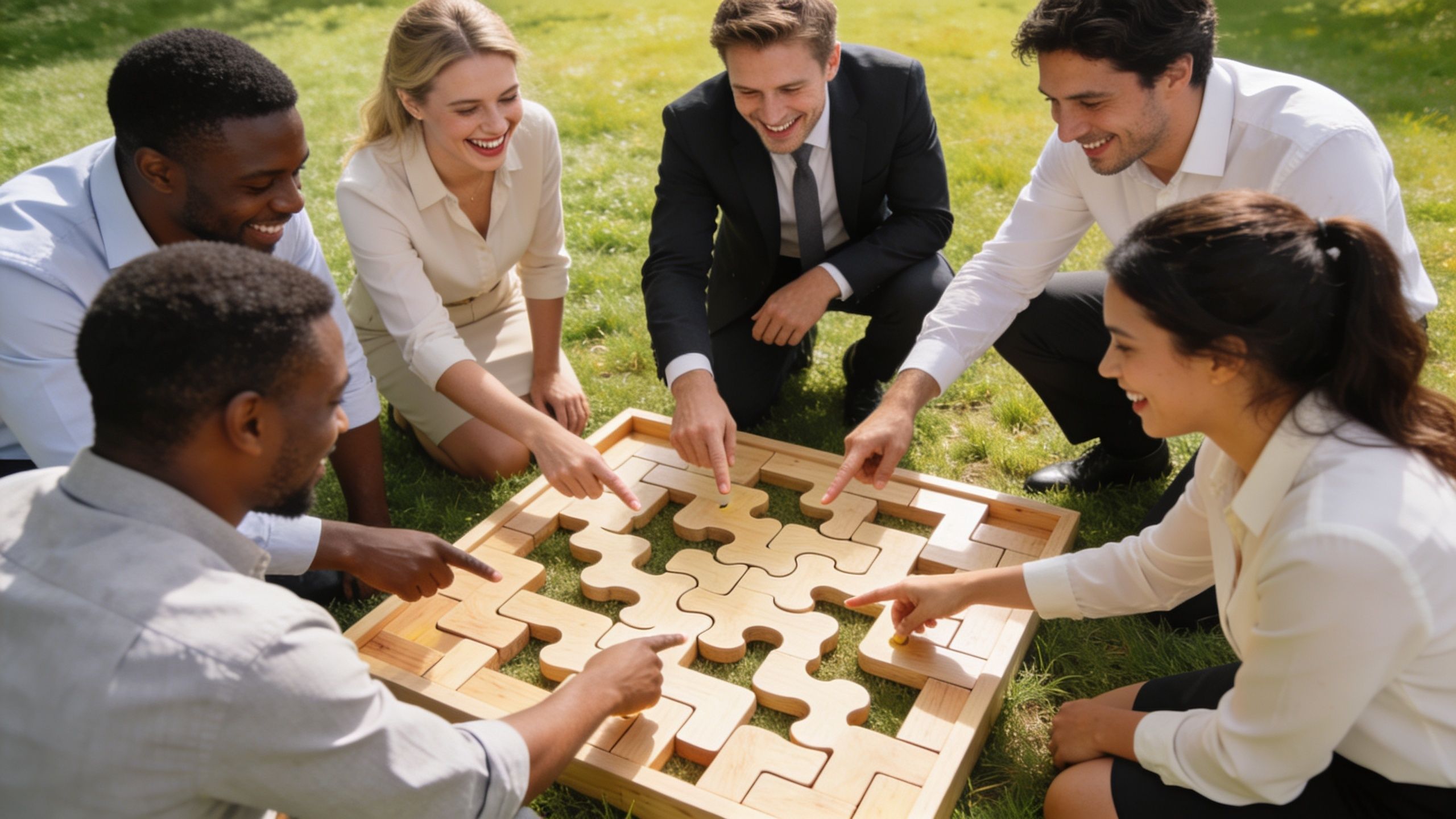
A classroom can explain conflict. It can't fully simulate what happens when a team is under time pressure, roles are unclear, and different personalities are trying to solve a shared problem. That's why experiential learning has a distinct advantage. It creates a low-stakes environment where teams can practise the very behaviours they'll need in the workplace.
The evidence on training outcomes supports a skills-based approach. Among employees who received conflict resolution training, 95% said it helped them seek mutually beneficial outcomes, and 76% reported positive results overall from the experience, according to the workplace conflict training statistics compiled here. The practical reading of that data is straightforward. Training works best when it changes behaviour, not when it only improves awareness.
Why experiential formats work better for transfer
Experiential and play-based formats make behaviour visible. A facilitator can observe who dominates discussion, who avoids tension, who listens well, and who jumps to solutions before the issue is clear. Teams can then debrief real behaviour rather than hypothetical examples.
That matters because conflict competence is relational. People need to feel pressure, interpret signals, recover from missteps, and try again. A smartly designed challenge can expose the same patterns that show up in meetings, project work, and stakeholder communication, but without the political weight of a live business issue.
What teams rehearse in practice
In a well-designed experiential session, participants often practise:
- Active listening under pressure: hearing instructions, checking assumptions, and responding without talking over others
- Negotiation with constraints: balancing competing priorities when not everyone can get their first choice
- Shared problem-solving: moving from blame to task clarity when a group gets stuck
- Constructive recovery: resetting after confusion, disagreement, or frustration rather than spiralling into shutdown or control
The safest place to improve conflict behaviour is often not during a live dispute. It's during a well-facilitated shared challenge where the stakes are lower but the dynamics are real.
Play-based learning also helps with retention. Teams remember what they felt, what they did, and what happened next. That creates stronger transfer than a slide deck alone. For organisations exploring this approach, play-based learning in the workplace offers a useful way to think about how behaviour gets embedded through experience rather than instruction alone.
How to Choose the Right Conflict Resolution Training Partner
Not all providers approach conflict resolution training with the same level of rigour. Some deliver a polished workshop that participants enjoy but struggle to apply later. Others build a system that equips leaders and teams to diagnose conflict accurately, manage it with structure, and reinforce the skill over time.
A strong benchmark comes from the view that effective training must be a complete system, not a single event. A quality program should train three layers of skill: diagnostic skill, process skill, and transfer skill, as outlined in this guidance on why conflict resolution training matters. That framework is useful because it helps buyers assess substance rather than presentation.
What to ask before signing off
How is the program contextualised for Australian workplaces
Generic imported content often misses local communication norms, cultural competency issues, and power dynamics that shape how conflict is experienced and addressed.What do participants practise during delivery
If the answer is mostly discussion and theory, behaviour change will be limited. Strong programs include rehearsal, facilitated feedback, and realistic scenarios.How is learning embedded after the session
Journals, peer learning, manager reinforcement, and follow-up conversations help prevent the usual drop-off after an event.How will success be measured
Providers should be comfortable discussing resolution rate, participant satisfaction, team morale, and relationship quality as practical evaluation points.
What tends not to work
Short awareness sessions can be useful as an introduction, but they rarely solve recurring team friction by themselves. Another weak approach is over-relying on policy language. Staff don't need a script full of formal terms for an everyday disagreement over decision-making or workload allocation. They need a clear process, enough practice to use it, and facilitation that respects the complexity of real workplaces.
The best training partners understand hybrid work, psychological safety, and culturally diverse teams. They also know when a conflict issue belongs in leadership development, when it requires facilitated team work, and when it needs a formal HR pathway instead.
Conclusion Building a More Resilient and Collaborative Team
Conflict resolution training is often framed too narrowly. It's not only for teams in trouble, and it shouldn't sit on the sidelines as a remedial HR measure. In a modern organisation, it's part of the operating system for collaboration.
The business case is clear. Conflict absorbs work time, leadership bandwidth, and formal management costs. The practical response is equally clear. Teams need a structured method, leaders need a better way to guide difficult conversations, and organisations need learning formats that move skills from theory into behaviour.
The most effective approach combines clear process with lived practice. A repeatable framework helps people manage disagreement with less ambiguity. Experiential learning helps them apply those skills when pressure rises. Together, those elements build teams that can disagree without fragmenting, solve problems faster, and maintain trust while doing demanding work.
Organisations that invest in conflict capability aren't just trying to reduce friction. They're building stronger communication, better decision-making, and more resilient performance.
Corporate leaders planning a team day, offsite, conference, or culture program can explore Corporate Challenge Events for play-based experiences that help teams practise communication, collaboration, and problem-solving in ways that carry back into daily work.