
A leadership team can look busy on every channel and still have a connection problem. The signs are familiar. Email threads get longer, meeting chat becomes a side conversation, feedback lands badly, and people start interpreting silence as intent. Nothing has collapsed, but the team no longer feels easy with one another.
That's usually where workplace connection gets misunderstood. Leaders treat it as a culture theme or an engagement activity, when it's part of operating performance. Teams that feel heard, included and safe to speak plainly don't just get along better. They coordinate faster, solve problems earlier and recover from friction with less wasted energy.
Table of Contents
What Is Workplace Connection?
Workplace connection isn't the same as friendliness. A pleasant team can still avoid hard conversations, misread one another and work in parallel instead of together. Connection is stronger than social ease. It's the shared belief that people can contribute, ask, challenge, admit uncertainty and still remain respected members of the team.
At a practical level, workplace connection sits underneath trust, psychological safety and mutual reliability. It affects whether feedback is taken as useful input or personal criticism. It shapes whether a meeting becomes a real working session or a sequence of status updates with no honest discussion.
A connected team tends to show a few observable patterns:
People clarify early: They ask, “Is that what you meant?” before assumptions harden.
Disagreement stays useful: Different views are discussed without becoming identity threats.
Support is visible: Colleagues step in, share context and reduce friction instead of protecting turf.
Communication has texture: Conversations include tone, intent and human awareness, not just information transfer.
Workplace connection is the invisible architecture behind good communication. When that architecture is weak, even competent teams start operating defensively.
This is why workplace connection should be treated as a structural condition, not a morale extra. Teams don't become connected because they had one good workshop or one social event. They become connected because their daily interactions keep confirming that it's safe and worthwhile to engage openly.
That distinction matters for leaders looking for real improvement rather than cosmetic activity. If a team is polite in meetings but guarded in decision-making, the issue isn't a lack of communication volume. It's a lack of relational quality. The useful starting point is to look for the early patterns of disconnection, including the hidden signals of team disconnection, before they show up as turnover, conflict or stalled execution.
Why Workplace Connection Is a Business Imperative
Weak workplace connection shows up as operational drag long before it appears in a culture review. Leaders see slower decisions, more rework, rising caution in meetings and a growing dependence on a few people who hold the team together informally. Those are business issues, not soft ones.
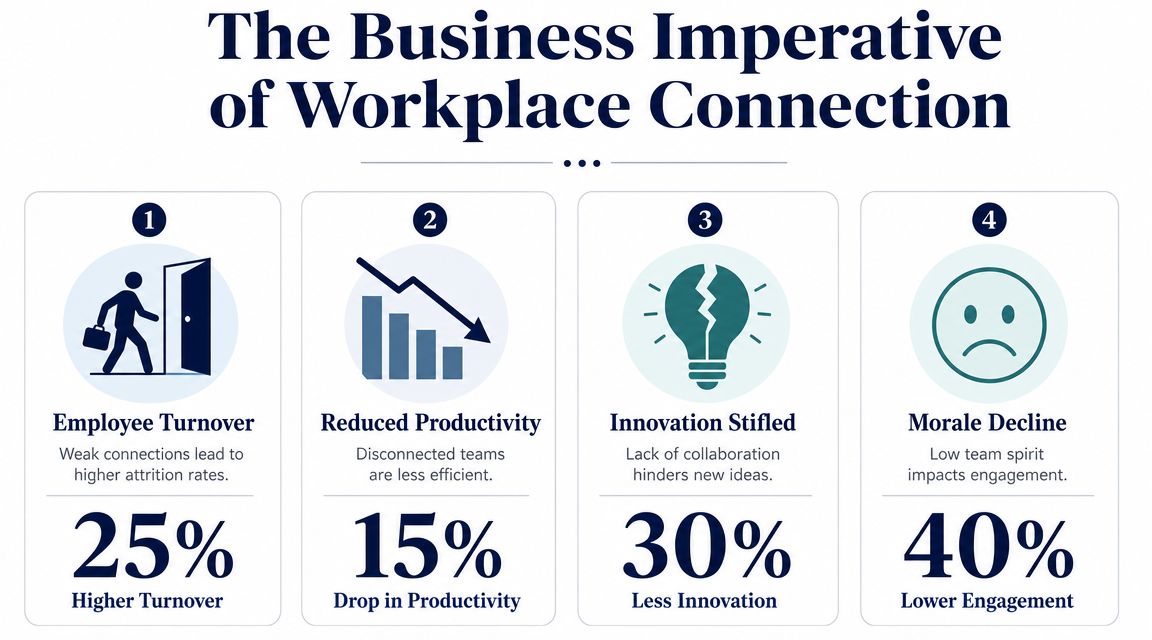
Connection is operational not ornamental
A team with strong connection usually communicates with less friction. People raise concerns earlier, ask for help sooner and spend less time decoding one another's intent. That creates better conditions for performance because cognitive energy goes into the work itself rather than into self-protection or damage control.
For CEOs and People & Culture leaders, the commercial value is straightforward. Clearer communication supports better execution. Stronger trust supports better judgement. Psychological safety supports better learning because people are willing to admit what they don't know and surface risks before they escalate.
A practical way to think about this is to stop separating engagement from coordination. They are closely linked. Leaders exploring how to enhance employee engagement often find the same levers keep appearing: communication quality, recognition, inclusion and manager behaviour.
The culture gap leaders need to close
The benchmark is difficult to ignore. A recent national benchmark from the Black Dog Institute found that 91% of workers had experienced poor mental health symptoms at work in the previous 12 months, yet only 30% felt their workplace had a mentally healthy culture according to this Black Dog Institute benchmark summary.
That gap points to a leadership problem. Many organisations talk about connection, wellbeing and support, but they don't redesign the conditions that sustain those outcomes. They run an event, publish a value statement or ask managers to check in more often, while leaving communication norms, feedback habits and team pressure untouched.
Practical rule: If people can't speak candidly, challenge respectfully and recover from mistakes, the culture isn't connected. It's just controlled.
The stronger response is structural. Review meeting practices. Tighten feedback quality. Train managers to handle tension without shutting people down. Create repeatable rituals that help distributed teams stay visible to one another. For leaders planning those broader changes, the state of work in 2026 is a useful framing resource because it places team connection inside wider workplace design choices rather than treating it as an isolated culture initiative.
The Digital Disconnect Why More Communication Can Weaken Connection
The communication shortage isn't the primary issue; teams have a channel problem. Messages are constant, but meaning is thin. A team can exchange updates all day and still miss the human cues that help people interpret urgency, emotion, hesitation and intent.
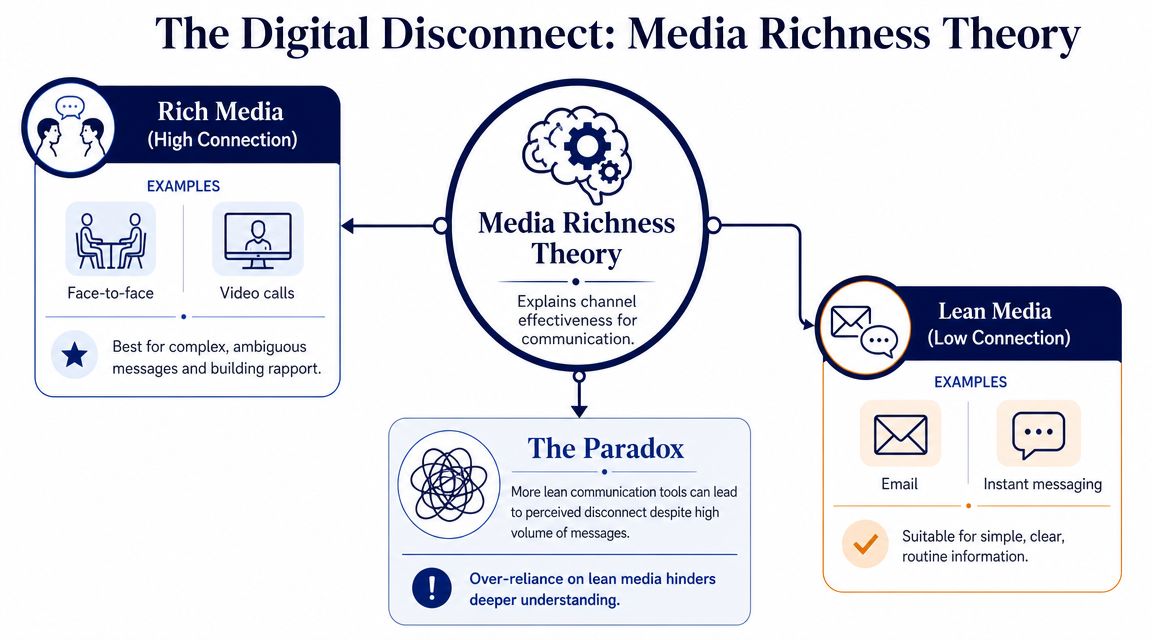
When the channel strips out meaning
Media Richness Theory offers a useful lens here. Some channels carry more context than others. Face-to-face communication is rich because it includes tone, pace, facial expression, body language and immediate feedback. Video can still carry a lot of that context. Email and instant messaging are leaner. They're efficient, but they remove cues that help people understand what's really being said.
That's why low-context channels work well for routine updates and simple decisions, but often fail under ambiguity. Performance feedback, conflict, role tension, strategic debate and emotionally loaded conversations need richer media. If leaders keep those conversations in email or chat because it feels quicker, they usually pay for that speed later in confusion, defensiveness or repair work.
A practical decision guide helps:
| Situation | Better channel choice | Why |
|---|---|---|
| Routine update | Email or chat | Fast, clear, low ambiguity |
| Clarifying confusion | Phone or video | Immediate feedback reduces misread intent |
| Sensitive feedback | Face-to-face or video | Tone and response can be managed in real time |
| Conflict or tension | Face-to-face first where possible | Richer cues support resolution and trust |
Many organisations also need firmer norms around digital tool sprawl. Teams using Microsoft 365, Teams, Outlook and shared files often benefit from clearer rules about where work lives and when escalation should move into conversation. A practical companion resource is mastering team communication in Microsoft 365, especially for leaders trying to reduce duplication and message fragmentation.
How leaders can see the gaps
Digital communication leaves a trace, and that trace can be useful if it's interpreted carefully. Organisational Network Analysis uses interaction data from digital tools to map information flow and identify disconnected teams or individuals. For leaders in distributed work settings, ONA provides a data-driven way to measure whether connection programs are improving communication density and cross-team ties, moving beyond simple satisfaction surveys, as outlined in Visier's overview of ONA for remote workforce connection.
ONA is useful because it reveals patterns that meeting attendance data can't. A team may appear highly active while still relying on a few central people to translate, connect and unblock everyone else. That structure creates fatigue and fragility. If those people leave or disengage, the network weakens quickly.
The answer isn't more digital traffic. It's better communication design. Rich channels for rich conversations. Lean channels for lean tasks. Recovery time for over-meeting teams. More deliberate hybrid practices. Leaders confronting overload can also review whether Zoom fatigue is real and how to avoid it when deciding which interactions should remain synchronous and which should not.
The Core Behaviours of Genuine Connection
Connection becomes visible in behaviour long before it appears in survey language. Teams build it through repeated acts of attention, interpretation and response. That's why the most useful leadership question isn't whether people like each other. It's whether their habits make one another easier to work with.

Active listening
Active-empathetic listening is a discipline, not a personality trait. It means listening for meaning, emotion and intent instead of preparing the next response while the other person is still speaking. In workplaces, that often looks simple on the surface: fewer interruptions, better follow-up questions, and short reflections such as “It sounds like the issue isn't the timeline, it's the lack of clarity on ownership.”
Managers who do this well reduce defensiveness because people feel understood before the discussion moves to action. Teams also make fewer false assumptions. A rushed leader hears a complaint. A listening leader hears a risk, a pattern or an unmet need.
Empathy over efficiency
Many leaders undermine connection by moving too quickly to solve. Efficiency matters, but timing matters more. If a team member raises frustration and gets an instant solution without any acknowledgment, the exchange may be productive on paper while still leaving the person unheard.
Empathy in a corporate setting doesn't mean lowering standards or avoiding accountability. It means recognising context before directing behaviour. For some teams, frameworks like the workplace love languages model can act as a useful prompt for discussing how different people best experience appreciation, support and recognition at work.
A fast answer can close a task. It rarely opens trust.
Intentional presence
Presence is one of the most underrated leadership behaviours in hybrid work. People notice when attention is split. They notice when a leader asks a question while scanning notifications, or when a meeting host gives in-room participants the full conversation and remote attendees a summary version.
Intentional presence means choosing to be fully in the interaction that matters. In practice, that can include:
Single-tasking in one-to-ones: No typing unless it's agreed and visible.
Designing hybrid meetings properly: Remote participants are invited in early, not after side discussion has already shaped the outcome.
Closing with clarity: People leave knowing what was decided, what remains open and who owns the next move.
Teams often use the phrase “team player” loosely, but connection relies on more than goodwill. It depends on behaviours colleagues can trust under pressure. A clearer definition is set out in this guide to what it means to define a team player, especially for leaders trying to make collaborative standards more observable.
Three Daily Habits to Build Stronger Connection
Culture shifts when behaviour becomes repeatable. Teams don't need a complex program to start improving workplace connection. They need a few habits that interrupt poor communication patterns before those patterns become normal.
Pick up the phone
When a message thread starts generating heat, ambiguity or too many interpretations, the best move is often to change the channel. A short phone call or video conversation can clear up tone, confirm intent and stop unnecessary escalation.
This habit works because it respects context. Email is efficient for documenting information, but it's weak at handling complexity. Leaders who model channel switching teach the team that speed doesn't outrank clarity.
Acknowledge and validate
People engage more openly when their perspective has been recognised before the discussion turns to solutions or correction. Validation doesn't mean agreement. It means signalling that the person's experience or concern has been heard accurately.
In practice, that can sound like this:
For a frustrated colleague: “That makes sense. The late change did create extra work.”
For a cautious team member: “There's a genuine risk in what you're flagging. It's worth unpacking.”
For someone offering an idea: “There's something useful in that. Keep going.”
These small acknowledgments change the emotional temperature of a conversation. They create the conditions for honesty without reducing standards.
Close the loop
A surprising amount of disconnection comes from unfinished communication. Someone assumes a message was understood. Someone else assumes silence means agreement. Weeks later, the team is dealing with avoidable resentment.
Leadership advice: Don't confuse sending information with shared understanding. Connection strengthens when people know the loop has actually been closed.
Closing the loop can be as simple as confirming the decision, naming the owner and checking that expectations match. Strong teams do this visibly. They don't leave alignment to inference.
A useful daily rhythm looks like this:
Clarify the ask before work starts.
Confirm the decision when the conversation ends.
Follow up briefly if there's any doubt about interpretation.
These habits look minor, but they accumulate. Over time, they reduce friction, increase reliability and make communication feel safer and cleaner.
How Play-Based Team Building Accelerates Connection
Connection is often understood conceptually. The harder part is behaviour change. People can define trust, psychological safety and collaboration perfectly well, then return to the same habits the moment pressure rises. That's why practice matters more than language alone.
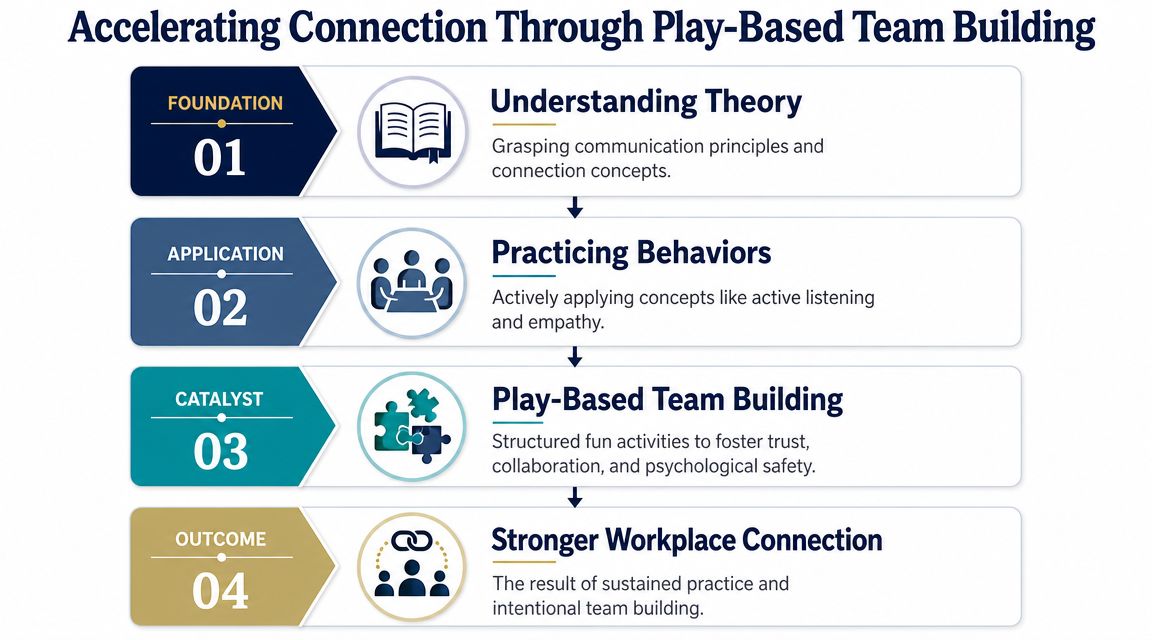
Why practice changes behaviour faster than theory
Play-based team building gives teams a practical environment to rehearse the behaviours that support connection. Shared challenges create live conditions for listening, decision-making, adaptability, encouragement and problem-solving. That's different from a discussion about teamwork. It asks people to do teamwork together.
Well-designed activities also loosen rigid workplace roles. The quiet analyst may become the clearest strategist. The formal manager may need to rely on others rather than direct them. Those shifts matter because they give teams new evidence about one another, which is often what connection has been missing.
A practical example is the use of facilitated programs such as Micro-Play team experiences, where short, purposeful activities are used to strengthen energy, communication and team interaction without requiring a full offsite day.
What carries back into work
The value of play in a corporate setting isn't the activity itself. It's the transfer. Teams remember who listened well under time pressure, who invited others in, who adapted quickly and who helped the group recover after a mistake. With good facilitation, those observations are converted into explicit working norms.
What tends to transfer back most effectively includes:
Listening under pressure: People learn to pause and process rather than speak over one another.
Trust through contribution: Team members see that value can come from different styles and roles.
Shared language: The group leaves with concrete examples it can refer to later in meetings and projects.
Psychological safety in action: People experience what it feels like to take a risk and still remain included.
Play becomes powerful in workplaces because it creates permission to interact differently. In that altered state, teams often rebuild energy, reduce barriers and form more useful patterns of collaboration than they can access in routine meetings. Used well, it isn't a break from performance. It's rehearsal for it.
Start Building a More Connected Team Today
Workplace connection improves when leaders stop treating it as a social by-product and start treating it as communication infrastructure. Teams connect more strongly when channels match the message, when people listen for meaning, and when managers create conditions where honesty is workable, not risky.
That also means avoiding the common trap of trying to measure connection only through attendance, activity logs or surveillance-heavy systems. Workplace analytics can infer connection from digital data, but HR leaders need to weigh the risks carefully. As outlined in this guide to workplace workforce analytics, the same infrastructure can enable granular employee tracking, and indoor-location systems can reconstruct historical movement patterns. Connection initiatives need data minimisation and purpose limitation, with a clear bias toward human-centred design rather than technological overreach.
A strong strategy usually combines several layers:
Communication discipline: Rich channels for nuanced issues, lean channels for simple tasks.
Manager capability: Better listening, clearer feedback and stronger meeting practices.
Team rituals: Repeated behaviours that build inclusion, visibility and trust over time.
Practice environments: Structured opportunities to rehearse collaboration, not just discuss it.
The organisations making progress in this space don't rely on one-off inspiration. They build durable habits. They make expectations visible. They help teams experience better ways of working together, then reinforce those behaviours in day-to-day operations.
If your team needs a practical way to strengthen workplace connection, Corporate Challenge Events designs facilitated play-based experiences that help teams practise listening, trust, adaptability and collaboration in ways that carry back into everyday work.