
When leaders talk about connection at work, they usually talk about communication, trust, or collaboration. They rarely ask a simpler question. Can this team still laugh together in a healthy way?
Not performative laughter in a town hall. Not polite laughter after a senior leader's joke. The kind that signals ease, shared presence, and enough interpersonal safety for people to drop their guard for a moment.
That gap matters because laughter is one of the most accessible forms of adult play available in the workplace. It changes group energy quickly, asks very little of participants, and doesn't require artistic skill, athletic ability, or a particular personality type. In the right format, it can support stress reduction and social connection without turning a work setting into a novelty act.
For teams under pressure, that makes laughter yoga worth a serious look. It isn't comedy, and it isn't about waiting for someone funny to rescue the room. It's a structured group practice that uses guided laughter, breathing, movement, and facilitation to help adults shift state together.
Table of Contents
- Is Your Team Forgetting How to Laugh Together?
- The Science of Shared Laughter in the Workplace
- Understanding the Laughter Yoga Method
- Corporate Laughter Yoga Session Plans and Exercises
- Adapting Laughter Yoga for Your Team and Workspace
- Measuring Impact and Deciding to Hire a Professional
- Conclusion: The Starting Point for a More Connected Culture
Is Your Team Forgetting How to Laugh Together?
A guarded team usually doesn't announce that it feels guarded. It shows up in tighter meetings, lower spontaneity, and the absence of shared moments that feel human. One useful leadership reflection is whether the team still has room for genuine laughter that connects people rather than excludes them.
Laughter at work is often misunderstood as a sign that people aren't focused. In practice, healthy laughter often signals the opposite. It can indicate trust, loosen rigid social patterns, and give people a way to reset after pressure without pretending the pressure isn't real.
That's one reason structured laughter yoga is worth considering. It gives teams a deliberate way to access shared energy and release tension without relying on jokes, banter, or a charismatic extrovert. For leaders trying to understand early warning signs of disconnection, this sits alongside broader indicators such as withdrawal, caution, and low participation, all explored in these hidden signals of team disconnection.
Healthy laughter is less about entertainment and more about whether people feel safe enough to participate without self-protection running the whole room.
In hybrid environments, this question becomes even sharper. Leaders already working on managing team habits in hybrid workplaces know that connection doesn't hold on its own. Teams need repeated, low-barrier rituals that help people re-enter a social state, especially when work has become heavily transactional.
A strategic leadership lens
Laughter yoga belongs in that conversation when it's used well. It isn't a replacement for strong management, role clarity, or psychological safety practices. It is a practical tool for helping adults move out of stress posture and into a more connected group rhythm.
For People & Culture leaders, the key question isn't whether laughter looks unusual on the surface. The better question is whether the workplace has become so controlled, fatigued, or self-conscious that people have stopped sharing the signals that help trust grow.
The Science of Shared Laughter in the Workplace
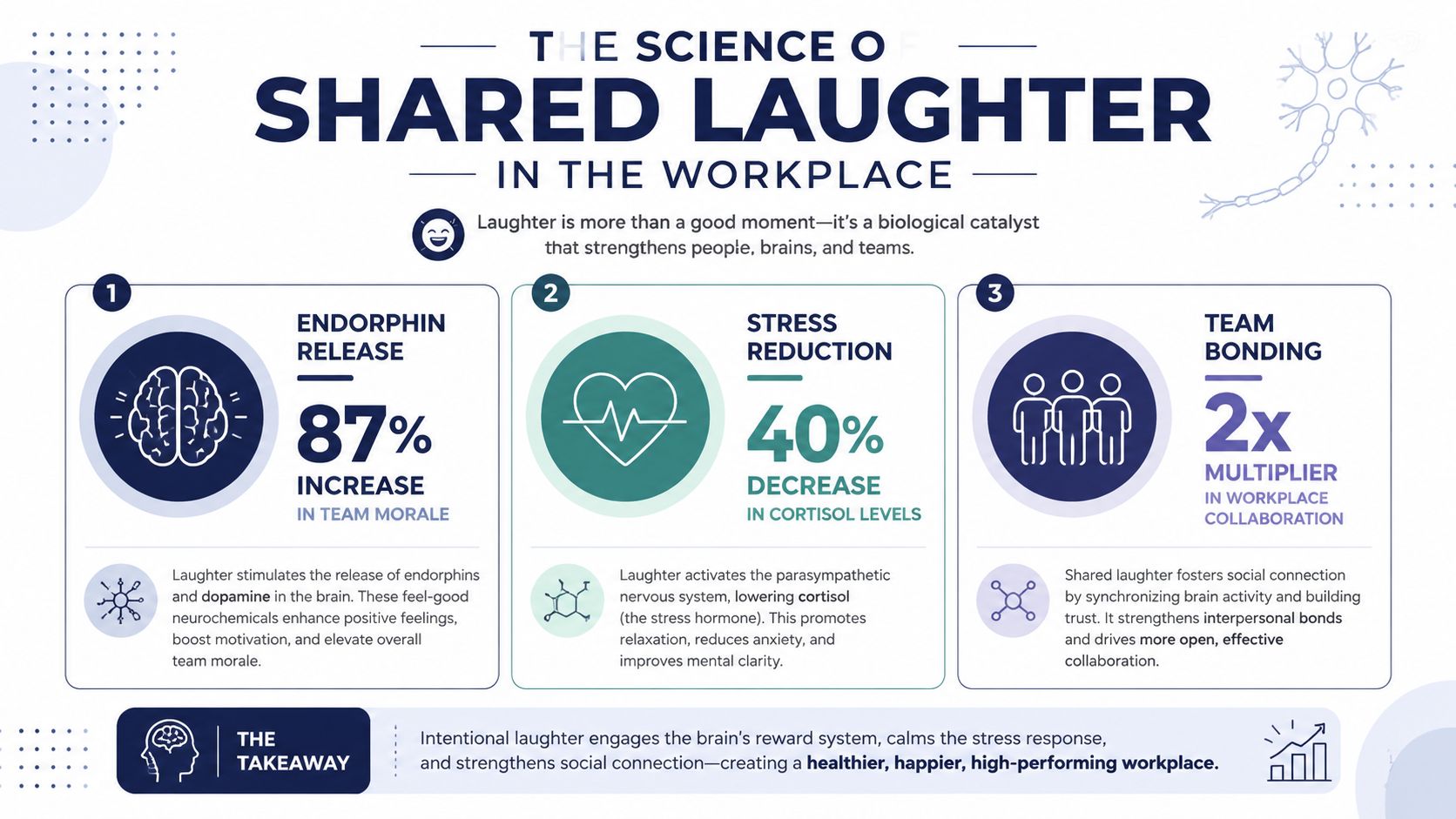
The strongest business case for laughter yoga is not that it makes work “fun.” It's that shared laughter changes group state. In workplace psychology terms, state matters because people think, speak, and collaborate differently when tension is lower and social ease is higher.
Why intentional laughter still counts
One common objection is that deliberate laughter sounds artificial. That objection misses the mechanism. The practice uses breathing, movement, eye contact, and repeated laughter cues to create a physiological and social response even when the laughter doesn't start from humour.
That matters because the evidence discussed in this Harvard Health overview of laughter yoga points to measurable outcomes in populations under real strain. A 2022 study reported that nurses attending laughter yoga classes twice a week for four weeks reduced their burnout risk. A 2023 study found that eight sessions improved quality of life and reduced loneliness among adults aged 65 and older.
Those aren't corporate office samples, and leaders should be careful not to overextend the findings. But they do support a practical conclusion. Laughter yoga is best treated as a structured, repeated group intervention that may help with stress and social connection, not as a one-off morale stunt.
Practical rule: If the goal is better connection under pressure, leaders should design for repeated exposure and group participation, not a token five-minute laugh at the end of a meeting.
What leaders should take from the evidence
For workplace leaders, the relevance is straightforward:
- Stress-loaded groups respond to format: The reported outcomes came from guided sessions delivered over time, not from casual humour.
- Social outcomes are part of the value: Reduced loneliness and improved quality of life point to the relational side of the practice, not just the individual mood effect.
- Delivery matters: Breathing, movement, and facilitation are part of the method. Stripping those out usually strips out the value.
There's also an important boundary. The evidence base is still limited and mixed, so laughter yoga shouldn't be framed as a clinical solution or a substitute for mental health support. It works better as a wellbeing energiser, a connection practice, and a state-shifting group intervention.
Leaders exploring broader performance benefits of play can also see laughter through the same lens as other embodied connection practices discussed in why teams need a dose of play. The underlying principle is similar. Adults collaborate better when the body, not just the intellect, is allowed back into the room.
Understanding the Laughter Yoga Method
Laughter yoga is often misread because of its name. Many corporate buyers expect yoga mats, silence, or flexibility work. That isn't the format.
What it is and what it isn't
According to Laughter Yoga International's explanation of the method, Dr. Madan Kataria created laughter yoga in 1995, and it is now practised in more than 120 countries. The method combines intentional laughter with yogic breathing and is built on the principle that the body cannot distinguish between voluntary and genuine laughter in terms of producing similar physiological benefits.
That history gives the practice more credibility than many leaders expect. It has a clear origin, a defined method, and a global footprint. It also explains why the format has travelled so well across workplaces and community settings. Participants don't need to be funny, culturally similar, or verbally quick.
Laughter yoga connects naturally to a broader adult play philosophy. Play at work isn't limited to games or competition. As explored in the shift from the playground to the boardroom, it can also mean creating conditions where adults become more socially flexible, expressive, and present.
What participants actually do
A workplace laughter yoga session usually includes a facilitator-led sequence of:
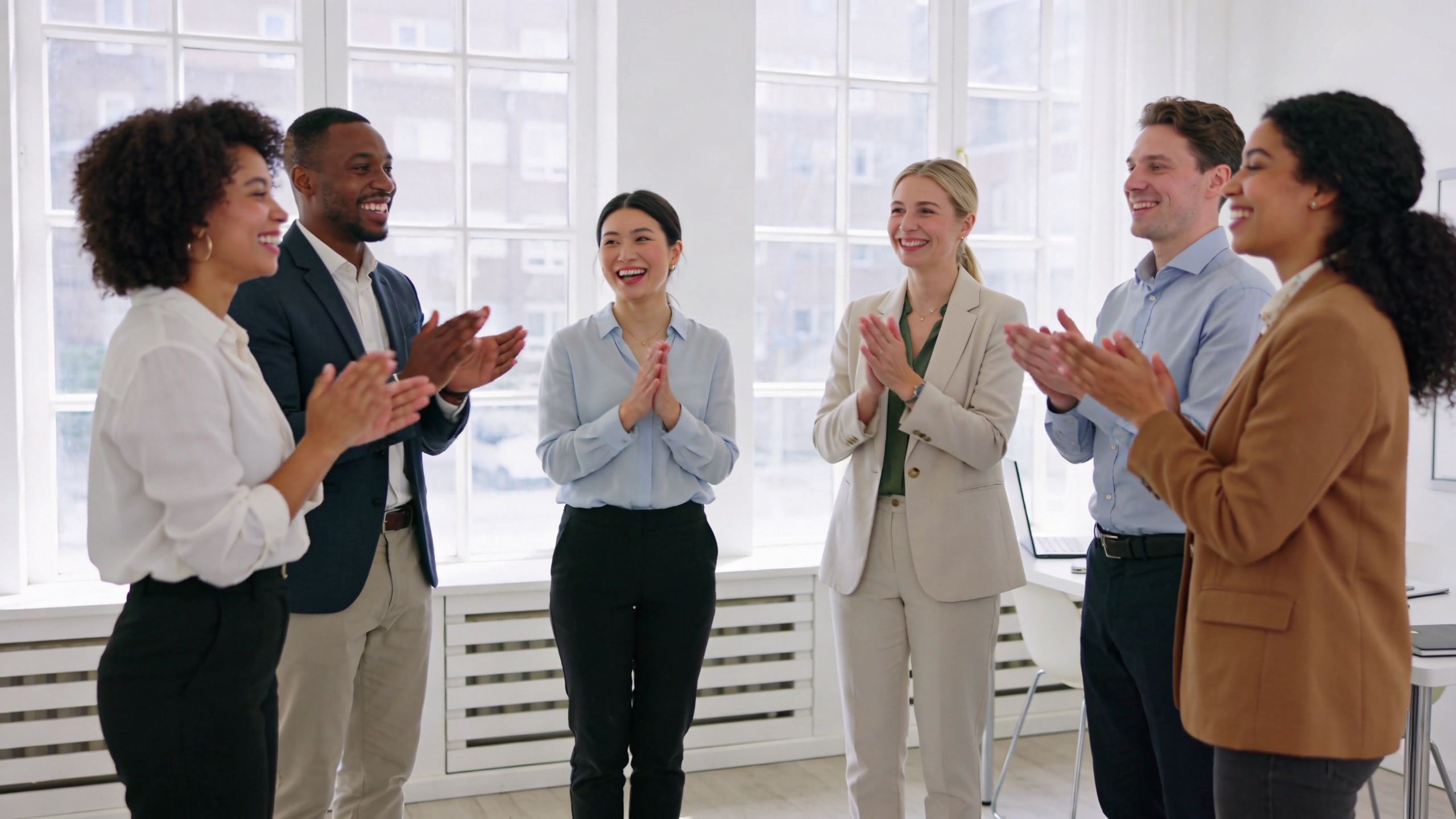
- Clapping and rhythm work to create synchrony and lower self-consciousness
- Breathing exercises drawn from yogic practice
- Guided laughter exercises that use movement, gesture, eye contact, and repetition
- A closing phase that settles the group rather than leaving energy scattered
The vital distinction is structure. Participants are not asked to improvise comedy or disclose personal stories. They're guided through a repeatable process that helps the group warm up, loosen, laugh, and regulate back down.
That's why the method often works best with sceptical professional audiences when it's introduced plainly. No hype. No forced insistence that everyone should love it. Just a clear explanation that this is a group exercise for connection, breathing, and stress release.
Corporate Laughter Yoga Session Plans and Exercises
A corporate laughter yoga session should be designed like any other facilitated intervention. It needs a clear purpose, realistic timing, and a sequence that takes people from caution to participation without rushing the middle.
A useful reference point is the structured group model described in this breakdown of laughter yoga session design. A complete session typically includes clapping and warm-ups, deep breathing, guided laughter exercises, laughter meditation, and guided relaxation. A full experience often needs 45 to 60 minutes to produce the intended physiological settling and group-bonding effects.
Sample laughter yoga session agendas
| Duration | Focus | Activities |
|---|---|---|
| 30 minutes | Light conference energiser | Brief welcome, clapping warm-up, breathing, a small set of simple laughter exercises, short close |
| 60 minutes | Standard team workshop | Welcome, clapping and movement, breathing, guided laughter exercises, laughter meditation, guided relaxation, reflection |
| 90 minutes | Deeper culture or wellbeing session | Full workshop format plus slower warm-up, more progressive exercises, longer debrief, clearer transfer back to team habits |
For most workplaces, 60 minutes is the strongest option. It gives enough time for resistance to soften, for the laughter to become less performative, and for the group to return to a settled state rather than being abruptly cut off.
Exercises that work in corporate settings
The most effective exercises are simple, low-risk, and easy to model.
Greeting laughter
Participants move through the room, make light eye contact, and greet colleagues with silent gestures that turn into laughter. This works because it mimics a familiar workplace behaviour, then gently breaks the script.Phone laughter
Participants mime taking a phone call, listen to an imaginary message, and respond with contagious laughter. It gives people a prop and a role, which reduces awkwardness.Presentation mistake laughter
Participants act out a minor work slip, then laugh with release rather than embarrassment. Used carefully, this can support a healthier relationship with imperfection.Gradient laughter
The facilitator starts with a small chuckle, then builds the room toward fuller laughter before slowing it down. This is especially useful for cautious groups because it creates permission in stages.
A good corporate exercise feels recognisable enough to enter quickly and different enough to interrupt the team's usual social habits.
Short facilitator prompts often work better than long explanations. Examples include:
- For warm-up: “Clap in rhythm, breathe fully, and let the sound do the work.”
- For eye contact exercises: “No pressure to perform. Stay light, stay moving, and let the group help you.”
- For the close: “Bring the energy down gradually so people leave centred, not overstimulated.”
A broader menu of employee engagement activities can help event planners place laughter yoga in context. It's especially effective when the event objective is reconnection, energy reset, or breaking social stiffness early in the day.
What doesn't work
Several choices usually undermine the session:
- Using it as a surprise ambush: Adults resist when they feel trapped into public silliness.
- Running it too briefly: A ten-minute slot rarely gives the room time to move past self-consciousness.
- Asking a manager with no facilitation skill to “just lead it”: Tone control matters.
- Treating it as stand-up comedy: The method doesn't depend on jokes, and trying to make it funny often makes it less effective.
The best results come when the session is framed as a serious, participatory wellbeing and connection practice. People don't need to be convinced that it's hilarious. They need to know they're in safe, competent hands.
Adapting Laughter Yoga for Your Team and Workspace
Laughter yoga is highly adaptable, but not infinitely so. The method depends on social contagion, shared cues, and the willingness of participants to join in without feeling exposed.

In-person, hybrid, and conference formats
The social mechanism is central. As noted by Laughter Yoga International, the effectiveness of laughter yoga relies on group participation, eye contact, and shared playfulness. In hybrid or remote environments, that creates a real design challenge because the facilitator has to bridge physical distance and protect psychological safety through a screen.
For in-person teams, circles or loose semi-circles usually work better than classroom rows. People need to see one another. For conference audiences, the session should be simpler, more rhythmic, and more tightly cued than for an intact team workshop.
Hybrid sessions need even more care. The strongest approach is usually to adapt rather than imitate the in-person version. Smaller gestures, clearer turn-taking, and explicit permission to participate at different intensity levels help reduce the strain of performing on camera.
Inclusion and safety considerations
Not every participant will enter the room ready to laugh. That's normal. Some will be reserved, some will be culturally cautious, and some will just need time.
Useful operating principles include:
- Offer graduated participation: People should be able to start with breathing, smiling, or light movement.
- Normalise hesitation: Scepticism often drops when it isn't treated as a problem.
- Screen for health considerations: Event organisers should encourage anyone with relevant medical concerns to check suitability before participating.
- Avoid forced intimacy: No exercise should require oversharing or physical contact.
The quality of a laughter yoga session is measured less by volume and more by whether the room feels safer, looser, and more connected by the end.
Leaders should also ask whether current workplace pressure has made the team more guarded than anyone wants to admit. If the answer is yes, the adaptation task is not about making people louder. It's about making participation feel safe enough to begin.
Measuring Impact and Deciding to Hire a Professional
A laughter yoga session shouldn't be judged by whether people looked enthusiastic in the moment. Leaders need a more useful test. Did the session create a visible shift in tension, connection, and willingness to engage?
What to measure after a session
For most organisations, simple measures are enough:
- Pulse questions immediately after the session: Ask whether people feel more energised, more connected, or more relaxed than before.
- Team observation in the next meeting: Watch for ease of interaction, spontaneous contribution, and less social stiffness.
- Facilitator notes: Record where resistance appeared, what helped people join, and whether the energy settled well at the end.
Qualitative feedback is especially valuable here. A strong response often sounds like, “That was less awkward than expected,” or “It changed the room.” Those comments tell leaders the session succeeded where many culture initiatives fail. It altered lived experience, not just opinion.
The business lens matters too. Teams already exploring the ROI of play know that not every outcome shows up as a hard metric immediately. Some interventions earn their value by helping a group reset faster, relate better, and carry less friction into work that already matters.
When internal facilitation is enough
An internal leader can sometimes run a light version successfully when:
- The team already has trust
- The group is small
- The purpose is a warm-up, not a deeper wellbeing intervention
- The facilitator is confident managing resistance without overtalking
In those cases, a short, well-structured exercise sequence may be enough.
When a professional facilitator is the better call
External facilitation is usually the preferred choice when the situation is more critical. That includes first-time introductions, large conference groups, low-trust teams, or settings where stress levels are high and the room needs careful handling.
A skilled facilitator does more than lead exercises. They pace the build, protect dignity, read resistance, and close the session properly. That last part is often underestimated. If a room is opened up without being grounded again, the intervention can feel messy rather than useful.
For People & Culture teams, the decision framework is simple. If the room needs nuance, containment, and confidence, bring in someone trained to do exactly that.
Conclusion: The Starting Point for a More Connected Culture
Laughter yoga deserves a more serious place in workplace conversations than it usually gets. Not because every team needs to become highly expressive, and not because laughter solves deep culture problems on its own. It deserves attention because it offers a low-barrier, structured way to help adults reconnect with breath, presence, and each other.
That's often how a healthier culture starts. Not with a grand program. With permission. Permission to loosen the social armour, interrupt stress patterns, and experience colleagues as human beings again.
For leaders, a useful reflection is whether the workplace still has enough room for healthy laughter, especially when pressure rises. If the answer is no, that's not a trivial culture issue. It may be an early sign that connection is thinning.
This topic will be explored further in the June edition of The Play Lab, which will feature an interview with laughter expert and gelotologist Merv Neal. For leaders who want to understand laughter as a serious workplace tool rather than a throwaway mood booster, that conversation will be worth watching.
If your team needs a smarter way to lift energy, strengthen connection, and bring the science of play into your next offsite, conference, or culture initiative, explore Corporate Challenge Events. Their play-based team building approach helps organisations create meaningful shared experiences that support trust, collaboration, and performance long after the event ends.