
Does team building create value beyond an enjoyable day away from the office? For business leaders, that question deserves a more useful answer than either automatic enthusiasm or blanket scepticism. A well-designed experience gives people a shared environment in which they can interact differently, discover strengths and practise better ways of working together.
The benefits of team building come from that practice. Play-based activities can make communication, trust, collaboration and problem-solving visible in ways that ordinary meetings often don't. A single event won't repair a damaged culture or solve unclear work design, but it can create a shared reference point that leaders and teams continue to use afterwards.
Table of Contents
- Why Team Building Still Gets Questioned
- What Team Building Really Means at Work
- The Three Pillars Behind Every Team Building Benefit
- 10 Benefits of Team Building in the Workplace
- Connection Benefits That Strengthen Working Relationships
- Thinking Benefits That Improve How Teams Work
- Feeling Benefits That Open People Up to Better Work
- Choosing and Measuring Team Building That Delivers Results
- FAQs and How to Take the Next Step
Why Team Building Still Gets Questioned
Can team building create value beyond an enjoyable day away from work? It is a fair question. Leaders are right to be cautious about activities with no clear purpose, limited accessibility or little connection to how their people work together afterwards. Enjoyment encourages participation, but enjoyment alone does not explain the importance of team building.
The difference lies in how the experience is designed. Purposeful team building can help adults enter a state of play, where they become more curious, engaged and willing to experiment. Within a structured challenge, behaviours such as listening, decision-making, leadership and adaptability become easier to observe. Leaders can then connect those observations to everyday work, including clearer handovers, greater participation in meetings and better coordination between departments.
This is the basis of modern team building. It uses an enjoyable shared experience to practise meaningful workplace behaviours, rather than treating a social outing as a complete team-development solution.
Research supports this more purposeful approach. A systematic review and meta-analysis of teamwork interventions found that team-development interventions can positively affect teamwork behaviours and team performance. Activities were particularly valuable when they gave participants opportunities to actively practise teamwork rather than simply receive information about it.
The need for these experiences is also clear in current engagement data. An Australian overview of ADP’s 2025 employee engagement findings reported that only 16% of Australian employees were fully engaged at work. Team building is not the only answer to disengagement, but it can give people an opportunity to reconnect, contribute differently and strengthen the relationships that support their everyday work.
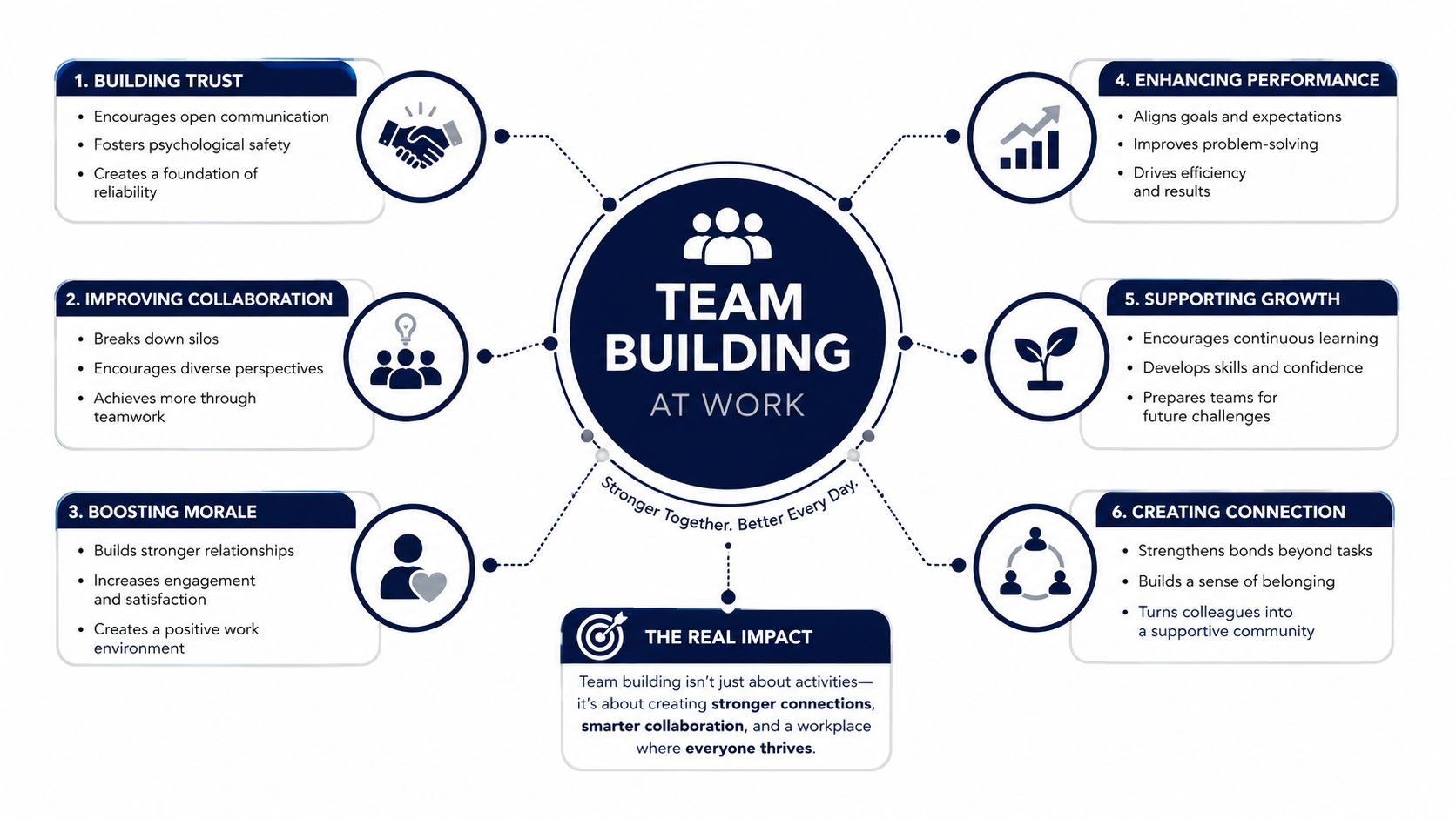
What Team Building Really Means at Work
At work, team building means creating a purposeful experience in which people can practise the behaviours their roles require. It is not simply about placing colleagues in the same room or giving them a break from their usual responsibilities. Effective team building creates a shared goal, meaningful interdependence and an opportunity to reflect on how the group worked together.
Play provides a powerful foundation for this process. The National Institute for Play describes play as a state shaped by free engagement, curiosity and absorption. When adults feel safe enough to explore, experiment and participate fully, they can enter this state too.
In the workplace, this changes the learning experience. People are not simply being told to communicate more clearly, trust one another or approach problems differently. They are placed in a situation where they must actively test those behaviours together and experience their impact in real time.
The latest Workplace Engagement Index highlights why this matters. Its 2026 findings revealed that one in four employees felt less engaged at work, while 56% had considered leaving their job within the previous six months. These challenges cannot be reversed by a single event, but they reinforce the need for intentional experiences that help people feel involved, valued and part of a functioning team.
This is what separates purposeful team building from a standard social event. Both can be enjoyable, but a well-designed experience also strengthens team bonding at work, develops collaboration and gives people shared behaviours they can take back into the workplace.
The Three Pillars Behind Every Team Building Benefit
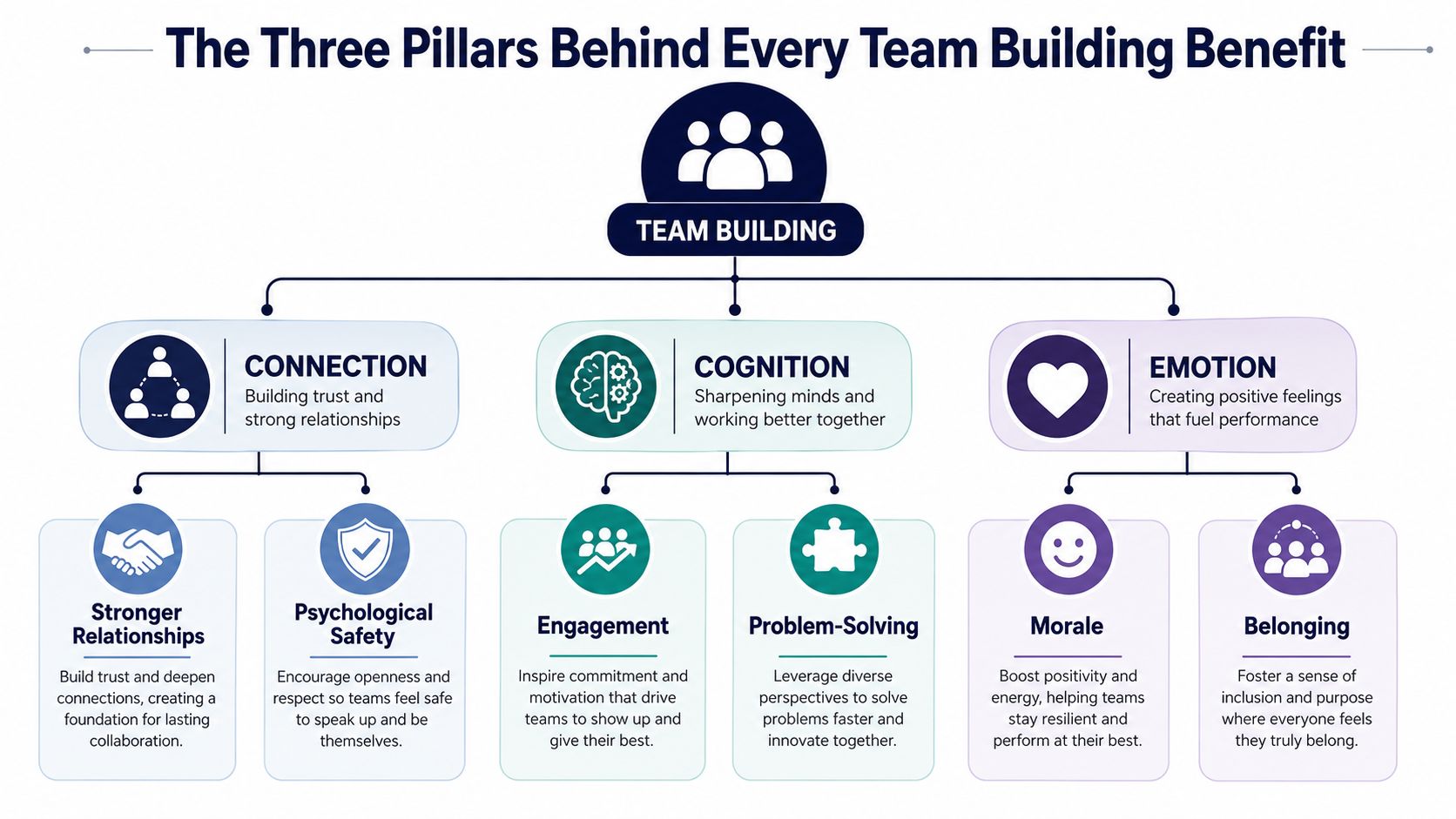
Teams do not always struggle because they lack skill or experience. Sometimes the real issue is how people connect, think and feel while working together.
A quiet meeting may reveal a connection problem. Everyone understands the agenda, but people hesitate to challenge an assumption, share an unfinished idea or ask for help. A stalled project may reveal a thinking problem, with plenty of information available but no shared way to assess options or make a decision. Constant pressure can create an emotional barrier, causing people to protect themselves rather than contribute openly or explore new possibilities.
The ten benefits of team building explored in this article fit within three reinforcing pillars:
-
Connection: Communication, trust, collaboration and stronger workplace relationships help people exchange information, speak openly and rely on one another.
-
Cognition: Problem-solving, creativity and a better understanding of individual strengths improve how teams interpret challenges, generate ideas and make decisions.
-
Emotion: Engagement, wellbeing and the state of play influence whether people feel safe, energised and open enough to participate, experiment and learn.
These pillars work together. Connection gives people the confidence to contribute. Cognition turns those contributions into ideas and coordinated action. Emotion influences whether people are willing to participate fully in the first place.
The most effective team-building experiences therefore do more than create a temporary lift in morale. They give people an engaging environment in which to practise real behaviours, understand one another differently and discover better ways of working together.
10 Benefits of Team Building in the Workplace
The benefits of team building extend beyond the activity itself. A well-designed experience gives people an opportunity to practise how they communicate, solve problems, respond to pressure and support one another. These ten benefits can be understood through three connected areas: how teams connect, how they think and how they feel while working together.
Connection Benefits That Strengthen Working Relationships
1. Improves Communication
A team can share an office and still operate as separate individuals. Effective communication requires people to listen carefully, clarify information and adjust their message so others can understand and act on it.
Team-building activities make these habits visible because participants must communicate while working towards a shared outcome. In Pipeline, each person holds responsibility for one part of the process. Success depends on how clearly participants exchange information, coordinate their movements and respond when the plan needs to change.
This gives teams an opportunity to notice where communication flows easily and where assumptions, unclear instructions or missed information create unnecessary friction. These observations can then be connected to workplace behaviours such as handovers, project updates and cross-departmental communication.
2. Builds Trust and Psychological Safety
Trust develops through repeated evidence. People make commitments, follow through, ask for help and learn how their colleagues respond when something does not go according to plan.
Safe Crack creates a contained environment in which teams must share information, test ideas and rely on one another to solve the challenge. Participants can see who speaks up, who asks clarifying questions and whether the group treats incorrect answers as failures or useful information.
Google’s Project Aristotle research into effective teams identified psychological safety as the most important dynamic among high-performing teams. Psychological safety means people feel able to contribute an idea, raise a concern or acknowledge a mistake without expecting embarrassment or punishment.
A single activity cannot manufacture trust instantly. However, a well-facilitated challenge can help teams recognise the everyday behaviours that either strengthen or weaken it.
3. Strengthens Collaboration
Collaboration is more than placing people together and giving them the same objective. It requires individuals to share responsibility, coordinate their contributions and recognise that the final result depends on the whole group.
Programs such as Pipeline and City Scramble create genuine interdependence. Participants need to divide responsibilities, exchange information and adjust their approach as new challenges emerge. No one person can complete the experience effectively in isolation.
These activities can reveal whether a team genuinely collaborates or simply divides tasks and works separately. A facilitated discussion afterwards can explore how decisions were made, whether everyone’s knowledge was used and how the group responded when priorities competed.
4. Develops Stronger Workplace Relationships
People often know their colleagues through job titles, departments and immediate responsibilities. Team building creates a different context in which those usual boundaries can soften.
A purpose-led program such as Bikes for Tykes brings people together around a shared charitable outcome. As teams complete challenges and build bikes for children in need, participants can discover qualities in their colleagues that may not be visible during an ordinary workday.
Someone known for their technical expertise may emerge as an encouraging communicator. A quieter colleague may contribute the detail that moves the team forward. These shared experiences create new reference points that can make future workplace interactions feel more natural and personal.
Relationships still require ongoing attention after the event. Leaders can support that process through regular check-ins, shared reflection and practices such as peer mentoring or a workplace coaching community. This helps turn a positive shared experience into stronger and more sustainable workplace connection.
Thinking Benefits That Improve How Teams Work
5. Increases Employee Engagement
Engagement grows when people feel involved, recognised and able to make a meaningful contribution. Team building can support these conditions by giving employees an active role in a shared experience rather than asking them to passively observe.
A program such as Play Offs gives people opportunities to contribute in different ways through a mix of challenges. Some participants may bring strategy, others energy, creativity, coordination or encouragement. This variety can help more people find a way into the experience and feel that their contribution matters.
Gallup’s employee engagement research links stronger engagement with important business outcomes, including productivity, retention, profitability and customer loyalty. Team building should not be treated as a complete engagement strategy, but it can contribute to a workplace experience in which people feel more involved with their colleagues and connected to a shared purpose.
6. Develops Problem-Solving Skills
Problem-solving becomes visible when a team encounters incomplete information, competing priorities or an approach that is no longer working. Instead of discussing problem-solving in theory, participants must make decisions together and experience the consequences.
In Safe Crack, teams analyse clues, share information and test possible solutions. Risk Reward adds uncertainty and strategic choice, requiring participants to balance opportunity with risk while reaching decisions as a group.
These experiences can reveal whether the team rushes towards the first idea, relies too heavily on one person or creates enough space for different perspectives. A useful debrief can explore which assumptions influenced the decision, how alternatives were assessed and what happened when new information became available.
Leaders can build on these observations using a more deliberate creative problem-solving model in everyday planning and decision-making.
7. Encourages Creativity
Creativity often benefits from a change in routine, environment or perspective. Team building temporarily removes people from familiar processes and gives them permission to experiment with ideas that may not be fully formed.
Stanford research found that walking increased creative output by an average of 60% compared with sitting, supporting the idea that changing physical context can influence creative thinking. The effect continued shortly after participants had finished walking, suggesting that movement can help unlock ideas rather than simply provide a break. Read the Stanford research on walking and creativity.
LEGO Legends encourages teams to think visually, experiment with possibilities and turn abstract ideas into something tangible. City Scramble combines movement with an unfamiliar environment, asking participants to interpret information, generate solutions and adapt as they progress.
The value is not in expecting every activity to produce a breakthrough idea. It is in helping teams practise curiosity, experimentation and the ability to build on one another’s thinking.
8. Reveals Individual and Team Strengths
Formal roles do not always show the full range of strengths within a team. A different challenge can reveal who organises information, generates ideas, notices details, remains calm under pressure or helps the group regain momentum.
Programs such as LEGO Legends, City Scramble and Survivor give participants multiple ways to contribute. Leadership may move between people as the challenge changes, allowing strengths to emerge without relying on job titles or hierarchy.
These observations should not be treated as formal assessments or definitive evidence of someone’s potential. They are conversation starters. A manager might discover that a quieter employee is an excellent strategic thinker, or that a confident leader could create more space for other voices. Teams can then discuss how those strengths could be used more deliberately at work.
Feeling Benefits That Open People Up to Better Work
9. Supports Wellbeing, Morale and Belonging
Positive social interaction, movement, laughter and time away from routine pressure can change how people feel about their workday and one another. Team building can give employees space to reconnect, release tension and experience being part of something shared.
The American Psychological Association’s guidance on workplace connection links workplace belonging and social connection with happier, healthier and more productive employees. This gives leaders a practical reason to consider how an experience makes people feel, as well as the skills it asks them to practise.
Active programs such as Mini Olympics can combine movement, teamwork and healthy competition. Minute to Win It uses quick, accessible challenges to generate laughter and shared energy. Charity programs such as Give a Dog a Home add a sense of purpose by bringing teams together to create something meaningful for the wider community.
Team building is not a treatment for burnout, chronic stress or mental health conditions. Its value lies in creating an inclusive and energising shared experience that can lift morale, strengthen belonging and remind people that positive interaction has a place within the working day.
10. Helps Adults Enter a State of Play
One of the most distinctive benefits of team building is its ability to help adults enter a state of play.
A play state arises when people become freely engaged, curious and absorbed in what they are doing. In this state, attention can deepen and people may become more willing to experiment, make mistakes, adapt and try again.
The National Institute for Play’s science overview connects play with cognitive, emotional, social and physical health throughout life. Its guidance on play in practice also explores how play can support flexible thinking, authentic connection, experimentation and sustainable performance.
Peer-reviewed research has examined the relationship between adult playfulness, coping and stress responses, along with links between adult playfulness and positive functioning. Together, this research reinforces that play is not simply entertainment for children. It remains a meaningful part of how adults connect, learn and respond to challenges.
Programs such as Play Offs, LEGO Legends and Minute to Win It can create the conditions for this state by combining clear challenges with curiosity, experimentation and enjoyment. The experience should feel psychologically safe and inclusive, allowing people to participate without feeling embarrassed or forced.
Corporate Challenge Events brings this science into the workplace through its Power of Play partnership with the National Institute for Play. This approach recognises play as a powerful human state with relevance to learning, connection, creativity, wellbeing and performance.
Choosing and Measuring Team Building That Delivers Results
Choosing the right team-building activity starts with one question: which workplace behaviour should this experience make easier?
A team experiencing poor information flow needs a different program from one seeking greater creativity, stronger cross-functional relationships or a more energised sense of connection. The goal should shape the activity, rather than choosing an experience first and attempting to justify it afterwards.
Leaders can brief a provider using three practical questions:
-
Which behaviour needs practice? Identify an observable change, such as clearer handovers, broader participation in decisions or greater willingness to ask for help.
-
Which activity creates that behaviour? Match the level of competition, movement, complexity and purpose to the team and its intended outcome.
-
How will the experience return to work? Include a debrief and identify one or two workplace practices that can reinforce the learning afterwards.
Measurement does not need to become overly complicated. Guidance on key areas to include in an employee engagement survey highlights areas such as connection, belonging, wellbeing, leadership and the wider employee experience. A short pulse survey before and after an event could ask how confidently employees communicate, contribute ideas, collaborate and seek support.
For organisations wanting a more structured approach, an overview of the Australian Public Service Commission engagement model explains how emotional connection and commitment can be measured through a focused set of engagement questions.
The most useful follow-up focuses on behaviour, not simply whether participants enjoyed the event. Leaders can revisit the original objective during team meetings and use practical guidance on measuring team performance to assess whether communication, collaboration or participation has changed over time.
FAQs and How to Take the Next Step
What are the main benefits of team building?
Team building can strengthen communication, trust, collaboration, relationships, engagement, problem-solving, creativity and workplace wellbeing. Play helps because it places adults in an active, exploratory state where they can practise these behaviours rather than only discuss them.
Why is team building important in the workplace?
It creates a structured setting for behaviours that routine work may conceal, including listening, speaking up, coordinating and adapting. The activity becomes a small working model of the team, making interaction easier to observe and discuss.
Can team building improve workplace performance?
It can support performance when the activity reflects real work behaviours and leaders reinforce the learning afterwards. It cannot replace clear roles, capable management or healthy work design.
How often should companies organise team-building activities?
Frequency should match the team's needs and operating rhythm. A recurring programme may support culture, while a focused intervention may fit a project or period of change.
What makes an activity effective?
Effective activities have a clear objective, inclusive design, skilled facilitation, psychological safety and a useful debrief. Entertainment alone rarely transfers into lasting workplace change.
How do leaders choose the right activity?
Start with the team challenge, then choose an experience that requires the desired behaviour. Leaders can review Corporate Challenge Events' team-building activities and select play-based learning that fits the organisation's goals.
Corporate Challenge Events offers play-based corporate programmes for communication, collaboration, charity, creativity, wellbeing and problem-solving at workplace events and offsites. Visit Corporate Challenge Events to explore options or discuss suitable outcomes.