
A team member has just finished a difficult client call. Another has stayed late to help meet a deadline. Someone else has quietly fixed a problem before it could affect the rest of the team.
The work continues, the next meeting begins, and nobody acknowledges what happened.
Now imagine someone pauses long enough to notice. They offer a specific thank-you, share the positive feedback with the team or take one task off that person’s already crowded list.
The action may take less than a minute, but it can change how that person experiences the rest of their day.
That is the idea behind Make Their Day, one of the four practices within the FISH! Philosophy. It is not about expensive rewards, forced compliments or grand displays of kindness. It is about intentionally contributing something positive to another person’s experience.
Practised consistently, these small moments can strengthen recognition, trust, belonging and the way people treat one another when work becomes demanding.
What does Make Their Day mean?
The FISH! Philosophy originated from observations of the energy and customer experience created by fishmongers at Seattle’s Pike Place Fish Market. Their behaviours were developed into four practical principles:
-
Be There
-
Make Their Day
-
Choose Your Attitude
-
Play
Together, these principles give teams a memorable framework for improving workplace relationships, engagement and culture.
Make Their Day asks people to find simple and meaningful ways to serve, support, recognise or delight someone else. The action is not performed to receive praise or secure something in return. It is a deliberate contribution to another person’s experience.
In practice, Make Their Day should be:
-
Intentional: You actively look for an opportunity to help or acknowledge someone.
-
Personal: The action reflects what will matter to that individual.
-
Meaningful: It responds to a genuine contribution, need or moment.
-
Timely: It happens close enough to the moment to feel relevant.
-
Sincere: It is about the other person, not the recognition you might receive for doing it.
That makes the principle more substantial than simply “being nice.” It requires attention. You need to notice what people contribute, understand what they may need and act in a way that feels genuine.
Why small moments matter at work
Workplace culture is shaped through repeated interactions.
It develops in meetings, client conversations, handovers, messages and the moments when someone asks for help. Policies and values provide direction, but everyday behaviour tells employees what the culture really rewards.
When people feel that their efforts are noticed, they are more likely to feel valued and connected to the team. Specific recognition can also reinforce the behaviours an organisation wants to see repeated.
Research from Gallup and Workhuman supports the importance of meaningful recognition. Their longitudinal research found that well-recognised employees were 45% less likely to have left their organisation two years later.
That does not mean a thank-you note will directly prevent someone from resigning. Retention is affected by leadership, pay, workload, development, flexibility and many other factors. However, recognition contributes to an environment in which people feel seen and connected.
Make Their Day also extends beyond manager-to-employee praise. It can strengthen relationships between colleagues, improve customer experiences and encourage people to support one another when pressure increases.
The effect comes from repetition. One thoughtful action can improve a moment. A workplace where people regularly notice and support one another can create a stronger cultural norm.
Make Their Day is different for everyone
A public compliment may energise one person and embarrass another. One employee may appreciate a handwritten note, while another would value practical assistance far more.
That is why personalisation matters.
Before deciding how to Make Their Day, consider:
-
What has this person contributed?
-
What do they appear to need right now?
-
Would they prefer public or private acknowledgement?
-
What form of recognition feels natural within your relationship?
-
Is the action inclusive and appropriate?
-
Am I doing this for them, or because I want to be seen doing it?
Generic praise can feel hollow because it does not tell the recipient what was noticed. “Great work” is positive, but “The way you kept that client conversation calm and gave everyone a clear next step made a real difference” is far more meaningful.
The second version recognises a specific behaviour and shows the person why their contribution mattered.
Practical help can be just as powerful. When someone is overwhelmed, another public compliment may not improve their day. Offering to handle a follow-up, clarify a priority or remove an unnecessary frustration might.
The gesture does not need to be large. It needs to fit the person and the moment.
Ten practical ways to Make Their Day at work
- Recognise something specific
Name the action, strength or behaviour you appreciated. Specific recognition feels more credible and helps the person understand the impact they created.
- Notice the work others do not see
Some of the most valuable contributions happen quietly. Acknowledge the person who prepared the information, fixed the process, supported a colleague or prevented a problem behind the scenes.
- Share positive feedback
When a customer, stakeholder or colleague says something positive about someone’s work, pass it on. Do not assume the person already knows how their contribution was received.
- Offer practical help
If someone is under pressure, ask whether there is a task, call or follow-up you can take off their list. Small acts of practical support often mean more than a motivational message.
- Give credit to the contributor
Name the person whose idea, insight or work influenced the result. This is particularly important in meetings where confident or senior voices may receive more attention.
- Ask, then listen properly
A genuine conversation can change someone’s day. Ask how they are going and give them enough attention to answer honestly. Do not ask while looking at your phone or preparing your response.
- Celebrate progress
Do not wait until the final outcome to acknowledge effort. Recognising progress can help people maintain energy during long projects, challenging periods or complex change.
- Create an opportunity
Making someone’s day can involve showing confidence in their potential. Invite them to present an idea, lead part of a project, attend an important meeting or develop a skill they care about.
- Remember what matters to them
A work anniversary, completed qualification, family milestone or goal mentioned in an earlier conversation can provide an opportunity for meaningful acknowledgement.
- Remove a recurring frustration
Fix the broken process, clarify the confusing handover or simplify the repetitive task that has been making someone’s work harder. Improving the conditions around a person can be more valuable than giving them a reward for enduring those conditions.
How leaders make the principle credible
Make Their Day cannot be treated as an HR campaign that leaders endorse but do not practise.
Employees watch what leaders notice, reward and ignore. If recognition consistently goes to the most visible people, quieter contributions begin to feel unimportant. If a leader promotes appreciation but rarely thanks anyone, the message loses credibility.
Leaders can bring the principle into everyday work by:
-
Giving recognition promptly and specifically
-
Learning how each person prefers to be acknowledged
-
Noticing effort as well as outcomes
-
Recognising collaboration, not just individual wins
-
Sharing customer feedback with the people responsible
-
Giving credit fairly
-
Encouraging peer-to-peer appreciation
-
Building recognition into existing conversations
This does not require another meeting or elaborate recognition platform. A leader can use weekly check-ins, project reviews, team meetings and informal conversations that already exist.
Consistency is more important than ceremony.
Leaders should also ensure Make Their Day is not used to avoid constructive feedback. People can be valued and still need clear conversations about expectations, performance or behaviour. Genuine care includes being honest when something needs to change.
What Make Their Day is not
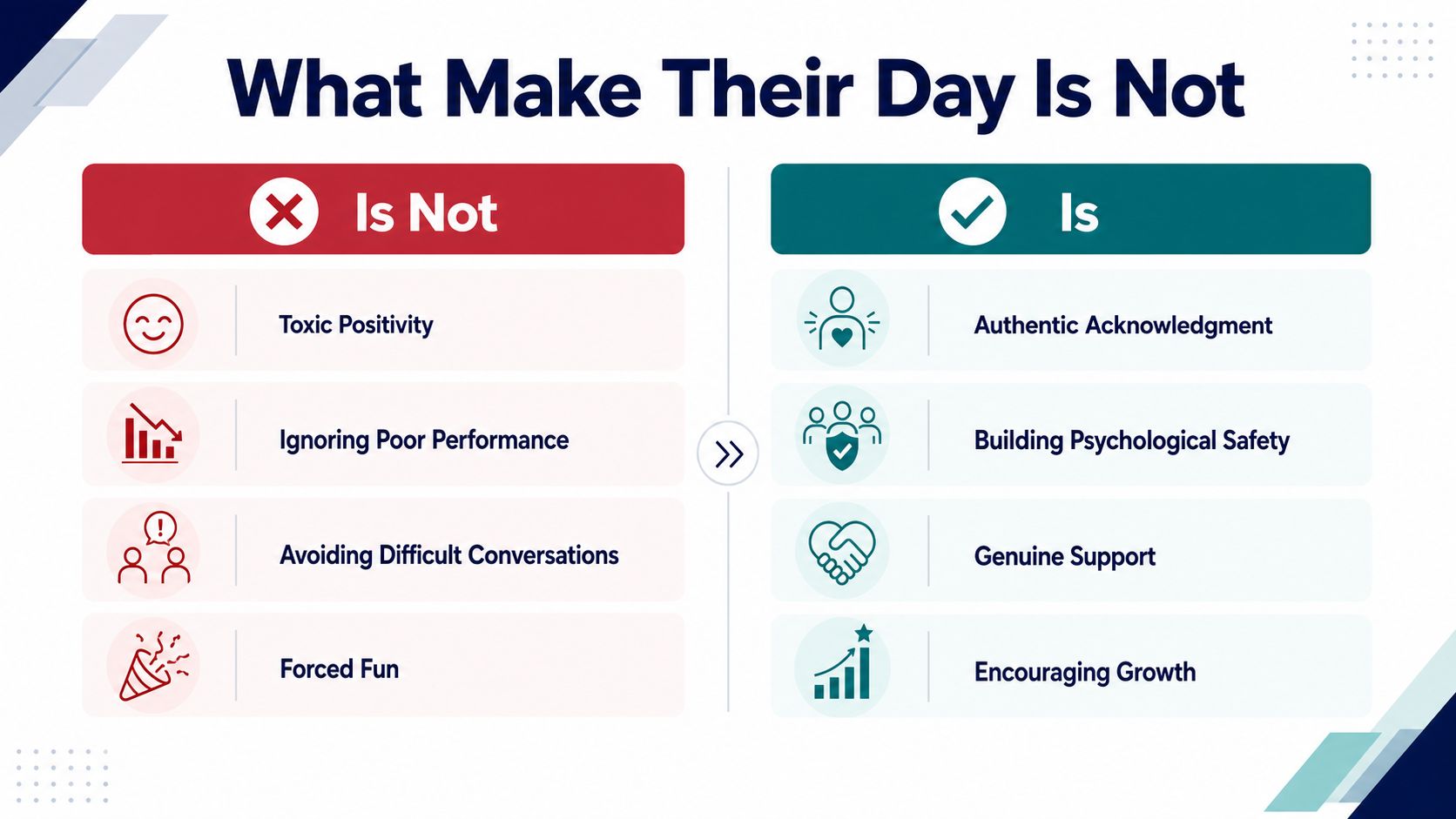
Make Their Day is not toxic positivity. It does not ask people to ignore frustration, hide difficult emotions or pretend everything is fine.
It is also not:
-
Praising everything regardless of quality
-
Manipulating people into working harder
-
Replacing fair pay with symbolic rewards
-
Expecting employees to endure excessive workloads
-
Forcing people into public recognition
-
Running compulsory compliment circles
-
Giving generic gifts with no personal meaning
-
Ignoring conflict or poor performance
-
Making kindness another target people must report against
A workplace cannot compensate for systemic problems with cupcakes and compliments.
Recognition will not repair an unsafe workload, inconsistent leadership, unfair treatment or a process that makes good work unnecessarily difficult. Make Their Day is most credible when it sits alongside fair policies, manageable expectations, genuine care and responsible leadership.
Sometimes the best way to make someone’s day is not to praise how well they are coping. It is to address the problem making their day unnecessarily hard.
Turning Make Their Day into a team habit
Understanding the principle is easy. Remembering to practise it during busy, pressured or frustrating periods is more difficult.
A simple five-step rhythm can help:
-
Notice: Pay attention to people’s effort, needs and contributions.
-
Personalise: Consider what would be meaningful to that individual.
-
Act: Respond promptly while the moment is still relevant.
-
Reflect: Notice how the action was received and what it taught you.
-
Repeat: Make the behaviour part of ordinary work.
Teams can test the principle through a simple one-week challenge. Invite each person to intentionally make one colleague’s, customer’s or stakeholder’s day better each day.
At the end of the week, discuss:
Which actions felt most genuine?
What did people appreciate?
What did the team learn about individual preferences?
Which behaviours could become part of normal work?
What made the actions easy or difficult?
The purpose is not to count acts of kindness or turn appreciation into a competition. It is to help people become more attentive to the effect they have on others.
Bringing the FISH! Philosophy to life
Make Their Day is powerful because it is simple enough to remember and practical enough to use immediately. Its impact, however, depends on whether people continue using it after the initial conversation.
The wider FISH! Philosophy gives teams a common language for being present, choosing their response, creating energy and contributing positively to other people’s experiences.
Corporate Challenge Events’ facilitated FISH! workshop helps teams explore all four principles and translate them into practical workplace behaviours. Leaders can also use these 12 ways to practise FISH! in the workplace to reinforce the ideas after the session.
Strong cultures are not created only through strategies, policies or annual events. They are also built in small moments when people choose to notice one another, respond with care and make a positive contribution.
Making someone’s day may take only a minute. The message it sends can last much longer.
Explore Corporate Challenge Events and its FISH! Philosophy workshop to help your team turn Make Their Day and the other FISH! principles into everyday workplace habits.