
A Monday meeting starts with an unresolved customer complaint, a missed deadline and a team already carrying too much pressure. One manager enters visibly frustrated, answers questions sharply and treats every concern as another obstacle. The room becomes cautious. People speak less freely, and the customer interaction that follows inherits the same tension.
That response is common, but it isn't inevitable. Choosing your attitude at work doesn't mean pretending everything is fine. It means recognising the conditions, noticing the effect of a reaction and deciding how to behave next. The FISH! Philosophy gives leaders and teams a practical language for making that decision visible, especially when workplace culture is being tested.
Table of Contents
- Why Attitude Shapes the Room Before Anyone Speaks
- What Choose Your Attitude Means
- Why This Practice Is Not Toxic Positivity
- Where Attitude Shows Up in Real Team Outcomes
- Five Practical Ways to Choose Your Attitude at Work
- The Role of Leaders in Setting the Tone
- Bringing Choose Your Attitude Into Your Workplace Culture
Why Attitude Shapes the Room Before Anyone Speaks
A team often reads a leader's tone before hearing the leader's words. A rushed entrance, a dismissive expression or a calm acknowledgement of pressure can influence whether colleagues raise risks, ask for help or stay silent. The same pattern appears in customer service. An employee who carries frustration from an earlier call into the next interaction may unintentionally make the customer feel responsible for a problem they didn't create.
Attitude isn't separate from performance. It shapes the conditions in which communication, judgement and collaboration take place. That doesn't make employees responsible for every organisational problem, and it doesn't excuse unreasonable workloads or poor leadership. It does mean that each person has some influence over the behaviour they bring to a difficult moment.
Leaders assessing these reactions can also consider the human needs described in the David Rock SCARF model, particularly the way perceived threat can affect participation and cooperation. Choose Your Attitude offers a simple pause before a response becomes the room's emotional reference point.
What Choose Your Attitude Means
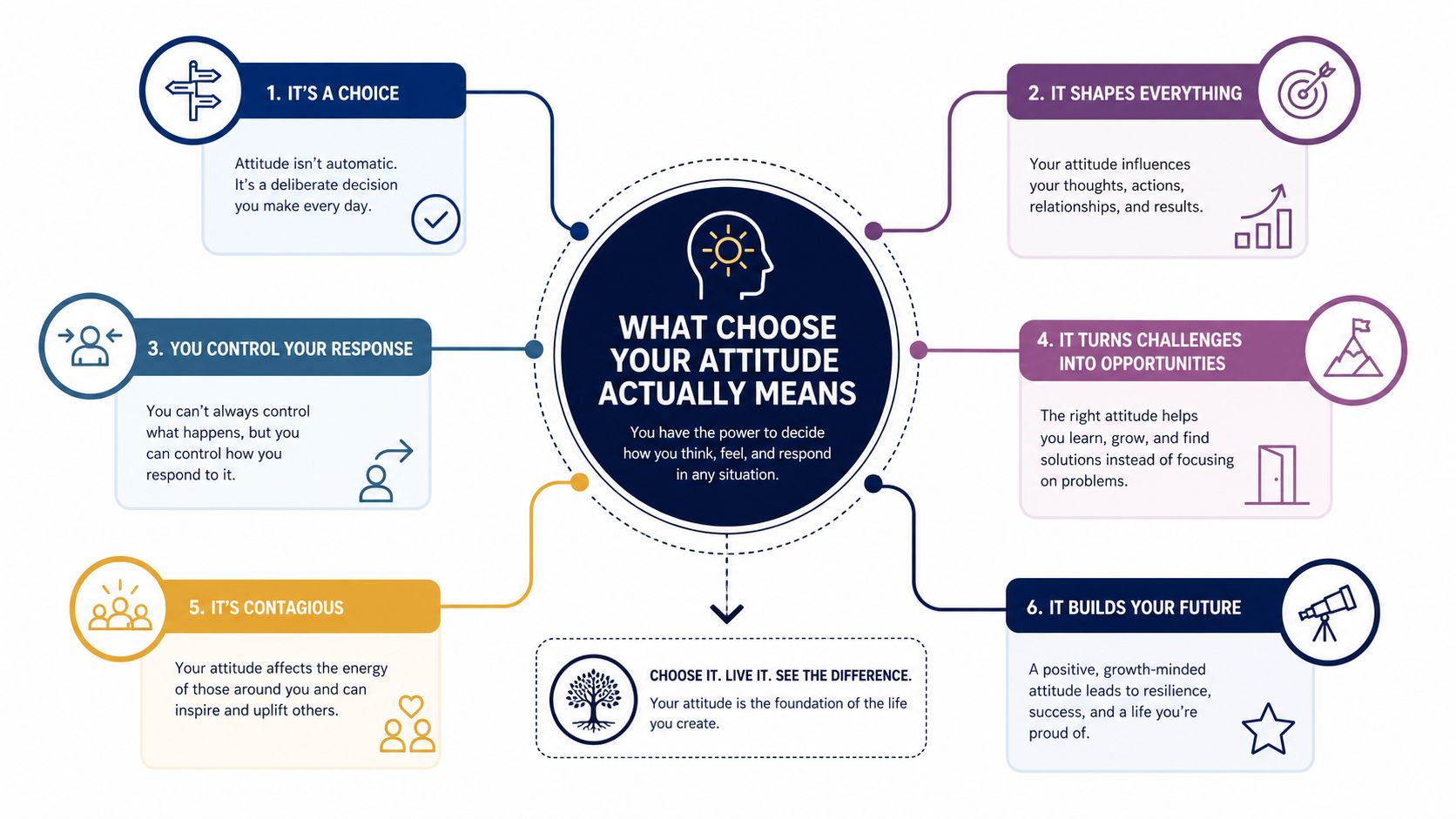
A manager begins a difficult check-in by acknowledging the pressure, naming the risk and choosing to discuss it respectfully. That decision captures Choose Your Attitude far more accurately than simply telling people to “stay positive”.
Choose Your Attitude is the practice of noticing what you are bringing into a situation and deciding how you want to respond. You may not choose your first emotion, and you cannot always control the circumstances, but you can pause before allowing that emotion to shape your behaviour.
Choose Your Attitude is one of the four practices of the FISH! Philosophy, alongside Play, Make Their Day and Be There. The philosophy was inspired by John Christensen’s visit to Seattle’s Pike Place Fish Market in 1997, where he observed how the fishmongers deliberately brought energy, attention and enjoyment to their work.
The official FISH! Philosophy describes attitude as a choice people make each day. At work, that choice could mean raising a risk before it becomes a larger problem, listening before responding, approaching a setback with curiosity or recognising a colleague’s effort during a demanding week.
Four questions can help make the practice part of everyday work:
-
How do I want to show up today? Choose the attitude you want to bring before pressure takes over.
-
Is my attitude helping my team or customers? Consider how your response is affecting the people around you.
-
Is this response moving the situation forward? Separate honest and productive challenge from behaviour that adds unnecessary friction.
-
Am I modelling what I want others to bring? Recognise that attitude is communicated through actions, tone and reactions, not just words.
The goal is not to choose happiness in every situation. It is to become more aware of your response and choose behaviour that supports what the moment requires. Leaders can explore all four FISH! Philosophy practices and consider how they can be reinforced through team conversations, recognition and regular check-ins.
Why This Practice Is Not Toxic Positivity
The most important distinction is between choosing a constructive response and being told to feel positive. An employee can be disappointed by a decision, concerned about their workload or frustrated by a customer interaction while still choosing to communicate clearly and treat others with respect.
Choose Your Attitude does not ask people to ignore or suppress difficult emotions. Awareness comes first. Someone might say, “This deadline creates a genuine risk, and the current plan is not workable.” The choice lies in what happens next. They might raise the concern early, explain its impact and propose an alternative rather than staying silent or directing their frustration at colleagues.
The practice should never be used to dismiss legitimate concerns. A positive attitude cannot resolve unsafe conditions, inequity, persistent overload or poor management. The Australian Workplace Wellbeing Survey, 68.5% of Australian workers reported sometimes or often feeling as though they were burning out at work. This reinforces why personal responsibility must sit alongside meaningful action on workload, leadership and work design.
Practical rule: Name the problem honestly, then choose the behaviour that gives people the best chance of addressing it.
This approach can support psychological safety in the workplace by allowing people to raise concerns honestly while still approaching the conversation in a way that encourages listening, problem-solving and action.
Where Attitude Shows Up in Real Team Outcomes
The workplace impact of attitude is not measured by how cheerful someone appears. It is measured by what other people experience through their behaviour.
A constructive attitude may show up as raising a risk before it becomes a larger problem, sharing information without blame or listening properly before responding. After a setback, it can mean helping the team understand what happened and decide what to do next, rather than allowing frustration to shape every conversation that follows.
These behaviours influence how effectively teams communicate, adapt and recover under pressure. They also affect whether people feel confident enough to contribute. ADP’s Australian engagement research found that 52% of employees who felt they were part of a high-performing team were fully engaged, compared with just 10% of those who did not. This significant gap shows how closely engagement is connected to a person’s everyday experience of their team.
The same behaviours shape customer interactions. Customers may not know what pressure an employee is carrying, but they experience the tone, attention and professionalism brought into the conversation. Effective interpersonal skills training turns qualities such as active listening, composure and clear communication into observable behaviours that can be practised, coached and measured.
This is why Choose Your Attitude is best reinforced through specific examples rather than broad reminders to “be positive”. A leader might recognise someone for raising a concern early, remaining composed during a difficult conversation or helping the team reset after a disappointing result. This identifies what the person did and why it helped.
Teams can also look at information sharing, follow-through, customer complaints, incident recovery and the quality of workplace handovers. A practical guide to measuring team performance can help leaders connect these behaviours to wider team goals.
Choose Your Attitude becomes valuable when the choice can be seen in what happens next. The challenge is making that choice easier to repeat when pressure is high.
Five Practical Ways to Choose Your Attitude at Work
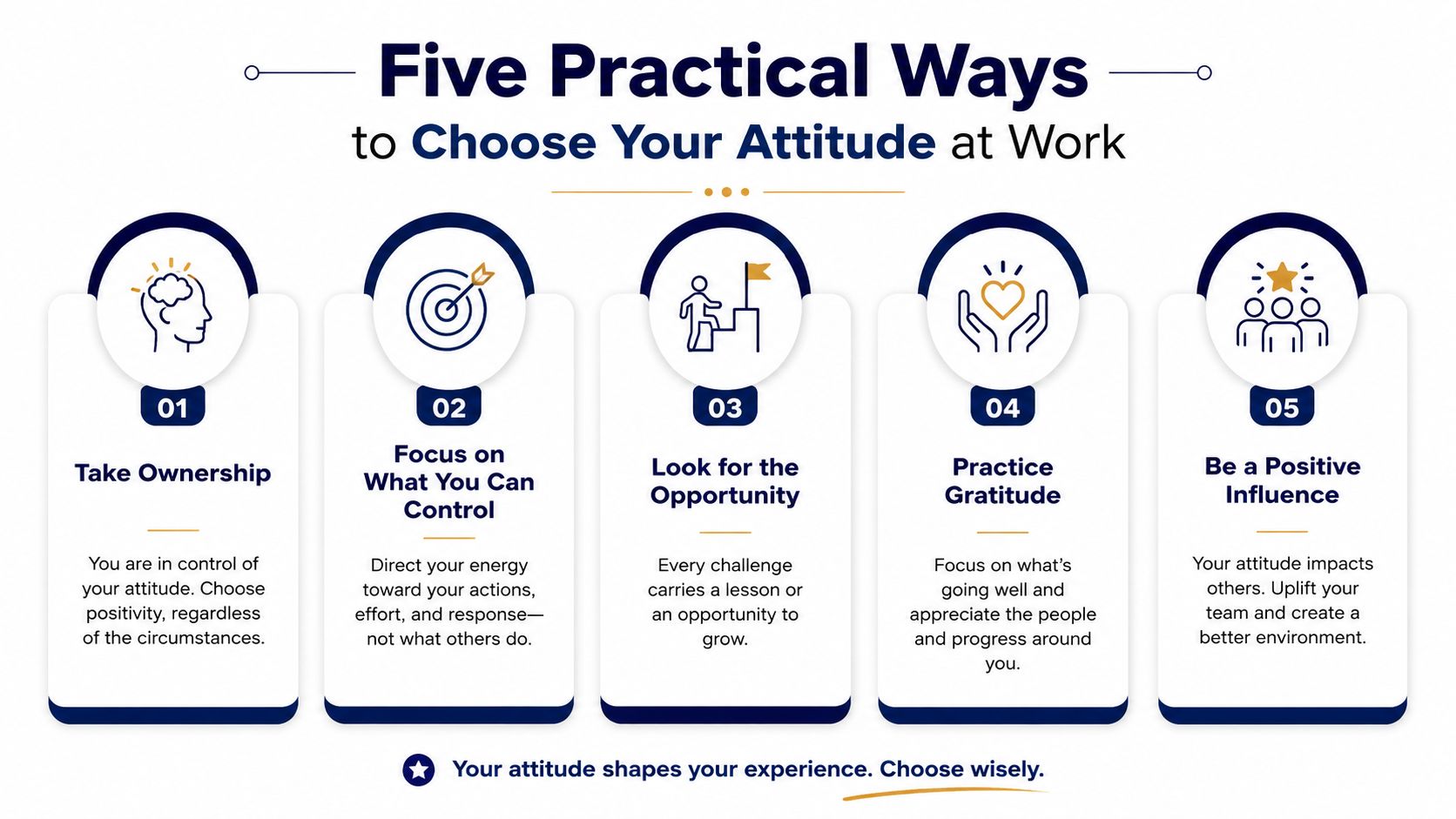
Choose Your Attitude becomes useful when it is connected to moments in which an automatic reaction is most likely to take over. These five practices give people a simple way to pause and choose what happens next.
-
Decide how to enter an important meeting. Before a difficult planning session, a manager can choose to arrive curious, prepared and direct rather than defensive. That decision doesn't remove disagreement. It sets a behavioural standard for handling it.
-
Pause when emotions are high. A terse email can wait while the writer checks whether the first draft reflects the response they want colleagues to receive. A short pause may create room for a factual reply that addresses the issue without escalating it.
-
Separate influence from control. A team can't control a supplier's delay or a customer's initial reaction. It can control whether it communicates early, documents the impact, offers realistic options and keeps affected people informed.
-
Reset after a difficult interaction. A customer complaint shouldn't determine the tone of the next call. A service team can acknowledge the emotional residue, clarify the next action and deliberately start the following interaction without transferring the earlier frustration.
-
Model the expected attitude. If leaders want openness during change, they need to explain what is known, admit what remains uncertain and invite useful questions. Teams notice whether leaders practise the behaviour they request.
To make these actions stick, teams can identify a common pressure point and agree on a simple reset they can use when it occurs. Leaders can reinforce the practice during check-ins by asking, “What attitude helped us this week, and what made it difficult?” This keeps the conversation focused on awareness, behaviour and the conditions affecting the team, rather than blame.
The Role of Leaders in Setting the Tone
Leaders communicate culture through reactions long before they explain it in a presentation. When a project changes direction, a leader who responds with curiosity and clear priorities gives employees permission to adapt. When results disappoint, a leader who examines the facts without humiliating people protects learning and keeps responsibility visible.
The reverse is also true. If a leader uses sarcasm, panic or silence during pressure, employees may copy that pattern or withdraw from the conversation. The practice therefore requires leaders to examine their own behaviour before asking employees to alter theirs.
Choose Your Attitude must never become a shortcut around structural responsibility. Leaders also shape the conditions in which people are being asked to choose their attitude. Clear priorities, realistic workloads, role clarity, recognition and fairness make constructive responses easier to sustain. Choose Your Attitude should support these leadership responsibilities, not replace them.
Practical leadership behaviours such as those outlined in the FISH! approach for leaders give teams a visible example to follow. Leaders can also examine leadership's role in fostering play as part of a wider culture approach.
Bringing Choose Your Attitude Into Your Workplace Culture

Choose Your Attitude is a small decision that can create a big ripple. When teams share a language for calling a reset, they become better at noticing unhelpful energy before it spreads and choosing what they want to bring into the next conversation.
That is exactly what Corporate Challenge Events’ accredited Fish Workshop is designed to do. Through play, storytelling, honest conversation and facilitated activities, teams bring Choose Your Attitude, Play, Make Their Day and Be There to life. It is not about telling people to smile through a difficult day. It is about giving them practical ways to shape the experience they create for one another.
The three-to-four-hour workshop is suitable for 6 to 500 participants and can be delivered indoors or virtually. Teams leave with shared language, practical actions and a renewed understanding of how everyday choices can build greater connection, adaptability, communication, creativity, psychological safety and engagement.
You cannot always choose what lands on your desk, what goes wrong or what changes without warning. You can choose what you carry into the next conversation. Curiosity instead of defensiveness. Clarity instead of blame. Connection instead of withdrawal.
When a whole team learns to make those choices together, attitude stops being something one person brings to work. It becomes part of how the team works.
Corporate Challenge Events offers accredited FISH! workshops for organisations seeking practical development in workplace culture, communication and engagement. Visit Corporate Challenge Events to discuss a facilitated session for a leadership group, conference, offsite or wider team.