
Problem solving doesn't fail in most organisations because people haven't heard of root cause analysis. It fails because teams can't apply good thinking quickly, together, and under pressure. In Australia, 64% of employed adults fall below minimal competence in problem-solving according to research on employed adults' literacy and problem-solving competence. That changes the conversation immediately. This isn't a polish-the-soft-skills exercise. It's a workforce capability issue.
For a new HR manager, that's useful news. It means problem solving training for employees should be designed like performance infrastructure, not like a one-off workshop. The strongest programs link directly to recurring business friction, build habits through realistic practice, and give leaders a way to measure whether better decisions are showing up in the flow of work.
Table of Contents
- Why Problem Solving Training is a Business Imperative
- Aligning Training with Your Organisational Goals
- Designing Your Core Training Content and Agenda
- Choosing High-Impact Experiential Activities
- Facilitation Techniques for Inclusive Problem Solving
- Measuring the ROI of Your Training Program
Why Problem Solving Training is a Business Imperative
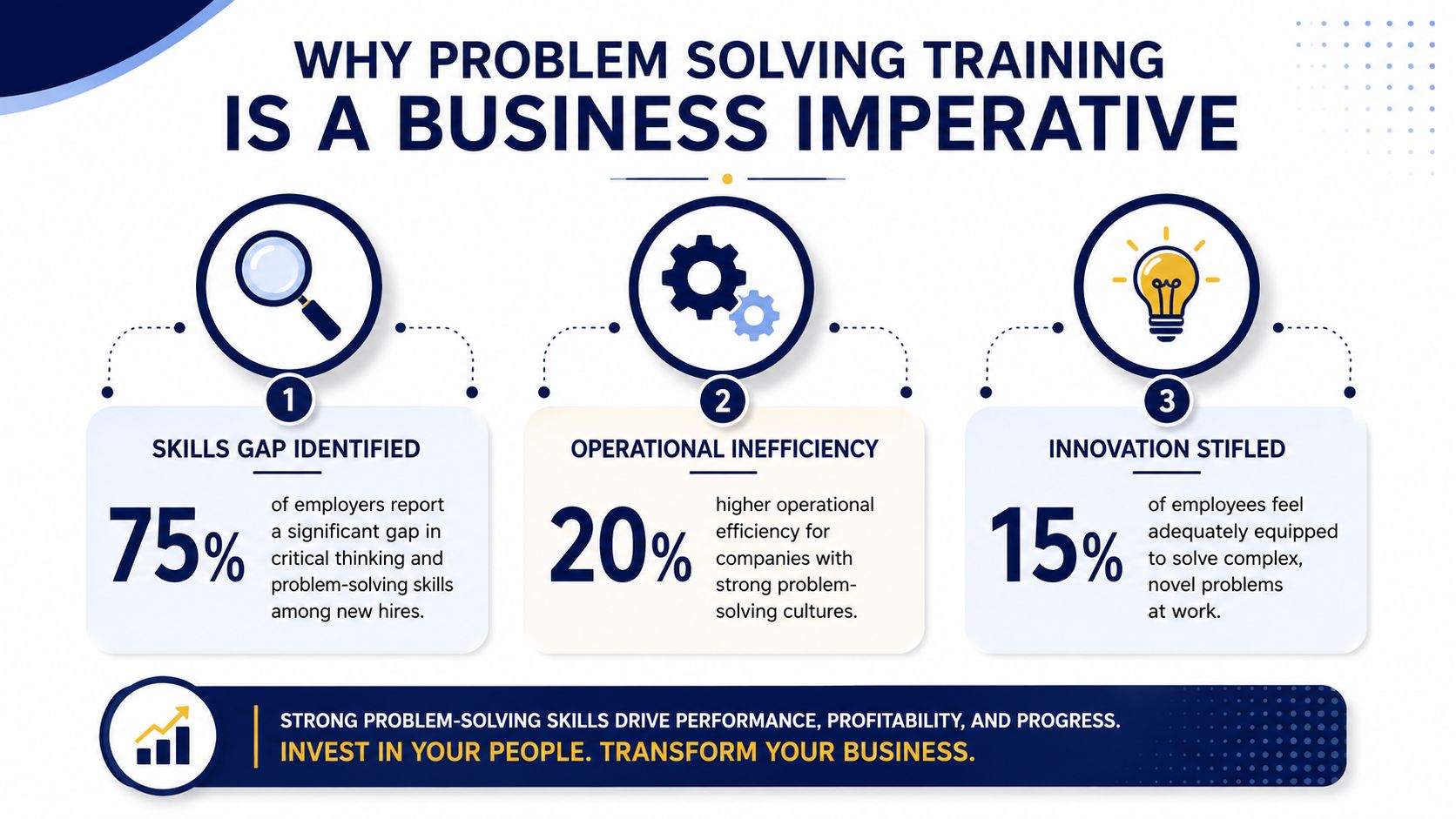
A common assumption in many organisations is that problem-solving skills develop organically through experience. In practice, that assumption leaves too much to chance. Teams learn inconsistent habits, stronger managers end up carrying weaker decision makers, and avoidable issues keep cycling back through the business.
I see this most clearly in companies that say they want more ownership from employees but have never taught a shared way to define a problem, test options, and decide what good evidence looks like. The result is familiar. Rework increases, escalation becomes the default, and routine decisions take longer than they should because people are relying on confidence, hierarchy, or habit instead of a usable method.
Problem solving affects execution quality every day.
What capable problem solving looks like at work
Workplace problem solving is a performance capability. Employees need to spot what is going wrong, separate symptoms from causes, weigh trade-offs, and apply a response under time pressure. That last part matters. Plenty of teams can discuss a model in a workshop. Far fewer can use it well during a live customer issue, a production delay, or a handover failure between functions.
That is why training design matters more than the model itself. A slide deck on 5 Whys may raise awareness, but it rarely changes behaviour on its own. Programs that transfer into the workplace usually combine clear frameworks with repeated practice, realistic scenarios, and play-based learning that lets people rehearse decisions, receive feedback, and build recall before the next real problem lands on their desk.
Strong training helps employees do a few things consistently:
- Frame the problem accurately so the team solves the right issue
- Identify likely causes instead of reacting to the most visible symptom
- Compare response options based on risk, effort, speed, and business impact
- Act, review, and adjust so learning carries into the next situation
If a team keeps fixing the same issue, the gap is rarely awareness alone. The gap is application under real working conditions.
Why leaders should treat it as performance infrastructure
For HR and People & Culture leaders, the business case is straightforward. Better problem solving reduces manager dependency, improves decision speed, and lowers the hidden cost of recurring mistakes. It also improves collaboration because teams have a common language for diagnosing issues and challenging assumptions without turning every disagreement into a personal debate.
There is a trade-off to manage. Practical training takes more effort than a single awareness session. Scenario design, facilitation quality, and follow-up practice all require time. But the cheaper option often produces familiar waste: strong attendance, good feedback forms, and very little change once people return to work. Leaders who need a stronger case for demonstrating training success should look beyond completion rates and focus on whether the program changes speed, quality, and ownership in day-to-day operations.
This matters even more as organisations reconsider how they build capability for performance and resilience. Our review of workplace capability trends in the state of work in 2026 points to the same pressure many HR managers already feel. Process alone does not carry the business through ambiguity. People need practice in making sound decisions together.
Treat problem solving training for employees as part of your operating infrastructure. It supports better judgment, cleaner execution, and stronger accountability across the business.
Aligning Training with Your Organisational Goals
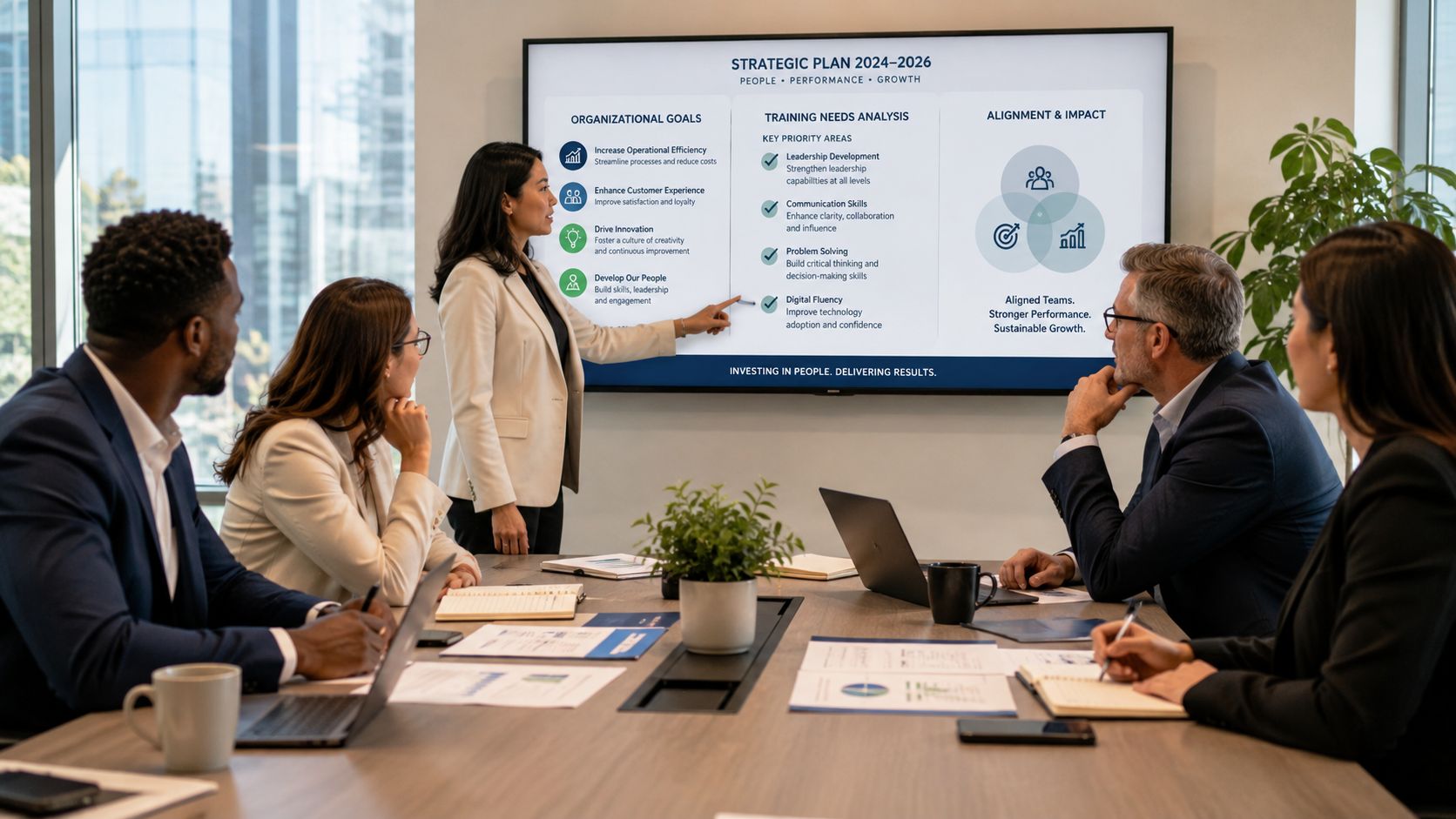
The fastest way to weaken a training program is to start with content before diagnosing the business need. “Problem solving” sounds universal, but the organisational pain usually isn't. One team may need faster decisions in live operations. Another may need better root cause discipline because the same error keeps resurfacing. A third may need stronger collaboration because people solve issues in silos and create downstream problems for everyone else.
A practical design process starts by identifying the work pattern that keeps breaking down.
Diagnose the actual problem behind the training request
Before drafting any agenda, HR leaders should sit with operational managers and ask questions that point to behaviour, not vague capability labels.
Consider prompts like these:
- Where does work slow down? Is the issue delayed decisions, repeated approvals, or confusion about ownership?
- What keeps recurring? If teams are fixing the same issue repeatedly, they may be reacting to symptoms rather than causes.
- What kind of problems matter most? Customer issues, project delays, quality breakdowns, handover failures, and innovation blockages require different practice scenarios.
- Who needs the training most? Frontline teams, project leads, people managers, and cross-functional groups often need different levels of decision authority and different examples.
This kind of diagnosis makes the learning objective sharper. It also helps avoid a common mistake: rolling out one generic workshop to every team and expecting it to solve very different operating issues.
Translate friction into training outcomes
Once the business friction is clear, the next step is turning it into outcomes a manager would recognise in daily work. A strong training goal is behavioural and observable. It describes what employees should do differently when an issue appears.
A useful training objective doesn't say “build problem-solving capability”. It says “team leaders will use a shared method to define issues, test causes, and agree on next actions within the same meeting”.
That level of clarity also makes stakeholder conversations easier. Instead of defending training as a development activity, HR can link it to outcomes leaders already care about, such as fewer repeat issues, better meeting discipline, cleaner escalation, or more confident team ownership.
For teams that are still working out where to focus first, this guide to determining your soft skill training needs is a useful reference point because it pushes the conversation back toward business need rather than catalogue-led training.
Set scope before choosing format
A first program doesn't need to solve every capability gap at once. In fact, broad programs often underperform because they cover too much and practise too little.
A better approach is to define scope across three dimensions:
| Scope decision | Strong choice | Risky choice |
|---|---|---|
| Audience | One function or one cross-functional cohort with shared challenges | Entire organisation with mixed needs |
| Problem type | A narrow set of recurring workplace issues | Every type of problem employees might face |
| Application window | Real issues teams can apply immediately after training | Abstract scenarios with no link to current work |
That discipline gives the program a fair chance of transfer. It also gives sponsors something tangible to evaluate later. If the training was built to reduce recurring operational errors or improve decision quality in project meetings, leaders can watch for those changes directly.
Designing Your Core Training Content and Agenda
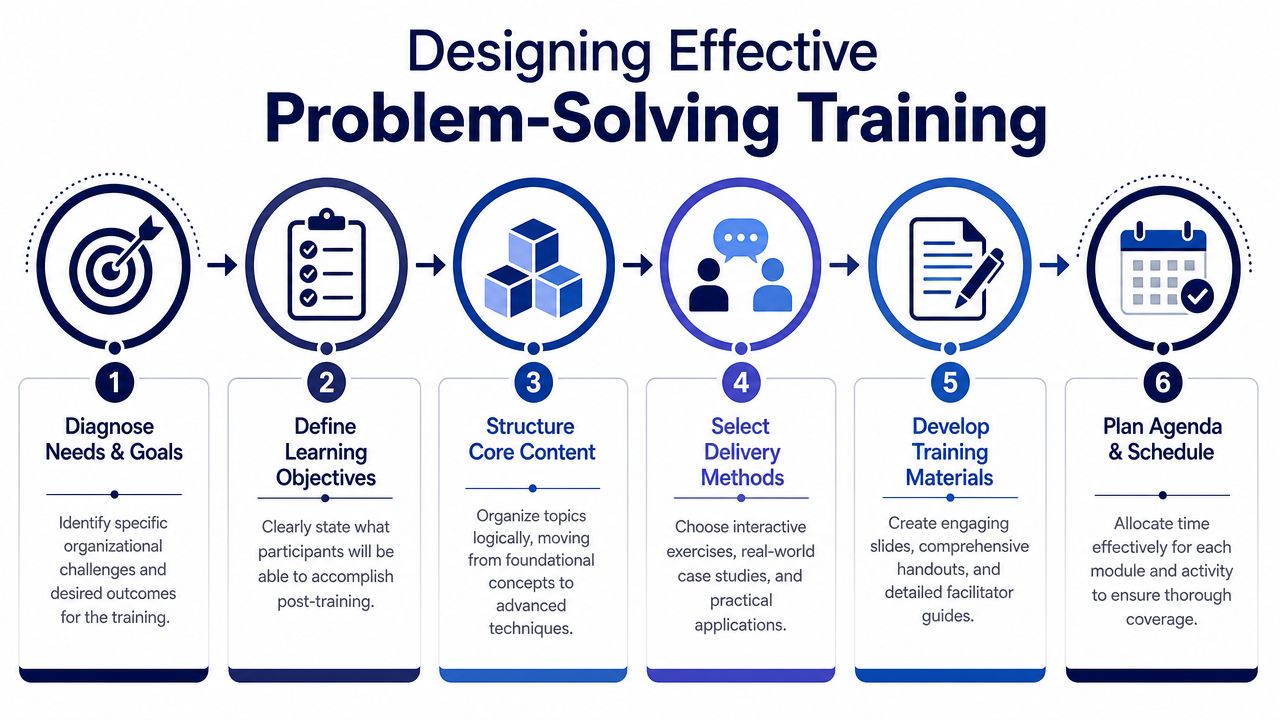
Once the training goal is clear, the curriculum needs structure. Many first-time programs often become too theoretical at this point. They collect useful models, stack them into slides, and assume exposure will create competence. It won't. A sound curriculum uses a simple operating framework, limits the number of tools, and builds in enough practice for employees to apply the method to work they recognise.
One effective base is the Lean Problem-Solving methodology, including the PDCA cycle. In Australian service sectors, full adoption has been associated with up to 35% lower process inefficiencies and a 28% increase in decision-making speed according to Lean problem-solving training outcomes in Australia. Those results don't come from handing people a diagram. They come from disciplined use.
Build the curriculum around one shared method
For a first program, a four-part structure is usually enough:
Introduce the principles
Employees need a clear explanation of value, waste, root cause thinking, and why jumping to solutions creates rework.Teach the core cycle
PDCA works well because it gives teams a repeatable sequence. Plan the response, do the test, check the result, act on what was learned.Add a small set of tools
Fishbone Diagrams and the 5 Whys can support diagnosis, but only when used to examine a real issue rather than complete an activity sheet.Apply the method to live work
Participants should practise on current service, project, operational, or customer problems they're likely to face again.
Write learning objectives that describe action
Good learning objectives are visible in behaviour. They should tell a facilitator, participant, and sponsor exactly what competent performance looks like.
Stronger examples include:
- Participants will define a workplace problem without confusing it with a symptom
- Participants will use PDCA to test and review a proposed fix
- Participants will identify likely root causes using 5 Whys or a Fishbone Diagram
- Participants will agree on corrective and preventive actions in a team setting
Weaker objectives usually use broad verbs such as “understand”, “appreciate”, or “be aware of”. Those are difficult to observe and even harder to measure.
Design principle: If the objective can't be seen in a meeting, a handover, or a workflow decision, it's too vague for training design.
A practical half-day agenda
A half-day workshop is often enough for a first rollout if the focus is narrow and the practice is well chosen.
| Time block | Focus | Delivery style |
|---|---|---|
| Opening | Current workplace friction and why a shared method matters | Facilitated discussion |
| Module one | Defining the problem clearly | Short teaching plus team exercise |
| Module two | Root cause tools such as 5 Whys and Fishbone | Guided application |
| Module three | PDCA in a real work scenario | Small group simulation |
| Module four | Team decision-making and action planning | Facilitated debrief |
| Closing | Commitments for workplace application | Individual and manager follow-up plan |
The trade-off is straightforward. If the session is too content-heavy, people leave impressed but unchanged. If it's all activity without a framework, energy rises but the method doesn't stick. The agenda needs both. Theory gives language. Practice turns language into behaviour.
Choosing High-Impact Experiential Activities
The biggest gap in most problem solving programs isn't content quality. It's transfer. People can often explain a model in the room and still fail to use it in the middle of a busy week. That's why delivery method matters as much as curriculum.
Research shows play-based, experiential training improves skill retention by 52% compared to lecture-based methods, yet less than 12% of Australian problem-solving programs incorporate this approach. That mismatch helps explain why training often feels successful on the day and disappears in application afterwards.
Why experiential learning works better than explanation alone
Lecture-led sessions can introduce terminology efficiently. They're useful for giving teams a baseline understanding of PDCA, root cause analysis, and decision discipline. But they rarely recreate the conditions that cause problem solving to fail at work, such as time pressure, partial information, competing views, or social hesitation.
Experiential activities do something different. They create a shared challenge where employees must notice patterns, test assumptions, adapt, and coordinate with others in real time. That's much closer to the way workplace problems appear.
The strongest activities usually build one or more of these capabilities:
- Analytical discipline through data sorting, sequencing, or cause testing
- Creative flexibility through resource constraints and alternative solution design
- Strategic coordination through interdependent decision-making
- Communication under pressure through time-bound tasks and changing information
- Collective reflection through debriefs that connect the activity back to work
Matching activities to problem-solving objectives
Not every activity suits every need. The right choice depends on whether the business wants sharper diagnosis, better collaboration, faster decision-making, or stronger adaptability.
| Activity Type | Best For Developing | Example (In-Person) | Example (Virtual) |
|---|---|---|---|
| Analytical | Root cause thinking, sequencing, evidence-based decisions | Process redesign challenge using flawed workflow steps | Shared whiteboard diagnosis exercise with competing data clues |
| Creative | Idea generation, flexibility, working within constraints | Construction challenge with limited materials and changing requirements | Digital concept sprint using breakout rooms and timed pivots |
| Strategic | Prioritisation, trade-offs, resource allocation | Scenario game with budget, time, and stakeholder constraints | Virtual crisis simulation with staged information release |
| Collaborative | Inclusive decision-making, role clarity, handovers | Team puzzle where no single person holds all the information | Remote problem room where information is distributed across participants |
| Pressure-based | Calm execution, communication, adaptation | Timed challenge with interruptions and rule changes | Time-boxed online mission with evolving obstacles |
A useful decision filter is whether the activity creates the same kinds of failure points the team faces at work. If a group struggles because senior voices dominate, the exercise needs distributed information and structured turn-taking. If a project team tends to rush into solutions, the task should reward diagnosis before action.
For leaders comparing formats, this guide to choosing the right team building activity for your team is helpful because it ties activity choice back to team objectives rather than defaulting to whatever seems most entertaining.
What tends not to work
Some formats look engaging but produce weak transfer.
A few examples stand out:
- Abstract games with no debrief leave people with a pleasant memory but no workplace application.
- Competitive exercises without reflection can reinforce speed over diagnosis.
- Activities that are too easy don't reveal habits under pressure.
- Simulations with no managerial follow-through fade quickly once participants return to normal routines.
Experiential design works when challenge, facilitation, and debrief are tightly connected. The activity is the rehearsal. The debrief is where employees attach meaning, language, and next-step application to what they just did.
Facilitation Techniques for Inclusive Problem Solving
Even a well-built program can underperform if the facilitation allows the same workplace hierarchy to dominate the room. In Australian organisations, 57% of diverse teams report that problem-solving sessions are dominated by senior staff, which makes inclusive facilitation a core training skill, not a nice extra.
When a few confident voices do most of the talking, the group loses two things at once. It loses information, because quieter participants often hold frontline insight. It also loses commitment, because people rarely support solutions they had no part in shaping.
Set the room before the discussion starts
Inclusive problem solving begins before the first exercise. Facilitators need to shape the conditions of contribution, not merely invite participation and hope for the best.
That usually means setting ground rules such as:
- Name the expectation of equal contribution so participants understand that airtime is part of the process
- Separate idea generation from evaluation so people don't self-censor too early
- Use structured turns when the issue is complex or status differences are pronounced
- Make evidence the centre of the discussion rather than job title or confidence
Seniority can clarify accountability. It shouldn't determine whose observations count.
The language used by the facilitator matters as well. “Let's hear from someone closer to the process” is often more effective than a general “any other thoughts?” because it directs attention to missing perspectives.
Manage dominant and quiet voices differently
A common mistake is treating all participation issues the same way. Dominant contributors and quieter contributors need different interventions.
For dominant voices:
- Acknowledge expertise, then redirect. “That's useful context. Let's pause there and gather other views before we assess options.”
- Time-bound their input during decision rounds.
- Give them a different role, such as summarising patterns after others have spoken.
For quieter or junior participants:
- Offer individual thinking time first so they can prepare a response.
- Use pair discussion before plenary discussion to lower the social threshold for speaking.
- Invite specific operational insight. “What are you seeing in the handover point that others might miss?”
The aim isn't forced equality of style. Some people are naturally concise, others expansive. The aim is equitable access to influence.
Build cultural safety into the method
Inclusive facilitation also requires attention to cultural and communication differences. Not everyone signals disagreement in the same way, and not every workplace values direct challenge equally. Good facilitators don't assume silence means agreement or that speed means clarity.
A few practices help:
| Facilitation move | Why it works |
|---|---|
| Written input before discussion | Captures ideas that might not surface verbally |
| Round-robin sharing | Reduces interruption and status-based entry barriers |
| Clarifying questions before critique | Slows premature judgement |
| Visible decision criteria | Keeps the group anchored to agreed standards |
For teams looking to broaden participation through shared activity rather than formal discussion alone, this perspective on how inclusive play brings every team member in is a useful complement to facilitation practice.
Inclusive problem solving doesn't dilute standards. It improves solution quality by widening the field of usable insight.
Measuring the ROI of Your Training Program
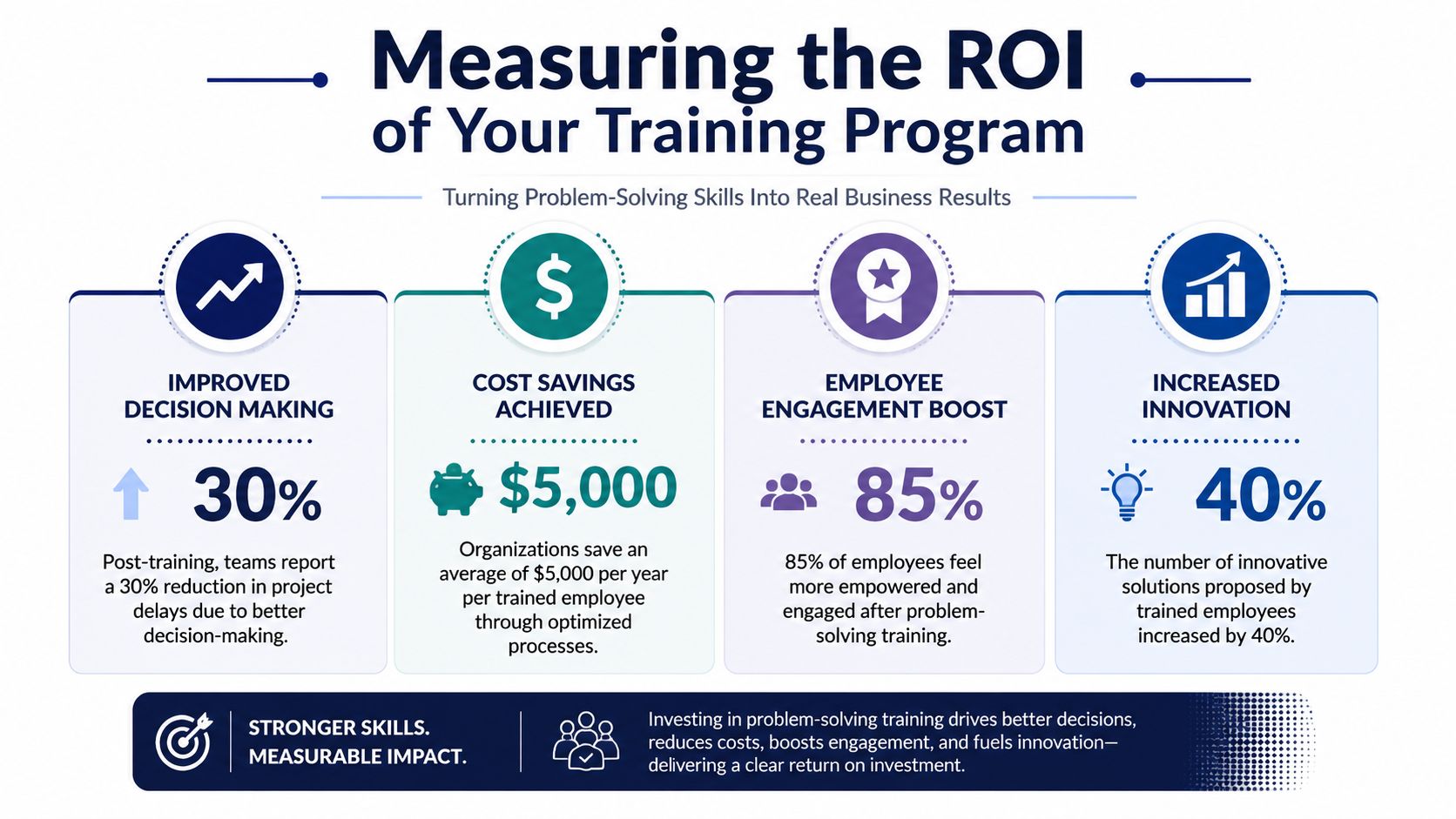
If HR can't show what changed after training, the program will be treated as an event rather than an investment. That's why measurement needs to be built in before delivery, not added as an afterthought with a satisfaction survey.
A practical ROI model starts by separating three levels of evidence: participant reaction, behaviour change, and business impact. Most organisations stop at the first level. They collect positive comments, note that the workshop was engaging, and move on. Senior leaders usually want the other two.
Track behaviour before chasing financial outcomes
The cleanest way to evaluate problem solving training for employees is to define the workplace behaviours that should appear after the program and observe whether they manifest.
Useful behaviour indicators include:
- Teams define problems more clearly in meetings before discussing solutions
- Managers ask for evidence and causes, not just fixes
- Recurring issues are documented and reviewed
- Escalations become cleaner because teams have already tested likely causes and options
- Action plans identify both immediate correction and prevention
These signals are visible quickly, and they help explain later operational changes. Without them, financial claims often feel disconnected from the training itself.
Measurement rule: Don't ask whether people enjoyed the training until the organisation has asked whether people are using it.
Connect the program to operational metrics leaders already trust
The most credible ROI measures are usually found in existing reporting systems. HR doesn't need to invent a new dashboard if the business already tracks service quality, error patterns, workflow delays, or project bottlenecks.
A useful approach is to compare pre- and post-training movement in metrics such as:
| Metric category | What to look for |
|---|---|
| Quality | Fewer recurring errors, cleaner handovers, fewer rework loops |
| Delivery | Faster decisions, smoother approvals, fewer project delays |
| Customer outcomes | Lower complaint recurrence, faster issue resolution |
| Team effectiveness | Better meeting discipline, clearer ownership, stronger cross-functional follow-through |
Sponsor alignment at the start delivers substantial benefits. If the original training brief was vague, the evaluation will be vague too. If the brief named a concrete business issue, the measurement path is much stronger.
Add the financial lens carefully
There is credible evidence that better problem-solving capability carries economic value. A one-standard-deviation increase in adaptive problem-solving proficiency is associated with a 7% higher hourly wage for employees, according to OECD analysis of adult problem-solving skills. For leaders, the point isn't to promise direct wage effects from a single workshop. The point is that this capability is economically meaningful and linked to employee value.
That supports a stronger position with senior stakeholders. Problem solving isn't an optional communication extra. It is connected to productivity, judgement, and the value employees create.
For organisations that want a broader view of how structured, experience-based learning contributes to business outcomes, the ROI of play offers a useful frame for thinking beyond attendance and enjoyment.
A simple reporting format often works best. Capture the original business problem, define the target behaviours, compare operational indicators before and after, and include manager observations about application quality. That gives executives a practical story: what changed, where it changed, and whether it's worth extending.
Corporate Challenge Events helps Australian organisations turn problem solving, collaboration, and culture goals into practical play-based experiences that teams can apply back at work. For leaders planning a conference session, offsite, culture program, or targeted development day, Corporate Challenge Events offers structured team building programs designed to strengthen communication, trust, decision-making, and workplace performance through serious fun.