
A leadership team asks for feedback on a project that's drifting off course. The room goes quiet. People glance at each other, someone says the plan looks fine, and the meeting moves on. Two weeks later, the risks that were obvious in the room become expensive, visible, and much harder to fix.
That usually isn't a capability problem. It's a psychological safety problem.
In many workplaces, the gap isn't that people don't have ideas, concerns, or useful questions. It's that they don't feel safe enough to raise them. That's why psychological safety in the workplace has become such an important leadership issue for People & Culture teams, managers, and internal organisers trying to build stronger team communication, better decision-making, and healthier workplace culture.
Psychological safety is not the absence of challenge. It is the presence of enough trust to meet challenge openly.
Table of Contents
What Is Team Psychological Safety
A team can have smart people, clear goals, and capable leadership and still struggle because people don't speak plainly. Questions stay unasked. Concerns are softened. Mistakes are hidden until they become operational problems.
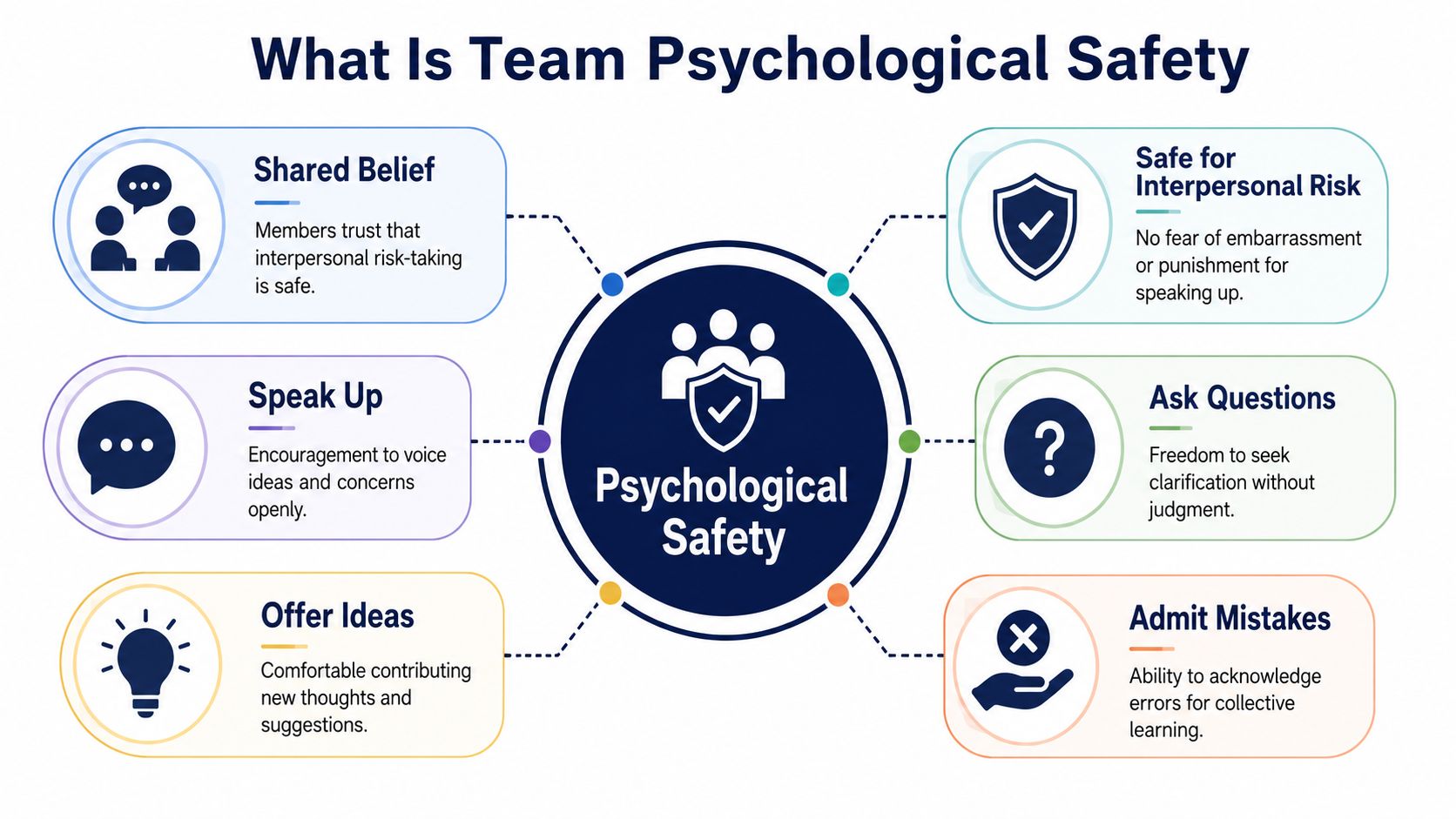
That's where team psychological safety comes in. Amy Edmondson introduced the concept in her 1999 paper Psychological Safety and Learning Behavior in Work Teams, defining it as a shared belief that the team is safe for interpersonal risk-taking. In plain English, that means people believe they can speak up, ask for help, admit mistakes, challenge ideas, and offer input without fear of embarrassment, rejection, or punishment.
It's a team condition, not a personality trait
Psychological safety in teams isn't the same as confidence. A confident employee can still stay quiet in a team that punishes dissent. A naturally reserved employee can contribute strongly in a team that listens well and responds respectfully.
The important point for leaders is that psychological safety sits at the team level. It's created through repeated signals. How managers respond to bad news. How peers handle disagreement. Whether meetings reward honesty or performance theatre.
The World 1st Australian Workplace Psychological Safety Report describes a psychologically safe workplace as one marked by interpersonal trust and mutual respect, where employees feel comfortable making mistakes or taking risks. That practical link between trust, contribution, and performance is also central to understanding what makes a good team.
A team with psychological safety doesn't avoid pressure. It makes pressure discussable.
What people actually do in a safe team
When psychological safety at work is present, teams tend to show a few very visible behaviours:
People ask questions early instead of pretending they understand.
Concerns get raised while they're still manageable rather than after the deadline slips.
Mistakes are discussed directly so the team can learn and adjust.
Ideas come from more than the loudest voices because contribution feels open, not political.
That is why psychological safety is imperative in modern workplace culture. It makes honesty operational.
Common Misconceptions About Psychological Safety
A lot of leaders resist the idea of psychological safety because they think it sounds soft, permissive, or vague. Usually, they're reacting to a misunderstanding rather than the concept itself.
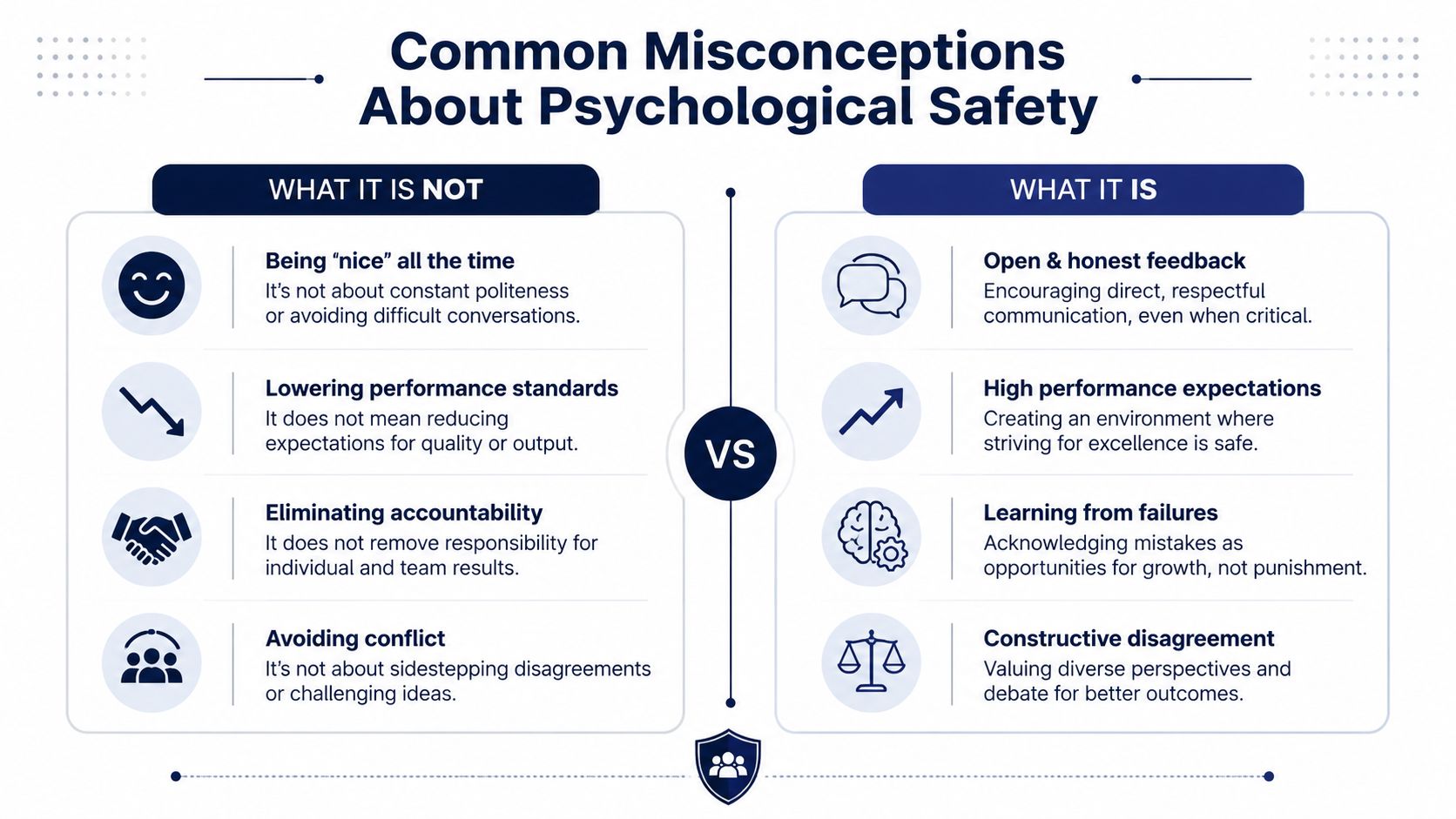
Psychological safety is not about keeping everyone comfortable all the time. It isn't about protecting people from accountability, avoiding hard conversations, or lowering standards so nobody feels challenged.
What leaders often get wrong
The most common misconceptions tend to show up like this:
“We're very direct here.” Directness alone doesn't create safety. In some teams, “direct” is a cover for dismissive behaviour.
“People need resilience.” They do. But resilience doesn't replace a culture where people can raise risks without being penalised.
“We can't let standards slip.” Good. Psychological safety works best alongside high standards, not instead of them.
“Conflict means the team isn't safe.” Not necessarily. Avoided conflict is often a bigger warning sign than respectful disagreement.
What it actually looks like
A psychologically safe team can still be ambitious, demanding, and performance-focused. It can debate hard and challenge assumptions while expecting quality work. The distinction isn't tone, it's timing: people tell the truth early enough for it to be useful, rather than after the cost of silence has already landed.
This matters because some leaders unknowingly build false harmony instead. Meetings look calm, but the real conversations happen afterward, in side chats and private messages. That isn't healthy alignment. It's disagreement that's been pushed underground. And none of this excuses poor behaviour: bullying, dismissiveness, and sarcasm still need addressing directly, since tolerating them erodes safety faster than most leaders realise.
The Research That Redefined Teamwork
Psychological safety didn't start as a trend term. It came from research into how teams learn and perform under pressure.
Amy Edmondson's 1999 work gave leaders a language for something many had seen but couldn't clearly explain. Some teams surfaced issues quickly and learned from them. Others buried problems, protected reputations, and repeated avoidable errors.
The critical insight from Edmondson's work
One of the most useful ideas from Edmondson's research is that high-performing teams can appear to make more mistakes, though the actual difference is that they are more willing to report and discuss mistakes. That changes how leaders interpret what they're seeing.
A team that openly names errors can look messy on the surface. A team that hides them can look polished right up until something fails publicly. The first team is usually learning. The second is often protecting itself.
That's why the concept became so influential in discussions about group dynamics and how teams function under pressure. Team performance depends not just on competence, but on whether competence can be shared, corrected, and improved in public.
Why this changed leadership practice
Edmondson also helped clarify something that still matters now. Psychological safety is not “anything goes.” It doesn't remove responsibility. It creates the conditions for better learning behaviour.
Leaders can't improve what people are afraid to say. Teams can't adapt if problems only surface once they've become costly. In that sense, psychological safety isn't a comfort concept. It's a learning mechanism.
Teams cannot learn from mistakes that remain hidden.
That's what made the idea durable. It connected candour with performance in a way leaders could apply.
How Google's Project Aristotle Made It Famous
The concept moved from academic research into mainstream business when Google made it visible to a much wider audience through Project Aristotle, a study of team effectiveness designed to understand why some teams consistently outperformed others.
Why that finding landed so strongly
The main finding challenged a familiar management instinct: that performance comes mainly from talent mix, technical strength, or personality fit. Instead, Google's data pointed to something more demanding to act on. How a team works together mattered more than who was on it. Norms mattered. Meeting behaviour mattered. Whether people could challenge, ask, test, and disagree mattered more than the credentials in the room.
What it means in day-to-day management
Because the finding came out of a highly analytical, delivery-focused company, it gave psychological safety a kind of credibility that academic research alone hadn't managed. It also matched what many managers already suspected from their own teams: a group of strong individual contributors can still underperform if people don't talk candidly, while a less polished group can outperform because its members share information quickly, recover from mistakes, and contribute without waiting for status permission. That's why psychological safety now sits underneath most serious conversations about collaboration, problem-solving, innovation, and execution, rather than being treated as a separate, softer topic.
Warning Signs of a Psychologically Unsafe Team
Low psychological safety rarely announces itself directly. It shows up in patterns that leaders often misread as disengagement, poor communication, or lack of initiative.
The signs are usually behavioural. Meetings stay quiet. People hold back questions. A handful of senior or louder voices dominate discussion. Leaders hear “all good” right up until an issue becomes urgent.
What leaders can observe early
A psychologically unsafe team often looks like this:
People stay quiet in meetings even when the topic clearly affects their work.
Only a few voices shape decisions, usually based on role, status, or confidence.
Mistakes are softened, delayed, or hidden because admitting them feels risky.
Team members avoid asking for help and try to solve everything privately.
Feedback arrives too late to prevent rework or project drift.
Disagreement moves outside the room into side conversations instead of productive debate.
People wait for permission rather than acting on reasonable judgment.
Those patterns matter because they don't just affect morale. They affect risk, speed, and quality.
The cost of silence
In Australia, mental health conditions accounted for 9% of all serious workers' compensation claims in 2020-21, and the most common causes were work-related harassment and bullying at 27.5% and work pressure at 25.2%, according to Safe Work Australia's psychological health in the workplace report. For leaders, that's a reminder that poor workplace culture and unsafe team dynamics can become serious organisational issues, not just interpersonal tensions.
Some employees may also stay quiet because of social anxiety and fear of judgment, especially in teams where fast talkers, status dynamics, or dismissive reactions shape discussion. That's not a reason to diagnose individuals. It's a reason to build environments where contribution doesn't depend on bravado in the first place, since silence is easy to misread as agreement when it's often closer to self-protection.
What doesn't work
Telling people to "just speak up more" rarely fixes anything. If the environment itself feels unsafe, a verbal invitation without any behavioural change behind it won't carry much weight. What tends to work better is examining the conditions producing the silence: who gets interrupted, how bad news is actually handled, and whether concerns raised early are treated as useful or as an inconvenience.
Evidence-Based Strategies for Building Safety
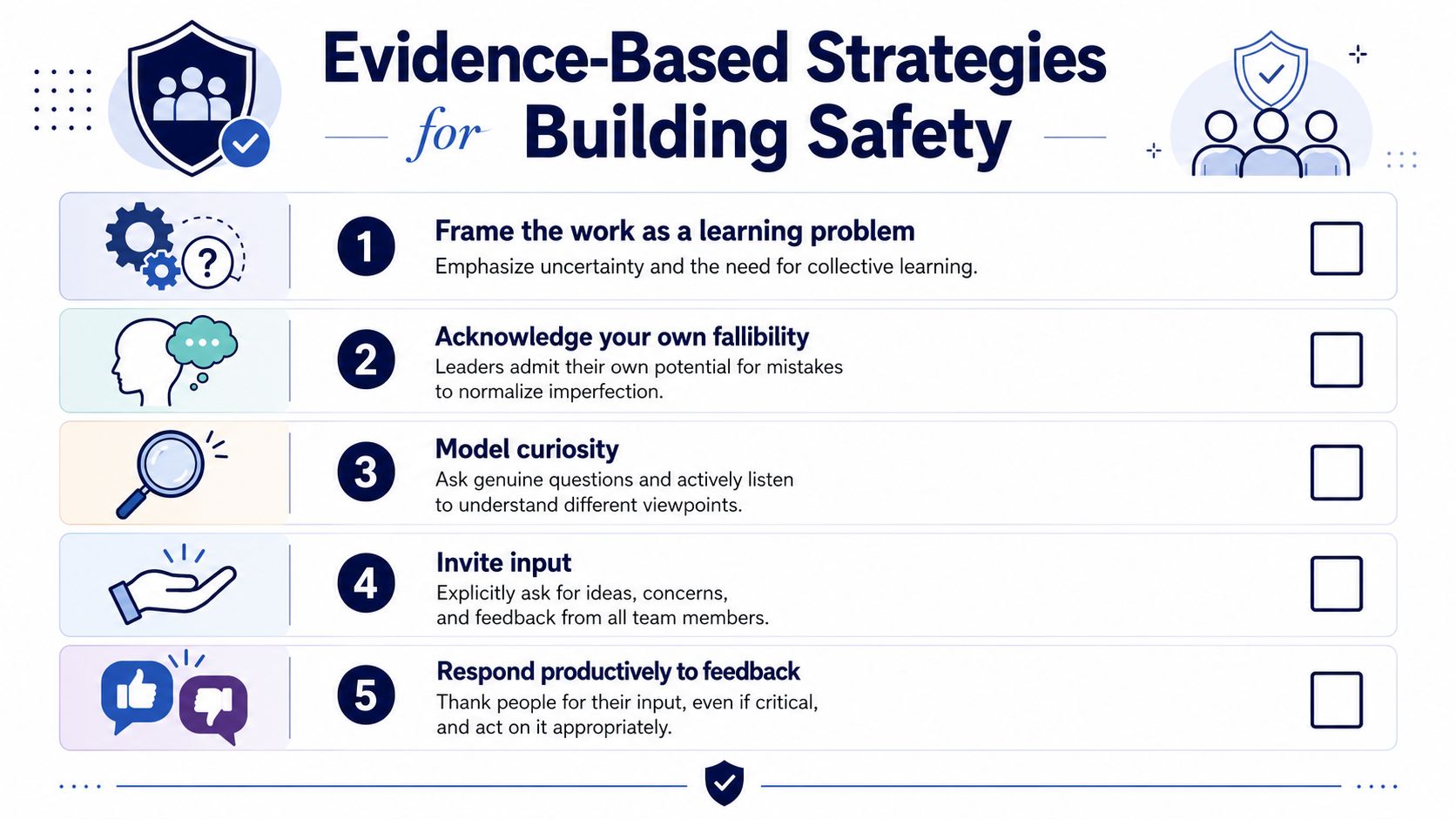
Psychological safety doesn't improve through posters, slogans, or a single town hall. It shifts when leaders repeatedly shape how the team handles uncertainty, disagreement, mistakes, and input, and it's increasingly a compliance matter as much as a culture one. Under Australia's model WHS laws, employers have a legal obligation to minimise psychosocial hazards, and recent regulatory changes and enforcement mean documented risk assessments and training are now a required part of building safer workplaces, as outlined in this analysis of psychosocial safety obligations on Australian employers.
Set the frame before the work starts
Leaders often assume people already know that questions and dissent are welcome. In most teams, they don't. A better approach names the work transparently: if a task involves uncertainty or cross-functional risk, say so upfront. Frame the work as learning as well as delivery when the team is navigating change or complexity, state plainly that early warnings are valuable, and clarify that challenge is aimed at ideas rather than people. That framing does the work a generic "feel free to speak up" never does.
Invite contribution on purpose
Open questions like "any thoughts?" tend to reward whoever is fastest or most senior to speak. A stronger practice varies how input gets collected: written responses before a meeting, small-group discussion, round-robin prompts, or anonymous questions. The same principle extends beyond meetings. Organisations trying to improve hiring with soft skills data often find that structured input surfaces strengths more reliably than relying on confidence signals alone.
This same principle applies inside teams and in communication skills at work. Good leaders don't just ask for input. They design for it.
Respond well when people take a risk
The fastest way to damage psychological safety in teams is to punish the first person who raises a concern.
Useful responses sound like this:
| Leader response | Effect on the team |
|---|---|
| “Thanks for raising that” | Signals that honesty is welcome |
| “What are we missing here?” | Keeps attention on the issue, not the person |
| “Let's look at what happened” | Supports learning over blame |
Leadership habit: When someone names a problem, separate the person from the problem.
Model fallibility and make mistakes discussable
Leaders don't need to perform weakness. They do need to show that not knowing is acceptable. Phrases like “What are we not seeing?” or “Where could this fail?” make space for better team communication.
Short debriefs also help. A simple review of what happened, what was learned, and what needs to change is often more effective than a long post-mortem that hunts for blame.
How Play Builds the Foundations for Safety
For many teams, the hardest part of psychological safety is not understanding the concept. It is practising the behaviours it requires.
Speaking up, admitting uncertainty, challenging an assumption, offering an unfinished idea or recovering publicly from a mistake all carry interpersonal risk. In high-pressure workplace settings, those behaviours are filtered through hierarchy, reputation and the perceived cost of getting it wrong.
A 2023 qualitative study into psychologically safe workplaces identified eight recurring elements that support psychological safety: effective communication, organisational culture, leadership practices, performance feedback, respect among colleagues, staff development, teamwork and trust. Those findings are useful because they move psychological safety out of the realm of aspiration and into observable workplace conditions.
This is where play-based team building becomes relevant. The elements identified in the study are not unique to play, but they are the same elements a well-designed play-based activity can bring into practice: communication under mild pressure, respect in the way people respond to each other, feedback in real time, teamwork under constraint and trust built through shared effort.
A practical guide to cultural change management for OKRs makes a similar point from a different angle: culture changes when organisations reshape the behaviours, habits and ways of working that sit underneath performance. It highlights the need to build transparency, accountability, learning from failure and continuous dialogue into how teams operate, rather than treating culture as a message to be announced.
That is the practical value of play. It gives teams a lower-stakes environment in which to rehearse the behaviours they need in higher-stakes work.
The value is not the activity itself. The value is the social pattern it creates.
In a facilitated challenge, people may need to speak before they have the perfect answer, listen while under time pressure, adjust when a strategy fails, accept feedback from peers and rely on others to complete the task. These are not abstract “team building” outcomes. They are behavioural repetitions of the conditions psychological safety depends on.
Play does not create psychological safety instantly. Nothing does. But it can give teams a practical way to practise the behaviours that make psychological safety more likely to emerge: contribution, trust, recovery, feedback, communication and adaptive problem-solving.
What to look for in team building design
Not all team building strengthens team psychological safety. Activities are more useful when they:
Require contribution from different people, not just the most confident participants
Allow trial and error so teams can recover without embarrassment
Encourage shared problem-solving rather than individual performance displays
Create reflection afterwards so the team can connect the experience to daily work
A Leader's Checklist for Cultivating Trust
Leaders don't need a perfect culture audit to assess psychological safety. They need a few honest questions and the discipline to answer them without defensiveness.
These prompts help surface the team's genuine experiences, not what leadership intends.
Questions worth asking regularly
Who speaks most in meetings? Look at airtime, not assumptions.
Who rarely contributes, and what might be making that harder? Silence often has a reason.
What happens when someone admits a mistake? The answer tells a leader more than any values statement.
Do people raise risks early, or only when they can't be hidden anymore?
Do leaders ask real questions, or mostly perform certainty?
Are disagreements handled in the room, or pushed into side conversations?
Can people challenge ideas without it becoming personal?
Does the team reward honesty as much as it rewards being right?
What leaders should listen for
The most useful answers are usually specific. If people speak in generalities, that can be a signal in itself.
Listen for patterns rather than isolated comments. If several people describe hesitation, delayed feedback, or caution around particular personalities, there is probably a team norm shaping that behaviour. If people struggle to name any example of a mistake being handled constructively, that also says a lot.
Teams do not become stronger by pretending everything is fine. They become stronger when people feel safe enough to say what needs to be said.
Psychological safety isn't about making work easier. It's about making truth, learning, and contribution easier. That's what allows teams to improve, especially when the pressure is real.
Corporate Challenge Events helps teams build trust, participation and positive team culture through play based team building, facilitated workshops and serious fun with lasting impact.