The most common advice about team building for neurodiverse teams is to find one activity that feels “safe” for everyone. That sounds sensible, but it usually points leaders in the wrong direction. Mixed-neurotype teams don't need a single neutral activity. They need an experience designed with enough structure, clarity and flexibility for different people to enter it in different ways.
That's a design problem, not a participation problem. Neurodiverse teams often include people with different communication preferences, sensory needs, processing styles, social energy levels and ways of contributing. When an event depends on speed, surprise, loud social energy or ambiguous instructions, the issue isn't that some employees “aren't engaging”. The issue is that the format has narrowed the doorway to participation.
Inclusive team building works better when leaders stop asking, “What activity will suit everyone?” and start asking, “How will this experience allow different people to contribute meaningfully?” That shift also aligns with broader DEI in the workplace efforts, because inclusion is built through process, not intention alone.
The Real Challenge of Inclusive Team Building

For most HR teams and event organizers, the challenge isn't creating a separate event for neurodivergent employees. It's ensuring one shared experience is accessible to a group with diverse cognitive styles in the same space. Guidance in this area consistently emphasizes inclusive design through various participation modes, sensory-aware environments, and structured contribution formats. In Australia, this holds significant workplace relevance because cognitive diversity is prevalent across different thinking styles, as discussed in the Australian context.
Inclusion starts before the activity
A lot of corporate events fail because they treat inclusion as an adjustment layer added at the end. The agenda is vague, the group task is socially intense, and the facilitator assumes that high visible energy equals success. That approach can leave quieter thinkers, people who prefer processing time, and employees managing sensory load on the edge of the experience.
Inclusive team building isn't about reducing challenge. It's about removing unnecessary friction so more people can meet the challenge well.
The stronger model is to build for variation from the start. That means recognising that a team can include people who want to speak, write, sketch, observe first, move, pause, pair up or contribute asynchronously. Team building for neurodiverse teams works when those pathways are planned on purpose, not improvised on the day.
Understanding the Mechanics of Inclusive Play
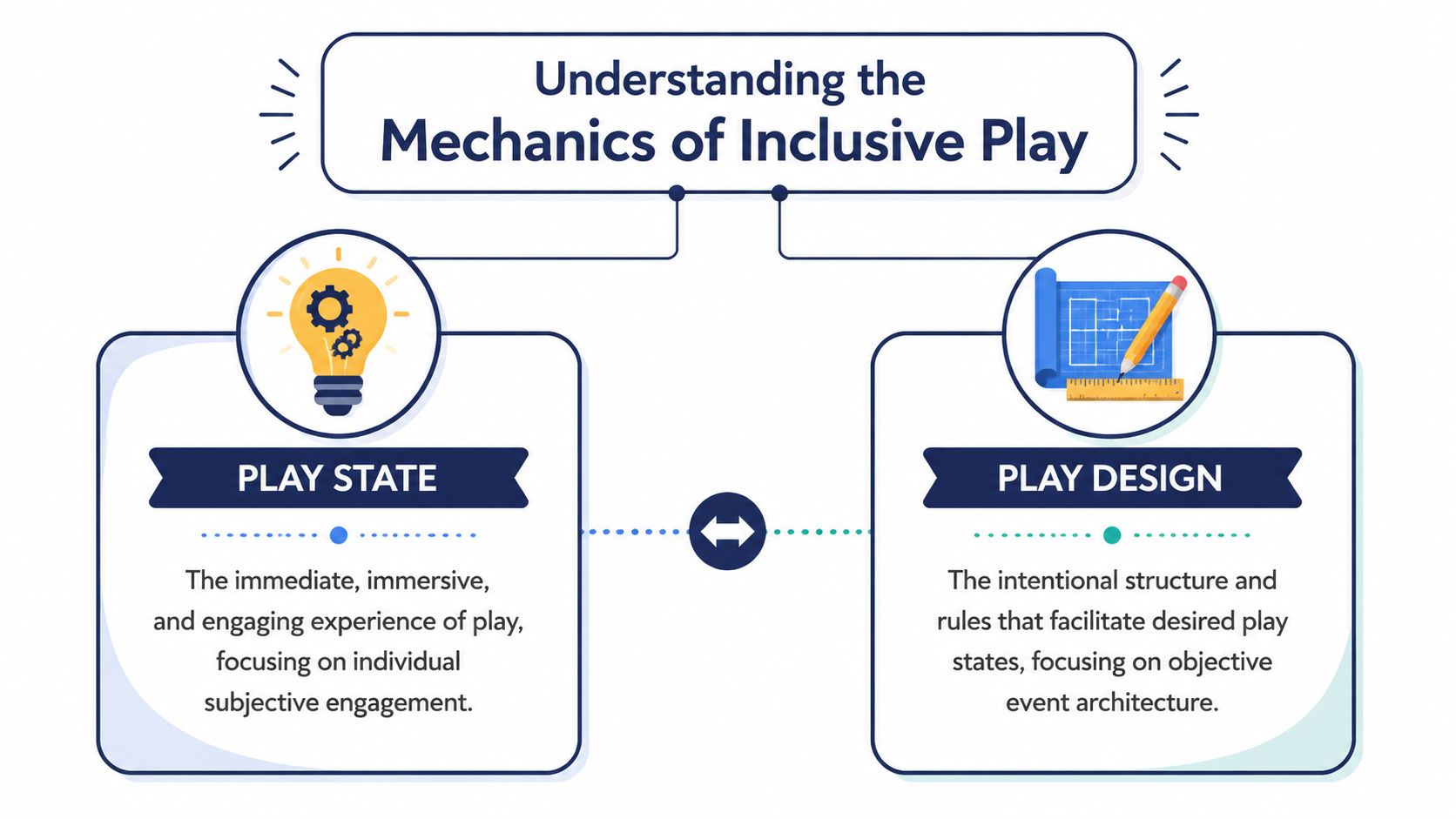
Play is often misunderstood in corporate settings. Leaders see the activity and assume the activity creates engagement. It doesn't. The same exercise can feel energising for one person, awkward for another and overstimulating for someone else. That's why inclusive design needs a clearer distinction between play state and play trait.
Play state and play trait
A play state is the in-the-moment experience of engagement. It's when people become curious, attentive, socially open or absorbed in the task. A play trait is different. It refers to a person's natural disposition toward playfulness, including what kinds of interaction feel comfortable, motivating or draining.
That distinction changes how events should be designed. A fast improvisation challenge may trigger a play state for a confident verbal thinker, while a structured puzzle, visual mapping task or object-based build may do the same for someone who prefers lower social pressure. The activity alone doesn't create play. The framing, timing, safety and choice architecture do.
Different people enter play differently
People often move into playful collaboration through different pathways:
-
Strategy and logic: clear goals, patterns, rules and problem-solving
-
Creativity and expression: storytelling, sketching, making or imagining
-
Observation and reflection: time to process before sharing
-
Humour and social warmth: lightness without pressure
-
Shared purpose: meaningful outcomes, including charity-focused tasks
Research on neurodiverse work teams argues that neurodiversity affects core team processes, including coordination and communication, so performance depends on how well the team adapts workflow and norms. That's why team building works better when it externalises thinking and reduces cognitive load through approaches such as visual mapping, structured role rotation and flexible communication. The same work also notes that psychological safety comes from predictable norms rather than forced social intensity, as outlined in this research on neurodiverse work teams.
A play-based approach grounded in these principles is less about pushing everyone into one visible style of connection and more about creating the conditions for connection to emerge. Corporate Challenge Events explores that idea in its perspective on inclusive play bringing every team member in.
Laughter, eye contact, movement and vocalisation can all signal that people are entering a play state, but they aren't universal proof of engagement. Some participants show involvement through attention, thoughtfulness and precise contribution.
Play can also influence systems linked to stress regulation, bonding, reward, attention and motivation. In workplace terms, that means carefully facilitated play may help create the conditions for trust, adaptability and social confidence. It doesn't guarantee those outcomes, and it shouldn't be treated like a shortcut. That is where play-based design becomes practical. It takes the science of play and turns it into a format people can actually enter.
How Play Makes Participation Easier
The most useful shift is to stop thinking about inclusive team building as a list of adjustments and start thinking about it as better experience design.
Play works because it gives people something shared to do. That matters for mixed-neurotype groups because connection does not have to rely only on direct conversation, fast verbal input or instant social confidence. A well-designed activity can carry part of the interaction for the group.
Instead of asking people to “bond” in the abstract, play gives them a task, a role, a rule set and a reason to engage. That structure can make participation feel clearer and less exposed.
This is where play-based team building becomes powerful. It creates a shared focus while still allowing different ways in. One person may contribute by solving the puzzle. Another may notice the pattern. Another may organise the materials, steady the pace, test an idea, build the object or bring humour into the moment.
All of those are valid forms of participation.
That is why neuroinclusive design should not be treated as a separate version of the experience. It should be built into the format from the start. As Catalyst notes in its guidance on how to embrace neurodiversity to build stronger teams, inclusion is not just about welcoming different thinkers. It is about creating environments where people can contribute and succeed.
In play-based team building, that means designing for different brains, not asking everyone to engage in the same visible way.
Structure Gives Play Somewhere to Land
Play does not mean throwing people into chaos and hoping connection happens.
The strongest play-based experiences have enough structure to reduce ambiguity and enough flexibility to let people find their own entry point. Participants should understand what the group is doing, why it matters, what the rules are and how they can take part.
This is especially important for neurodiverse teams because unclear social expectations can create unnecessary friction. If the only instruction is “jump in whenever you like”, the format will usually favour the fastest, loudest or most socially confident people in the room.
A better design gives people visible pathways into the experience:
-
a clear task
-
defined stages
-
flexible roles
-
time to think
-
different ways to contribute
-
a facilitator who makes the process easy to follow
This is where meeting design and play design overlap. SpeakNotes’ guide to ground rules in meetings makes the point that shared expectations help teams stay focused, make decisions and avoid dominant voices taking over. The same principle applies in team building. Clear rules do not restrict participation. They make participation easier.
Choice Is What Makes Play Inclusive
Not everyone enters play the same way.
Some people come alive through competition. Others prefer creative expression, physical movement, object-based building, strategy, humour, storytelling, exploration or quiet observation. The goal is not to pick one “safe” activity that suits everyone. The goal is to design an experience with enough variety for different people to find their way in.
That is why charity builds, creative challenges and structured problem-solving programs can all work well for teams with varied thinking and communication styles when they are designed properly.
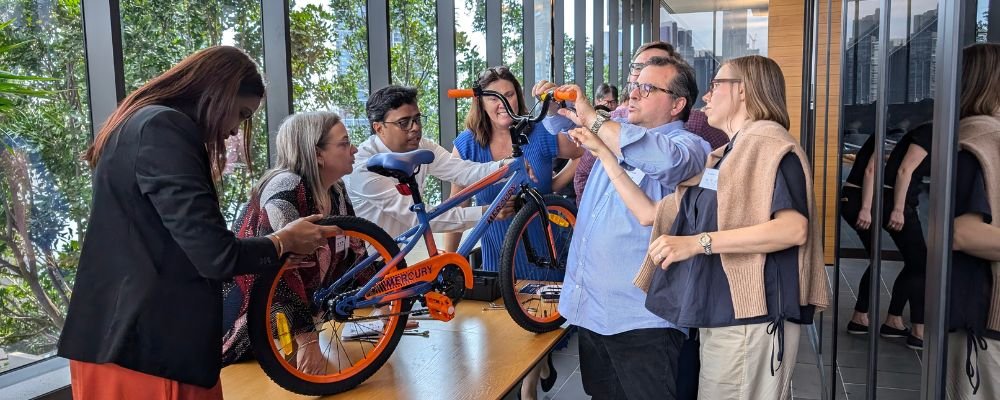
A charity build, for example, gives the group a shared purpose. It also creates multiple contribution points: reading instructions, organising parts, assembling materials, checking quality, managing time, encouraging the group or preparing the final handover. No one has to perform connection. They can build it side by side.
That is the real strength of play. It lets people connect through doing.
Spring Health’s article on supporting neurodiverse team members highlights the importance of clear communication, flexibility and support systems. In a team-building setting, those ideas translate into practical design choices: visible instructions, role flexibility, structured collaboration and facilitators who recognise contribution in different forms.
Facilitation Turns Activity Into Inclusion
The activity matters, but facilitation is what makes it work.
A facilitator sets the tone, explains the task, protects the pace and helps people understand what good participation looks like. They also make quieter forms of contribution visible. Someone who is observing carefully, spotting risks, noticing patterns or keeping the group organised may be deeply engaged, even if they are not the loudest person in the room.
Good facilitation helps a team see that.
For cognitively diverse groups, this matters because play should not become another performance test. It should create a low-pressure way for people to practise connection, problem-solving and collaboration with enough structure to feel safe and enough choice to feel natural.
The best question for leaders is not, “Will everyone like this activity?”
It is, “How many meaningful ways does this experience give people to take part?”
That is where inclusive play design becomes a serious tool for team culture. It reduces unnecessary friction, opens up different forms of contribution and gives people a shared experience that feels easier to enter, not harder to survive.
The Power of Designing for the Edges
The strongest inclusive events aren't built around an “average” participant. The best play-based team building does not ask everyone to show up the same way. It creates a shared experience with enough structure, choice and momentum for different people to contribute without forcing the same style of participation.
That's why one-size-fits-all team building so often misses the mark. It assumes the issue sits with the employee who doesn't respond to the format, when the actual issue is often the format itself. This broader pattern is part of why one-size-fits-all engagement strategies fail.
Choice is the key idea to hold onto. In inclusive team building, choice isn't an exit ramp from participation. It's the structure that allows people to opt into connection, contribution and shared experience in ways that are safe, useful and real.
For organisations planning team building for neurodiverse teams, Corporate Challenge Events offers play-based formats that can be built to accommodate clear structure, flexible participation, sensory awareness and meaningful team outcomes. That makes it easier for HR teams, event organisers and leaders to create experiences that support connection without forcing everyone through the same doorway.